
Emily Dickinson
Dive into Emily Dickinson’s complete collection of poems — read them online for free, filter to discover your favorites, and explore our article to learn more about the poet.



















Emily Dickinson (1830–1886) was an American poet born in Amherst, Massachusetts, and is widely regarded as one of the most original voices in nineteenth-century literature. She lived much of her adult life in relative seclusion, and fewer than a dozen of her poems were published during her lifetime. After her death, the full scope of her work — nearly 1,800 poems — was gradually brought to light, reshaping how readers and scholars understood American poetry.
Dickinson wrote in a style immediately recognizable for its compressed syntax, slant rhyme, unconventional punctuation, and the frequent use of the hymn-like common meter. Her poems resist easy categorization: they move between philosophical inquiry, spiritual doubt, intimate observation, and stark emotional honesty. She rarely gave her poems titles, and many of the titles used today — including The Chariot and Exclusion — were assigned by early editors.
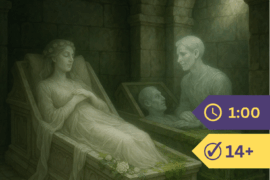
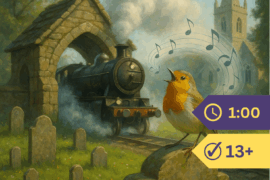
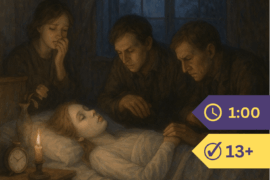
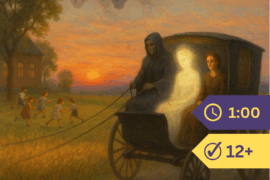
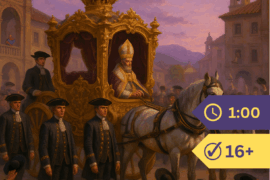
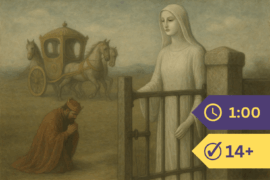
Death, immortality, and the threshold between life and the unknown are among Dickinson’s most persistent concerns. The Chariot, perhaps her most discussed poem on the subject, presents Death as a courteous companion escorting the speaker on a carriage ride into eternity. The bustle in a house approaches grief with quiet domestic precision, while I died for beauty, but was scarce draws a parallel between beauty and truth in the stillness of the tomb. These poems share a willingness to sit with uncertainty rather than resolve it.
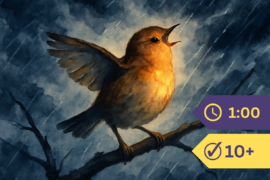
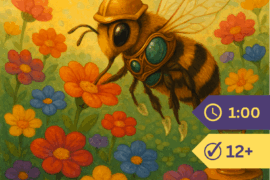
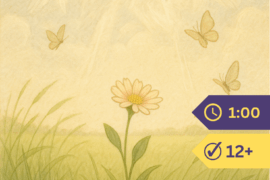
Nature provided Dickinson with an equally rich field of inquiry. In There’s a certain slant of light, a winter afternoon’s light becomes the occasion for a meditation on spiritual oppression and internal change. Indian Summer examines the deceptive warmth of late-autumn days with a mixture of wonder and suspicion, while The Daisy follows soft the Sun uses a simple botanical observation to explore devotion and asymmetry in relationships. Even in shorter pieces such as Much madness is divinest sense, Dickinson turns an apparently natural observation into a sharp social critique.
Dickinson’s place in literary history is secured not only by the volume of her output but by the distinctiveness of her formal and thematic innovations. Her work influenced generations of poets who followed, and her manuscripts — many written on scraps of paper and sewn into hand-bound fascicles — continue to be studied for what they reveal about her process and intentions. She remains one of the most closely read poets in the English language.