The Travellers And The Purse

Summary


Read "The Travellers And The Purse," a short Aesop fable about two men whose friendship is tested the moment one of them finds a gold-filled purse on the road. Refusing to share his luck, the finder insists the fortune is his alone — until an angry mob comes running and suddenly "I" becomes "we" again. The story builds to a sharp, satisfying moment where his companion's reply cuts straight to the heart of what selfishness really costs.


Read Online

Two men were traveling in company along the road when one of them picked up a well-filled purse.

“How lucky I am!” he said. “I have found a purse. Judging by its weight it must be full of gold.”

“Do not say ‘I have found a purse,'” said his companion. “Say rather ‘we have found a purse’ and ‘how lucky we are.’ Travelers ought to share alike the fortunes or misfortunes of the road.”

“No, no,” replied the other angrily. “I found it and I am going to keep it.”

Just then they heard a shout of “Stop, thief!” and looking around, saw a mob of people armed with clubs coming down the road.
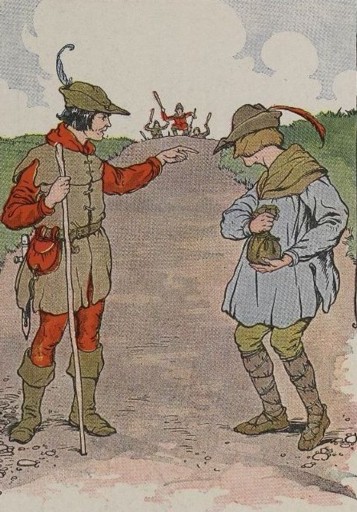
de reizigers en de portemonnee

The man who had found the purse fell into a panic.

“We are lost if they find the purse on us,” he cried.

“No, no,” replied the other, “You would not say ‘we’ before, so now stick to your ‘I’. Say ‘I am lost.'”


Credits

Aesop was an ancient Greek storyteller, believed to have lived around the 6th century BCE, whose fables have been retold across cultures for over two thousand years. His stories typically feature brief, punchy plots built around a single moral — a structure "The Travellers And The Purse" follows with particular wit. Aesop's fables were originally passed down orally before being compiled into written collections that remain widely read today.