
Robert Southey
Dive into Robert Southey’s complete fairy tales and legends — read them online for free, filter to discover your favorites, and explore our article to learn more.
Robert Southey (1774–1843) was an English poet and writer of the Romantic era, best known during his lifetime as Poet Laureate of Great Britain, a title he held from 1813 until his death. Born in Bristol, he was a prolific author whose output spanned poetry, biography, history, and prose fiction. Though his formal verse has largely faded from popular attention, several of his prose writings have proven remarkably durable, cementing his place in the history of English literature through storytelling rather than stanzas.
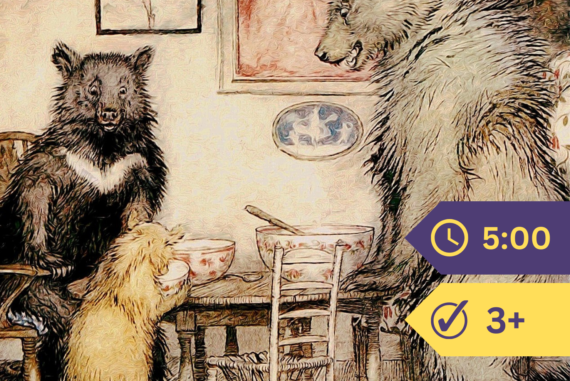
Southey’s most enduring contribution to world literature is almost certainly his telling of The Three Little Bears, first published in his 1837 collection The Doctor. In this foundational story, three bears of different sizes — a small bear, a middle-sized bear, and a great big bear — return to their forest cottage to find that an uninvited old woman has been sampling their porridge, sitting in their chairs, and sleeping in their beds. Southey’s version predates the now-familiar golden-haired girl of later retellings; the intruder in his original tale is an old woman rather than a child. The story as most readers know it today, featuring the young girl known as Goldilocks, evolved through subsequent retellings, one popular version of which is collected as Goldilocks and The Three Bears. Southey’s original framing established the structure — the rule of three, the graduated sizes, the domestic intrusion — that all later versions follow.
Beyond fairy tales, Southey also engaged with chivalric romance and legend. His work on How the Child of the Sea Was Made Knight reflects his broader interest in medieval literature and Arthurian-adjacent traditions. The story follows the lineage of King Falangiez of Great Britain and traces the path of a young knight through a world of royal succession, dynastic honor, and courtly valor. Southey’s engagement with such material was part of his wider scholarly and literary curiosity — he translated Spanish and Portuguese romances and maintained a deep fascination with the literature of the Iberian Peninsula throughout his career.
Southey was a central figure in the first generation of British Romantic writers, associated early in his career with Samuel Taylor Coleridge, with whom he briefly shared radical political ideals. Over time he moved toward more conservative positions, a shift that drew criticism from contemporaries including Lord Byron. Nevertheless, his contributions as an editor, translator, and storyteller gave later generations a rich body of source material. His version of the Three Bears story in particular stands as one of the most consequential pieces of prose in the history of the English fairy tale, quietly shaping a narrative tradition that has endured for nearly two centuries.