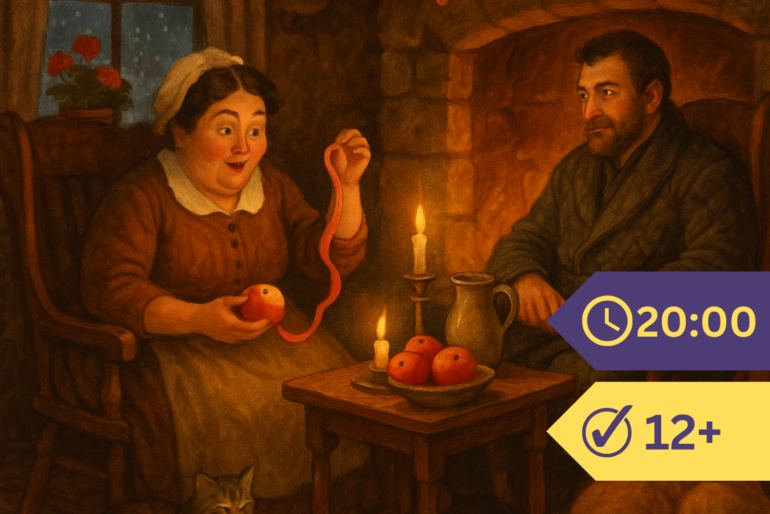
The fire crackled cheerfully on the broad hearth of an old-fashioned inn in an old-fashioned village on Virginia’s Eastern Shore. A cat and three kittens basked in the warmth, and a decrepit yellow dog, lying full in the glow of the blaze, wrinkled his black nose approvingly as he turned his hind feet where his fore feet had been. Over the chimney hung several fine hams and cuts of dried beef. Apples were festooned along the ceiling, and other signs of plenty and good cheer were scattered generously about. There were plants on the windowsills — geraniums and succulents, a monthly rose just budding — and pots of violets that perfumed the whole room whenever they took it into their purple heads to bloom. The floor was carefully swept, the chairs had not a speck of dust on leg or rung, the long settle near the fireplace shone as if freshly varnished, and the eight-day clock in the corner had had its white face newly washed and seemed determined to tick all the louder for it.
Two armchairs were drawn up at a cozy distance from the hearth. A candle, a newspaper, a pair of spectacles, a dish of rosy apples, and a pitcher of cider filled the little table between them. In one of these chairs sat a comfortable-looking woman of about forty-five, with cheeks as red as the apples and eyes as dark and bright as they’d ever been, her elbow on the table and her head resting in her hand, gazing thoughtfully into the fire.
This was Widow Townsend — widow of Mr. Levi Townsend, who had been mouldering in the neighboring churchyard for seven years and more. She was thinking of her dead husband, possibly because all her work was done, the servant had gone to bed, and the sight of his empty chair across the table, and the silence of the room, made her a little lonely.
Seven years, the widow’s reverie ran. It seems as if it were more than fifty. And Christmas nearly here again, and yet I don’t look so very old. Perhaps it’s not having any children to wear me out, as they do other people. She glanced at the window with the comfortable certainty of a woman at peace with her choices. They may say what they like — children are more plague than profit, that’s my opinion. Look at my sister Jerusha, with her six boys. She’s worn to a shadow, and I’m sure they’ve done it, though she’ll never own it.
The widow took an apple from the dish and began to peel it.
How fond Mr. Townsend used to be of these apples! He’ll never eat any more of them, poor fellow. She sighed. Heigho! I remember very well how I used to throw apple peel over my head when I was a girl, to see who I was going to marry.
She stopped short and blushed — for in those days she hadn’t known Mr. Townsend at all, and had always looked eagerly to see if the peel had curled into a capital S.
How handsome Sam Payson was. And how much I used to care about him! I wonder what became of him. Jerusha says he left our village just after I did, and no one’s heard of him since. What a silly thing that quarrel was. If it hadn’t been for that—
Here came a long pause, during which the widow looked very steadily at the empty armchair of the late Levi Townsend. Her fingers played carelessly with the apple peel, drawing it slowly toward her. She looked around the room.
“Upon my word, it’s very ridiculous, and I don’t know what the neighbors would say.”
Still the plump fingers drew the red curl nearer.
“But they can’t see me — that’s a comfort. And the cat and old Bose will never know what it means. Of course I don’t believe any of it.”
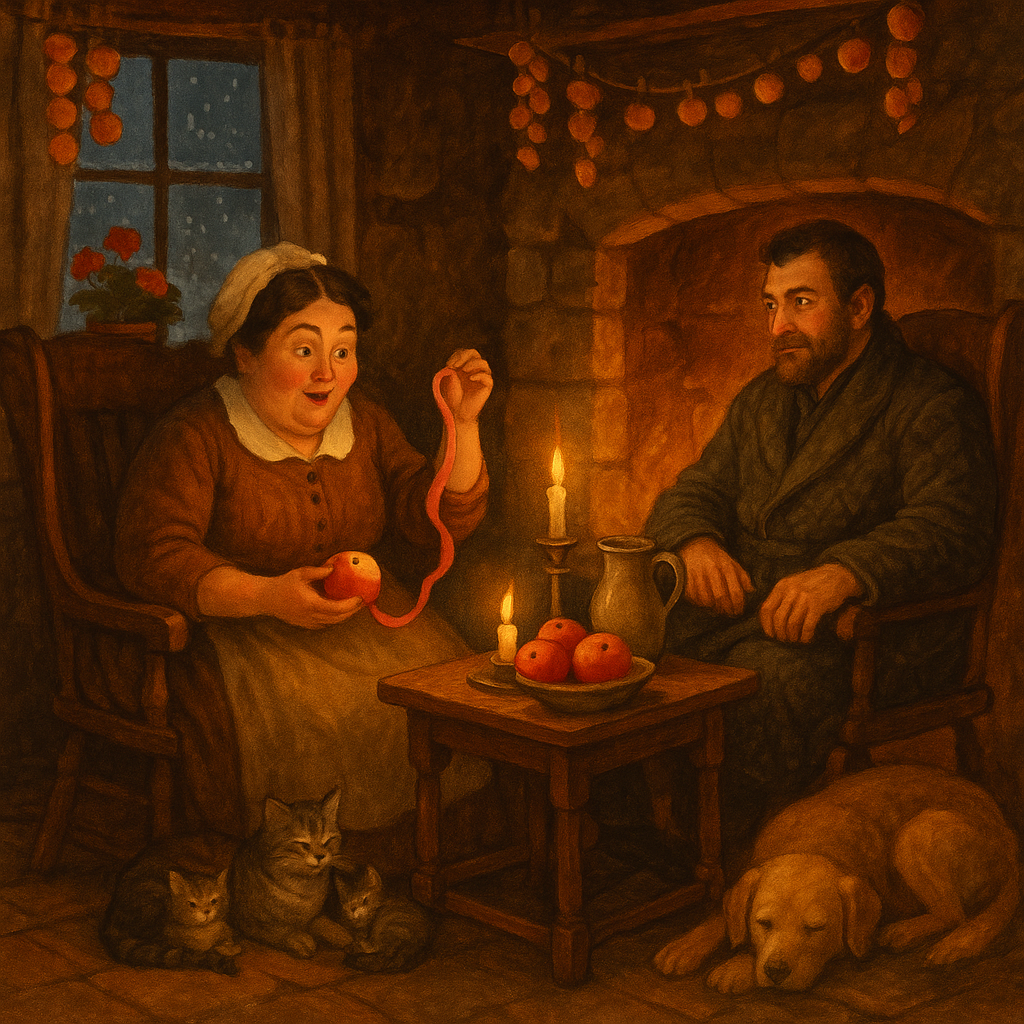
The peel hung gracefully from her hand.
“But still — it would seem like old times, and—”
Over her head it went, and curled up quietly on the floor a little way off. Old Bose, who always slept with one eye open, saw it fall and marched deliberately over to sniff it.
“Bose — Bose — don’t touch!” cried his mistress. She bent over the peel with a beating heart and turned as red as fire. There was as handsome a capital S as anyone could wish to see.
A great knock came suddenly at the door. Bose growled, and the widow screamed and snatched up the apple peel.
It’s Mr. T. — it’s his spirit come back, because I tried that silly trick, she thought, with a fearful flutter.
Another knock — louder than the first — and a man’s voice called out: “Hello — the house!”
“Who is it?” asked the widow, somewhat relieved to feel that the departed Levi was still safely in his grave on the hillside.
“A stranger,” said the voice.
“What do you want?”
“To get a lodging for the night.”
The widow deliberated. “Can’t you go on? There’s a house half a mile farther if you keep to the right-hand side of the road, and turn to the left after you pass the—”
“It’s raining cats and dogs and I’m very delicate,” said the stranger, with a cough. “I’m wet to the skin. I don’t mind sleeping on the floor.”
“Raining, is it? I didn’t know that.” The kind-hearted little woman unbarred the door quickly. “Come in, whoever you may be. I only asked you to go on because I’m a lone woman with only one servant in the house.”
The stranger entered, shaking himself like a Newfoundland dog on the step and scattering a small shower of drops over his hostess and her nicely swept floor.
“Ah — that looks comfortable after hours in a storm,” he said, catching sight of the fire. He strode toward the hearth, with Bose sniffing suspiciously at his heels, and settled himself into the armchair — Mr. Townsend’s armchair, which had been kept more or less sacred to his memory for seven years. The widow was horrified, but her guest looked so weary and worn that she couldn’t ask him to move. She busied herself stirring up the blaze so he might dry his dripping clothes the sooner.
Then a new thought struck her. Mr. Townsend had worn a comfortable dressing-gown during his last illness; it still hung in the closet at her right. She couldn’t let the poor man catch his death sitting in a wet coat. If he was already in Mr. Townsend’s chair, why should he not wear Mr. Townsend’s dressing-gown? She went nimbly to the closet, took it down, fished out a pair of slippers from the rack below, and brought them to him.
“I think you’d better take off your coat and boots — you’ll have rheumatic fever if you don’t. Here are some things to wear while they dry. And you must be hungry. I’ll go into the pantry and find you something to eat.”
She bustled away, and the stranger made the exchange with a quizzical smile playing around his lips. He was a tall, well-built man, with a bold but handsome face, sunburned and heavily bearded, looking anything but “delicate,” though his blue eyes glanced out from under a forehead as white as snow. He looked around the kitchen with a mischievous air and stretched out his feet in the late innkeeper’s slippers.
“Upon my word — stepping into the old man’s shoes with a vengeance. And what a hearty, good-humored woman she is. Kind as a kitten.” He leaned forward and stroked the cat and her kittens, then patted old Bose on the head. The widow, returning with a laden tray, looked pleased at his attention to her animals.
“It’s a wonder Bose doesn’t growl — he generally does if strangers touch him.” She set the tray down and looked at the little stand, where there was no room. “Dear me, how stupid of me.”
“I’ll manage it,” said her guest, gathering up the newspaper, candle, apples, and spectacles — she felt a small pang watching him handle them, for they had been her husband’s — and setting them on the settle. “Give me the tablecloth, ma’am, I can spread it as well as any woman. I’ve learned that along with scores of other things in my wanderings. Now let me take those dishes — they’re far too heavy for those hands.” The widow blushed. “And please, sit down with me, or I cannot eat a morsel.”
“I had supper long ago, but I think I can manage something more,” said Mrs. Townsend, drawing her chair nearer.
“Of course you can — in this cold weather people ought to eat twice as much. Let me give you a slice of this ham. Your own curing, I dare say.”
“Yes. My poor husband was very fond of it. He used to say no one understood curing ham and drying beef better than I.”
“He was a most sensible man, I’m sure. I drink your health, ma’am, in this cider.” He took a long draught and set down his glass. “Nectar itself.”
The widow was feeding Bose and the cat, who considered themselves entitled to a share of every meal eaten in the house, and didn’t quite hear him.
“Fine dog, ma’am. And a very pretty cat.”
“They were my husband’s favorites.” A small sigh followed.
“Ah — your husband must have been a very happy man.” The blue eyes rested on her so long that she grew flustered.
“Is there anything more I can get you, sir?” she asked at last.
“Nothing, thank you. I’ve finished.”
She rose to clear the things away. He helped her, and somehow their hands had a curious knack of brushing together as they carried dishes to the pantry shelves. Coming back to the kitchen, she put the apples and cider back in their usual places and brought out a clean pipe and a box of tobacco from an alcove near the chimney.
“My husband always said he couldn’t sleep after a late supper unless he smoked,” she said. “Perhaps you’d like to try it.”
“Not if it’s going to drive you away,” he answered — she had her candle in hand.
“Oh, no. I don’t mind smoke at all.” She put the candle down. Some faint suggestion about propriety troubled her briefly, but she glanced at the old clock and felt reassured. It was only half past nine.
The stranger pushed the stand back once the pipe was lit, and drew her easy-chair a little closer to the fire, and his own.
“Come, sit down,” he said. “It’s not late. When a man has been knocking about in California and all sorts of places for twenty years, he’s glad enough to find a berth like this — and a pretty woman to talk to again.”
“California!” she exclaimed, dropping into the chair at once.
Unconsciously, she had long cherished the idea that Sam Payson — the lover of her youth, with whom she had so foolishly quarreled — had pitched his tent, after many wanderings, in that far-off land. Her heart warmed to this stranger who had something of Sam’s looks and manner about him, and who had very possibly met him — perhaps known him well. At that thought her heart beat quick, and she looked very graciously at the bearded man who, wrapped in Mr. Townsend’s dressing-gown, wearing Mr. Townsend’s slippers, sitting in Mr. Townsend’s chair, smoked Mr. Townsend’s pipe with such an air of feeling thoroughly and comfortably at home.
“Yes, ma’am. Six years in California. And before that, I sailed quite round the world on a whaling ship.”
“Good gracious!”
The stranger sent a puff of smoke curling over his head.
“It’s a very strange thing, ma’am, how often you see one particular thing when you go wandering about the world after that fashion.”
“And what is that?”
“Men without house or home above their heads, roving here and there, turning up in all sorts of odd places — caring very little for life, making fortunes just to throw them away again. And all for one reason. You don’t ask me what it is? No doubt you already know.”
“I think not, sir.”
“Because a woman has jilted them.”
There was a long pause. Mr. Townsend’s pipe emitted short, rapid puffs. A guilty conscience needs no accuser, and the widow’s cheek burned as she thought of the absent Sam.
“I wonder how women manage when they’re served the same way,” said the stranger musingly. “You never meet them roaming the world like that.”
“No,” said Mrs. Townsend, with some spirit. “If a woman is in trouble, she must stay at home and bear it as best she can. And there are more women bearing such things than we know of, I dare say.”
“No doubt. We never know whose hand’s caught in a trap unless they cry out. And women are too shy, or too sensible — take your pick — for that.”
“Did you ever, in all your wanderings, meet anyone by the name of Samuel Payson?” asked the widow, in a carefully unconcerned tone.
The stranger glanced toward her; she was rummaging in the table drawer for her knitting and didn’t notice. When the needles were found and in motion, he answered her.
“Payson — Sam Payson? Why, he was my most intimate friend! Do you know him?”
“A little — that is, I used to, when I was a girl. Where did you meet him?”
“He came with me on that whaling voyage, and afterward to California. We had a tent together, six months working the same claim.”
“I suppose he was quite well?”
“Strong as an ox.”
“And — and happy?” pursued the widow, bending closer over her knitting.
“Hm. The less said about that the better, perhaps. He seemed to enjoy life after a fashion. And he did well enough out there — made himself comfortable.”
Mrs. Townsend didn’t pay much attention to that part. She hadn’t finished asking questions, but was puzzling over the next one. At last she brought it out beautifully: “Was his wife with him in California?”
The stranger looked at her with twinkling eyes. “His wife, ma’am! Bless you, he has no wife.”
“Oh, I thought — I mean, I heard—” Here the little widow thought better of it and stopped short before she committed herself to a tremendous lie.
“Whatever you heard about his marrying was pure nonsense, I assure you. I knew him well, and he had no such thoughts. Some of the boys teased him about it, but he soon put a stop to that.”
“How?”
“He told them plainly that the only woman he’d ever loved had broken off their engagement years before and married another man. After that, no one mentioned the subject to him — except me.”
Mrs. Townsend laid her knitting aside and looked thoughtfully into the fire.
“He was another specimen of the class I was speaking of. I’ve seen him face death a score of times as quietly as I face this fire. ‘It matters very little what carries me off,’ he used to say. ‘I’ve nothing to live for and no one who’ll shed a tear for me when I’m gone.’ It’s a sad thing for a man to feel, isn’t it?”
Mrs. Townsend agreed that it was.
“Did he ever tell you the name of the woman who jilted him?”
“I know her first name.”
“What was it?”
“Maria.”
The plump little widow nearly started out of her chair — the name was spoken so exactly as Sam himself would have said it.
“Did you know her too?” he asked, watching her keenly.
“Yes.”
“Intimately?”
“Yes.”
“Where is she now? Still happy with her husband, I suppose, never giving a thought to the poor fellow she sent out into the world?”
“No,” said Mrs. Townsend, shading her face with her hand, her voice unsteady. “No — her husband is dead.”
“Ah. But still, she never thinks of Sam.”
Dead silence.
“Does she?”
“How can I tell?”
“You’re her intimate friend. You know. Tell me.”
“I don’t know why I should. But if I do, you must promise me — on your honor — never to tell him, if you ever meet him again.”
“Madam, what you say to me shall never be repeated to any mortal man. On my honor.”
“Well, then — she does remember him.”
“How?”
“As kindly, I think, as he could wish.”
“I’m glad to hear it, for his sake. You and I are the friends of both parties — we can rejoice with each other.” He drew his chair much closer to hers and took her hand. For a moment the widow resisted, but it was a warm and certain clasp, and the rosy palm lay quietly in his. The dark beard bent so low it nearly touched her shoulder. It didn’t seem to matter much. Was he not Samuel’s dearest friend?
“It was a foolish quarrel that parted them,” said the stranger softly.
“Did he tell you about it?”
“Yes, on board the whaler.”
“Did he blame her much?”
“Not as much as himself. He said his jealousy and temper drove her to break things off — but he thought sometimes that if he’d only gone back to her and spoken kindly, she would have had him after all.”
“I’m sure she would,” said the widow piteously. “She’s owned it to me more than a thousand times.”
“She wasn’t happy with another, then.”
“Her husband was very good and kind,” said the little woman, thinking a little penitently of the grave on the hillside. “They lived pleasantly together. There was never a harsh word between them.”
“Still — might she not have been happier with Sam? Be honest now. Say exactly what you think.”
“Yes.”
“Good. That’s what I wanted to arrive at. And now I have a secret to tell you, and you must take it to her.”
Mrs. Townsend looked rather frightened. “What is it?”
“I want you to go to her, wherever she is, and say: ‘Maria’—” he paused. “What makes you start so?”
“Nothing. Only you speak so like someone I used to know, now and then.”
“Do I? Well — take the rest of the message. Tell her that Sam loved her all the way through. That when he heard she was free, he began to work in earnest. He has a fortune now, and he is coming to share it with her, if she’ll let him. Will you tell her this?”
The widow didn’t answer. She had freed her hand and covered her face with it. After a long moment she looked up. He was waiting patiently.
“Well?”
“I will tell her.”
He rose and walked up and down the room. Then he came back and leaned against the mantelpiece, absently stroking old Bose with his slipper.
“Make her understand that he wants her for his wife. She may live where she likes and how she likes — only it must be with him.”
“I will tell her.”
“Say he has grown old, but not cold. That he loves her perhaps better now than he did twenty years ago. That he has been faithful to her through his whole life, and that he will be faithful till he dies.”
He broke off. The widow answered still, “I will tell her.”
“And what do you think she’ll say?” he asked, in an altered voice.
“What can she say but come?”
“Hurrah!”
The stranger swept her out of her chair as if she weighed nothing and kissed her soundly.
“Don’t — oh, don’t!” she cried. “I am Sam’s Maria!”
“Well — I am Maria’s Sam!”
Off came the dark wig and the false beard — and there was the dear face she had never forgotten.
I leave you to imagine the scene. Even the cat got up to look. Old Bose sat on his stump of a tail and tried to work out whether he was on his heels or his head.
The widow gave one little scream — and then she—
But stop. Quiet people like you and me, dear reader, who have long since got over all such follies, have no business here. I will only add that two hearts were very happy, that Bose concluded after a while that everything was right and lay down to sleep again, and that one week later, on Christmas Eve, there was a wedding at the inn that made the neighbors stare.
The widow had married her first love.