It was afternoon recess at No. 4 District School in Warner. A heavy snowstorm had kept nearly everyone inside the warm schoolroom — all except a few adventurous souls who were tumbling about in the snowdrifts outside, getting their clothes soaked and preparing themselves for scoldings at home. Their shrill cries and laughter floated in through the walls, but the small group near the stove paid them no attention at all.
There were five or six little girls and one boy. The girls, with the exception of Jenny Brown, were trim and sweet in their winter dresses and neat school aprons. They perched on the desks and the arms of the settee with careless grace, like birds, some of them with their arms linked. The one boy lounged against the blackboard. His dark, straight-profiled face was all aglow as he talked. His big brown eyes gazed now soberly and impressively at Jenny, then gave a merry dance toward the other girls.
“Yes, it does — honest!” said he.
The other girls nudged one another softly. But Jenny Brown stood with her innocent, solemn eyes fixed on Earl Munroe’s face, drinking in every word.
“You ask anybody who knows,” continued Earl. “Ask Judge Barker — ask the minister —”
“Oh!” cried the little girls. But the boy shook his head impatiently at them.
“Yes,” said he. “You just go and ask Mr. Fisher tomorrow, and you’ll see what he tells you. Why, look here” — Earl straightened himself and stretched out an arm like an orator — “it’s nothing more than reasonable that Christmas-trees grow wild with the presents all on them! What sense would there be in them if they didn’t, I’d like to know? They grow in different places, of course; but around here they grow mostly on that mountain over there. They come up every spring and blossom out at Christmastime, and folks go hunting for them to give to their children. Father and Ben are over on the mountain today —”
“Oh, oh!” cried the little girls.
“I mean, I guess they are,” Earl amended, trying to put his feet on the boundary line of truth. “I hope they’ll find a full one.”
Jenny Brown had a little, round, simple face. Her thin brown hair was combed back and braided tightly in one tiny braid tied with a bit of shoestring. She wore a nondescript gown that nearly trailed behind her and showed in front her little coarsely shod feet, which toed in helplessly. The gown was a faded green, scalloped and bound around the bottom with some green-ribbon bows down the front. It was, in fact, the discarded dress of a benevolent woman who aided the poor substantially but not tastefully.
Jenny Brown was eight, and small for her age — a strange, gentle, trusting little creature who never doubted the truth of what she was told, which sorely tempted the other children to impose upon her. Standing there in the schoolroom that stormy recess, in the midst of that group of wiser, richer, mostly older girls and that one handsome, mischievous boy, she believed every word she heard.
This was her first term at school, and she had never before seen much of other children. She had lived her eight years all alone at home with her mother, and she had never been told about Christmas. Her mother had other things to think about. She was a dull, spiritless, quiet woman who had lived through much trouble. She worked — doing washings and cleanings — like a poor, feeble machine that still moves but has no interest in its motion. Sometimes the Browns had almost enough to eat; at other times they half-starved. It was a half-starving time just then. Jenny had not had enough to eat that day. There was a pinched look on the little face upturned toward Earl Munroe’s.
Earl’s words gained authority simply by coming from Earl himself. Jenny had always regarded him with awe and admiration. It was remarkable that he should speak to her at all.
Earl Munroe was quite the king of this little district school. He was the son of the wealthiest man in town. No other boy was so well dressed, so gently bred, so comfortably lodged and fed. Earl himself understood his importance and had at times the loftiness of a young prince in his manner. Occasionally some independent urchin would bristle with democratic spirit and tell him to his face that he was “stuck up,” and that he hadn’t so much more to be proud of than other folks — that his grandfather was nothing but an old ragman!
Then Earl would wilt. Arrogance in a free country is likely to have an unstable foundation, and Earl’s tottered at the mention of his paternal grandfather, who had given the family fortune its first push by driving a tin-cart about the countryside. Moreover, the boy was really pleasant and generous-hearted, and had no deep desire for lonely state and disagreeable haughtiness. He enjoyed being lordly once in a while — that was all.
He did so now, with Jenny. He eyed her with a gay condescension that would have greatly amused his tin-peddler grandfather.
Soon the bell rang. They all filed to their seats, and the lessons began.
After school that evening, Earl stood in the doorway when Jenny passed out.
“Say, Jenny,” he called, “when are you going over on the mountain to find the Christmas-tree? You’d better go pretty soon, or they’ll be gone.”
“That’s so,” chimed in one of the girls. “You’d better go right away, Jenny.”
She passed along, her face shyly dimpling with her little innocent smile, and said nothing. She never talked much.
She had quite a long walk home. Presently, as she was pushing weakly through the new snow, Earl went flying past her in his father’s sleigh, with the black horses and the fur-capped coachman. He never thought of asking her to ride. If he had, he wouldn’t have hesitated for a moment.
Jenny, wading along, could see the mountain always before her. The road led straight to it, then turned and wound around its base. The snow had stopped, and the sun was setting clear. The great white mountain was all rosy against the red western sky. Jenny kept her eyes fixed upon it. Down in the valley shadows, her little simple face, pale and colorless, gathered another kind of radiance.
There was no school the next day, which was Christmas Eve. It was pleasant, and not very cold. The whole village was out — the little stores crowded, sleds trailing Christmas greens going flying, people with parcels under their arms and their hands full.
Jenny Brown was also out. She was climbing Franklin Mountain.
The snowy pine boughs bent so low they brushed her head. She stepped deep into the untrodden snow; the train of her green gown dipped into it and swept it along behind her. And all the time she was peering through those white fairy columns and arches for — a Christmas-tree.
That night, when the mountain had turned rosy and faded and the stars were coming out, a frantic woman came running down the road to the Munroe house, panting, crying out now and then in her distress. It was the only house between her own and the mountain. She rained clattering knocks on the door — she could not stop for the bell. Then she burst inside and threw open the dining-room door, crying out in gasps:
“Have you seen her? Oh, have you? My Jenny’s lost! She’s lost! Oh, oh, oh! They said they saw her coming up this way this morning. Have you seen her? Have you?”
Earl and his father and mother were having tea in the handsome oak-paneled dining room. Mr. Munroe rose at once and went forward. Mrs. Munroe looked with a pale face around her silver tea urn. And Earl sat as if frozen.
He heard his father’s soothing questions and the mother’s answers. She had been out at work all day; when she came home, Jenny was gone. Someone had seen her going up the road toward the Munroes’ that morning around ten o’clock. That was her only clue.
Earl sat there and watched his mother draw the poor woman into the room and try to comfort her. He heard, with a dawning understanding, his father order the horses to be harnessed immediately, and watched him putting on his coat and hat in the hall.
When he heard the horses trot up the drive, he sprang to his feet. When Mr. Munroe opened the door, Earl — his coat and cap already on — was right at his heels.
“Why, you can’t go, Earl!” his father said. “Go back at once.”
Earl was white and trembling. He half sobbed. “Oh, Father, I have to go!”
“Earl, be reasonable. You want to help, don’t you, and not hinder?” his mother called from the dining room.
Earl caught hold of his father’s coat. “Father — listen. I — I think I know where she is.”
Then his father turned sharply, his mother and Jenny’s stood listening in bewilderment, and Earl told his ridiculous, childish, and cruel little story. “I didn’t dream she’d really be — such a little — goose as to go,” he choked out, “but she must have, for” — with brave candor — “I know she believed every word I told her.”
It seemed a fantastic theory, but a likely one. It gave direction to the search, while adding enormously to the searchers’ fear. The mountain was a wide region in which to find one little child.
Jenny’s mother cried out, “Oh, if she’s lost on the mountain, they’ll never find her! They never will, they never will! O Jenny, Jenny, Jenny!”
Earl gave a despairing glance at her and bolted upstairs to his own room. His mother called pityingly after him, but he only sobbed back, “Don’t, Mother — please!” and kept on.
The boy lay face downward on his bed, crying as if his heart would break. Presently he heard the church bell clang out fast and furious. Then came loud voices down in the road, and the flurry of sleigh-bells. His father had raised the alarm, and the search was organized.
After a while Earl got up and crept to the window. It looked toward the mountain, which towered up, cold and white and relentless, like one of the ice-hearted giants of the old Indian tales. Earl shuddered as he looked at it. Presently he went downstairs and into the parlor.
In the bay window stood, like a gay mockery, the Christmas-tree. It was a small one that year — only for the family, since some expected guests had failed to come — but it was well laden. The presents were to have been distributed after tea. There were some for his father and mother, some for the servants, but the bulk of them were for Earl.
By and by, his mother, who had heard him come downstairs, peeped into the room — and saw him busily taking his presents from the tree. Her heart sank with sad displeasure and amazement. She would not have believed her boy could be so utterly selfish as to think of Christmas presents now.
But she said nothing. She stole away and returned to poor Mrs. Brown, whom she was keeping beside her. Still, the thought of it stayed with her through that long, terrible night, as they sat waiting and listening to the signal horns echoing over on the mountain.
Morning came at last, and Mr. Munroe with it. No success so far. He drank some coffee and was off again. An hour or two later the breakfast bell rang. Earl did not respond, so his mother went to the foot of the stairs and called him — with a stern ring in her soft voice, for she was still thinking of his heartlessness with the presents. When he didn’t answer, she went upstairs and found he was not in his room. Then she looked in the parlor and stood staring.
Earl was not there — but neither was the Christmas-tree, nor his presents. They had vanished bodily.
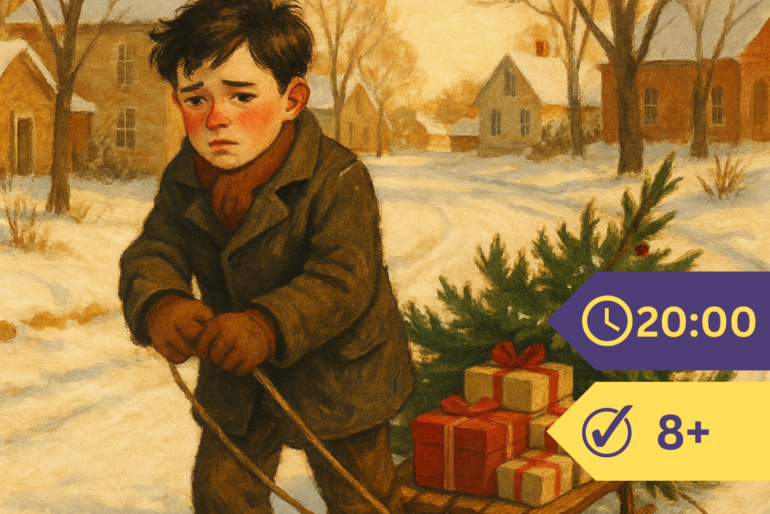
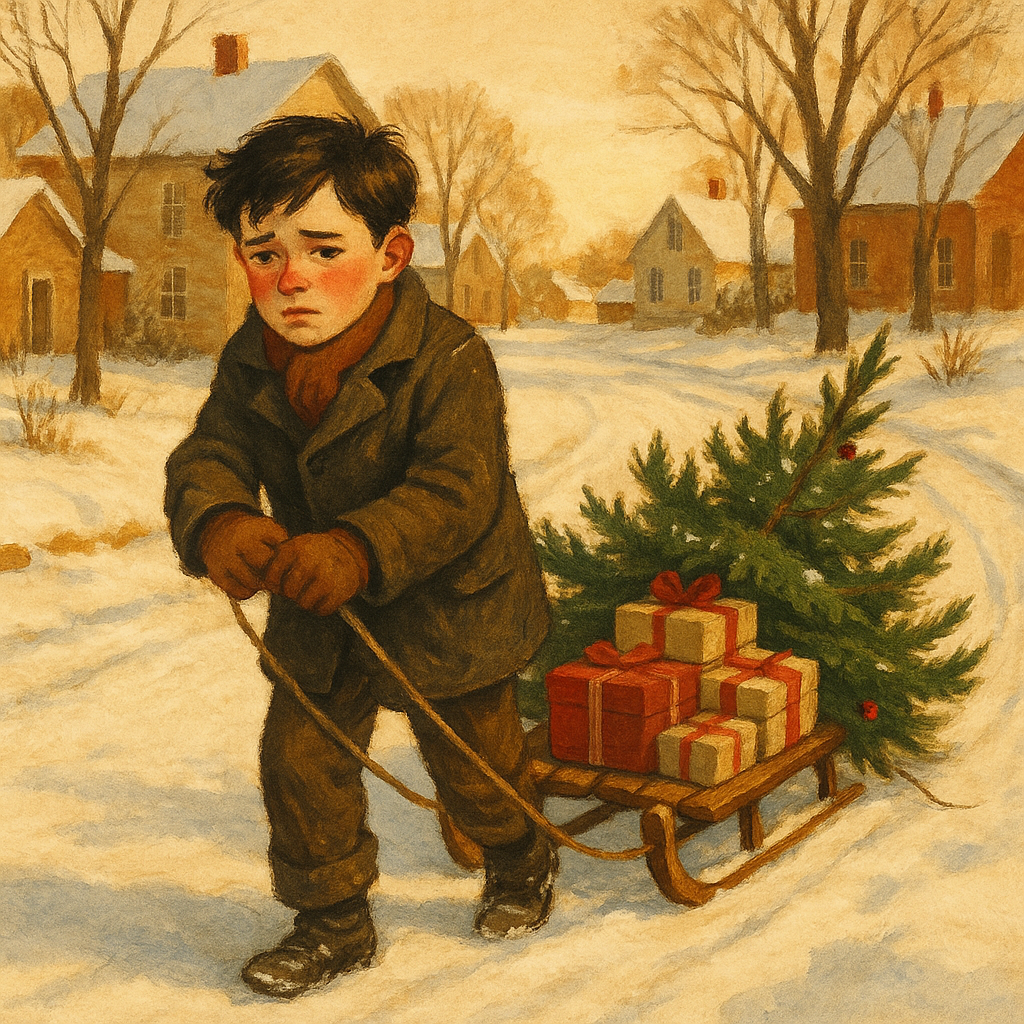
Just at that moment Earl Munroe was hurrying down the road, dragging his big sled. Loaded on it were all his Christmas presents and the Christmas-tree. The top of the tree trailed in the snow; the branches spread over the sled on either side and rustled as he went. It was a heavy load, but Earl tugged manfully in an enthusiasm of remorse and atonement — a fantastic, extravagant atonement, planned by that same fertile imagination which had invented the story for poor little Jenny, but now driven by every good and repentant impulse in the boy’s nature.
On every one of those neat parcels, written above his own name in his big, crooked, childish hand, were the words: Jenny Brown, from —. Earl Munroe had not saved one Christmas present for himself.
Pulling along with brilliant cheeks and glowing eyes, he met Maud Barker. She was Judge Barker’s daughter — the same girl who had joined him in urging Jenny to hunt on the mountain for the Christmas-tree.
Maud stepped along, placing her trim little feet with dainty precision. She wore new high-buttoned overshoes and carried a new beaver muff — in one hand only. The other dangled mittenless at her side, pink with cold, but on its third finger sparkled a new gold ring with a blue stone.
“Oh, Earl!” she called out. “Have they found Jenny Brown? I was going up to your house — why, Earl Munroe, what have you got there?”
“I’m carrying my Christmas presents and the tree up to Jenny’s,” said the boy, flushing red, “so she’ll find them when she comes back.” There was a small, defiant catch in his voice.
“But — why?”
“I rather think they belong to her more than to me, after what happened.”
“Does your mother know?”
“No. She wouldn’t mind. She’d think I was only doing what I ought.”
“All of them?” queried Maud, faintly.
“You don’t suppose I’d keep any back?”
Maud stood staring. It was beyond her little philosophy.
Earl was passing on when a thought struck him. “Say, Maud,” he cried eagerly, “haven’t you something you can add? Girls’ things might please her better, you know. Some of mine are — rather odd, I’m afraid.”
“What have you got?” demanded Maud.
“Well, some of the things are well enough. There’s plenty of candy and oranges and figs and books — there’s one by Jules Verne she’ll probably like. But there’s also a great big jack-knife, and — a brown-velvet bicycle suit.”
“Why, Earl Munroe! What could she do with a bicycle suit?”
“I thought maybe she could rip the seams and sew them some way and get a proper dress cut, or something. Don’t you think she could?” Earl asked anxiously.
“I don’t know — her mother could tell,” said Maud.
“Well, I’ll hang it on anyway. Maud, haven’t you anything to give her?”
“I — don’t know.”
Earl eyed her sharply. “Isn’t that muff new?”
“Yes.”
“And that ring?”
Maud nodded.
“She’d be delighted with them. Oh, Maud, put them in!”
Maud looked at him. Her pretty mouth quivered a little; some tears twinkled in her blue eyes. “I don’t believe my mother would let me,” she faltered. “Come with me and I’ll ask her.”
“All right,” said Earl, with a tug at his sled-rope.
He waited with his load in front of Maud’s house until she came forth, radiant, lugging a big basket. She had her last winter’s red cashmere dress, a hood, some mittens, some cake and biscuit, and a few nice slices of cold meat. “Mother said these would be much more suitable for her,” said Maud, with a funny little imitation of her mother’s manner.
Over across the street, another girl stood at the gate, waiting for news.
“Have they found her?” she cried. “Where are you going with all those things?”
Somehow, Earl’s generous, romantic impulse spread like an epidemic. This little girl soon came flying out with her contribution. Then there were more — quite a little procession filed finally down the road to Jenny Brown’s house.
The terrible possibilities of the case never entered their heads. It never once occurred to them that little, innocent, trustful Jenny might not come home to see the Christmas-tree they were setting up in her poor home.
It was with no surprise whatever that they saw, around noon, Mr. Munroe’s sleigh drive up to the door — carrying Jenny, and her mother, and Mrs. Munroe.
Afterward they heard the whole story. A woodcutter had found Jenny crying on the east side of the mountain at sunset and had taken her home with him. He lived five miles from the village and was an old man, not able to walk so far that night to bring them word of her safety. His wife had been very kind to the child. Around eleven o’clock some of the searchers had met the old man plodding along the mountain road with the news.
They did not stop for explanations now. They shouted to Jenny to come in, quick! They pulled her with soft insistence into the room where they had been at work.
Then the child stood with her hands clasped, staring at the Christmas-tree.
All too far away had she been searching for it. The Christmas-tree grew not on the wild mountainside, in the lonely woods, but at home, close to warm and loving hearts — and that was where she found it.