Part I
The twilight of a Christmas Eve, gray with the promise of coming snow, crept slowly over the old plantation of Brierwood, softening the outline of a decrepit house that still reared its roof in massive dignity, and a tumbledown barn flanked by barren fields. A quiet melancholy hung about the old house as if it brooded over a host of bygone Christmases — Yuletides when the snowy dusk had been ushered in to the lowing of cattle and the neighing of horses safely housed in the barn. There was little livestock now, no blooded stock — nothing with wings save one belligerent old turkey gobbler fleeing from a white-haired old man who tried in vain to drive him to his roost.
In the library, a man tall and eagle-eyed peered out beneath bushy white eyebrows at the fading landscape, watching the shapes of the old man and the recalcitrant turkey. He watched the chase end with an impertinent gobble, and at the sound of a closing door in the rear of the house, tapped the bell at his side. Footsteps shuffled along the hallway, and the old man entered, breathless from his chase.
Colonel Fairfax wheeled with military precision. “Uncle Noah,” he said sternly, “tomorrow will be Christmas.”
The old man nodded and hobbled hurriedly to the wood fire, bending over to poke it in order to hide the look of anxiety in his face. “Laws-a-mercy, Colonel Fairfax,” he grumbled in good-natured evasion, “you’d most freeze to death, I reckon, without sending for one of the servants to pile up this fire.”
The mention of servants was one of Uncle Noah’s many small fictions, used to convince himself and his master that nothing had changed in the Fairfax fortunes since the old days. That he was the last of the Colonel’s retainers — a wageless, loyal dependent attending to the manifold tasks of a sole domestic — Uncle Noah never admitted, even to himself. That his quaint pretensions were daily stimulants to the proud old Colonel, who was eating his heart out with memories, he was well aware. And so the small fictions, revealing the deep understanding between the two of them, peopled the old house with imagined plenty, to the quiet comfort of both.
But today Uncle Noah felt uneasily that the mention of servants had not bolstered the Colonel as it usually did. From the corner of his eye he saw that the Colonel had drawn himself up to military rigidity — a sign that the old soldier was on his mettle and would brook no opposition.
“Uncle Noah,” he said, fixing a stern eye on the old man, “in the Fairfax family there has always been a turkey at Christmas.”
Uncle Noah’s reply gave no suggestion of the way his heart was beating. “Yes, sir,” he agreed, “oftentimes more than one.”
“Owing to circumstances understood by you and myself, but by no one else, there would be no turkey this year — save that—”
“Y-e-e-s, sir?” Uncle Noah laid a wrinkled hand upon the nearest chair for support.
“We have a live turkey in stock,” ended the Colonel firmly, looking squarely into the old man’s eyes.
Uncle Noah’s heart gave a convulsive leap. The thunderbolt had fallen. The fierce old turkey gobbler — solitary tenant of the outbuildings, the imperious creature upon whom Uncle Noah had bestowed the full affection of his loyal old heart — had been sentenced to death by the highest earthly tribunal Noah recognized.
“I’m afraid he’ll be tough, Colonel Fairfax,” he quavered. “Massa Dick — you wouldn’t kill old Job? He’s too smart for a bird, and he’s done a powerful deal of running in his day. I reckon he’s mostly muscle.”
There was an agonized appeal in the old man’s voice that cut straight to the Colonel’s heart. “Uncle Noah,” he said kindly, “it can’t be helped. Job goes for the sake of — someone else.”
“The Mistress?”
“Yes. Thank God, Uncle Noah,” the Colonel laid a gentle hand on his shoulder, “that she doesn’t know of our — financial crisis” — his halting utterance showed how distasteful the words were to him — “save, of course, that we must live with economy, as we have for years. Of the catastrophe of last fall she knows nothing, and a Fairfax Christmas without a turkey would — she must not know,” he finished abruptly.
The Colonel had spoken with a simple dignity and confidence that brought Uncle Noah back from the field of sentiment to the barren desert of reality. Three pitiless facts stood clear before him: the Mistress was grieving her heart out for the son with whom the Colonel had quarreled three years before; of this money trouble from which Colonel Fairfax had shielded her, she must as yet know nothing; and there was no turkey for the Christmas dinner. Things looked very dark for the ill-fated Job, roosting in unsuspecting security in the old barn.
With bowed head the old man walked slowly toward the door.
“Uncle Noah,” the Colonel’s voice was firm, “you will deal with Job tonight.”
“I nearly forgot, sir,” faltered Uncle Noah, “that supper’s ready. The Mistress has come downstairs — can’t he live till after supper?”
The Colonel nodded, carefully avoiding the old man’s troubled eyes, and went to join his wife.
“Christmas Eve, my dear,” he announced cheerfully as he bent to kiss the sweet, wistful face that turned to greet him. “I beg your pardon for keeping you waiting. Uncle Noah and I were discussing tomorrow’s turkey” — he gazed calmly at Noah, who was nervously handling the tea things — “he has selected a large bird and I have been advising a smaller.”
The Colonel opened his napkin and deftly tucked the hole in the end out of sight beneath the table. “Now, Uncle Noah, what have we tonight for supper?”
To Uncle Noah this nightly question had become a sacred institution — a stimulus to imaginative powers highly developed in his quaint dialogues with the Colonel. He forgot the doomed Job. It was Christmas Eve, and his gift for invention took festive flight.
“Well, sir,” he beamed, “we have a little chicken gumbo, some fried chicken just the right golden brown, creamed potatoes, hot biscuits with currant jelly — and sliced ham and baked potatoes.”
Colonel Fairfax thoughtfully considered the appetizing prospect, in accordance with the rules of the game. What did it matter that the luscious dishes existed only in Uncle Noah’s imagination? The little pretense gave each of them a genuine thrill — surely reason enough to maintain it. As usual, the Colonel found his cue in the closing items of the list.
“It all sounds delicious, Uncle Noah,” he observed graciously, “but I have a touch of my old enemy the dyspepsia today. I think I shall have the sliced ham and baked potatoes. That will do for us both, I think.”
Mrs. Fairfax agreed, her kindly eyes fixed upon Uncle Noah’s attentive face.
“And, sir,” Uncle Noah began — it was Christmas Eve, and this game must be perfectly played — “shall I attend to the distribution of gifts in the servants’ quarters, sir?”
“Yes,” agreed the Colonel, “see that no one is slighted!”
Mrs. Fairfax bowed her face upon her hands to hide the tears that suddenly blinded her, and an odd, uncomfortable silence fell upon the little group.
At length the Colonel pushed his chair back and rose. “Uncle Noah,” he said sternly, a suspicious brightness in his eyes, “that turkey of yours is making a terrible noise under the window. Make him stop. Patricia, I don’t wonder he makes you nervous. He’s an old renegade.”
That the object of the Colonel’s wrath had long since retired to roost mattered not at all. The turkey had developed a convenient habit of gobbling under the window whenever emotion drove the Colonel to seek a vent in stern commands. Uncle Noah crossed to the window and commanded Job to be quiet. Mrs. Fairfax — southern gentlewoman, thoroughbred to the last — steadied herself, and as Uncle Noah returned, bade him serve the supper in tones as well controlled as they were gentle.
Part II: The Inspiration
In the great bare kitchen Uncle Noah wiped his steel-rimmed spectacles and stared about him.
“The Mistress grieving her heart out for young Master Dick,” he reflected, “and the Colonel saying ‘slight no one!’ Lord above, what is this old world coming to? Every time she cries for young Master Dick, the Colonel says Job is gobbling—”
The old man choked at the thought of Job’s approaching fate, and, replacing his spectacles, carefully carried in the supper, prolonging its simple service to the very last minute, with the single aim of adding precious time to the doomed turkey’s life.
When at length he sought the barn it was quite dark, and the velvet stillness of the night was dotted thickly with snowflakes. With trembling fingers he opened the great barn door, lit a queer old lantern hanging just within, and hung it high upon a hook. The dim light revealed the carriage-house, in one corner of which, upon a rough improvised roost of shingles, the tyrant Job slept the sleep of the just and unjust rolled into one. As the light flickered upon his ruffled feathers, the turkey emitted a throaty grunt of disapproval and shifted to avoid the glare.
Uncle Noah addressed him with great firmness. “Now see here, Job,” he said, “it’s no use putting on your high and mighty airs tonight. I’ve come to talk to you, sir. Do you understand?”
Job majestically tucked his head beneath his wing, as if to intimate his indifference to the proposed interview.
Uncle Noah surveyed his ruffled back feathers with increased respect. “So you refuse me an interview, Job Fairfax. You’re sleepy — that’s what’s got into you.” He stroked the turkey with a gentle hand. Job, resenting the indignity, withdrew his head from the sheltering wing and pecked at the brown fingers, then turned around with a stately movement and faced the light once more with a sleepy blink of his bright, bead-like eyes.
“Now, sir, we can talk,” exclaimed Uncle Noah in delight. Drawing up an old box he seated himself before the roost and beamed over his glasses.
“The Colonel says you gobble under the window about suppertime,” he began confidentially. “When the Mistress cries about young Master Dick, the Colonel has to scold something, and as you’re the most important personage on the place, he naturally selects you.”
The turkey held his head upon one side, apparently in critical admiration of the old man’s scarfpin, which resembled a grain of corn mounted on a needle.
Uncle Noah, who had always had a faint mistrust of Job’s attitude toward this ancient heirloom, promptly removed it to a place of safety. Then, with a sudden resolve that no thought of the coming tragedy should mar this last visit with his old companion, he rose and sought a dim corner of the barn, returning with a box.
“These here, Job,” he explained, “are the flowers that young Master Dick has sent his mother every holiday since he went away from here. In the morning, when the Colonel sees them at her plate, he’ll declare you’re gobbling something fierce under the window — he always does.”
The old man broke the string of the box and removed a glowing mass of purple orchids — odd, transient tenants of the old barn. Job suddenly reached over and pecked a blossom from its stem, ate the heart with the dainty air of an epicure, and discarded the remainder with a noise very like a gobble of disgust.
Uncle Noah rose in scandalized protest. “You good-for-nothing, miserable, sassy turkey!” he scolded, hastily removing the orchids. “You are certainly the most scandalous, no-account bird I ever knew. Eating one of the Mistress’s orchids! Job, you go most too far. Now, sir, be quiet and listen to this note I got from young Master Dick,” and he carefully read the written lines aloud to the listening bird:
Dear Uncle Noah: I have written Foster and Company as usual to send Mother’s orchids. They should get there Christmas Eve. Will you put them at her plate in the morning? I find they are the only suggestion of me that the Colonel will allow in the house. I tried another letter this week, but it came back unopened. Uncle Noah, give Mother “A Merry Christmas” for me. DICK.
Uncle Noah laid the letter on his knee and drew from a worn leather wallet several newspaper clippings — glowing reports, gleaned from a stray paper, of the success of a young architect in a distant northern city, one Richard Fairfax, Jr. Uncle Noah proudly read them aloud for the hundredth time, adding little explanatory remarks to the turkey, who gobbled threateningly but failed to intimidate his tormentor.
“Job, what do you think about this quarrel?” Uncle Noah said as the turkey eyed him sternly. “I say the Colonel’s too hard on the boy. A quarrel’s a quarrel, you say — maybe you’re right. But it’s this Fairfax pride that keeps him from reading the boy’s letters, and nothing else, sir. He’s sorry for that quarrel — don’t you forget it. But the Colonel, he’s prouder than Lucifer. You say you understand pride because you’re proud yourself.” Then, as the turkey relapsed into slumber, “Now, see here, Job — you’re no more sleepy than I am.” Uncle Noah poked the turkey gently, and Job arched his neck with a threatening flap of wings and descended from his perch. “Fight me, will you?” demanded Uncle Noah in secret delight. “You’re the touchiest bird! Here — fight with these crusts of bread.”
Job spread his tail magnificently and began an erratic consumption of the bread crusts, pertly taking them one by one from the old man’s hand and arranging them on the barn floor for later and more personal inspection.
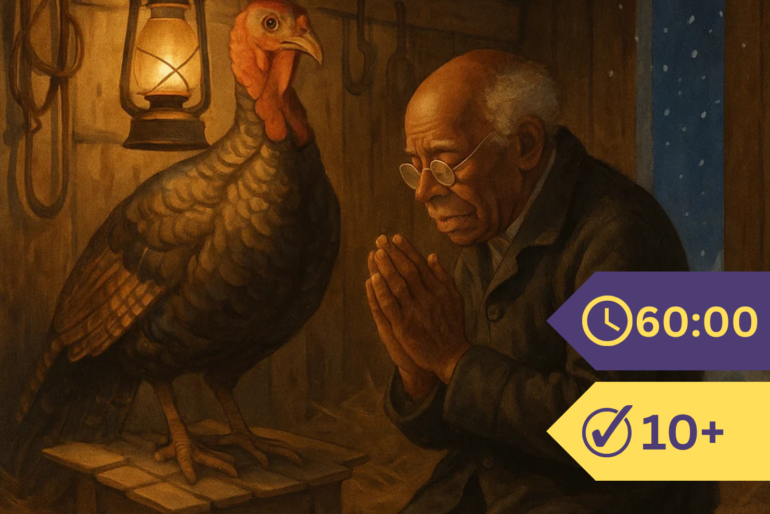
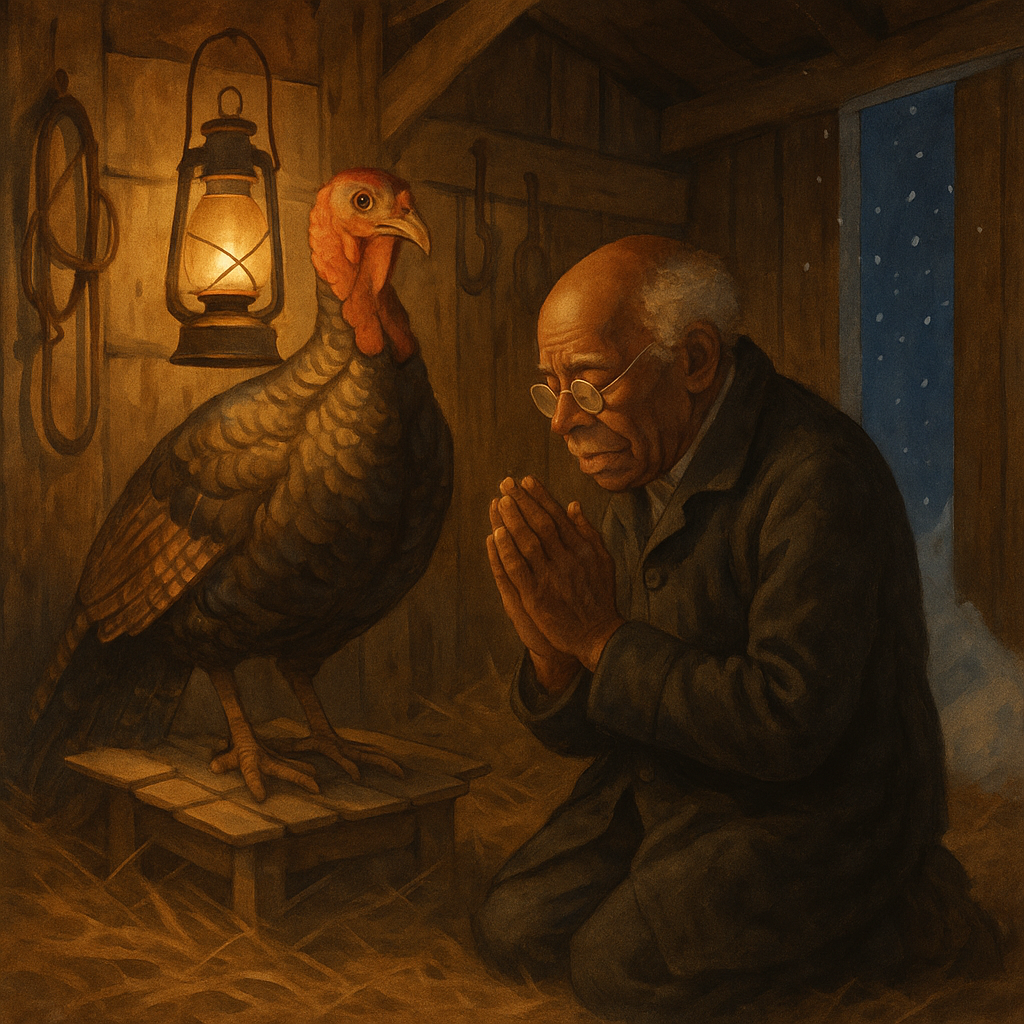
Uncle Noah watched him with misty eyes. Presently his gaze sought the rusty ax in the corner, and a great tear rolled down his cheek. Caught in a sudden wave of anguish, he dropped to his knees and clasped his trembling hands. The dusky barn, littered with odds and ends, was dimly visible in the glimmering light of the lantern, whose slanting rays fell upon the doomed bird and the praying old man. A terrible earnestness lined his face with a holiness of purpose and made it beautiful.
“Oh, Lord,” he prayed, “save this old turkey gobbler. I know, Lord, he’s a powerful worthless bird, but he’s all I’ve got. I’m just an old man, and Job, he understands me. Lord, I don’t want to live any more if I have to kill old Job. Send me an inspiration, Lord, and tell me how I can save his worthless old hide. Save him — and God bless the Colonel! Amen.”
For a time — in which the only sound was Job’s feet as he strutted about seeking an edible successor to the bread — Uncle Noah remained on his knees, perhaps awaiting inspiration. At length he rose, seated himself on the box once more, and buried his white head in his hands. Snowflakes filtered slowly through a crevice in the wall, heaping into a little fantastical drift. Absently Uncle Noah watched them, his mind traveling back to many a snowy Christmas long ago.
Suddenly his face glowed with radiance and he drew a long breath of relief. “Job,” he said, leaning forward and patting the turkey, “I have it! You’d scarcely believe it, sir, but I’m going to save you.”
He arose transformed, the despondent droop of his lean body replaced by alert energy. “Now, Job,” he coaxed, “I just want you to come along with me peaceably, sir. I’m after you to save your old hide from the Christmas platter.”
But Job, with a malicious enjoyment of the game, was prancing wildly about the barn, flapping his wings in hysterical derision of his breathless pursuer. Brought to bay at last, he squawked a protest and struggled violently as Uncle Noah unceremoniously tucked him under one arm.
“There, sir,” exclaimed the old man triumphantly, “I have you! You are certainly the most worthless turkey on this plantation.”
Tightly clasping the outraged tyrant, Uncle Noah tiptoed to the lantern and blew it out. Then stumbling across the floor he slipped out of the barn and set out across the snowy fields to a tumbledown shanty — sole survivor of a string of old outbuildings. Into its dilapidated interior he thrust the protesting turkey, pausing at the door as he struck a match to survey the bird’s temporary quarters.
“Now, Job Fairfax,” he began, “I know you’re just mad clean through. You naturally object to being carted out in the snow in the middle of the night without being asked. Your back’s full of snow? Well, I just ask you, Job Fairfax — isn’t that better than being without a head? Now, sir, I ask you to be most terrible quiet this night. I’m going into Cotesville on a little errand, and I don’t want the Colonel to know you’re here.”
He closed the rickety door and hurried back across the fields, his eyes behind their spectacles shining with excitement. Muffling himself in a red knitted scarf, a dingy overcoat, and a worn fur cap with earlaps, he left the house again, pausing only long enough to peer through the library window at the Colonel, who was reading aloud to his wife, both drawn up in the cheery warmth of the blazing fire. Then he hurried on along the road to town.
With a prayer in his heart for the success of his mission, Uncle Noah trudged steadily down the two miles to Cotesville, past Major Verney’s plantation — the lights of the great house twinkling brightly through a curtain of snow — and into the snow-laden air of the village streets, alive with Christmas shoppers. Holly and mistletoe, Christmas trees filling the air with the scent of pine, dancing snowflakes and bright lights, wonderful windows dotted in Christmas glitter and cheery voices — who could resist them? Uncle Noah felt his heart quiver with hope, and jubilantly turned his steps toward the railroad station ahead.
The Northern Express flashed through the snow and came to a stop with a clang and a roar, disgorging a chattering holiday crowd changing cars at Cotesville on their southbound journeys. Uncle Noah hastened his shuffling steps; the Express and its horde of transient visitors had been a vital part of his inspiration. Upon the platform people stamped about in the snow or laughed and chatted, quite oblivious to the old man who slowly made his way among them. One by one Uncle Noah left them all behind, great disappointment in his face. In their laughing countenances he had found nothing of what he sought.
Part III: The Gray-Eyed Lady
Just ahead, a girl appeared from the shadows and walked quickly toward the waiting room. Uncle Noah looked into her fresh, sweet face; then his own lit up with renewed hope, and he followed her in and touched her timidly on the arm. The girl turned, revealing a face rosy with cold and a pair of warm gray eyes fringed in black lashes — eyes that offered a glimpse of an impulsive heart brimming over with Christmas spirit.
Uncle Noah removed the battered fur cap and bowed low with the deference of a Cavalier. “I’ve just come in to — to ask you, Miss,” he said simply, “if you’d like to buy an old servant. I’m for sale.”
“For sale!” The girl took in the quaint figure with a glance of blank astonishment. “Why — surely you—”
“I’m old, Miss,” he interrupted timidly, but meeting her gaze with unwavering sincerity. “I expect I’m getting on toward a hundred. But I’m powerful tough and full of work, and — and, Miss, I have to sell myself tonight because—”
Uncle Noah paused uncertainly, seeking the right words. The girl, readily intuitive, glanced swiftly about to assure herself that the waiting room was free from unsympathetic ears. Then, strangely drawn to this quaint old figure, and eager to put him at his ease, she impulsively pushed a rocking chair toward the old stove in the center and motioned him to be seated.
But Uncle Noah had been reared in the Fairfax household, where a gentleman never sat when a lady was still on her feet. With a courtly gesture the old man bowed her to the chair he had drawn for him. A quick gleam of approval flashed in the gray eyes, and with a deepening flush of puzzled interest, the girl instantly seated herself, unfastening the silver fox at her throat as she felt the warmth of the old stove.
“Please — I would so much rather you, too, would sit down,” she said impulsively, and as Uncle Noah drew forward another of the rickety rocking chairs, she bent toward him — a light in those wonderful gray eyes that won Uncle Noah’s heart.
“Tell me,” she said kindly. “Tell me just why you want to sell yourself.”
He had not laughed at him. She had not laughed at all. Uncle Noah glowed to the tips of his fingers at the ready sympathy in her voice. He beamed mildly at her over his spectacles, turning the old cap round and round in his hands as he sought to voice the words that struggled to his lips.
“The Colonel’s money — and, Miss, he hasn’t had much since the War — all of it went in the Cotesville bank crash last fall, and he doesn’t want the Mistress to know. I’m the only one of the servants left, and there’s only one turkey gobbler left of the stock. He’s my old pet, Miss — most like family to me — and—” Uncle Noah choked.
The girl’s eyes were soft with feeling. “And the Colonel told you to kill your pet for the Christmas dinner?” she finished gently.
Uncle Noah nodded. “He said we must have a turkey for Christmas dinner, or the Mistress would suspect the — the trouble we’re in. Out in the barn I prayed for an inspiration, and I believe it came.”
“And so you decided to sell yourself—” began the girl.
“Yes, Miss.” Uncle Noah’s voice had grown apologetic. “You see, Miss, I’m the only thing I truly own, except this old stickpin. I’m a free man — have been since the War — and if I have a mind to sell myself, I reckon no one can stop me. I’m selling my own self.” There was a gentle defiance in the old man’s argument.
“And you — you wouldn’t accept a — a loan?” The girl flushed.
The old man’s wounded eyes were answer enough. Uncle Noah had not lived in an atmosphere permeated with Fairfax pride without feeling its influence.
“I’m not asking for charity, Miss,” he averred stubbornly. “I’m selling something. I reckon if you buy me, Miss, and let me go back and stay Christmas with the Colonel, I’ll sell myself cheap. You see, I’m planning first to buy a turkey to take Job’s place on the platter, and then to give the Colonel a grand Christmas with the rest of the money I get — saving out just enough to buy back my old bird and come to you the first day after Christmas. It’ll be hard to leave the Colonel and the Mistress, but I reckon it’s just got to be done.”
Uncle Noah gulped and blinked, and there was a glimmer of wet lashes about the warm gray eyes that had won his heart.
The girl was silent so long that Uncle Noah shifted uneasily. But at last she spoke, a little tremulously. “For what price will you sell yourself?” she asked, and Uncle Noah never doubted but that she regarded the arrangement in the same light in which he himself had viewed it.
He turned about for his purchaser’s thorough inspection, his bald head above the fringe of white hair glistening in the lamplight. “Do you think I’m worth, say, twenty-five dollars?” he asked, regarding her steadily over his spectacles.
The girl touched her throat with an unconscious gesture. “Yes, you are,” she cried impulsively. “You are indeed!” And before Uncle Noah had quite time to adjust himself to the joy of his unique sale the girl thrust a roll of bills into his hands and disappeared through the station door.
Part IV: Christmas Intrigue
Uncle Noah hobbled after her. His new mistress had quite forgotten to tell him where to deliver himself when his Christmas with the Colonel was over. But when he reached the door she was eagerly greeting a man who had just alighted from a waiting carriage. Uncle Noah could but dimly see him — but as the genial voice reached his ears he halted in the shadow, quite content. It was Major Verney! The fact that the Colonel’s old friend and neighbor had driven in from Fernlands to meet the gray-eyed lady — who, Uncle Noah now recalled, had had the very Verney look about her eyes — seemed to the watching old man a direct interposition of Providence. A scant mile of fields lay between the two plantations, and, Christmas over, Uncle Noah had but to trudge across them to deliver himself to the Major’s guest.
“And, Ruth,” concluded Major Verney in laughing reprimand, “you have kept me waiting. Why, child, the Northern Express came in fifteen minutes ago.”
Uncle Noah did not catch the girl’s reply as Major Verney assisted her into the carriage and they drove rapidly away.
The old man beamed happily after the retreating carriage; then, with his hand tightly clasped about the precious roll of bills for which he had so willingly bargained, he began a tour of the Cotesville stores. When at length he staggered into the big grocery for his final purchases he was laden with a miscellaneous collection of Christmas packages from which he was cheerfully disentangled by the bulky proprietor himself. Uncle Noah made a critical pilgrimage about the store, pausing at last before a counter where a number of turkeys had been laid out for inspection. A very respectable fowl was presently wrapped in brown paper and laid beside the other bundles, along with bags of cranberries and apples, oranges and nuts, celery and raisins, cigars for the Colonel, a box of candy for Mrs. Fairfax, great bunches of holly and mistletoe, Christmas wreaths for the windows, and a large bag of cracked corn for the reprieved Job, now glumly roosting in the ruined hut.
As Uncle Noah carefully counted out the money required for this astonishing outlay, the proprietor remarked pleasantly: “Uncle Noah, do you happen to know where I can get someone to scrub up my store every morning?”
Uncle Noah fingered his scarfpin. “How much do you pay for the work?” he asked.
“Fifty cents a day.”
The old man leaned forward in sudden tense excitement. “Do you think I could do it?” he demanded.
The proprietor, secretly astonished by his manner, nodded assuringly. “Why, yes, easily — it’s nothing much. But the Colonel—”
“The Colonel doesn’t have to know,” exclaimed Uncle Noah. “I’ll come mornings before he’s up. I declare to goodness, sir, I need the money most powerfully.”
The proprietor was easy-going and not given to unnecessary curiosity. So the bargain was sealed on the spot, under a pledge of deepest secrecy.
Somewhat dazed by this extraordinary sequence of events, Uncle Noah, his eyes shining with excitement, started for the door — quite forgetting the countless packages on the counter.
The proprietor recalled him with a hearty laugh. “Uncle Noah — you’ve forgotten one or two little bundles here.”
With a gasp the old man hurried back. But try as they would, room for all the bundles could not be found about his person. The proprietor energetically tucked packages into every pocket, piled them tower-fashion upon his arms, and hung a collection bound together with string over his shoulder, while Uncle Noah wheezed and groaned and struggled to find new storage space in his clothes — but still there remained bundles and bundles at which he gazed over his spectacles in growing discomfiture.
“What am I going to do? I can never carry all this home in the snow on these old legs of mine.”
“Get one of the station cabs,” advised the grocer. And so, after considerable discussion, the bundle problem was solved.
Ten minutes later Uncle Noah entered a hired carriage for the first time in his life. At the town florist’s he rapped a signal to the driver to stop and — glowing with anticipation — shuffled into the warm, scented air of the little shop. Here, to the clerk’s astonishment, he ordered a bunch of violets to be delivered Christmas morning to “the young lady with the gray eyes staying at Major Verney’s.”
“Surely,” smiled the clerk, “you don’t want that on the card?”
But Uncle Noah was stubborn. More: he insisted on writing the inscription himself, his spelling quite as quaint as his handwriting. And so the card went, to be read by the wonderful gray eyes in the morning.
Back through the snow in his rickety carriage rolled Uncle Noah, rattling home along the snowy road down which he had trudged in the early evening, chuckling now and then in a mental rehearsal of his new plan.
Fifty cents a day! he thought. And tomorrow I’ll slip over to Fernlands and ask her to let me buy myself back on the installment plan. Most likely she’ll take a dollar a week, and with all the rest of that grocer money the Mistress won’t have to know what the Colonel and I are going through.
In accordance with Uncle Noah’s whispered directions the cab crept gently up the driveway at Brierwood and paused at the kitchen door, where the driver — who had taken a great fancy to the old man — became a benevolent stevedore, tiptoeing in and out of the kitchen with the bundles. Job’s understudy came last, and Uncle Noah, tightly pressing the precious fowl in his arms, watched the carriage drive slowly away. Then, after an interval in the kitchen devoted to hiding his purchases, he sought the library, striving to simulate a decent depression over the assumed fate of Job.
Colonel Fairfax looked up inquiringly as he entered.
“I’ve just come to tell you, sir,” said Uncle Noah with a meaning glance toward Mrs. Fairfax, “that I have the turkey all ready for the oven.”
A faint red crept through the Colonel’s skin, but he met the old man’s eyes squarely. “Thank you, Uncle Noah,” he said, and Noah shuffled hurriedly away.
In his old rocking chair by the kitchen fire, Uncle Noah — alert and excited — waited until he heard the Colonel and Mrs. Fairfax go up to bed. Then, chuckling softly, he extinguished the lights and, carrying one of his Christmas bundles, plodded across the field to Job’s temporary hermitage. The light of a match revealed the tyrant roosting glumly on the summit of a ruined plowshare.
“I’ve brought you a Christmas surprise, Job Fairfax,” said Uncle Noah, and he sprinkled the floor thick with corn that the turkey might find it in the morning.
With his heart full of thanksgiving the old man plodded homeward through the snow. As he reached the old barn, the great clock in the library struck twelve, and faintly through the snowy air floated the distant silvery chimes of the Cotesville bells — clear and sweet, ringing in a Christmas morning.
Part V: Fernlands
Creeping to bed long after the first rooster had crowed, Uncle Noah was back in the kitchen with the sunrise, his tired eyes opening jubilantly upon a snapping cold Christmas morning radiant in gold and white. Downstairs, clusters of holly and mistletoe festooned doors and windows, dotted the old-fashioned lamps with spots of crimson, and crowned the family portraits — evergreen wreaths hung in every window. All the work of a wrinkled pair of faithful hands toiling while the world slept. In the library a blazing wood fire leaped and crackled. In the dining room the table was spread for breakfast. Long-needed articles of china, which had mysteriously disappeared from time to time since autumn, dotted a tablecloth free from holes — a new one subjected to a severe laundering during the night — and the napkins had been mended. A great bowl of purple orchids glowed at Mrs. Fairfax’s plate.
The Colonel greeted the Christmas festoons in the library with a stare of astonished approval. A question had risen to his lips, but the warning look in Uncle Noah’s eyes — glancing toward Mrs. Fairfax — had checked it. These two had kept many financial secrets from the dear lady, and the Colonel promptly decided that Noah had sold some forgotten relic and had once more made use of his remarkable faculty for expanding a small sum to incredible elasticity. He praised the result warmly. Mrs. Fairfax, too, brightened wonderfully, yielding to the Christmas spirit with which the old man had contrived to fill the house.
Uncle Noah felt a glow of delight at their outspoken appreciation and, bowing elaborately, ushered his master and mistress in to breakfast. Here again, as he seated himself, the Colonel was conscious of an agreeable flood of astonishment. There was quite an air about this Christmas breakfast. Fixing his keen eyes on the tablecloth and napkins, he stealthily fingered them with a searching look at the waiting old man — then caught sight of the orchids, and the tear-stained face of his wife bending over them. With a wrench of his chair he arose.
“Patricia!” he said stormily. “Did I not say that nothing of his — did I not—” He paused and gulped. “Uncle Noah,” he added unsteadily, “that turkey of yours is gobbling like a fiend under the window—”
The Colonel stopped abruptly, reddened as his eyes fell upon Noah — who had wisely turned away — and sternly reseated himself.
Uncle Noah hobbled from the room, his face working convulsively. In the kitchen he shook with silent laughter, doubling over breathlessly and clasping his hands over his stomach in aching distress.
“And what, Uncle Noah,” asked the Colonel kindly when the old man presently re-entered the dining room, “have we for our Christmas breakfast?”
“Well, sir,” Uncle Noah began fluently, “we have grapefruit, cereal with cream, quail on toast, fried oysters — oatmeal, hot muffins, fried chicken, cornbread and coffee!”
The Colonel, appearing to consider the options thoughtfully, replied as usual: “It all sounds delicious, Uncle Noah, but I have a touch of my old enemy dyspepsia today. I think I shall have some cornbread and coffee — and so will Mrs. Fairfax.”
“I don’t think you quite understand me, sir,” averred Uncle Noah firmly, “and I expect your dyspepsia isn’t so bad this morning. We have for breakfast, sir: grapefruit, cereal with cream, quail on toast, fried oysters — oatmeal, fried chicken, hot muffins, cornbread and coffee.”
There was no mistaking the emphasis this time. Colonel Fairfax darted a lightning glance at the old man and amended his selection with a question in his voice. “Well, now I come to think of it, Uncle Noah,” he said, “my dyspepsia isn’t nearly so bad. I’ll have — let me see — oatmeal — that was in the list, I believe — fried chicken — am I right? — muffins, cornbread and coffee.”
There was a conviction in the Colonel’s deep voice that something extraordinary was afoot, and Uncle Noah — flustered by its ominous ring — hurried from the room. He had dimly pictured his master’s gracious astonishment and pleasure. Any queries relative to the financial source of the Christmas abundance had been entirely lost in the darky’s jubilant excitement. Now he groaned in dismay.
“You’re in a mess for sure, Uncle Noah,” he apostrophized himself. “What’ll you do when dinnertime comes? Here you have a Christmas dinner fit for a king, and the Colonel knows perfectly well that we had only a little left from the money we got when we sold the silver teapot.”
It was Christmas, however, and Uncle Noah felt convinced that the Providence that had watched so well over his Christmas Eve would order a special dispensation for his new dilemma. While awaiting its manifestation he would studiously avoid the Colonel, and would slip across to Fernlands — once the turkey was safely in the oven — and beg the gray-eyed lady to accept a dollar a week in his inspired scheme of self-redemption.
With this in mind Uncle Noah served the breakfast, hurried his preparations for the midday feast, and at five minutes of eleven — the turkey safely roasting — set out across the fields for Major Verney’s.
At Fernlands, the eleven strokes of the grandfather’s clock in the great hall found the gray-eyed lady in the arms of a young fellow who had just bounded lightly up the walk from the sleigh Major Verney had dispatched to Cotesville to meet the morning train. The Major, smilingly awaiting his opportunity to greet the newcomer, ran an approving eye over the handsome young man.
“Well, Dick,” said the Major, advancing with outstretched hand as the girl flushed prettily and smoothed back the dark mist of hair from her forehead, “how are you, my boy? Busy, of course — we read fine things of you in the papers. What, sir, do you mean by falling in love with my only niece? Here my brother writes me that his daughter is engaged to a man who knows me, and will I pack off a carload of testimonials endorsing the little rascal who used to steal my apples. What, sir, do you mean?”
“Well, Major,” Dick answered as he was ushered into the big living room, his laughing eyes alight with happiness, “she had the Verney eyes, and you know I always liked them.” He sank into a chair by Ruth with a smiling glance at the Major. “It’s unusually cold for down here — there’s a real bracing Northern sting in the air. And what a snow! It’s packed so firm the runners fairly flew.”
The Major was still bustling about, urging Ruth into a chair by the fire that he himself might sit by Dick, poking energetically at the blazing logs, and firing a volley of directions at the household.
“There!” he exclaimed, finally seating himself. “Now, sir, relative to this infatuated young person on my left, who has condescended to visit her uncle for the first time in memory. I met her last night according to telegraphed instructions, and she kept me waiting — let me see—”
“Uncle!” protested Ruth. “You’ve added fifteen minutes to that wait every time you’ve mentioned it.”
“My dear child, politeness alone has kept me from naming the full extent of my wait. If you please, sir,” he turned to Dick, “she was in the clutches of a beggar who obtained twenty-five dollars by a most extraordinary yarn.”
“Twenty-five dollars!” Dick whistled, smiling at the flush that crept up to the gray eyes. “Was it an aged father this time or a hungry brood of motherless waifs, Ruthie?”
“Dick, listen!” cried the girl. “Uncle misjudges him entirely. It was a dear old man and he told me the strangest story.”
“You don’t often find a grateful soul who sends you violets in the morning purchased with some of your own money,” said the Major, pinching the flushed cheek. “Tell him, Ruthie — it was odd, and I believe I’d have done the same thing myself.”
The girl flashed a grateful look at him, and then told the story of her strange transaction of the night before so eloquently that the Major and Dick heard her through with sober faces, secretly touched by its pathos. “And he must have recognized Uncle Edward,” she ended, “for the violets came this morning with the quaintest card.”
For an instant she dreamily scanned the fire — seeing in its glowing embers the brown wrinkled face with its honest eyes, peering at her over his spectacles in troubled hope — then she sprang to her feet.
“Uncle Edward, did you tell Uncle Neb to wait with the sleigh? Those sleigh-bells are beginning to sound impatient.”
“Merciful goodness!” cried the Major. “I certainly did. I had the strictest commands to drive to church for Mother Verney at eleven o’clock. Sam — tell Uncle Neb I’ll be right out.”
“I’ll tell him, Uncle,” called Ruth, flying swiftly up the long hall to the library window.
But no clear call went ringing over the snow to Uncle Neb. Instead there was silence, broken at length by a voice calling softly with great excitement: “Dick! Uncle Edward! Do come here — look!” she cried as they quickly joined her. “You see, Uncle — he didn’t forget!”
Smiling, the two men looked from the window. An old man muffled in a threadbare overcoat was plodding up the walk, his eyes scanning the house with evident curiosity.
The Major uttered a quick exclamation and the girl wheeled about.
“Don’t you see?” she cried. “He’s come today, honest old fellow that he is! See, Dick—”
She stopped abruptly, looking from one to the other. Something in the two stern faces staring beyond her at the approaching figure struck a chill to her heart. Dick’s face had gone white, and the Major’s hand had stolen to the younger man’s shoulder as if to steady him.
There was a startled incredulity in the Major’s face as he said quietly: “Brace up, old man. You didn’t know. Neither did I.”
“Ruth,” Dick asked unsteadily, “is that the old man whose — whose master—”
“Yes!” cried the girl, premonition sharp in her voice. “Oh, Dick — who is he?”
Dick’s eyes met hers as he answered, “It’s — it’s Dad’s Uncle Noah. Ruth, I—” He turned and sought the hall.
Ruth’s face flamed at his words. Uncle Noah’s story came crowding over her again in the light of Dick’s revelation. His father and mother! The stern old Colonel, of whom Dick always spoke with such respectful loyalty in spite of their quarrel, and the dear mother whose tender eyes gazed from the old daguerreotype Dick always carried — these two were Uncle Noah’s beloved Colonel and Mistress.
She turned; the Major had followed Dick to the hallway. A shuffling step sounded on the porch outside, and the girl hurried toward the door, a sudden light of daring in her eyes. Impulse had always ruled the Verneys, and Ruth was a Verney from the crown of her dark head to the tips of her small feet. Catching up Grandmother Verney’s long cloak from a chair, she softly left the house.
Dick, struggling into his overcoat, turned at the Major’s touch on his arm.
“Just a minute, Dick.” Major Verney’s genial voice was gentle as a woman’s. “Remember that what the Colonel refused in prosperity he’s not likely to accept in adversity. Sit down here by the fire until we talk it over.”
“But, Major—” there was anguish in the boy’s voice — “I must go to him. Think of Uncle Noah doing all of this to help them, and I—”
But the Major had already removed the overcoat and gently pushed his guest into a chair by the fire. “Yes, yes,” he said as he seated himself. “We know all about that, my boy. But I’m afraid, Dick, the Colonel wouldn’t let you in. He’s very bitter.”
Dick groaned. He was calmer now. “You’re right, Major,” he said steadily. “It hurt so at first I didn’t think. I can’t go now.” He leaned forward anxiously. “The Cotesville Bank—?”
“Crashed in the autumn — September.” Dick bit his lip, and the Major added: “He was heavily invested?”
Dick stared at the fire. “It was all he had.”
“I see.” The Major’s quiet voice gave no hint of his own emotion. “I didn’t know. Of course I heard he’d lost something; we all did. But I thought he had other money.”
“No. Tell me, Major — you’ve been going to Brierwood this winter just as usual?”
“Of course — every Wednesday night. The Colonel and I are too old to alter the habit of a lifetime, and besides we both love that long evening playing chess. There’s always a roaring wood fire and a pot of coffee, and your mother always plays Beethoven for us just before I go.”
A look of relief crossed Dick’s face. “‘Always a fire,'” he repeated. “I’m glad of that. There was no suggestion of — of want?”
“Heavens, no!” The Major’s deep voice was full of assurance. “Last week,” he added thoughtfully, “the coffee was rather weak — but it never occurred to me that—” He stopped abruptly, rose from his chair with sudden energy, tramped down to the end of the hall and back, and blew his nose fiercely. “Damn the Fairfax pride! Here Uncle Noah has been coming into the library Wednesday nights and telling the Colonel that the stock had all been bedded down for the night — when all the time there’s been nothing left but this confounded old turkey gobbler we’ve been hearing about. He swore last week that somebody had stolen the silver teapot. Abominable old — he must have sold it.” The Major threw out his arms with a wrathful gesture. “All this comedy for my benefit. Here I’ve been there every week and never suspected, thanks to the extraordinary stratagems of that old man. Damn the Fairfax pride!”
The Major sat down as suddenly as he had risen and attacked the fire with vicious energy. “Tell me, Major,” Dick presently asked, “have you ever mentioned me to the Colonel since I went North?”
“Once.” The Major made a wry face. “I never tried again.”
Dick colored. “Does he know about Ruth?”
“No — I dared not mention it.” The Major looked at the other intently. “Dick,” he said, “what was this quarrel all about, anyway?”
“In the beginning, Major,” admitted the young man, flushing, “it was so childish — I’m ashamed to speak of it.”
“Out with it!” commanded the Major. “I won’t be hoodwinked by a Fairfax any longer.”
“Well, sir — it was about the War.”
“The War!” exclaimed the Major. “By gad, sir — what about the War?”
“Dad and I were talking it over, and — to be frank, Major, I said I thought the North had been right, and that if I had been alive at the time, I would have fought with them, despite my kinsmen.”
“Go on! Did you fight in any other post-mortem wars? The Revolution? The fall of Rome?”
Dick ignored the sarcasm. “My sympathy for the North made him furious. We quarreled terribly and both of us said things we didn’t mean. It was the Fairfax temper, sir; I—”
“Damn the Fairfax temper!” roared the Major. “Thank Heavens the Verneys are mild!”
Dick laughed in spite of himself. “I apologized,” he continued soberly, “but he wouldn’t listen. Told me to get out; said if I chose to reconsider my opinions about the North, we’d talk it over — and I, of course, refused.”
“Of course!” interpolated the Major drily.
“I’ve written since, suggesting that we forget it all and start again. But he won’t listen, sir.”
The Major stroked his beard ominously. “Did it ever occur to you, Dick, that enough families were estranged by that War without carrying it over into the Twentieth Century? How long after the War were you born? Twenty years, wasn’t it? Your father and Ruth’s were married about the same time.”
“Every man has a right to his opinions, Major,” Dick asserted with spirit. “Of course I have no personal knowledge of the War — but the North was right.”
“Fairfax to the core,” thought the Major in secret admiration. “The boy’s his father all over again. Well, Dick,” he said mildly, “we older men of the South feel a little differently about this War. But, my boy, these post-war disputes don’t pay — particularly when one participant was born long after the guns were quiet. In my opinion you didn’t know enough about the War to quarrel over it. Great Scott, quarreling over the War! Dick, you deserved to be spanked.”
The jingle of sleigh-bells rang blithely through the silence that followed, and the Major sprang to his feet. “Merciful Heavens — it’s noon! That must be Uncle Neb still waiting, and Grandmother Verney must be standing on the church porch, mad as a hornet.” He was at the door now, calling: “Uncle Neb — why under the canopy didn’t you remind me?”
The driver scratched his head. “Major, sir,” he confessed, “I haven’t been here. I drove Miss Ruth over to Brierwood with Uncle Noah to see Colonel Fairfax.”
The Major summoned Dick in great excitement. “Dick — get into your overcoat as fast as you can and drive over to Brierwood with Neb. Ruth’s gone ahead of you, and you couldn’t have a better deputy short of an angel.”
Dick wrung the Major’s hand and fled to the waiting sleigh, color flooding his face.
“And, Neb,” called the Major frantically, “hurry back, or Grandmother Verney will be tramping home in the snow, rheumatism or no rheumatism.”
With a wild jingle of bells that seemed to Dick the hysterical echo of his own heartbeats, the sleigh was off.
Part VI: The Colonel’s Christmas
At Brierwood the Colonel — wrought to a high tension of excitement by the mysterious flood of Christmas prosperity, the latest manifestation of which had been a fresh newspaper and a cigar of no mean label — had been vainly searching for Uncle Noah, bewildered by the old man’s odd vanishings. Just as the Colonel had returned to the library, drawn his favorite chair up to the cheerful blaze of the wood fire, and opened his favorite volume, a door in the rear of the house shut softly. Convinced that Uncle Noah had returned, the Colonel closed his book and adjusted his glasses, determined to have an immediate reckoning with the author of all this Christmas cheer.
A light step sounded behind his chair, and the Colonel turned — quite primed for an altercation. In an instant, however, the old man was on his feet, bowing grandly despite his astonishment. A girl stood in the doorway, her cloak falling loosely about her figure. Her cheeks were blazing scarlet from the cold, and the deep gray eyes, fringed in black lashes, bore something in their warm depths that stirred familiar memories.
“Colonel,” she said, stretching out a slim white hand, “I’m Ruth Verney — Major Edward’s niece. I’ve just driven one of your people over from Fernlands, and I thought you wouldn’t mind if I ran in for a moment to enjoy your fire.”
“Why, child,” the Colonel cried, forgetting all else in his delight, “you must be Walter Verney’s daughter.” Ruth smiled and nodded. “I knew it — you have his eyes. Sit down here. I knew your father well; when we were boys he and I were inseparable.” He paused and added simply: “That was before the War.”
The dark lashes veiled for an instant a certain excitement in the gray eyes. “I’m down for Christmas with Uncle Edward,” Ruth explained; and before the Colonel had fully realized it they were chatting happily together like old friends. Suddenly the girl exclaimed: “Colonel Fairfax, I know you’ll be glad to hear that Dad and the Major are friends again.”
“Indeed I am!” agreed the Colonel heartily. “In the old days we would have laughed at the man who could possibly have suggested a quarrel between the Verney twins.”
“Nothing but a cruel war could have done it,” said the girl quietly. “What does it matter now if Daddy fought for the North and the Major for the South? It’s all so long ago. A quarrel about it now is simply foolish.”
The Colonel cleared his throat. “Yes,” he admitted, “it is foolish.”
“You see,” Ruth leaned eagerly forward, “I met a man who knew the Major, and he praised him so highly that I lay awake all night thinking what a pity it was that two such splendid men should still be enemies over an old war. You know, Colonel, they would have been friends long ago — only each was too proud to make the first move. Wasn’t it foolish?”
The Colonel nodded, carefully shading his eyes from the fire.
“They were just wasting precious years of companionship,” went on the girl. “That thought came to me as I lay awake, and the very next morning I wrote to the Major. You see, Colonel Fairfax, I feel this way: there is no North and no South now. Daddy and the Major are citizens of the same country.”
The Colonel rose and busied himself about the fire. When he put back the tongs and reseated himself, his cheeks were hot from its blazing warmth.
“And that’s what I told Uncle Edward, and, Colonel, he wrote me back such a glorious letter that I had to show it to Daddy. He was delighted. He said that any two men who went on fighting over the battles of a dead war were ‘old fools.'”
Colonel Fairfax winced.
“So,” finished the girl with glowing eyes, “Uncle Edward came rushing North in a great state of excitement, and that’s how I came to be here for Christmas.”
In her impetuous criticism of the old quarrel, and her broad, impulsive expression of patriotism, Colonel Fairfax had listened to certain truths that had long been quietly germinating in his own mind. Before he could recover from the surprise of finding that he agreed with her, Ruth — touched by the lines of care graven upon his fine old face — had caught her breath with a little sob, slipped from her place by the fire, and was kneeling beside his chair, her eyes starry with light, her lovely face luminous with tender appeal.
“Colonel,” she cried, a catch in her voice, “I’m going to marry Dick. It was he who praised Uncle Edward so.”
The Colonel’s face grew scarlet; then he laid a trembling hand upon the girl’s bowed head. “Child,” he said, “you — you—” Tears blinded his eyes and he stopped.
In the silence that followed came the sharp sound of a quick footfall. The Colonel looked up. Dick Fairfax stood in the doorway, his eyes burning strangely in the white stillness of his face.
The father rose and straightened himself with something of his old stern dignity — but at a warm, girlish touch on his arm he gulped.
“Dick,” he said, his voice unsteady, holding out a trembling hand, “we’re — we’re both citizens of the United States, and — it’s Christmas Day.”
Almost before he had finished, the boy had bounded across the floor and wrung the outstretched hand, his face radiant with delight. By the fire Ruth wept softly, and the Colonel gently patted her dark head, his eyes full of tenderness. Then, taking refuge from the sharp pain of his emotion in austere command:
“Dick,” he said sternly, “go to your mother.”
When Uncle Noah — in a state of beatification impossible to describe — summoned the four to the wonderful Christmas dinner, Colonel Fairfax was eagerly listening to Ruth’s account of Dick’s success, and Dick was gently patting his mother’s silver hair, a halo of silver crowning a face radiant with happiness. It was a Christmas reunion whose full meaning Uncle Noah could not yet quite comprehend. That he had been the unlikely instrument of it all, the gray-eyed lady had already told him; but Uncle Noah, busy with numberless culinary problems in the kitchen, had not yet had time to take it in.
At four o’clock Major Verney — who had been restrained from dashing over to Brierwood for hours only by the necessity of soothing his irate mother after her long wait on the church porch — blustered in with the aggrieved old lady on his arm.
“We’ve come to supper,” announced the Major. “No, Dick — sit down. I know all about it, and tonight you’re all coming back to Fernlands with me to celebrate the betrothal of these two youngsters.”
“It has been a day of mysteries,” the Colonel said. “But will someone please tell me what Uncle Noah was doing at Fernlands this morning when he was needed here?”
A silence fell over the little group. The subject was one whose delicacy forbade the ghost of a blunder.
It was the Major who at last drew his old friend into the deep window recess — where but the night before he had watched Uncle Noah pursuing the elusive Job — and told him the story of the faithful old man’s Christmas Eve.
The Colonel listened intently, the snowy landscape outside growing blurred and misty as the record of the old man’s devotion gradually unfolded. Before the Major had finished, the Colonel’s hand had crept to the bell at his side, and as Uncle Noah’s shuffling footsteps echoed along the corridor, he turned and stared with unseeing eyes at the outline of the old barn. Dick shifted a log, and a warm crimson glow irradiated the old library — falling like a halo of soft fire about the figure of the old man as he paused before his master.
“Uncle Noah,” said the Colonel brokenly, “I—” but his voice failed him, and he wrung the old man’s hand in silence.
The Major bent and whispered a few swift words. A great light illumined the brown face.
“Don’t you go thanking me, Massa Dick,” Uncle Noah murmured, patting the Colonel’s hand with reverent devotion. “I’m not worth it. All I deserve is a good scolding for disobeying orders. I don’t rightly understand all of it yet — but I do know, sir, that the lady with the gray eyes who’s staying at the Major’s is — is a good fairy, sir. And, Colonel, the Christmas supper is ready.”
Joyously they filed out, Dick lingering in the firelight for a word with Ruth. Grandmother Verney, in high good humor, went out on the Colonel’s arm — the grievance of the morning’s belated sleigh quite forgotten in the genial warmth of Fairfax hospitality.
“And what, Uncle Noah,” asked the Colonel, as he always did, “have we tonight for supper?”
“Well, sir,” beamed Uncle Noah, “we have ham and turkey, and cranberry sauce and celery, and baked apples and mince pie and fruitcake and — and — laws-a-mercy, Colonel, I’m too kerflusterated to remember any more.”
“We’ll have them all!” cried the Colonel.
A terrific gobbling arose beneath the dining-room window, and the Major rose and stared out in astonishment.
“Merciful goodness, Dick — what is that awful racket?”
“Laws-a-mercy, sir,” cried Uncle Noah, “it’s Job! I let him out a while back and clean forgot to put him to roost. I reckon he’s come to remind me.”
And, beaming happily at the radiant Christmas party, Uncle Noah flung up the window and in a voice of tremendous authority commanded the tyrant to be silent.