Tom Smithers was a member of the Honourable Society of the Middle Temple. We needn’t go into how it happened, but on Christmas Day 184—, Tom found himself with no invitation to dinner, not a coin in his pocket, and not so much as a mutton-chop in the larder. People may scoff at his story for its improbability — but Tom told me so himself, and has since got into practice, and leads his sessions to this day to confirm it.
What to do? “Confound it!” thought Tom. “There must be someone hanging about on Christmas Day. Some of them might have asked me, though.” He ran his fingers over the names of the people he was in the habit of dining with. “I’ll be hanged if I’ll go and ask the Reddies to ask me.”
Resolved and done. Tom dressed and sallied out of the Temple. It was six o’clock; the Strand was almost deserted; first-floor windows gleamed ruddily over the shops. As he walked westwards there was light in drawing-rooms, and on area walls the kitchen firelight danced promisingly, and Tom felt there was dinner in the world for everybody but him.
The Reddies lived in —— Street, —— Square. There was no light in their kitchen window, and their drawing-room was dark. Tom’s heart sank.
“They’re dining out,” he sighed. “I can’t call at this time of day, dressed too — the servants would know I was sponging for a dinner. Can’t stand that. Let’s see: who else is there hereabouts? Oh, the Tiptons! Yes, Fred Tipton has asked me to come a hundred times, and I know they make a rule of having a family party on Christmas Day. They can’t refuse to take a poor devil in who has no family to go to.”
And, made bold by the sheer fact of his homelessness and hope, Tom made his way to the stately portico of the Tiptons. They had crept nearer to the square and were, in fact, just shouldering their way in — their ambition was to be in it, and into it they were safe to get, sooner or later, for they had set their hearts on it.
There was light enough in the kitchen and a brilliant glow through the chink of the dining-room shutters, which bespoke wax-lights and plate, red curtains and fire, and all the other luxuries of the season. Tom’s heart yearned to it all — not so much for the warmth and good fare and wine, but for the sense of cosy family gathering it suggested.
“I will, by Jove!” he said at last, took a breath to screw his courage to the sticking-place, and rat-tat rat-a-tat-tat went the knocker. In walked Tom, as bold as if he had been an invited guest.
“Mr. Smithers!” roared the magnificent footman. “Mr. Smithers!” repeated the other magnificent footman on the first landing. “Mr. Smithers!” firmly and sonorously uttered the gentleman in black, who threw open the drawing-room door.
Tom’s heart sank within him as his name fell on the blank and dreary circle.
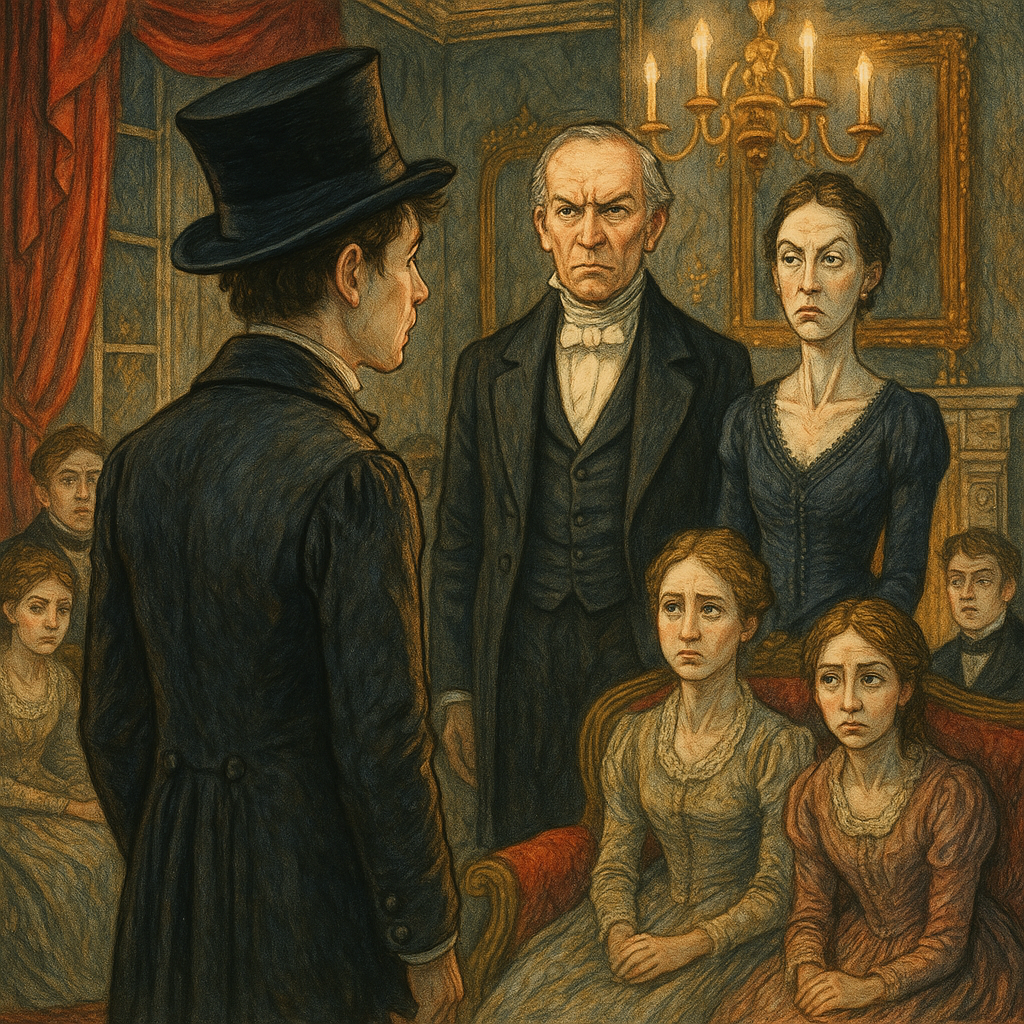
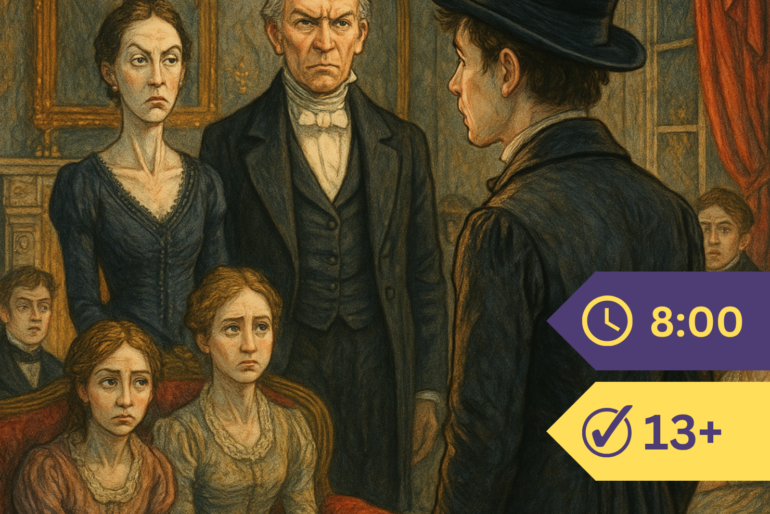
In spite of lustres and lamps and mirrors and curtains and sofas and ottomans and a roaring fire in the grate, there was a cold, icy chill ripping every look, and a cramp in every movement of every soul in the room.
Mr. Tipton, a magnificent man in a stiff white cravat, advanced in a stately manner with eyebrows raised in a way that expressed quite distinctly: What the deuce brought you here? Mrs. Tipton, a thin lady with a general air of hunger, reared herself bolt upright, if possible, and repeated the look. The poor Miss Tiptons shrank into their shoes and seemed to grow visibly chillier; and even Tom’s friend Fred, who passed for “a devilish good fellow,” seemed to have lost all his natural warmth under the influence of this family vault of a drawing-room.
Tom couldn’t make his heart up to tell the truth, so he stammered something about “a late call.” He had got into the house where you ought not to dine on a Christmas Day — the house where they make a duty of every pleasure, and among other painful duties duly observe the tradition of a family dinner at Christmas. Not that it isn’t a fine custom when the family feels warmly and the gathering glows. But here it was the magnificent Mr. Tipton, whose selfishness was so much narrower than most men’s that it seemed hardly to extend even to his family; and frozen Mrs. Tipton, who never betrayed by a spark in her eye the presence of any warmth whatever in her heart; the poor girls, who between their father’s magnificence and their mother’s chill had subsided into dreary social machines; the son, who felt papa, mamma, sisters, and family party “a confounded bore,” as he didn’t scruple to tell Tom Smithers when they got five minutes’ private conversation.
There was also an elderly aunt with expectations — who, being of the same kidney as the Tiptons themselves, knew perfectly well that they had those expectations, and was perpetually letting them know that she knew it. A deaf uncle who was a rival for the rich aunt’s will. And two poor relations, for whom Tom’s heart bled — a pathetic young girl, and a sort of decayed, mangy-looking man of indescribable age, one of the men who are always shifting from one agency to another and have drifted out of “a snug little bottle-ale business” into “a fine opening in the coal trade, on commission.”
Tom didn’t envy them their family party — though he heard a good many pointed hints given while he was there about “the great pleasure it was to Mr. Tipton to meet them as members of the family, and so on” — which they meekly and uncomfortably acknowledged.
There was no move to ask Tom to dinner, and he felt grateful for it before he had been there ten minutes. He tried to converse, to sentimentalize, to argue, to rattle — it was all in vain. Every subject dropped dead as soon as it was started; ideas could not live in that atmosphere — it was too grand and genteel for anything.
At last, driven to desperation, Tom sprang up; and just as the gentleman in black opened the door to announce “Dinner,” Tom made a bolt and escaped from the numbing, freezing house into the less numbing, freezing cold without, leaving the Tiptons equally scandalised by his unseasonable entrance and abrupt departure.
As he hurried past the Reddies’, on his way back to his chambers, Tom cast a disconsolate glance up at the house. Could it be? There was light in the kitchen — and light in the drawing-room! Huzza! “They are at home!” He knew them of old — the best people alive — and their house as a house where truth and kindliness reigned, where a hearty welcome waited without ostentation, warmed by the best of all Christmas fires: the warmth of honest, loving hearts.
Before the chill of the Tiptons had quite thawed from him, Tom Smithers was shaking hands with a bluff and genial host and a bright-eyed, cordial hostess, in the house where you ought to dine on a Christmas Day.