This is a story of three Christmas trees. The first was a real one, but the child we speak of did not see it. He saw the other two, but they were not real — they existed only in his fancy. The plot is very simple; and as this has been said so early, those who find it unpromising may lay the book down in good time.
Probably every child who reads this has seen a Christmas tree or more; but in the small town of a distant colony where our story is set, that could not once have been said. Christmas trees were by no means so universal, even in England, as they are now — and in this little colonial town they were quite unknown. Unknown, that is, until the Governor’s wife gave her first great children’s party. At which point we will begin.
The Governor had given a great many parties in his time. He had entertained high officials and minor ones, visiting soldiers and local grandees. Everyone with the remotest claim on his hospitality had been attended to; the ladies had had their full share of balls and pleasure parties. Only one part of the population had any complaint — but it was a large part: the children. He was a bachelor, and knew little about little boys and girls; let us pity rather than blame him. At last he took a wife, and among the many advantages of this important step was a proper recognition of the claims of the town’s youngest citizens. It was towards happy Christmastide that “the Governor’s amiable and admired lady” (as the local newspaper styled her) sent out the invitations for her first children’s party. At the top of the notepaper was a very red robin carrying a blue Christmas greeting in his beak, and at the bottom — written in the aide-de-camp’s best flourish — were the magic words: A Christmas Tree. The handwriting, though handsome, was rather difficult to read. But most of the children managed to make it out, and those who couldn’t were not slow to learn the news by word of mouth. There was to be a Christmas tree! Like a birthday party, but better — there would be presents for everyone.
One of the invited children lived in a little white house with a spruce fir before the door. The spruce fir was a useful landmark, for it was by no means easy to find any given house in this little town, especially a small white one in one of the back streets. Most of the houses were small, most were painted white, and the back streets ran parallel to one another with no names, all so alike that strangers were constantly confused. If you had asked the way to a friend’s house, you might have been told: “Go straight forward and take the first turning to the left. You’ll find four streets running at right angles, each with a big old pine tree. Take the last street but one, and the fifth white house is the one you want — it has green blinds and a garden with roses.” Even with directions like these you would probably have found the house only partly by design and partly by accident.
Some neighbours maintained that the little white house had a name; that all the houses and streets had names, only they were traditional and unrecorded, and very few people knew them and nobody used them. The name of the little white house was said to be Trafalgar Villa, which seemed so inappropriate for the modest, peaceful little home that the man who lived in it tried to discover why it had been so called. He thought his predecessor must have been in the navy, until he found that he had been a draper. At last someone suggested that as there was a public-house called the Duke of Wellington at the corner of the street, there had probably been a nearby one called The Nelson, which had burned down, and that the man who built The Nelson had also built the house with the spruce fir — and so the name had arisen. An explanation just plausible enough, since public-houses and fires were both common occurrences in those parts.
But none of this has much to do with the story. The child we speak of lived in the little white house with the spruce fir just in front of it.
Of all the children who looked forward to the Christmas tree, he looked forward to it the most intensely. He was an imaginative child, simple and happy, easy to please. His father was an Englishman, and in the long winter evenings he would tell the boy tales of the old country while his mother listened too. Perhaps the parents enjoyed the stories most. To the boy they were new, and therefore delightful; but to the parents they were old — and as regards some stories, that is better still.
“What kind of bird is this on my letter?” the boy asked on the day the invitation arrived. “And oh — what is a Christmas tree?”
“The bird is an English robin,” his father said. “Quite different from what’s called a robin here — smaller and rounder, with a redder breast and bright dark eyes, and it lives and sings at home all through the winter. A Christmas tree is a fir tree — just like the one outside our door — brought into the house and covered with lights and presents. Picture our fir tree lit up with candles on every branch, with dolls and trumpets and bon-bons and drums and toys of all kinds hanging from it like fir-cones, and on the very topmost shoot a figure of a Christmas Angel in white, with a star upon her head.”
“Fancy!” said the boy.
And fancy he did. Every day he looked at the spruce fir and tried to imagine it laden with presents, brilliant with candles — and thought how wonderful that old country must be, Home, as it was called even by those who had never seen it, where the robins were so very red and where at Christmas the fir trees were hung with toys instead of cones.
It was certainly a pity that, two days before the party, an original idea about snowmen struck one of the children who played together in the back streets with their sleds and snowshoes. The idea was this: instead of an ordinary snowman, whose legs had to be mere stumps for fear of toppling, and who could do nothing but stand at the corner of the street staring with pebble eyes until he melted or was knocked apart — instead of that, they would have a real, live snowman who would walk about on proper legs, to the astonishment and (happy thought!) perhaps the alarm of passers-by. The novelty would be achieved by piling snow on one of the boys until he looked as much like a snowman as circumstances allowed.
At first everyone wanted to be the snowman, but when it came to the point it was found to be far duller to stand still and be covered up than to run about and heap the snow — and no one was willing to take the part. At last it fell to the little boy from the Fir House. He was somewhat small, but he was so good-natured that he would always do as he was asked. So he stood manfully still, arms folded over a walking-stick upon his chest, while the others piled the snow upon him. The plan was not as successful as they had hoped. The snow would not stick anywhere except on his shoulders, and when it got into his collar he cried with the cold; but the others were so anxious to carry out their project that they begged him to bear it “just a little longer,” and the boy whose idea it had been wiped the child’s eyes with his handkerchief and declared — with the hopefulness so easy when the suffering is someone else’s — that he “dared say when all the snow was on, he wouldn’t feel it at all.” He did feel it, though, and so severely that the children were obliged to give up the game, take the stick from his stiff little arms, and lead him home.
It appears that with snowmen, as with some other figures in conspicuous positions, it is far easier to find fault than to fill their place.
The result was a feverish cold, and when the day of the party came, the ex-snowman was still in bed. The other children felt the disappointment as keenly as he did, and it greatly dampened the pleasure of the party to think that they had prevented him from sharing in the treat. The most penitent of all was the boy who had invented the snowman scheme. He had generously offered to stay home with the invalid, which was as generously refused; but the following evening he was allowed to come and sit on the bed and describe the party for his friend’s amusement.
He was a quaint boy, this one — with a face as broad as a coin, eyes as bright as a squirrel’s, and mischief lurking all about him, visible even in the folds of his hooded winter coat of blue and scarlet. In his hands he brought the sick child’s present from the tree: a brewer’s dray with two white horses and little barrels that came off and on, and a driver with wooden joints, a cloth coat, blue boots, and earrings — his hair painted in braids, which is clearly the fault of doll manufacturers, who will persist in making them all of the fairer sex.
“And what was the Christmas tree like?” asked the invalid.
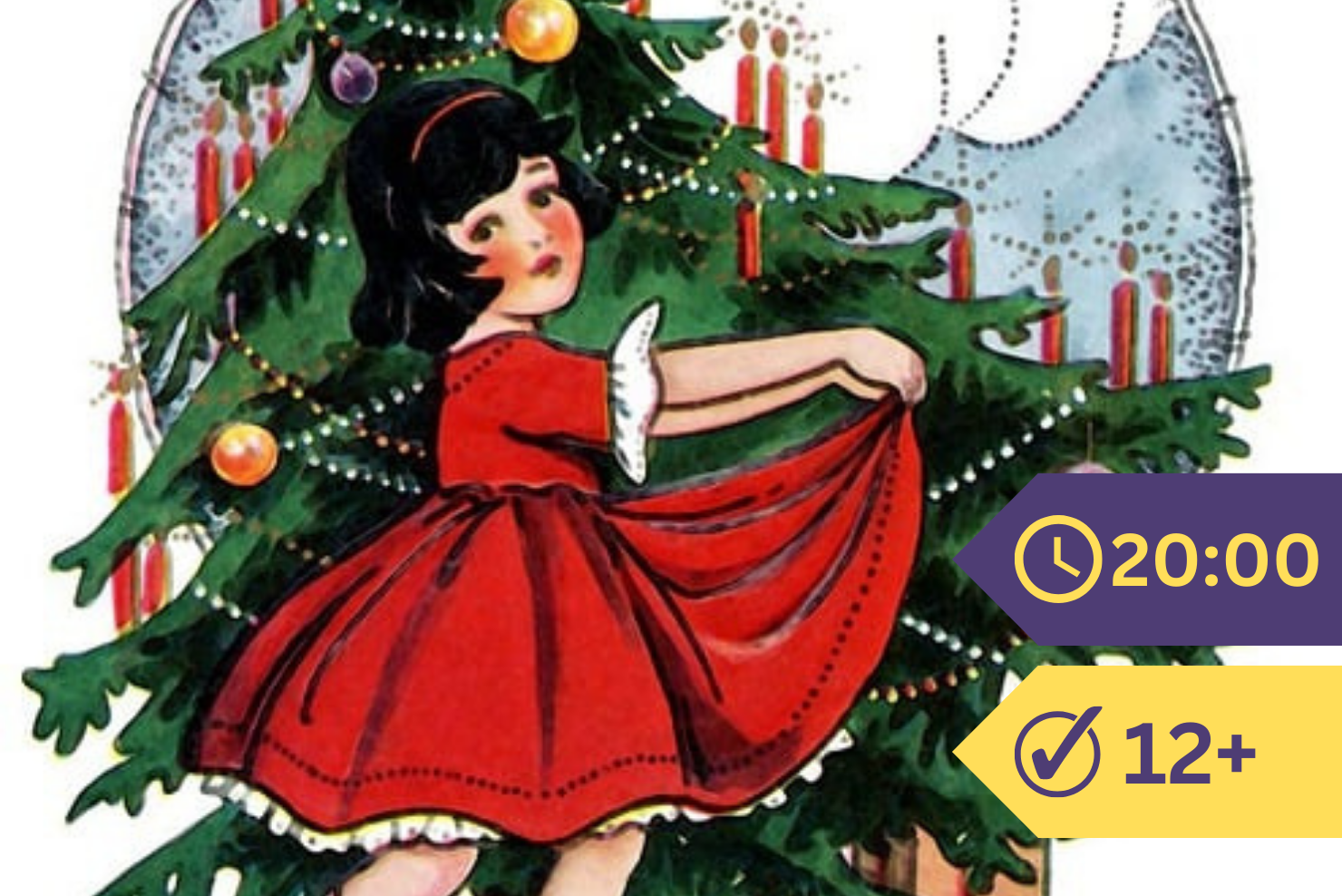
“Exactly like the fir outside your door,” came the reply. “Just about that size, planted in a pot covered with red cloth. It was kept in another room until after tea, and then when the door was opened — it was like a street fire at night, such a blaze of light! Candles everywhere! And on all the branches the most beautiful presents. I got a drum and a penwiper.”
“Was there an angel?” the child asked.
“Oh yes!” said the boy. “It was on the topmost branch, and they gave it to me — and I brought it for you. Because, you know, I am so very, very sorry that I thought of the snowman and made you ill. I do love you, and I beg you to forgive me.”
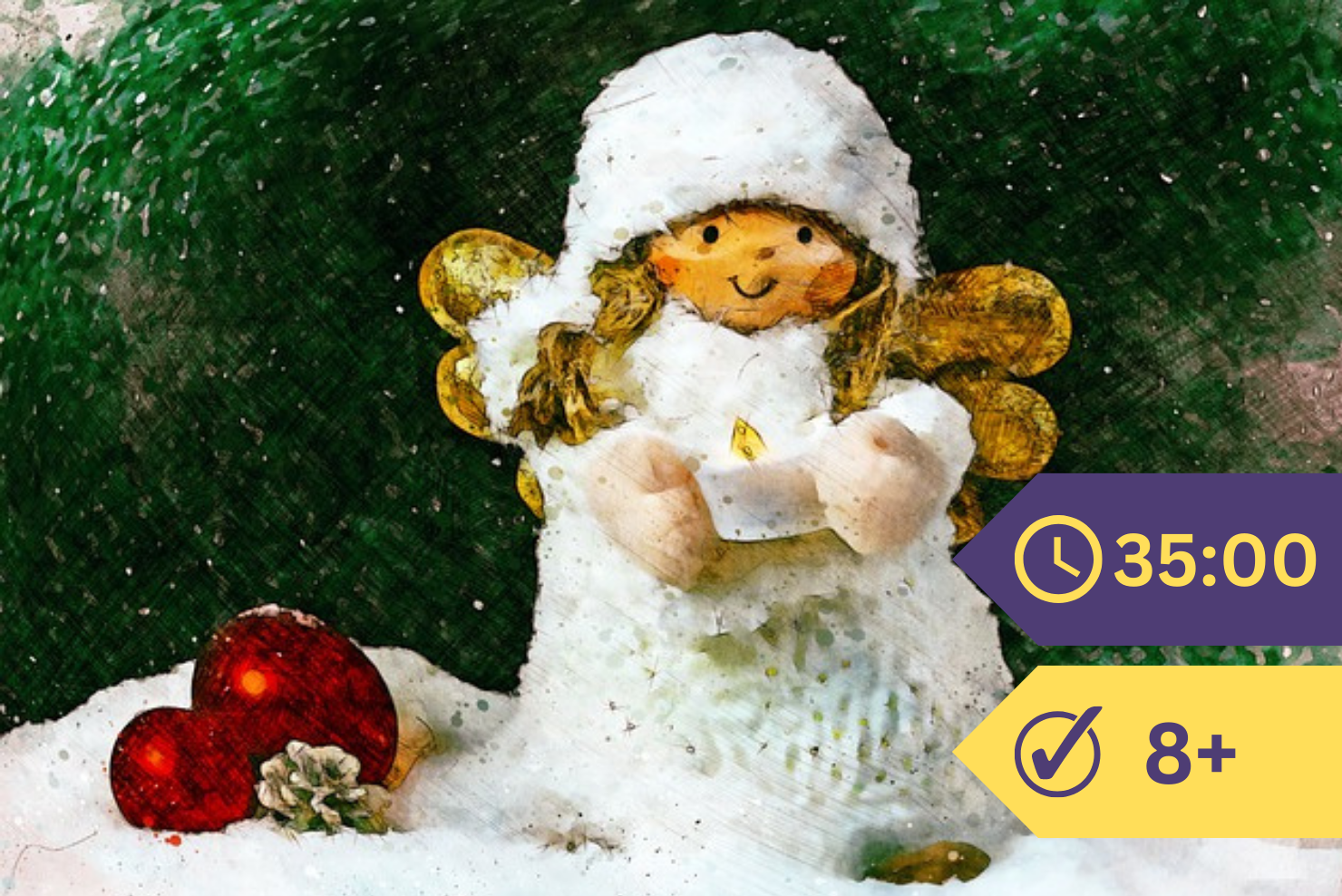
The roguish face stooped over the pillow to be kissed; and out of the pocket of the hooded coat came forth the Christmas Angel. Her face bore a strong family likeness to the wooden drayman, but her feet were hidden in folds of snowy muslin, and on her head glittered a tinsel star.
“How lovely!” said the child. “Father told me about this. I like it best of all. And it is very kind of you — though it isn’t really your fault that I caught cold. I should have liked it if we could have managed it; but I think to enjoy being a snowman, one ought to be snow all the way through.”
They had tea together, and then the invalid was tucked up for the night. The dray was put away in the cupboard, but he took the angel to bed with him.
And so ended the first of the three Christmas trees.
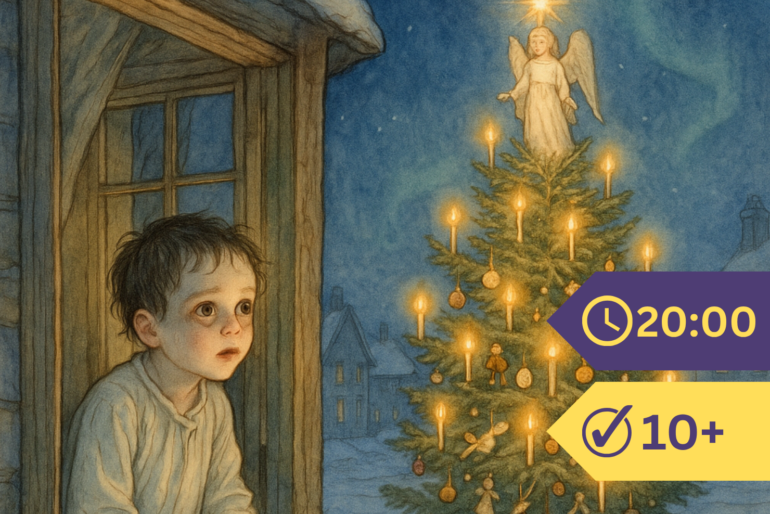
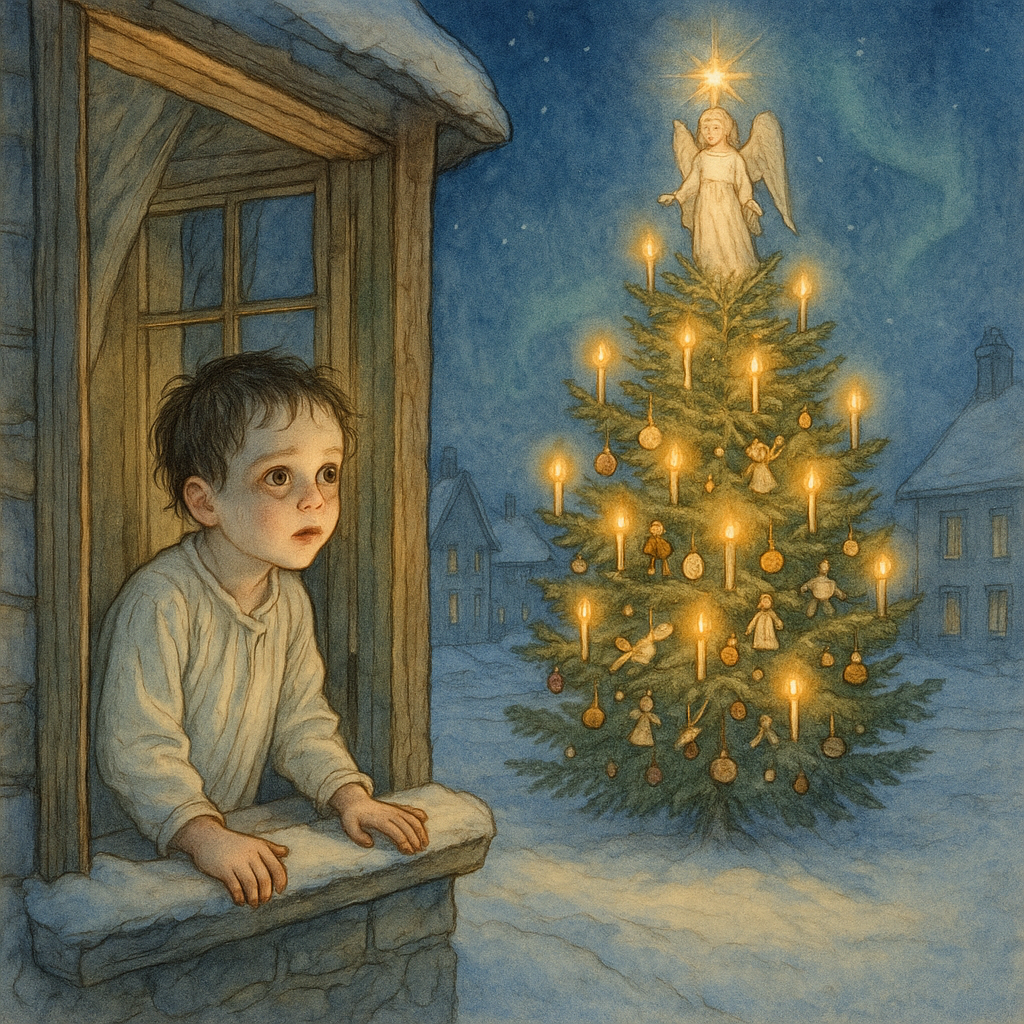
Except for a warm glow from the woodstove, the room was dark. But about midnight it seemed to the child that a sudden blaze of light filled the chamber. At the same moment the window curtains were drawn aside, and he saw that the spruce fir had come close up to the panes and was peeping in. How beautiful it looked! It had become a Christmas tree. Lit candles shone from every familiar branch, toys of the most fascinating kinds hung like fruit, and on the topmost shoot stood the Christmas Angel. He tried to count the candles, but somehow it was impossible — when he looked at them they seemed to change places, to move, to become like the angel, and then to be candles again, while the flames nodded to each other and repeated the blue greeting of the robin: A Merry Christmas and a Happy New Year! He tried to make out the presents, but beautiful as they looked he could not quite discover what any of them were, or choose which he would have. Only the Angel he could see clearly — so clearly! She was more beautiful than the doll under his pillow. She had a lovely face like his own mother’s, he thought, and on her head gleamed a star far brighter than tinsel. Her white robes waved with the flames of the candles, and she stretched her arms toward him with a smile.
I am to go and choose my present, thought the child — and he called out: “Mother! Mother dear! Please open the window.”
But his mother did not answer. So he thought he must get up himself, and with an effort he struggled out of bed.
When he was on his feet, everything had changed. Only the firelight shone on the walls, and the curtains were once more firmly closed. It had been a dream — but so vivid that in his feverish state he still believed it must be true, and he dragged the curtains back to find the glorious sight again. The firelight showed only a thick coating of frost on the panes. With all his strength he pushed the window open and leaned out into the night.
The spruce fir stood in its old place — but it was beautiful in its Christmas dress. Beneath it lay a carpet of pure white. Snow was clustered in exquisite shapes on its feathery branches, wrapping the treetop and its little cross-shoots like a white robe around a figure with outstretched arms.
There were no candles to be seen, but the northern lights shot up into the dark blue sky, and just over the fir tree shone a bright, bright star.
“Jupiter looks well tonight,” said the old professor in the town observatory, adjusting his telescope — but to the child it seemed the star of the Christmas Angel.
His mother had heard him call and came to put him back to bed. And so ended the second of the three Christmas trees.
It was enough to have killed him, all his friends said afterward — but it did not. He lived to be a man, and, what is rarer, he kept the faith, the simplicity, the tenderness, the vivid fancy of his childhood. He lived to see many Christmas trees “at home,” in that old country where the robins have red breasts and sing through the winter. There a heart as good and gentle as his own became one with his; and once he brought his young wife across the sea to visit the place where he was born. They stood near the little white house and he told her the story of the Christmas trees.
“This was when I was a child,” he added.
“But that you still are,” said she — and she plucked a sprig of the fir tree and kissed it and carried it away.
He lived to tell the story to his children, and even to his grandchildren; but he was never able to decide which had been the more beautiful — the Christmas tree of his dream, or the spruce fir as it stood in the loveliness of that winter night.
This is told not because it has anything to do with any of the three Christmas trees, but to show that the story is a happy one, as is right and proper — that the hero lived and married and had children and was as prosperous as good people in books should always be.
Of course he died at last. The best and happiest of men must die; and it is only because some stories stop short that every hero is not duly buried before we lay the book down.
When death came for our hero he was an old man. His beloved wife, some of his children, and many of his friends had died before him, and of those he had loved there were fewer to leave than to rejoin. He had had a short illness, with little pain, and was now lying on his deathbed in one of the great towns of the North of England. His youngest son — a clergyman — was with him, along with one or two of his other children, and by the fire sat the doctor.
The doctor had been sitting beside the patient, but now that he could do no more he had moved to the fireside. The medicine bottles had been cleared from the bedside table, which was now spread with a clean linen cloth and set with the silver vessels for the last communion.
The old man had been wandering somewhat during the day. He had talked much of going home to the old country, and in the wide drift of dying thoughts he seemed to mingle memories of childhood with his hopes of what lay beyond. At intervals he was clear and collected — one such moment had been chosen for his last sacrament — and he had fallen asleep with the blessing still in his ears.
He slept so long and so peacefully that his son began to hope there might be a change, and looked toward the doctor, who still sat by the fire with one leg crossed over the other. The doctor’s eyes were on the bed; but at that moment he drew out his watch and looked at it with an air of professional certainty that said plainly: It is only a question of time. Then he recrossed his legs and turned to the fire again. The son understood as clearly as if it had been spoken aloud, and he too turned away and sighed.
As they sat, the bells of a church in the town began to chime for midnight service, for it was Christmas Eve — but they did not wake the dying man. He slept on and on.
The doctor dozed. The son read in the Prayer Book on the table, and one of his sisters read with him. Another, overcome with grief and weariness, slept with her head upon his shoulder. Except for the warm glow of the fire, the room was dark.
Suddenly the old man sat up in bed — and in a strong, clear voice cried with unmistakable joy:
“How beautiful!”
The son gently held back his sisters and asked quietly: “What, dear Father?”
“The Christmas tree!” the old man said in a low, eager voice. “Draw back the curtains.”
They were drawn back — but nothing could be seen. Still the old man gazed as though in rapture.
“Light!” he murmured. “The Angel! The Star!”
Then silence; and then he stretched out his hands and cried passionately:
“The Angel is beckoning to me! Mother! Mother dear! Please open the window.”
The window was thrown open, and all eyes turned involuntarily where the dying man’s were gazing. There was no Christmas tree — no tree at all. But over the rooftops, the morning star shone pure and pale in the dawn of Christmas Day. The night was past; and above the distant hum of the streets, the clear voices of some carol singers carried the words of an old hymn:
While shepherds watched their flocks by night,
All seated on the ground,
The Angel of the Lord came down,
And glory shone around.
When the window was opened, the soul passed; and when they looked back to the bed, the old man had lain down again and, like a child, was smiling in his sleep — his last sleep.
And this was the third Christmas tree.