It was New Year’s Eve at Jack Ralston’s ranch, and the family and guests had gathered around the great open fireplace after a late dinner. The lights were out; the party sat in the flickering warmth of a big pine-log fire that threw quaint shadows in every direction.
Outside, a blizzard had been raging for three days. The wind howled through the mountain peaks, driving the snow before it and piling it in immense drifts against everything in its path. It was bitter cold as it tore through the valley, doing its utmost to bury the house from view — but sheltered as it was by two giant rocks, one on either side, with the mountain at its back, the house sat snug enough in its little hollow.
The weather had kept the men indoors, and they were grumbling about the game they would have bagged if only they could have gotten out. The conversation eventually trailed off into a long pause.
“Say, Jack — it’s some time yet before midnight. Can’t you spin us a yarn?” said Bobby Caruthers at last.
“Well,” said Jack, “I was just thinking of a night very like this one, fifteen years ago, when — if it hadn’t been for the pluck of that little woman yonder — I wouldn’t be here tonight to see the new year come in.”
He gazed fondly at his wife across the fire. She still looked like a young woman in the flickering light, though on one side of her sat her son, a fair young giant, and on the other her daughter, a beautiful girl just coming into womanhood.
“Fill your pipes,” said Jack, “and I’ll tell you the story.”
“Fifteen years ago I wasn’t as prosperous as I am now. I was just starting out ranching — only been here three years — and where this house now stands we had nothing but a small log cabin. Young Jack over there was six years old, and Miss Ruth was a three-year-old toddling around the place.
“The winter had opened badly. Snow came very early and with it bitter cold. We had plenty of fuel, so we kept warm enough. The cabin was in this same spot, and the two big rocks helped break the worst of the wind — but we were completely buried, so that we had to dig a tunnel from the front door out into the open air. The boys and I were kept mighty busy hauling forage out to the cattle.
“About two weeks before Christmas, after a heavy snowfall, I started out with all hands to gather the herd together, build some hay-stacks for the winter, and push through to Dolores to provision up in case we couldn’t get back for a while. I also wanted to get Christmas presents for the children. I told my wife not to worry if I was gone several days.
“Well, it took us over a week just to fix the cattle and get through to Dolores, and several of the boys were badly frostbitten along the way. We were ready to push back in a few days — and then another heavy snowfall came. And another. And another. It seemed to snow without stopping. The days slipped by one by one until Christmas came and went, and there I was, snowed in at Dolores, getting more anxious with every passing hour. I knew the food at home must be running low. And here was Christmas gone, with nothing for the children. I was nearly out of my mind.
“Two days before New Year’s there was a let-up. I made up my mind to push through at any cost. Only one man would come with me — the others flatly refused. They said it would be sure death, that another storm was already coming. We started out anyway on our fifty-mile ride.
“The trails were one succession of immense drifts. We made very slow progress leading the packhorse. After a full day’s riding we had covered only twenty-five miles, and the new storm was already on us — a real snorter. We dug a hole in the snow and lay down for a few hours, but it was so cold we couldn’t sleep more than a few minutes, and we started again before we froze.
“Then the storm hit in earnest. The snow, driven by the fierce wind, cut our faces like needles. The cold seemed to numb every thought. My horse gave out and couldn’t move another step. I let him go and mounted the packhorse. Night came on. The whisky that had been giving us some warmth gave out. We no longer knew where we were, though we thought we couldn’t be many miles from home — if only we were on the right trail.
“My companion’s horse went next. I was stronger than he was, so I put him on my horse and walked along by his side, holding the saddle. We hadn’t gone a mile further when the horse he was on dropped down exhausted.
“I don’t know where I found the strength, but I shouldered the pack myself and we both plunged on. I wouldn’t give in — the thought that they might be starving at home forced me forward. I don’t know how far we walked or in what direction. My one thought was to keep moving.
“The poor fellow beside me was completely gone. He lay down in the snow and begged to be left alone. I dragged him to his feet, and he only begged me again. I grabbed him by the collar and pulled him along, stopping to rest every few minutes. I couldn’t see. I couldn’t feel. I longed myself to lie down in the soft snow and sleep. Then I thought of the faces at home — faces I might never see again. That gave me a few more steps.
“At last I was completely done. I couldn’t go another yard. I felt that death couldn’t be far off. I sank down and cried in sheer helplessness. I don’t know what made me, but I struggled to my feet one more time and called out — again and again — and the storm only mocked me. I sank down once more. I was so sleepy, so tired. The snow was so soft.
“The next thing I remember was whisky being poured down my throat. Then I was being dragged through the snow, and then — I was home.
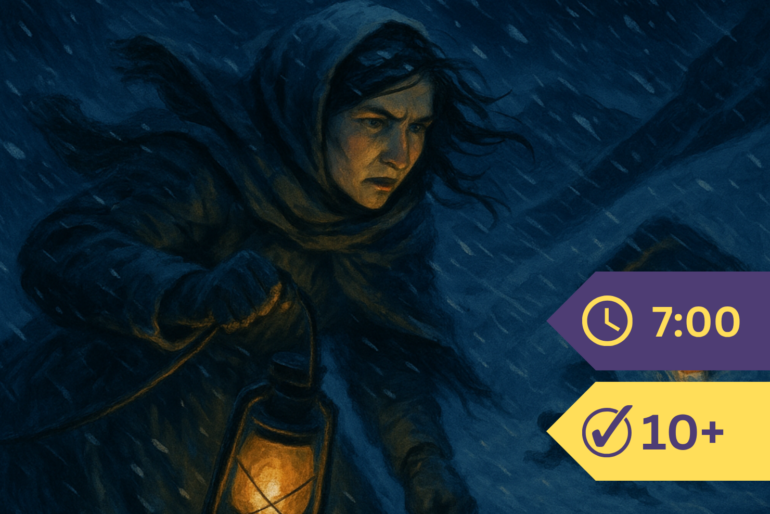
“It turned out that my wife had somehow had a feeling that I was out in that storm. She had been going to the mouth of the tunnel every little while, nearly every night. When I gave up to die I was nearer home than I knew — and she heard my call. She got whisky, found a man to hold a torch so she could find her way back, and plowed through that storm until she reached me. Then she dragged me home by main force.
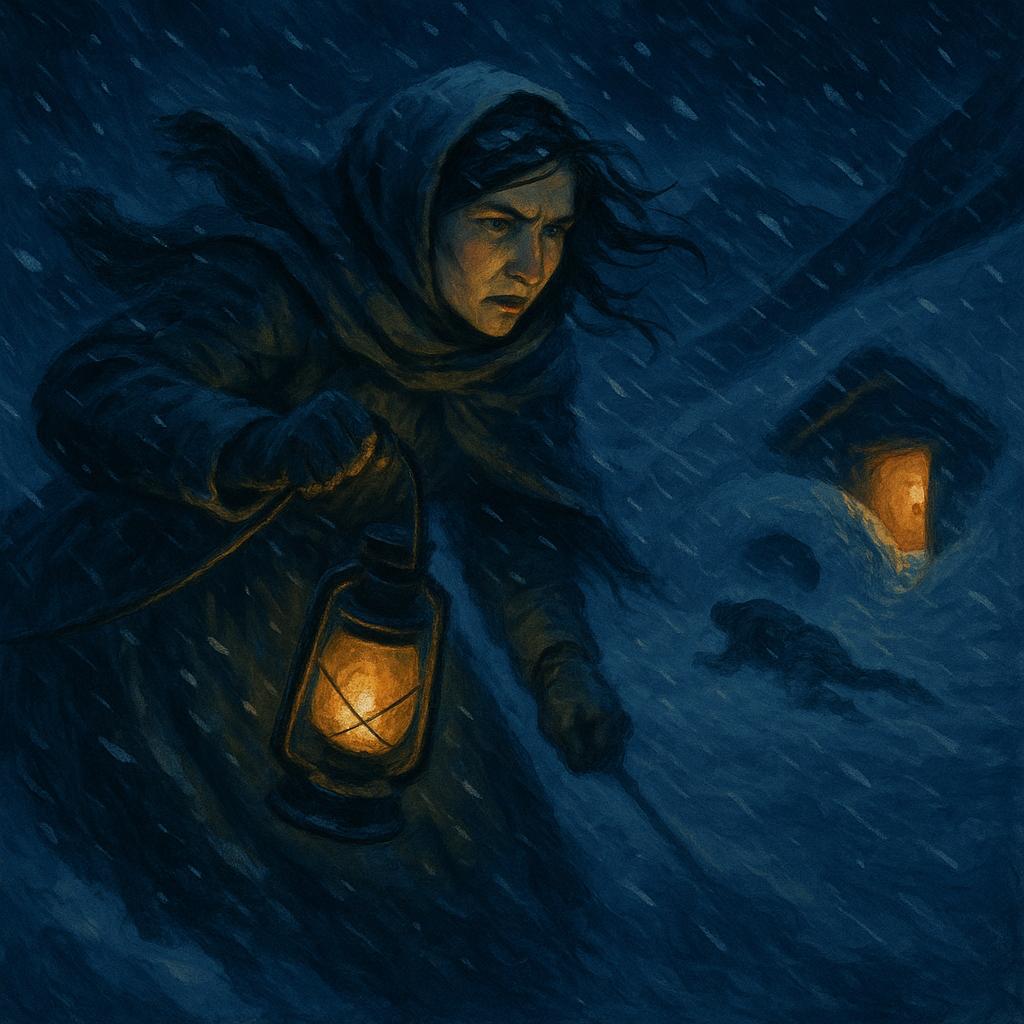
“Not only that — she went back out again and brought in the other poor fellow.
“It was weeks before I got over the effects of that night. But I tell you, boys, it was the happiest New Year I ever had.”
Jack Ralston paused and looked across the fire.
“It’s nearly midnight — so fill up, all of you, and make ready to drink the New Year in when the clock strikes. And I know you’ll join me in one toast: The Heroine of New Year’s Eve — My Little Wife.“
“Let’s have it,” came in a chorus from around the fire.