I.
Everyone ought to be happy at Christmas. But there are many things that ought to be and yet are not, and people are sometimes sad even in the Christmas holidays.
The Captain and his wife were sad, though it was Christmas Eve. Sad, though they were in the prime of life, blessed with good health, devoted to each other and to their children, with comfortable means, a snug house on a small freehold of their own, and — one might say — everything that heart could desire. Sad, though they were good people, whose peace of mind rested on a firmer foundation than earthly goods alone; contented, busy people too. Sad — and in the nursery this was held to be quite past all reason — though the children were at that very moment performing the ancient Christmas mumming play known as “The Peace Egg,” for their parents’ entertainment.
The play was none the worse for the actors being mostly too young to learn parts properly, so there was very little of the rather tedious dialogue, and plenty of bright costumes and ribbons, and of fighting with wooden swords. Robert, the eldest of the five children, looked bonny enough to warm any father’s heart as he marched up and down with an air learned from watching many a parade on the barrack-square. Nicholas did not cry, in spite of falling hard, nor even when Dora — playing the Doctor — accidentally stepped on his little finger while helping him up. Still, the Captain and his wife sighed nearly as often as they smiled, and the mother dropped tears as well as pennies into the cap which Tom, playing the King of Egypt, brought round after the performance.
II.
Many, many years before, the Captain’s wife had been a child herself, and had laughed to see the village mummers act “The Peace Egg,” and had been quite happy on Christmas Eve. Happy, though she had no mother. Happy, though her father was a stern man — very fond of his only child, but with an obstinate will that not even she dared thwart.
She had lived to thwart it, and he had never forgiven her. It was when she married the Captain. The old man had a prejudice against soldiers, which was quite reason enough in his opinion for his daughter to sacrifice her future happiness by giving up the soldier she loved. At last he gave her a choice: the Captain, or his own favour and money. She chose the Captain, and was disowned and disinherited.
The Captain bore a fine character and was a good and clever officer, but that counted for nothing against the old man’s whim. He made a very good husband, too; but even this did not move his father-in-law, who had held no communication with either of them since the day of the marriage and had never laid eyes on his own grandchildren.
Amid the ups and downs of their wandering life — the discomforts of shipboard and colonial postings, unreliable servants and unfamiliar illnesses — the Captain’s tenderness never wavered. If life was rough, the Captain was ready. He had been, at one time or another, sick-nurse, doctor, carpenter, nursemaid and cook to his family, and had, moreover, a firm conviction that nobody filled any of these roles quite so well as himself. His profession kept him neat, well-dressed and active. In the roughest of their ever-changing quarters he was always a smart man, and his manner toward his wife never changed from that of her young days’ lover.
As years passed and children came, the Captain and his wife grew tired of travelling. New scenes were small comfort when news arrived of old friends dying. One patch of the dear, grey, familiar home sky was worth more, after all, than miles of unclouded southern heaven. The grey hills and overgrown lanes of her old home haunted the Captain’s wife day and night, and home-sickness — the weariest of all sicknesses — began to take the light from her eyes before its time. The Captain felt it too. “I should like a resting-place in our own country, however small, before everybody we know is dead,” he would say, fretfully. “But the children’s prospects must be considered.” The continued estrangement from the old man was its own abiding sorrow, and they hoped that if only they could get home, they might persuade him to peace and forgiveness at last.
They were sent home. But the hard old father still would not relent. He returned their letters unopened. This bitter blow made the Captain’s wife so ill she nearly died, and within a single month the Captain’s hair turned iron-grey. He reproached himself for having ever taken the daughter from her father — “to kill her at last,” as he put it. And thinking of his own children, he even reproached himself for having robbed the old widower of his only child. After two years at home, his regiment was ordered abroad again. He could not effect an exchange, and they prepared to move once more — from Chatham to Calcutta. Never before had the packing, so long familiar, felt so bitter a task to the Captain’s wife.
It was at the darkest point of this gloomy time that the Captain came in, waving a letter above his head — a letter that changed all their plans.
Now, close by the old home of the Captain’s wife, there had lived a man considerably older than herself who had loved her with a devotion equal to that of the young Captain. She had never known it. When he saw that she had given her heart to his younger rival, he kept silent, and never sought the advantage he knew he might have had — the old man’s authority in his favour. So generous was the love he could never conquer that he spent his life trying to reconcile her father to his children, and when he died he bequeathed his house and small estate to the woman he had loved.
It will be a legacy of peace, he thought, on his deathbed. The old man cannot hold out when she and her children are constantly before his eyes. And perhaps God will let me know of the reunion I was not permitted to see.
And so it came about that the Captain’s regiment sailed to India without him, and that the Captain’s wife and her father lived on opposite sides of the same road.
III.
The eldest of the Captain’s children was a boy. He was named Robert, after his grandfather, and seemed to have inherited a good measure of the old gentleman’s character, mixed with gentler traits. He was a fair, fine boy — tall and sturdy for his age, with his father’s regular features and (he flattered himself) his father’s firm step and military bearing. He was apt, like his grandfather, to regard his own will as everyone else’s law, and this opinion was devotedly shared by his brother Nicholas. Though the Captain had left the army, Robin continued to command an irregular force of volunteers in the nursery, and no colonel was ever more despotic. His brothers and sisters were infantry, cavalry, engineers and artillery by turns, as his whim dictated.
Only the Captain was a match for his strong-willed son.
“If you please, sir,” said Sarah one morning, bursting in on the Captain just as he was about to leave for the neighbouring town — “if you please, sir, I wish you’d speak to Master Robert. He’s past my managing.”
“I’ve no doubt of that,” thought the Captain, but he said only, “Well, what’s the matter?”
“Night after night I put him to bed,” said Sarah, “and night after night he gets up the moment I’m out of the room and says he’s orderly officer for the evening, and goes about in his nightshirt with his feet as bare as the floorboards.”
The Captain fingered his heavy moustache to hide a smile, but he listened patiently to Sarah’s complaints.
“It isn’t so much him I’d mind, sir,” she went on, “but he goes round all the beds and wakes up the other young gentlemen and Miss Dora, one after another, and when I speak to him he gives me all the cheek he can manage, and says he’s going round the guards. The other night I tried to put him back in his bed, but he got away and ran all over the house with me hunting him everywhere, and not a sign of him anywhere, till he jumps out at me from the garret stairs and nearly knocks me down. ‘I’ve visited the outposts, Sarah,’ says he. ‘All’s well.’ And off he goes to bed, bold as brass.”
“Have you spoken to your mistress?” asked the Captain.
“Yes, sir. And the mistress spoke to him, and he promised not to go round the guards again.”
“Has he broken his promise?” asked the Captain, with a look of anger and also of surprise.
“When I opened the door last night, sir,” continued Sarah, “what should I see in the dark but Master Robert walking up and down with the carpet-brush tucked under his arm. ‘Who goes there?’ says he. ‘You audacious boy!’ says I. ‘Didn’t you promise your ma you’d leave off these tricks?’ ‘I’m not going round the guards,’ says he. ‘I promised not. But I’m on sentry-duty tonight.’ And say what I would, all he had for me was, ‘You mustn’t speak to a sentry on duty.’ So I says, ‘As sure as I live till morning, I’ll go to your pa’ — for he pays no more attention to his ma than to me, nor to any one else.”
“Please see that the bed is taken out of my dressing-room,” said the Captain. “I will attend to Master Robert.”
With this Sarah had to be content, and she went back to the nursery. Robert was nowhere to be seen and made no reply to her summons. The unwary nursemaid accordingly went into the bedroom to look for him — whereupon Robert, who was hidden under a table, darted out and promptly locked her in.
“You’re under arrest!” he shouted through the keyhole.
“Let me out!” shrieked Sarah.
“I’ll send a file of the guard to bring you to the orderly-room,” said Robert, “for preferring frivolous complaints.” And he departed to the farmyard to look at the ducks.
That night, when Robert went up to bed, the Captain quietly locked him into his dressing-room, from which the bed had been removed.
“You’re on sentry-duty tonight,” said the Captain. “The carpet-brush is in the corner. Good-evening.”
As his father had anticipated, Robert was soon tired of the sentry game under these new conditions, and long before the night was half gone he wished himself safely undressed and in his own comfortable bed. At half-past twelve he felt he could bear it no longer and knocked at the Captain’s door.
“Who goes there?” said the Captain.
“Mayn’t I go to bed, please?” came the small, miserable voice of poor Robert.
“Certainly not,” said the Captain. “You’re on duty.”
And on duty poor Robert had to remain, for the Captain had a will quite as firm as his son’s. So Robert wrapped himself in his father’s travelling rug and slept on the floor.
The next night he was very glad to go quietly to bed, and stay there.
IV.
The Captain’s children sat at breakfast in a large, bright nursery — the room where the old bachelor had died, and which the children now filled with cheerful noise, just as he would have wished.
All five of them sat round the table, with five bowls of bread-and-milk steaming before them. Sarah was waiting on them, and beside the table sat Shadow, the black retriever, his long curly back swaying slightly with the effort of keeping himself upright, his grave hazel eyes fixed with intense attention on each breakfast bowl in turn. He was as silent and sensible as Sarah was talkative and empty-headed. Though large, he was unassuming. Pax, the pug, on the other hand — who came up to the first joint of Shadow’s leg — stood defiantly on his dignity and his short stumps. He always planted himself in front of the bigger dog, made a point of hustling him in doorways and insisted on going first down the stairs.
Robert’s tongue was seldom idle, even at meals. “Sarah, who is that tall old gentleman at church, in the seat near the pulpit?” he asked. “He wears a cloak like what the Blues wear, only all blue, and he’s tall enough for a Life-guardsman. He stood when everyone else was kneeling and said ‘Almighty and most merciful Father’ louder than anybody.”
Sarah knew perfectly well who the old gentleman was. She also knew that the children did not know, and that their parents had not yet seen fit to tell them. But she had a passion for telling and hearing news, and would rather gossip with a child than not gossip at all. “Never you mind, Master Robin,” she said, nodding wisely. “Little boys aren’t to know everything.”
“Ah, then you don’t know either,” replied Robert. “If you did, you’d tell.”
“I do,” said Sarah.
“You don’t,” said Robin.
“Your ma has forbidden you to contradict, Master Robin,” said Sarah, “and if you do I shall tell her. I know well enough who the old gentleman is, and I might tell you — only you’d go straight off and tell again.”
“No I wouldn’t! I can keep a secret, I really can!” Robin shouted, dancing round her and catching at her skirts. “Pinch my little finger and try me! Do tell me, Sarah, there’s a dear — and then I’ll know you do know.”
Keeping a secret was quite beyond Sarah’s powers.
“Do let my dress alone, Master Robin — you’re pulling out all the gathers,” she said. “Now listen while I whisper. As sure as you’re a living boy, that gentleman is your own grandpapa.”
Robin let go of Sarah’s dress. His arms fell to his sides and he stood with his brows knit for several minutes, thinking hard. Then he said, emphatically: “What stories you do tell, Sarah.”
“Oh, Robin!” cried Nicholas, who had pressed close, his thick curls bristling with curiosity. “Mamma said that wasn’t a proper word to use, and you promised not to say it again.”
“I forgot,” said Robin. “I didn’t mean to break my promise. But she does tell — ahem — you know what.”
“You wicked boy!” cried the enraged Sarah. “How dare you say such a thing, and everyone in the place knows he’s your ma’s own father.”
“I’ll go and ask her,” said Robin, and he was at the door in an instant — but Sarah, alarmed at the thought of getting into trouble herself, caught him by the arm.
“Don’t go, love. It’ll only upset your ma. It was all just my nonsense.”
“Then it isn’t true?” said Robin, indignantly. “Then why did you tell me so?”
“It was all my jokes and silliness,” said the unscrupulous Sarah. “And your ma wouldn’t like to know I’d said such a thing. Master Robert wouldn’t be so mean as to tell tales, would he, love?”
“I’m not mean,” said Robin stoutly, “and I don’t tell tales — though you do, and you tell you-know-what besides. Still, I won’t go this time. But I’ll tell you what: if you tell tales about me to Papa any more, I’ll tell him what you said about the old gentleman in the blue cloak.” With which parting shot Robin strode off to rejoin his brothers and sisters.
V.
After leaving the nursery, Robin wandered outside and peered through the gate at the end of the drive. A party of boys was going through what looked like a military exercise with sticks, with a good deal of stamping — but instead of mere words of command, they all spoke in turn, as if in a play. Being not at all shy, he joined them and asked so many questions that he quickly learned all about it. They were rehearsing a Christmas mumming-play called “The Peace Egg.” Why it was called that they could not tell him, since there was nothing whatever about eggs in it, and far from being a play of peace, it was a series of battles between various valiant knights and princes. When the rehearsal ended, Robin went with the boys to the sexton’s house — the sexton being the father of the boy who played the King of Egypt — where they showed him the costumes: bright-coloured fabrics covered with ribbons, all except the one for the “Black Prince of Paradine,” which was black, as suited his title. They showed him the play-book as well, which could be bought at the post-office store.
“So you’re the mummers who come round at Christmas and act in people’s kitchens, and people give them money — the ones Mamma used to tell us about?” said Robin.
The boy hesitated, then said, “Well, I suppose we are.”
“And you go out in the snow from one house to another at night — don’t you love it?” cried Robin.
“We like it well enough,” the lad admitted.
Robin bought a copy of “The Peace Egg.” He was determined to put on a nursery performance and to take the main part himself. The others were willing enough, but there were difficulties. The play had eight characters, and there were only five children. They decided among themselves to leave out the Fool, and Mamma said that another character was not to be acted by any of them, or even mentioned — “the little one who comes in at the end,” Robin explained. Mamma had her reasons, and they were always good ones. She had not been entirely pleased that Robin had bought the play at all. It was a very old thing, she said, and rather strange — not really suited for children. If Mamma thought some of the parts not quite right for the children to learn, the children found them far too long; so in the end she chose passages for each of them that were easy to learn, and which, with a great deal of fighting, told the story quite as well. Whatever was lost was more than made up for by the costumes, which were splendid.
Robin was St. George, Nicholas the Valiant Slasher, Dora the Doctor, and the other two played Hector and the King of Egypt. “And now we’ve no Black Prince!” cried Robin in dismay.
“Let Shadow be the Black Prince,” said Nicholas. “When you wave your sword he’ll jump for it, and then you can pretend to fight with him.”
“It’s not a sword, it’s a stick,” said Robin. “But yes — Shadow can be the Black Prince.”
“And what’s Pax to be?” asked Dora. “Because you know he’ll come if Shadow does, and he’ll run in ahead of everyone else besides.”
“Then he must be the Fool,” said Robin, “and that will do perfectly well, because the Fool enters first — and Pax can wear his little red coat and the collar with the bells.”
VI.
Robin thought Christmas would never come. To the Captain and his wife it seemed to be coming too fast. They had hoped it might bring reconciliation with the old man, but it seemed they had hoped in vain.
There were times now when the Captain almost regretted the old bachelor’s bequest. The familiar scenes of her old home only sharpened his wife’s grief. To see her father every Sunday in church — older, a little more frail each week — but with never a look of tenderness for his only child: this wore on her sorely.
She suffered less when we were abroad, the Captain thought. A home that breaks her heart is after all no great gift.
Christmas Eve came.
“I think it’s quite Christmas enough now,” said Robin. “We’ll do ‘The Peace Egg’ tonight.”
And so, as the Captain and his wife sat quietly and sadly by the fire, the door opened and Pax trotted in, shaking his bells, followed by the nursery mummers in full costume. The performance was a great success. It was not by any means designed to be touching — yet, as has been said, the Captain’s wife shed tears.
“What’s wrong, Mamma?” said Robert, dropping his wooden sword at once and running to her side.
“Don’t pester Mamma with questions,” said the Captain. “She’s not very well and rather sad. We must all be very kind and good to poor dear Mamma.” And he lifted her hand to his lips as he spoke. Robin seized the other hand and kissed it tenderly — he was deeply fond of his mother. At that precise moment, Pax took a short run, jumped up onto Mamma’s lap, sat there facing the company, opened his black mouth wide, and yawned with a perfectly timed absurdity worthy of any professional clown. Everyone burst out laughing.
“And now we’ll go and act in the kitchen,” said Nicholas.
“Supper at nine o’clock, mind!” called the Captain. “And we’re having real frumenty and Yule cakes — just like the ones Mamma used to tell us about when we were abroad.”
“Hurray!” shouted the mummers, and they ran off, Pax leaping from his place just in time to hustle the Black Prince in the doorway.
When the dining-room door was shut, Robert raised his hand. “Hush!”
The mummers listened. There was only a distant harsh scraping sound, as of stone being rubbed.
“They’re cleaning the passages,” Robert said. “Sarah told me they meant to finish the mistletoe and have everything done by supper-time. They don’t want us, I know. Look here — we’ll go real mumming instead. That will be fun!”
Nicholas grinned with delight.
“But will Mamma let us?” he asked.
“It’ll be all right as long as we’re back by supper-time,” said Robert quickly. “Only we must make sure not to catch cold. Come and help me find some wraps.”
The old oak chest of spare shawls, rugs and coats was soon ransacked, and the mummers’ bright costumes hidden under a motley assortment of wrappings. But the moment Shadow and Pax caught sight of the coats, they began to leap and bark, as was their invariable habit whenever they saw anyone dressing to go out. Robin was terrified this would give them away — but though the Captain and his wife heard the barking, they did not guess the cause.
The front door was opened very quietly and closed very softly, and the nursery mummers slipped away into the night.
VII.
It was a beautiful night. The snow on the drive was well-trodden and firm underfoot, but on the trees and shrubs it lay soft and white. The children’s breath rose in little clouds and their costumes glittered in the frosty air.
“It’s much better being out at night than in the daytime,” said Robin.
“Much,” agreed Nicholas, with deep feeling.
“We’ll go wassailing next week,” said Robin. “I know all about it, and perhaps we’ll collect enough money to buy proper tin swords with scabbards for next year. I don’t like these sticks. Oh, I do wish it wasn’t so long between one Christmas and the next.”
When they turned onto the high road, Nicholas asked, “Where shall we go first?”
Robin looked around. There was a gate at the end of the drive opposite — a larger house than theirs, dark-windowed and substantial. “This one,” he said. “We’ll act here.” And they all pressed through the gate as quickly as possible. Once safe inside the grounds, they shouldered their sticks and marched with great composure.
“You’re heading for the front door,” said Nicholas. “Mummers ought to go to the back.”
“We don’t know where it is,” said Robin, and he rang the front-door bell.
There was a long pause. Then lights appeared, steps approached, and at last came the sound of much unbarring, unbolting and unlocking — it might have been a prison. The door was opened by an elderly, timid-looking woman who held a tallow candle above her head.
“Who’s there?” she said. “At this hour of night?”
“We’re Christmas mummers,” said Robin stoutly. “We didn’t know the way to the back door, but—”
“And don’t you know better than to come here?” said the woman. “Be off with you, as fast as you can.”
“You’re only the servant,” said Robin. “Go and ask your master and mistress whether they’d like to see us perform. We do it very well.”
“You impudent boy, be off!” the woman repeated. “The master would no more let you or any other such—”
“Woman!” A voice directly behind her made her jump as if she had been shot. “Who gave you authority to say what your master will or will not do before you have asked him? The boy is right. You are the servant, and it is not your place to choose on my behalf whom I shall or shall not see.”
“I meant no harm, sir, I’m sure,” said the housekeeper, “but I thought you’d never—”
“My good woman,” said her master, “if I had wanted someone to think for me, you are the last person I should have engaged. I employ you to follow orders, not to think.”
“I’m sure, sir,” said the housekeeper — whose only form of argument was repetition — “I never thought you would have seen them—”
“Then you were wrong,” her master said sharply. “I will see them. Bring them in.”
He was a tall, gaunt old man, and Robin stared at him for some moments, puzzling over where he had seen someone very like him. Then he remembered. It was the old gentleman of the blue cloak.
The children threw off their wraps, the housekeeper helping them while chattering ceaselessly from sheer nerves. “Well, to be sure,” she said, “their costumes are lovely. And they seem quite a better sort of children — quite well-spoken. I might have known they weren’t like common mummers, but I was so flustered by the bell going so late, and—”
“Are they ready?” said the old man, who had stood like a statue in the dim flickering light of the candle, grimly watching proceedings.
“Yes, sir. Shall I take them to the kitchen, sir?”
“For you and the other idlers to gape and gossip at? No. Bring them to the library.” And he stalked off, leading the way.
The housekeeper led them to the library and then withdrew — nearly falling on her face as she left the room by tripping over Shadow, who had slipped in last like a black shadow.
The old man settled himself in a carved oak chair by the fire.
“I didn’t say the dogs were to come in,” he said.
“But we can’t do without them, please,” said Robin boldly. “You see, there are eight parts in ‘The Peace Egg,’ and there are only five of us — so Shadow has to be the Black Prince, and Pax has to be the Fool. We really must have them.”
“Five and two make seven,” said the old man, with a grim smile. “What do you do for the eighth?”
“Oh, that’s the little one who comes at the end,” said Robin cheerfully. “Mamma said we weren’t to mention him — but I think that’s because we’re children. You’re grown-up, so I’ll show you the book and you can judge for yourself.” He pulled “The Peace Egg” from his pocket. “There — that’s the picture of him on the last page. Black, with horns and a tail.”
The old man’s stern face relaxed into a broad smile as he examined the grotesque little woodcut — but when he turned to the first page, the smile vanished. His eyes blazed. He had seen Robin’s name.
“Who sent you here?” he asked, in a low, strained voice. “Speak the truth. Did your mother send you?”
Robin thought the old man was angry with them for playing truant. He said, carefully, “N-no. She didn’t exactly send us. But I don’t think she’ll mind our having come, as long as we’re back by supper-time. Mamma never forbade us going mumming.”
“I don’t think she ever thought of it,” said Nicholas candidly, swaying his curly head from side to side.
“She knows we’re mummers,” Robin went on, “because she helped us with the costumes. When we were abroad she used to tell us about the mummers who acted at Christmas when she was a little girl — and so we thought we’d be mummers — and so we acted for Papa and Mamma — and so we thought we’d act for the maids, but they were cleaning the passages — and so we thought we’d really go mumming. And we’ve got several more houses to visit before supper-time, so we’d better begin, I think.” And without further ceremony he began to march round the room, raising his sword — and the performance got underway quite as creditably as before.
As the children acted, the old man’s anger drained away. He watched them with an interest he could not suppress. When Nicholas took several hard whacks from Robert without flinching, the old man actually clapped his hands. He declared, after that, that he would not have had the dogs excluded for anything.
It was right at the end, when they were all marching in a ring holding each other’s swords raised “over the shoulder” and singing “A-mumming we will go” — that Nicholas suddenly brought the whole circle to a halt by stopping dead and staring up at the wall.
“What are you stopping for?” demanded Robert, spinning round indignantly.
“Look there!” said Nicholas, pointing to a small painting that hung just above the old man’s head.
Robin looked. Then he said abruptly: “It’s Dora.”
“Which one is Dora?” asked the old man, in a sharp, strange voice.
“Here she is,” said Robin and Nicholas at once, dragging her forward. “She’s the Doctor — you can’t see her face for her things. Dora, take off your cap and pull that hood back. There! Oh, it is like her!”
It was the portrait of their mother as a child — but of this the nursery mummers knew nothing.
The old man looked — and as Dora’s peaked cap and hood fell away, revealing her face and fair curls, he gave a sharp cry and buried his head in his hands. The boys stood stunned. But Dora went straight to him and put her small hands on his arms with natural, childish sympathy. “Oh, I am so sorry! Have you got a headache? Shall Robin heat the shovel in the fire for you? Mamma has hot shovels for her headaches.” And though the old man did not speak or move, she went on comforting him, stroking his white hair.
At that moment Pax took one of his sudden little runs and jumped up onto the old man’s knee, in his own particular way, and yawned at the company.
The old man was startled. He lifted his face abruptly.
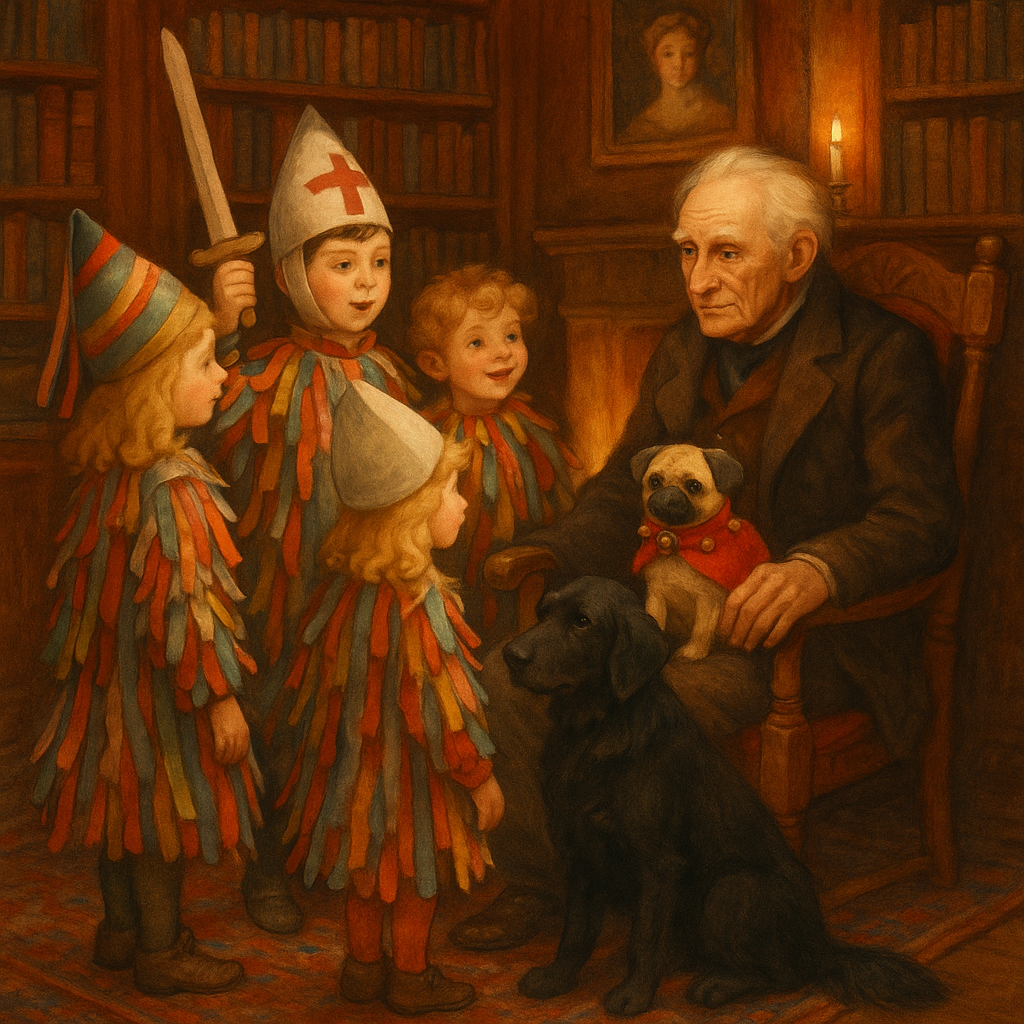
It was wet with tears.
“Why, you’re crying!” exclaimed the children together.
“It’s very strange,” said Robin, frowning. “I can’t understand what’s the matter tonight. Mamma was crying too when we were acting for her, and Papa said we weren’t to pester her with questions, and he kissed her hand, and I kissed her hand too. And Papa said we must all be very good and kind to poor dear Mamma — and I mean to be, because she’s so good. And I think we should go home now, or perhaps she’ll worry,” Robin added.
“She’s so good, is she?” asked the old man. He had set Pax gently off his knee and lifted Dora up instead.
“Oh, isn’t she!” said Nicholas, swaying his curly head from side to side.
“She’s always good,” said Robin firmly. “And so’s Papa. I’m always doing something I oughtn’t to,” he added, slowly. “But then, I don’t pretend to obey Sarah. I don’t care a fig for Sarah. I won’t obey any woman but Mamma.”
“Who is Sarah?” asked the grandfather.
“She’s our nurse,” said Robin, “and she tells — I mustn’t say what she tells — but it isn’t the truth. She told a story about you the other day,” he added.
“About me?”
“She said you were our grandpapa. So I knew she was telling — you know what.”
“How did you know it wasn’t true?” the old man asked.
“Why, obviously,” said Robin, “if you were our Mamma’s father, you’d know her, and be very fond of her, and come to see her. And then you’d be our grandfather, and you’d have us to visit you, and perhaps give us Christmas presents. I wish you were,” Robin added, with a sigh. “It would be very nice.”
“Would you like that?” the old man asked Dora.
And Dora, who was half asleep and very comfortable, put her small arms round his neck exactly as she would put them round her father’s, and said, “Very much.”
He set her down at last, very gently — almost reluctantly — and left the children alone. Presently he returned, dressed in the blue cloak, and picked Dora up again.
“I will see you home,” he said.
VIII.
The children had not been missed. The clock had only just struck nine when there came a knock at the door of the dining-room, where the Captain and his wife still sat by the Yule log. She called “Come in” wearily, expecting the frumenty and the Yule cakes.
But it was her father — with her child in his arms.
The Captain had many friends who knew of the long estrangement between his wife and her father. Some of them were in church the next morning — Christmas Day — when the Captain’s wife came in. They braced themselves and looked away; but a startling sight met the gaze of the whole congregation. The old grandfather was walking into church side by side with the Captain.
“They met in the porch,” whispered one man from behind the shelter of his hat.
“They can hardly make a scene in a place of worship,” said another, going pale.
“She’s gone into his pew!” cried a girl in a sharp whisper.
“And all the children after her,” her sister added, incautiously loud.
There was now no doubt about it. The old man in his blue cloak stood for a moment politely pressing his son-in-law to go first. Then the Captain bowed and passed in, and the grandfather followed.
By the time the service was over, everyone knew of the happy peacemaking, and everyone was glad. One old friend after another pressed forward with blessings and good wishes. This was a proper Christmas at last, they all said. There was rejoicing all round.
But only the grandfather and his grandchildren knew that it had been hatched from “The Peace Egg.”