Driven downwards by the storm that had raged for two days around the lofty red ramparts of the Sierra Roja, the blacktail deer came down in broken bands to seek refuge in the lower foothills. A light tracking snow had fallen there too, and their trails lay fresh for hunters to follow.
Cherokee Sam had been out since first light, long rifle on his shoulder and lean deerhound at his heels. It wasn’t pleasure that sent the gaunt hunter slipping like a shadow through the pine-clad canyons in his hunting moccasins. Meat was needed back at the dirt-roofed cabin in the gulch — and bread too, despite the fact that the stubble poking up through the snow in the bottomland marked where a corn patch had been harvested. He had planted it; other hands had gathered it in.
Mixed like his blood were Cherokee Sam’s occupations, and his sinewy hands swung a pick and shook a gold pan as often as they lifted a rifle. When his company of gold-hunters from the Nacoochee country first struck the Sierra, they’d scattered through it to prospect for placer, and that was when he’d found the gulch. It had never panned out so much as a color, but the wild solitude of the place had struck something deep in the wanderer’s heart. No trail led through the storm-felled tangle of trees, and no foot but his own had ever trodden the grama grass or brushed the wild cypress bending over the stream. Right where the beavers had built their dam, Cherokee Sam had pitched his cabin. From a distance, its mud-daubed exterior might have been taken for a mud palace built by the king beaver himself — but for the thin thread of smoke that slowly melted into the air above it.
In the rich bottomland nearby he had planted a corn patch with a provident eye toward ash-cakes and hearth bread, and in the evenings when he came over the hill after a day’s hunting and saw the cabin with the corn waving green below, he called the spot home.
Then one afternoon, as he sat idly in his open doorway, a little gray burro came picking its way nimbly through the fallen trees. Its rider was a small, dwarfish man of haughty bearing, his cheeks wrinkled and his beard grizzled, but his eyes as piercing and his hair as black as Sam’s own. Seated on his long-eared mount, the man addressed Sam gravely and inquired, in tolerable English, whether he was aware that he was trespassing on the lands of the patrón, who lived at the plaza on the plain below.
“No,” said Cherokee Sam shortly, rising to his full towering height above the little rider. “I don’t know nothing about no patrón.”
Well, then he was sorry to have to tell him, said the Spanish stranger with smooth courtesy. He was the mayordomo — the estate manager — and this was the patrón‘s land, and the coyote who was killing all the deer had best seek some other spot. Far away, too, for the patrón‘s lands stretched far indeed. He swept his willow wand toward the Sierra rising above and the plain rolling away below. In every direction as far as the eye could reach — all of it the patrón‘s, by virtue of a Spanish land grant.
Cherokee Sam laughed in scorn. “I’ve heard of them grants. What good are they? Squatters’ rights and squatters’ rifles rule in this free country, I reckon. Go back to your patrón, little man, and tell him I’ve took up my homestead here, and here I’ll stay.”
As he spoke he raised his rifle across his arm and fixed the burro-rider with a look of black thunder.
He might have done better with a little less defiance. When the corn turned yellow and he came back from one of his periodic prospecting trips to harvest it, he found only bare stubble waiting for him.
And so it was that Cherokee Sam — hunter, prospector, and squatter — now stood at Christmastime without so much as a corn pone, with the lean months of winter still ahead.
He was heading home at sunset with a doe slung across his shoulders, her legs tied over his chest and her head trailing back against the eager hound’s muzzle, when he came out of the timber and paused at the Shut-in. This was a tall upheaved ledge of red sandstone that rose from the slopes on either side and sealed the gulch off from the plain below, leaving only a narrow gap for the stream to pass through.
Above him lay the foothills and his wild snowbound home in the shadow of the Sierra. Below, the snow had not fallen, and the plain glowed brown and warm in the last amber light of the setting sun. There, softened by distance with a saffron shimmer about its dark outlines, lay the gray adobe plaza, sleeping beside a silver thread of river.
Down there were corn and oil, the fat of the land. He would have nothing for Christmas but the deer on his back. A dangerous gleam came into the hunter’s eyes as he thought of his stripped corn patch and stared at the home of his enemy.
As if sharing his mood, the hound raised its hackles and growled. Cherokee Sam looked down — and stopped cold. A small figure stood motionless at the base of the Shut-in, gazing up at him.
It was a boy. He was richly and somewhat fantastically dressed in a silken jacket and silk pantalones buttoned down the outer seams and gathered at the waist with a silk sash. On his feet were buckskin zapatos soled with rawhide and tied with ribbon drawstrings. Over his long dark hair he wore a white sombrero with gay silk tassels — which he removed respectfully as the hunter descended toward him.
“Good evening, Señor Don San Nicolás,” the boy said, fixing him with soft black eyes full of eager confidence. “Tonight is Noche Buena — Christmas Eve — and Padre Luis told me you would pass through the Shut-in on your way to the plaza. So I’ve come to meet you.”
Cherokee Sam was taken completely aback. “I don’t go by no such name,” he replied gruffly. “I’m Cherokee Sam. I live down there.” He gestured toward the dirt-roofed cabin in the gulch.
The boy’s face fell. “I wanted badly to see the saint,” he said, “and I never can when he comes to the plaza — I’m always asleep by then.” He replaced his sombrero with a princely air. “I’m the patroncito, señor.”
Sam’s expression darkened. The young patrón — the son of his enemy — the boy whose father had stripped his corn patch bare. Even now they would be searching for him, and here the child stood, in his power. There was no snow below, and no trail for searchers to follow.
For a long moment the hunter stood weighing something in himself. Then something in the boy’s small upturned face — that open, utterly fearless trust — settled the matter for him.
“What did you do that for?” the patroncito asked, in a tone of quiet authority, laying his hand on the bullet hole behind the doe’s shoulder.
“I had to have meat for my Christmas dinner,” Sam said simply. “Come along with me, and I’ll show you that Spanish Santa Claus you’re hunting for.” He held out his hand.
The patroncito placed his own in it without hesitation. The giant slowed his stride to match the boy’s shorter steps. Then the boy stopped and said, in the tone of one accustomed to being obeyed:
“The snow is deep. Carry me.”
Cherokee Sam had never in his life answered to a master. But now, without a word, he stooped and — like another giant Saint Christopher — lifted the child onto his shoulder and plunged through the drifts toward the cabin.
He hung the doe from a pine in front of the cabin, then pushed open the slab door and breathed the banked embers back to life, stacking on pitch pine until the fireplace blazed. He pulled a couple of deerskins from his sleeping corner and threw them down before the fire, and gestured for the patroncito to sit.
The boy obeyed — and Cherokee Sam, looking at him in the firelight, felt a grim satisfaction. It would be a long time before the patrón saw his son and heir again. But these thoughts were interrupted.
“Would you please take my shoes off, Don Cherokee Sam?” said the patroncito. “My feet are wet and my fingers are too numb to manage the ribbons.”
The hunter knelt and untied the ribbons and drew off the zapatos and then the long silk stockings.
“Muchas gracias, Don,” said the patroncito, settling back to toast his bare toes at the fire.
His fearlessness sat well with his rough host. And his manner — imperious without meaning any harm — struck Cherokee Sam as funny, and he entered into the game with a kind of wry humor.
“If you’ll excuse me, Mister Patroncito, I’ll fix supper.”
He said it as though this required great culinary preparation. What it actually required was cutting three steaks from the doe’s haunch with his sheath knife and laying them with a lump of fat in the frying pan. These he turned and browned. Two tin cups of water completed the meal.
The patroncito took kindly enough to the venison. Then he tasted the water and paused. “I’d thank you for a cup of hot coffee, Don Cherokee Sam — with plenty of sugar, if you please.”
Sam was embarrassed by this polite but impossible request. “Coffee’s bad,” he said, shaking his head. “Spoils my nerves so I can’t hold a steady aim. Water’s best.”
The boy was genuinely polite. He emptied his cup without complaint. But presently he paused again in his work on the venison.
“Pardon me, but you’ve forgotten the bread.”
Sam rose. What could he set before this small lord from the plaza? “Bread’s been mighty scarce with me this winter,” he muttered. “And I planted a good plenty of corn out there, too.”
The memory sharpened his resentment, and he paused.
“Why didn’t you harvest it, then, like the farmhands do?” asked the patroncito pleasantly.
“It was stolen,” Sam muttered — then caught himself, and added in a softer tone, “by bears and such varmints, I reckon.”
With this compromise between anger and truth, he reached up and took down a small sack from the roof beam. It held the few ears he’d gleaned from the stripped field — his seed corn for next spring.
“Patroncito,” he said in a tone of friendly confidence as he shelled an ear into the dry frying pan, “there’s nothing like fresh venison and cold running water and the free air of heaven — and maybe a little parched corn once in a while — to make a man feel like a man.”
Under this encomium the parched corn was eaten with gravity. Supper over, Sam cleaned up — a simple operation that consisted of dashing cold water into the still-hot pan and hanging it on its nail.
“You said you’d show me San Nicolás,” the patroncito then hinted politely.
“It’s early yet,” said Cherokee Sam. “He’s just now taking the trail in the Sierra, and the drifts are deep. But he’ll be here.”
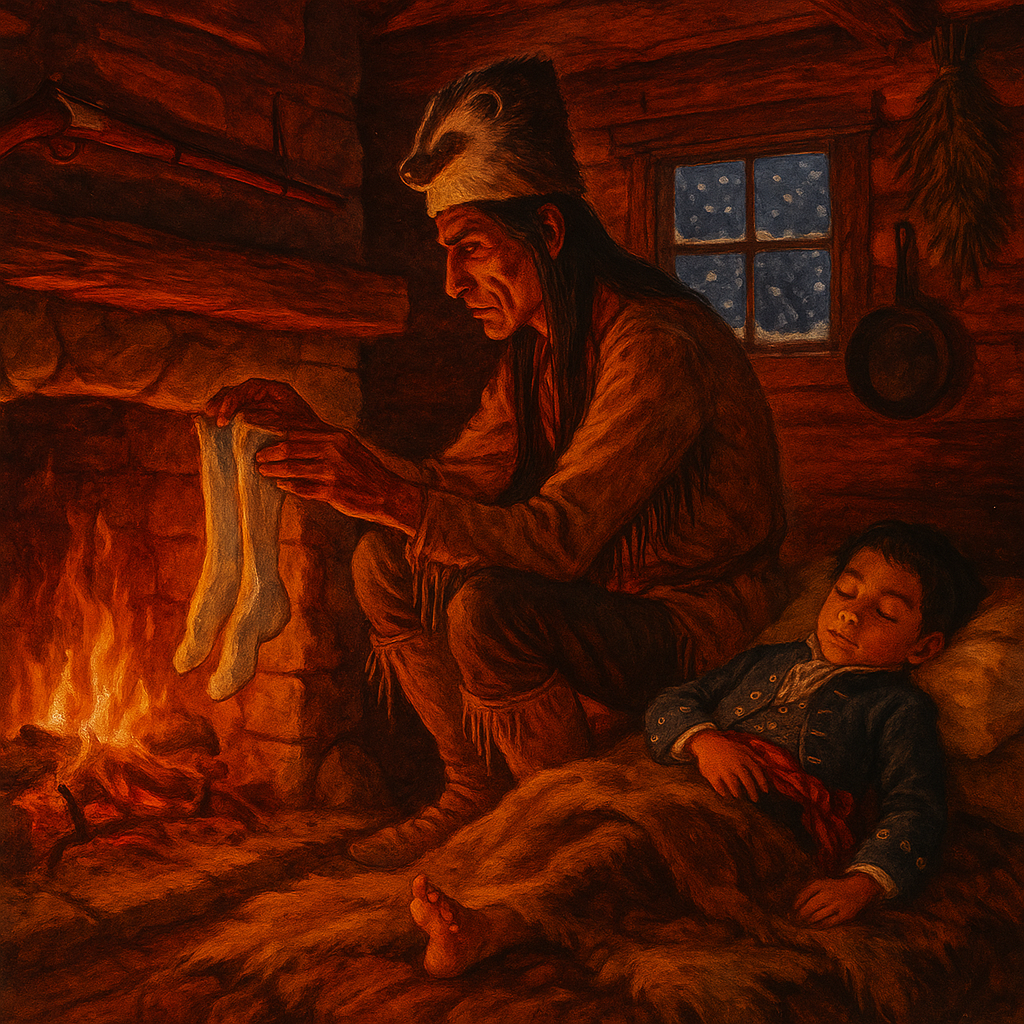
“My stockings, Don — they should be ready. They’re still damp. Would you hold them to the fire for me?” said the patroncito.
Cherokee Sam held the damp silk stockings to the blaze. The patroncito watched him, growing sleepy.
“He’s a long time coming, Don Cherokee Sam,” the boy murmured — and nodded — nodded again — and slipped down onto the deerskin, fast asleep.
The hunter lifted him as easily as he’d lift a hare, laid him on the bed, and drew the covering gently over him. Then he replenished the fire without a sound and squatted before it, going back to his stocking-drying.
The resinous wood burst into flame and filled the smoke-blackened cabin with a pungent scent and a deep red glow. The light fell on the patroncito where he lay on his couch of skins, caressing the small bare foot he’d thrust from under the covering and dancing on the silver buttons of his fine pantalones. Over the boy, like something out of a fairy tale, wavered the great shadow of the hunter’s head — made stranger still by his towering cap of badger skin plumed with a tail.
Cherokee Sam’s face in the firelight was fierce and wild. But it was composed, too — free of the small meannesses that cramp smaller souls. And as he sat looking at the soft stockings now dry in his hands, a smile crossed his thin lips.
Then, without warning, the firelight flared up bright and went suddenly out — and though the door never opened, and the hunter’s sharp ears caught no sound, he felt a presence in the cabin. Looking up, he seemed to see, dim in the shadow, the form of San Nicolás, long delayed by the drifts. What that Spanish Christmas saint looked like, or what he said to remind one lawless man of the season of peace and goodwill — that remained forever a secret between them.
The patroncito woke to see snow sparkling in the Christmas morning sun through the open doorway. Over the fire Cherokee Sam was already frying venison, and on either side of the hearth hung the long silk stockings — filled.
“And I never saw him!” said the patroncito reproachfully, staring at them. “Oh, why didn’t you wake me, Don Cherokee Sam?”
“Didn’t dare,” Sam explained. “It wasn’t safe — he told me not to.”
He watched anxiously as the boy took the stockings down. But he need not have worried. As their contents tumbled out onto the deerskin, the patroncito let out a cry of pure delight.
A handful of garnets. Bits of broken agate. A shivered topaz. Shining cubes of iron pyrites — fool’s gold — picked up on one fruitless prospect or another by San Nicolás. A tanned white weasel-skin purse. And ornaments carved from young bucks’ antler, shaped with patient skill on winter evenings.
Never before, for all his silk and silver buttons, had the petted patroncito received gifts so thoroughly prized as these.
“Never mind breakfast,” he said imperiously, gathering them up. “Take me to the plaza right away.”
The hunter humbly complied. But they had scarcely come through the granite gateway of the Shut-in when they met a party from the plaza — the patrón himself at the head of it, searching with desperate anxiety for his missing son. They had been out all night.
Cherokee Sam remembered the counsel San Nicolás had given him in the dark hours.
“Patrón,” he said, with quiet dignity, leading the boy forward. “I bring you a Christmas gift.”
Then — as Cherokee Sam described it afterward — “there was a jabbering and a waving of hands.” And he, turning, strode back up the gulch to his cabin and his cold unfinished breakfast. His resentment still rankled.
It did not last the day.
The gray burro came ambling up the gulch once more, bearing the small mayordomo — this time on a mission of peace. Behind him came a whole pack-train, well laden, drawing up before the astonished Cherokee Sam’s door. With hat in hand and a bow of genuine courtesy, the mayordomo asked Don Cherokee Sam where he would like the patroncito‘s Christmas gifts to be stored.
“In the cabin,” said Sam, staring at the loaded animals, “if it’ll hold them. I ain’t got anywhere else.”
The mayordomo waved his wand, and in moments the cabin was filled wall to wall with box, bag, and bale. Cherokee Sam had provisions and good things enough to last until Christmas came again.