“I’ll never do so again! If I do, may I be plucked for my Greats!”
That, my friends, is a substantial oath, because this is the Oxonian equivalent of “may I fail my finals.” So you’ll understand exactly how much I mean it when I say: I’ll never do so again.
When I resolved to stay in Oxford over the short Christmas vacation — to spend Christmas Day in the deserted halls of Brazenface — I had no suspicion that I should find myself there as solitary as Robinson Crusoe. I hadn’t the remotest idea that I should be the monarch of all I surveyed; that I should be the only poor desolate brute in the place. But so it was.
Willoughby, Collins, and I had, after a year of hunting, idling, and “larking” about together, taken it into our heads to stop the suppers and the wine parties, open our web-cobbed Lexicons, spread the Greek plays across the table, dig out our old “Thucydides,” and start a reading coach of which I was appointed “unicorn,” or leader. Like most college study schemes, we set off at a slapping pace, and at the end of a fortnight found ourselves so blown that we had to stop at a jolly wine-party. This put us back a week, and we had to retrace our steps over a good deal of the road. A second fortnight, we picked ourselves up again, and it was unanimously agreed that the Christmas festivities — pretty girls, home cooking, and all the social pleasures that would disperse the accumulated classical muddle in our heads — should most emphatically not be allowed. The Reading Coach would run straight through the Christmas vacation. The very next day we got the licence to do it.
When we had seen the last team of men off from the Mitre, and the last train leave the station, we walked up the deserted High and came back across the now dreary and silent Quad to our snug rooms. We sat down by the firelight, talked as martyrs may have talked, and made our solemn resolution. All went well until Christmas Eve. Like cloistered monks, we buried ourselves within the college walls and issued forth only for brisk walks. On Christmas Eve, Collins and I went out together for our evening constitutional, Willoughby having pleaded a headache. When we came back to my rooms, our surprise at finding the following laconic epistle on my table may be imagined:
“Dearly beloved Charley and Collins,
“By the time you read this, I fervently trust I shall have got clean away from Alma Mater. The nearer we came to Christmas-day, the more dutifully I thought I was acting in not going home to see my own Alma Mater, who, I’ll be bound, has been sobbing her eyes out at the thought of making the Christmas pudding without her young Hopeful to help her. Excuse me putting a ruse upon you, but I was afraid you would lay violent hands on me and detain me, against my will, in this dreary Brazenface.
“Yours elopingly,
“W. Longueville Willoughby.”
I’m not quite sure what we said on the occasion, but though we both agreed he was the most ungrateful reprobate that the confiding arms of Friendship had ever embraced, I think we entertained a very strong — though unexpressed — idea that we should only be too glad to follow his example. But if our surprise and indignation were great then, they were still more greatly excited the next morning.
I had lain rather late, having no horrid bell to rouse me for chapel, and it was after ten on the morning of Christmas-Day before I went to Collins’s rooms for breakfast, for we always boiled one kettle between us. The breakfast things were laid, certainly, but for one person only. And to increase my wonderment, on diving into his bedroom — where I heard somebody moving — whom should I see but old Mrs. Tester, the bedmaker, busily cramming linen, clothes, and a mixed heap of articles into the portmanteaus that were gathered around her. The fearful truth flashed upon me: Collins was gone.
“Tell me — tell me the worst!” I gasped, and old Mrs. Tester handed me the following note:
“Dear old Charley,
“It’s really too bad, upon my honour! But what else could I do? I dreamt about Willoughby all night, and the first thing this morning I got a letter from my sister to say what a beast I was for not going home on Christmas-day — and that all kinds of things are going to be done, and that no end of people are there — Fanny among the rest — and what an awful state she’s in about my preferring to stay here. Now, who could stand this? Especially when one thinks of the infernal dullness of this hole. So I’ve made up my mind and my carpet-bag to go by the eight-fifty train, and shall get to Hammersley in time for dinner. Mother Tester is to send off the heavy luggage by the next train. Quicken her about it — there’s a good fellow. But do go home yourself, old fellow, by the next train; it’s the proper thing to do, and depend upon it, too much reading is bad for the lungs. I feel mine going already. Don’t victimize yourself with the brutalizing books — get away home to the family, have a bit of polish, and you’ll ever bless the advice of yours, in a deuce of a hurry,
“Henry Collins.”
I would rather have passed over the events of the day without exposing myself in the eyes of the public — as I feel I did in the eyes of the respectable Mrs. Tester. But I did not go home by the next train. I stayed where I was. I laughed a hollow “Ha! ha!” — such as I had heard the stage pirates and villains do — and I rather thought I wished myself a stage villain, to do somebody an injury, and expend the fury of my gloomy anger. Half-time came, and I slank across the Quad on my own for dinner.
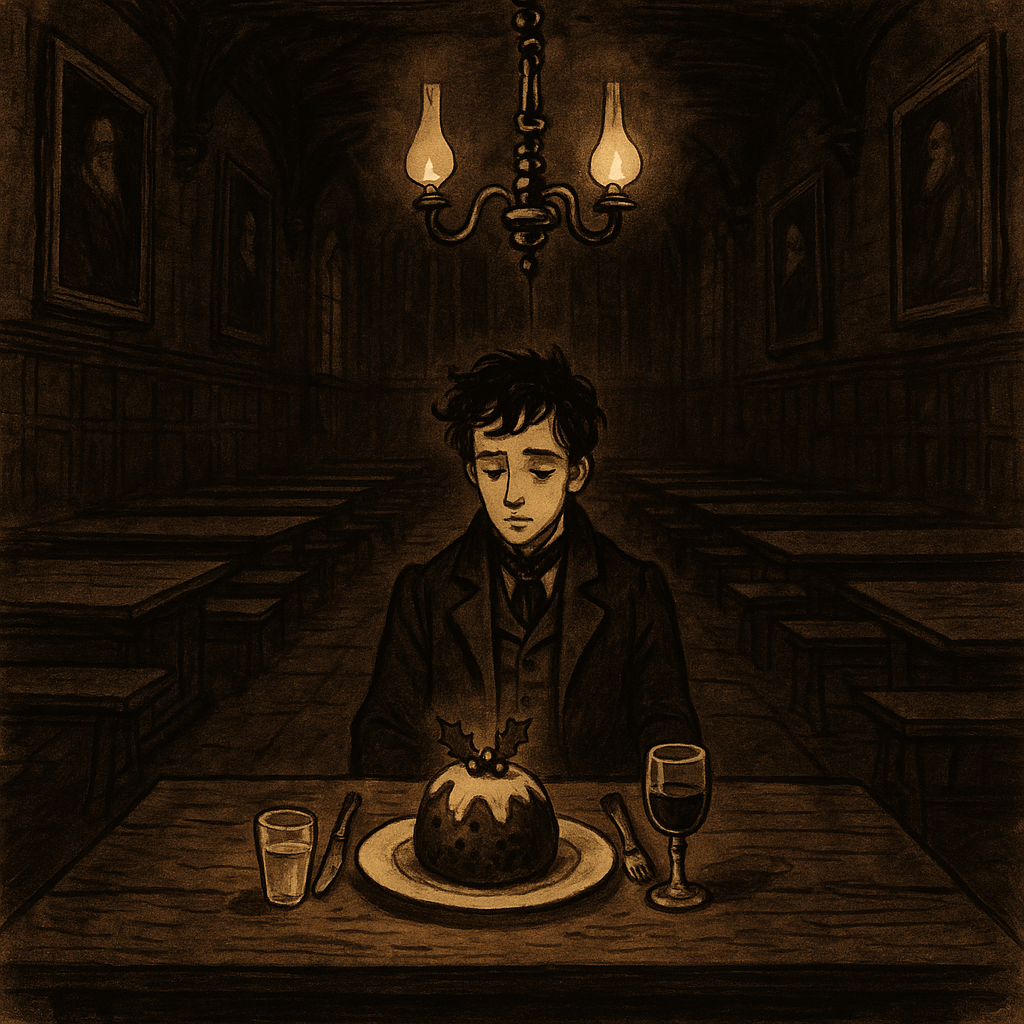
There was a cloth laid for me across the end of one of the long tables, and the nearest chandelier had two of its lamps lit for my especial benefit. Of course there was no High-table. The Dons, who were still in residence, would dine together on that day; and now Willoughby and Collins were gone, I was positively the only man left up — the only man left in College on Christmas-day. “Ha! ha!” Desolation had marked me for her own. Our Dining-Hall at Brazenface is, as every one knows, one of the largest in Oxford, and the feeble light from the two solitary lamps made it appear more vast and solitary than ever. When I peered into its farthest depths, and thought of the brilliancy, the crowd, the laughter, and the loud hum of conversation that during Term reigned at that time, I cut into the roast beef before me with a savage energy. But they had given me a proper Christmas dinner! I can only think it made me worse: if I had had the other dishes, I might possibly have forgotten the day and not felt so wretched. The cook, in his mistaken kindness, had decorated the plum-pudding with a large piece of holly; and there was no forgetting that it was Christmas.
My scout waited on me; to do so, he had been obliged to leave a party of his fellow-servants, and was sulky accordingly. He told me this, and asked my permission to rejoin them as soon as he had put my tea-things ready against I wanted them. So even he was going to a merry party, and would be in company and enjoy himself; while I — “Ha! ha!”
The very eyes of the founders and benefactors seemed to be fixed upon me from their canvas, as I ate my solitary dinner. It was soon over: it was not at all the sort of thing I wished to linger upon. I walked out of Hall, and through the Second Quad, to the cloisters of our Chapel. It was the most lonely place I could find, and it harmonized with my thoughts and condition. There, busy Fancy took me back to past Christmas-days and showed me all their joys and pleasures. I saw the happy groups at home, the family meetings, the hearty welcome of long-loved faces, the greeting of well-remembered friends, the gathering round the social table, the laughing faces of the children, the light-hearted smiles, the gleaming holly-berries and shining leaves, the mistletoe hanging enticingly from the ceiling, the noisy games, and the merry dance. I saw all these things; and my classical reading, not yet having converted me into a stoic, resolution gave way before nature.
Within an hour I had packed a few things, followed Willoughby’s and Collins’s example, and was being whirled away by the Express Train, every moment farther and farther from Oxford. I never before was so glad to leave it. Thanks to the railways, I got home that night in time to bid the assembled party “a Merry Christmas” before they broke up; and in time, too, to kiss Helen Clifford under the mistletoe!
I don’t think Mrs. Tester will ever again be able to say of me that I was the only man left in College on Christmas-day. If she can — may I be plucked for my Greats!