When Lucien de Hem saw his last hundred-franc note raked away by the croupier, when he rose from the roulette table where he had just lost what remained of his small fortune — scraped together for this one last desperate gamble — the room seemed to tilt. His head swam; his legs felt hollow. He dropped onto the leather banquette that ran around the gaming table and sat there in a daze, mechanically watching the rituals of the place: the worn, haggard faces of the gamblers under the glare of three shadeless lamps, the clicking and sliding of gold coins over the green felt. He was ruined. Finished. Overcome by exhaustion, he sank into a heavy sleep.
When he woke, his mouth was stale and his tongue stuck to his palate. A glance at the clock told him he had slept barely half an hour. He felt a desperate need for fresh air. The hands pointed to a quarter to midnight.
As he rose and stretched, it came to him that it was Christmas Eve — and by one of memory’s strange tricks he felt for a moment like a child again, the kind who sets his little boot by the hearth before going to bed. Just then old Dronski shuffled over: one of the permanent fixtures of the place, the traditional Polish gambler, wrapped in a greasy coat trimmed with braid and frogging, muttering behind his dirty grey beard.
“Lend me five francs, would you, Monsieur? I haven’t left this table in two days, and in two whole days seventeen hasn’t come up once. Laugh if you like — but I’ll stake my hand that when the clock strikes twelve, seventeen will be the winning number.”
Lucien shrugged and searched his pockets. He didn’t even have enough for the small tip expected of a gentleman on his way out. He collected his hat and coat from the antechamber and slipped down the narrow stairs.
Outside, Paris was transformed. During the four hours he had spent in the gambling den, it had snowed heavily. The street — one of those tight canyon-cuts between tall buildings in the heart of the city — was intensely white. Above, in a calm blue-black sky, cold stars glittered. Lucien shivered in his furs and walked quickly, a hollow despair in his chest, thinking dark thoughts about what awaited him at home.
He had not gone a hundred yards when he stopped.
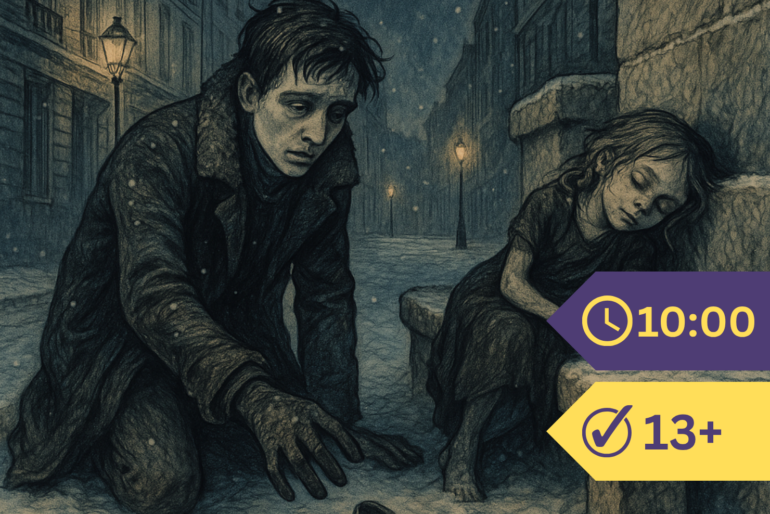
On a stone bench beside the grand doorway of a wealthy house sat a little girl, six or seven years old, barely covered by a ragged black dress. She had fallen asleep there in spite of the bitter cold, her small body hunched forward in a posture of exhausted submission. Her head and one thin shoulder had settled into the angle of the freezing wall. One worn slipper had slipped from her dangling foot and lay in the snow before her.
Lucien reached instinctively into his pocket, then remembered he had nothing to give. But he drew closer, pulled by pity. He was thinking he might carry her somewhere warm — when something glinted in the little slipper on the ground. He bent down.
It was a gold louis.
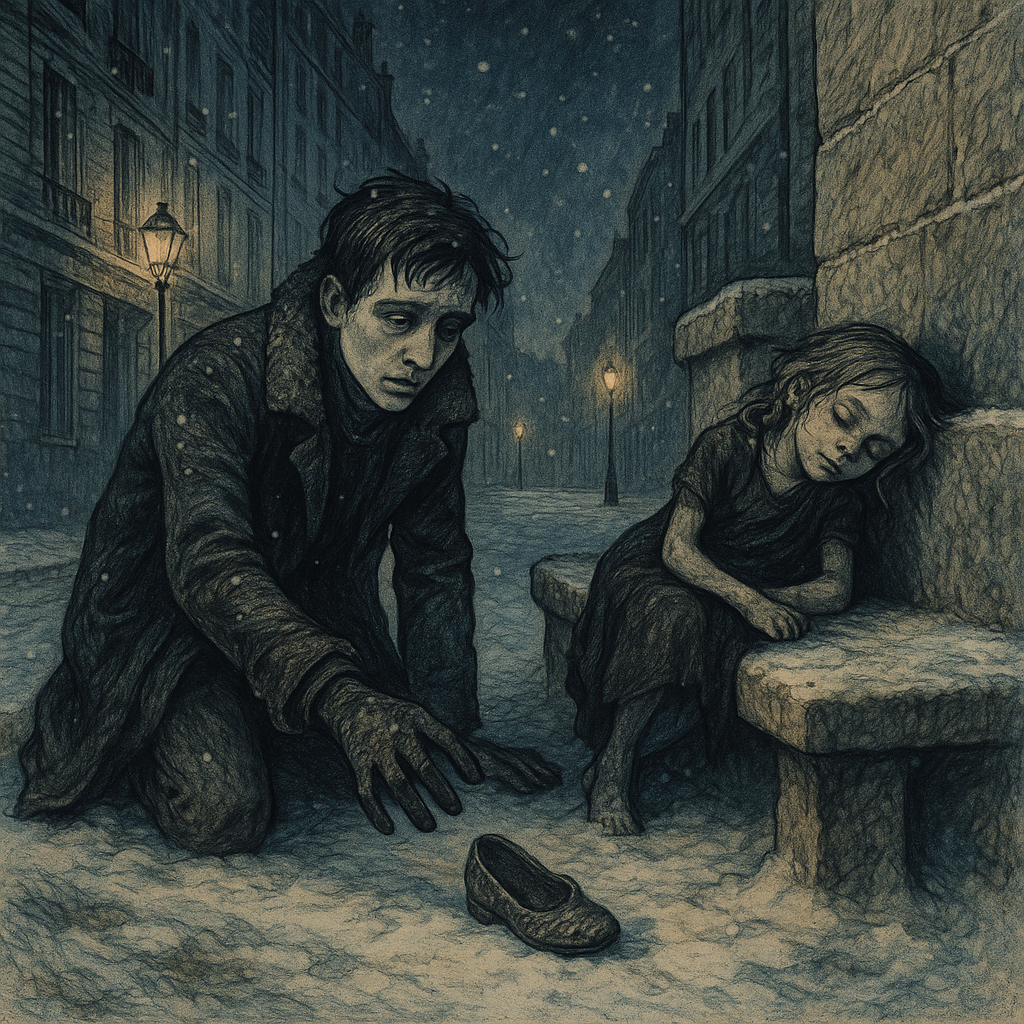
Some kind soul — a woman, he thought — had passed by, seen the tiny shoe in the snow, and remembered the old Christmas legend. With quiet fingers she had slipped a generous coin inside, so that the forsaken little one might still wake to believe in the gifts of the Christ-child, and face her misery with a renewed spark of faith.
A gold louis! Days of warmth and food. Lucien was just about to wake the child and show her what fortune had brought her, when a voice seemed to sound in his ear — the slow drawl of old Dronski: Two whole days seventeen hasn’t come out once. I’ll stake my hand that when the clock strikes twelve, seventeen will be the winning number.
And then this young man of twenty-three — son of honest men, bearer of a proud military name, never in his life guilty of anything he was ashamed of — had a monstrous thought. A mad desire seized him. He glanced up and down the empty street, and — seeing no one — knelt, reached out with trembling fingers, and stole the gold coin from the little slipper. Then he was on his feet and running.
He took the stairs of the gambling house two at a time, burst through the door at the first stroke of midnight, and threw the coin onto the table.
“Seventeen!”
Seventeen came up. He pushed everything onto red. Red won. He left the stack where it was. Red came again. He doubled, three times, four — and never lost. Before him the gold and banknotes accumulated in a heap. He tried the twelve, the column, every combination the table offered. His luck was something no one had seen before, something almost uncanny. The little ivory ball seemed bewitched, seemed to know his will and obey it. In a few bold strokes he recovered what he’d lost at the start of the evening. Then he staked two and three hundred louis at a time, and won those too, until at last he had clawed back every franc of his inheritance.
He had never even taken off his coat. Its pockets bulged with rolls of banknotes and clinked with gold. He stuffed money into his inside pockets, his waistcoat, his trousers, his cigar case, his handkerchief. Everything served as a wallet. Still he played; still he won; his head spun like a drunkard’s. It was a sight — this young man hurling gold onto the table by the fistful, with a gesture of absolute certainty and contempt.
But there was something gnawing at him. Something like a red-hot coal behind his ribs. He could not shake the image of the child asleep in the snow. The child he had robbed.
In a few minutes, he told himself, I’ll go back. She’ll be there — of course she’ll be there. It isn’t really a crime. I’ll make it right. More than right. I’ll go back the moment the clock strikes, I swear it. I’ll pick her up and carry her home while she sleeps. I haven’t harmed her — I’ve made a fortune for her. I’ll keep her with me and raise her as my own. She’ll want for nothing, as long as she lives.
But the clock struck one. A quarter past. Half past. Lucien was still at the table.
Finally, minutes before two, the man across from him pushed back his chair and announced in a loud voice: “The bank is broken, gentlemen. That’s all for tonight.”
Lucien started. He elbowed through the knot of admirers around him and ran back down into the snowy street. In moments the gaslight showed him the child still on the bench.
“Thank God,” he breathed, and his heart gave a great leap.
He took her small hand in his. How cold it was. He slid his hands beneath her arms and lifted her. Her head fell back. She did not wake.
The deep sleep of childhood, he thought.
He pressed her to his chest to warm her, and with a vague dread he bent to kiss her eyelids, trying to rouse her — and saw that beneath the half-open lids her eyes were dull and fixed and glassy. A terrible suspicion cut through him. He put his lips to her mouth.
There was no breath.
While Lucien had been building his fortune with the coin stolen from this little one, she — homeless, abandoned — had died of cold.
A choking knot seized his throat. He opened his mouth to cry out — and woke.
He was on the leather banquette in the gambling room, where he had fallen asleep just before midnight. The night waiter had left around five o’clock and, out of pity, had not disturbed him.
A pale December dawn was greying the windows.
Lucien went out, pawned his watch, found a bathhouse, then walked to the Bureau of Recruits and enlisted as a volunteer in the First Regiment of the Chasseurs d’Afrique.
He is now a lieutenant. He has not a sou beyond his army pay. He makes it do — he is a steady officer and has not touched a card since. He even manages to put a little aside, it seems. A comrade who followed him up one of the steep lanes of the Casbah recently saw him stop and lay a coin in the lap of a small Spanish girl who had fallen asleep in a doorway.
The coin was a gold louis.