A bright-faced boy stood in the center of a group of ragged children, telling them a story. Behind them were the forlorn shacks of a mining camp, built of mismatched boards and scraps of tin, with tar paper for roofing. A fluttering line of washing was the only sign of life — the men were away in the mines, and the few women in camp were busy indoors.
It was a desolate scene, but the children had forgotten it. They were spellbound, their minds so full of the picture the boy was painting that the snowy fields before them and the miserable camp behind them seemed miles away. Instead they saw what he saw — for he was gazing straight ahead into some distance of his own, a light on his face as though he were watching the very scene he described.
“There were angels,” he said in a clear, thrilling voice, “hundreds of them, all with glistening wings and faces as bright as sunlight. They turned the dark night into day, and when the shepherds saw them, they were afraid. But the angels said, Fear not — and told them to go to a stable in the city nearby, where, lying in a manger, they would find a baby King. So the shepherds hurried up the steep path to the city, carrying the lambs in their arms, and the sky rang with the angels’ song. It was the gladdest night in the whole world.”
“But that isn’t all!” cried the children. “Tell us about the wonderful star and the men on camels!”
“Listen,” said the boy — although every child was already listening with all his might — “listen to what I’m going to tell you today. It is the most marvelous thing you have ever heard. In ten days Christmas will be here, though the people at this camp are so busy and so lonesome they’ve forgotten it. But when I asked my mother how we could ever have Christmas here, so far from home, she said that perhaps —” here the lad, Carl, paused, gazing again into the distance, his face alight — “perhaps,” he said softly, “the glorious star would shine again, and lead us — not wise men on camels, but us, the children — to the birthplace of a little baby.”
“Shall we see the angels too?” asked one girl, her voice trembling. “Will the dark sky be bright and full of singing?” demanded another. “Will the shepherds be there? The camels? The men with precious gifts?”
“Perhaps so,” said Carl. He didn’t know, only that they must watch every night now for a new star. That would be the beginning — the beginning of the most wonderful Christmas since the angels sang over the plains of Bethlehem.
A shrill whistle blew — supper — and the children ran back over the snowy path to the big shack where the men gathered for meals. They found the men already seated, talking in angry voices. One of the leaders had just read aloud a letter from the mine’s owner: so little gold had been found that unless more was discovered within ten days, the mine would be closed. As the miners had been working on shares, their wages would barely cover the trip home.
A murmur of anger ran around the room. These men had come to this desolate place dreaming of returning rich for life. Now, after months of hard and dangerous work, they would leave poorer than they’d arrived. Many of them could see, in their minds, the bare homes where families were counting the days, expecting men with pockets full of gold.
“We’ll never go back as beggars!” one man cried. “Better blow up the mine with us in it than watch our children starve!” shouted another.
And then the children came rushing in, their faces bright with hope.
“Ten days from now will be Christmas!” one little boy called out. “And something wonderful will happen!” cried another.
The men rounded on them. “If any child mentions Christmas again, I’ll make him sorry he did,” one man growled. “In ten days we’ll all be paupers,” said another. “Is that your wonderful thing?”
To the children, Carl’s story began to feel like an idle dream. How could a baby King, a glorious Christ Child, come to this wretched place? How could an angel’s song be heard in a camp where, as the night wore on, fighting and swearing grew louder in the darkness?
Still, the miners went out every morning before dawn in desperate hope of finding the gold in time, and every evening returned more discouraged than before. It was no wonder their faces grew rough and fierce, and that the children crept out of their way. The families with children here were worse off than most — small wages wouldn’t cover the return trip of a whole family, and after ten days there would be no food and no way out. Starvation stared them in the face, and Christmas meant nothing to them now.
Only Carl’s mother still thought of it, with a small sad smile. When Carl asked her again about the star and the baby of whom she’d spoken, she said gently, “When the Christ Child came, His mother had no finery in which to dress Him.” Then he saw tears in her eyes, and he didn’t dare ask further — though the thought of the little King was with him day and night.
Late every afternoon the children gathered beside a cluster of snow-laden fir trees behind the shacks. There, the gloom and fear of the camp seemed to fall away. The snow-covered mountains glittered in the distance, and Carl told them again about the shepherds and the angels.
Then one evening, as the children watched with breathless excitement, a radiant star appeared in the darkening sky. They were quite certain it was the same star that had led the wise men long ago. All that night they lay awake on their hard cots, trembling with excitement, listening for the music of angels. But only the sound of arguing men came through the darkness, and again the children’s bright dreams were shadowed by the misery around them.
Still, each afternoon they had their hour of happiness beside the frost-hung firs, with the star shining above, and Carl speaking of his hopes. He never doubted for a moment that the star would lead them to the blessed birthplace. As the days passed, he added new thoughts to his picture.
“When the wise men came,” he said one afternoon, “they brought gifts — bags of gold, the kind our fathers are searching for, the kind they say has cost them everything. Perhaps —” his voice trembled with the wonder of it — “when the Christ Child comes, He may bring to the miners some of the gold the wise men once brought to Him.”
The thought was so astonishing that the children planned to tell the men. But when they looked up at those grim, weary faces, their courage failed them, and they went quietly to bed.
So nine days slipped by, and the afternoon before Christmas came. Tomorrow, if no gold was found, the mine would close. The men went out that morning in dead silence, despair written on every face. Snow had fallen heavily all night and a few flakes still drifted from the leaden sky. The shacks were cold and cheerless; the women moved through their tasks with heavy steps. Only Carl’s mother was not among them — but no one, sunk in their own misery, gave her a thought. The children huddled in a corner under a ragged quilt, and Carl, by the magic of his words and his faith, brought color to their cheeks and brightness to their eyes.
“Today is the day He will come,” he whispered. “My mother went out into the snow this morning, and before she left she kissed me and said, The little baby is coming today, my son — where is the home ready to receive him? I don’t know exactly what she meant, but the angels will be waiting to care for the little King.”
“But if it’s snowing, how will we see the star?” the children asked.
As if in answer, the sun came out brilliantly. The world shone like a fairyland of silver and powdered diamonds, and the children rushed out into it, running across the fields, eager and joyful and expectant. The short afternoon passed quickly; the sun set in a glory of rose and gold, and then again the splendid evening star appeared — the one on which all their hopes were fixed. It was bigger and brighter than ever before, but it didn’t move as they had expected, and for a moment a puzzled silence fell over the group.
Then Carl laughed out loud. “Look!” he exclaimed, pointing to the old barn beyond the fir trees where the camp’s animals were kept. “It doesn’t move because it’s here! Right below the star — the stable! We thought, just like the wise men, that the star would lead us to a palace. But perhaps again the little King is lying in a manger.”
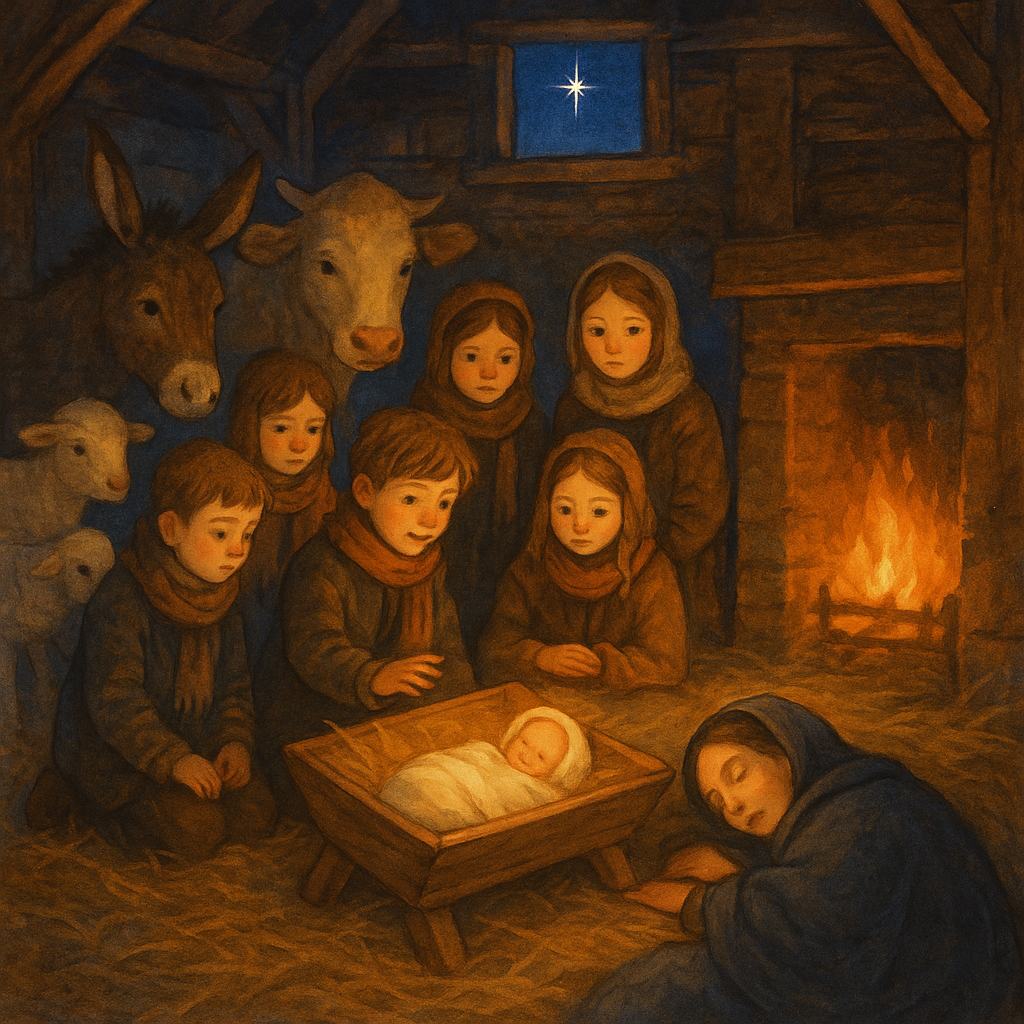
For a moment it seemed too wonderful to be true. Could the King already be there, in that old barn, waiting for them? Then suddenly everything seemed possible. With the glorious star above them and the glittering mountains behind them and Carl’s joyful voice calling them forward, faith in the King’s coming felt perfectly natural. With hearts as full as the shepherds’ on the plains of Bethlehem, the children climbed the snowy path to the little stable, from whose windows there already shone a golden light.
Very quietly, the children opened the door and stepped inside.
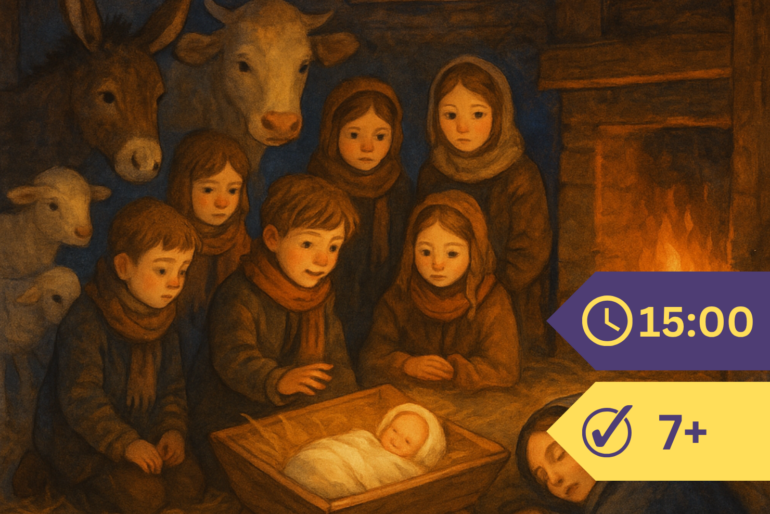
At first they saw nothing. Their eyes were dazzled by a great fire burning in the rough stone fireplace — a fire laid with evergreen branches, so that the room was full of the fragrance of Christmas trees. “This is the frankincense and myrrh,” whispered one child. “He must have brought it for us.”
Then, as their eyes adjusted, they saw in one dim corner the old donkey that hauled loads for the miners. Beside him stood a cow, a couple of sheep, and on the rafters above perched a pair of blue pigeons. The children had seen these animals many times before — but now, in the firelight, with the star shining above, the same creatures that had surrounded the Christ on that first Christmas seemed as wondrous as a host of angels.
And then, at last, they saw the One they were looking for.
The cow’s manger had been pulled out beside the blazing fire, and in it, warm and cozy and wrapped in swaddling bands, lay a tiny, beautiful baby. With a gasp, the children knelt in the straw before him. Around his head there was no circle of heavenly glory — but his sweet blue eyes opened wide and shining in his small face, and to the children he seemed truly the baby King of their dreams. Beside him on the straw lay a woman wrapped in a dark cloak. Even Carl didn’t recognize her at first as his own mother.
She had crept away that morning to the one quiet place in the camp, where her husband had built the great fire to keep her warm. And there, with the peaceful animals around him, Carl’s little brother had been born.
“The Christ Child has come to us,” one child whispered with pure joy. “The little King is here,” said others softly. “He has brought the fragrance the wise men gave him,” murmured another.
“And he has brought the joy of Christmas — to last us all forever,” said Carl.
They were so overwhelmed by the beauty of the scene that they had quite forgotten the longed-for gold — and then the door swung open and Carl’s father stepped into the room. His face shone with a light that seemed to have nothing to do with the fire or the sunset. His voice rang with gladness: “Wife — they’ve found the gold. The mine will give treasure to us all.”
The children clasped their hands in quiet bliss. They had known it would come with the little King’s coming — gold for the desperate men, peace for the tired women, happiness for everyone — and it had come true, more wonderfully than they had dared to dream.
The star shone through the window in the loft. The last rays of the sunset turned the snow to gold. And within, in the firelight, the children knelt, gazing at the little newborn baby in the manger.
That was how the miners found them.
The men were coming back jubilant — the gold discovery would make them all rich, and they were planning a loud celebration. But on the way to the shacks they passed the stable. It was strange to see it lit at this hour. One man turned aside to look. As he stood in silence at the window, another joined him, and then another, until the whole crowd stood outside, peering in without a sound.
The kneeling children. The baby in the manger. The star above. What did it mean?
“It’s Christmas Eve,” one man murmured. “That must be big Carl’s little one,” said another, “but even the blessed Lord Jesus Himself couldn’t have looked any sweeter.”
“Gifts of gold,” said the leader, his voice carrying to every ear, “were brought once to the Christ on His first birthday. It’s His birthday tonight — though none of us remembered it — and now the gifts of gold have come to us. Who can say they haven’t come from Him, the Lord we had forgotten?”
There was silence. Then, as night fell and the stars came out over that peaceful scene, something changed in the hearts of every man and woman and child in that camp.
Later, when the children understood that the baby was Carl’s little brother, the wonder was no less. Perhaps they felt the truth that the Christ Child is born in every baby who comes into the world — or perhaps they simply felt the nearness of something holy, as the men and women around them lost their hardness and became gentle, joyful, kind. From that Christmas Eve until the mine was worked out and the men scattered happily back to their homes, the camp was a different place. The drinking and fighting stopped. The men played with the children — shyly at first, then merrily, thinking of their own children waiting at home. The women sang at their work, and if the music was nothing like the angels’ song, it was full of warmth and peace and good will.
And so, to the children, the camp became truly a place where, on that marvelous Christmas Eve, the Christ Child had been born.