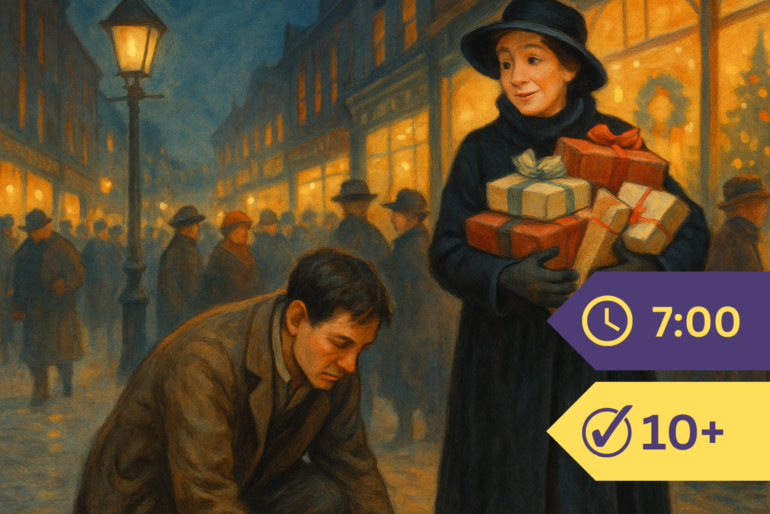
It was Christmas Eve, and Market Street was thronged with the usual crowd of last-minute shoppers — those who always seem to wait until the final hour to make their purchases. And yet it was a pretty sight: a vast crowd of people, all looking merry and bright and congenial.
But there was one man in the throng who felt neither happy nor even cheerful, and that was Jack Harley — who had just been released from San Quentin Prison that afternoon and had barely reached the city.
He was idly speculating on his friendlessness. He had no friends to go to, no position waiting for him, not a great deal of money, and the sense of being a stranger in a hostile world. Then a lady passing him — her arms laden with packages — was jostled by the surging crowd. She grasped wildly at one of the bundles, but it slipped free and fell to the curb with a crash.
Before the accident had fully registered, Jack found himself picking up the fallen parcel and returning it to its owner. He expressed his regret that the contents — apparently a doll — appeared to be broken, and offered to help carry the rest of her packages to wherever she was going.
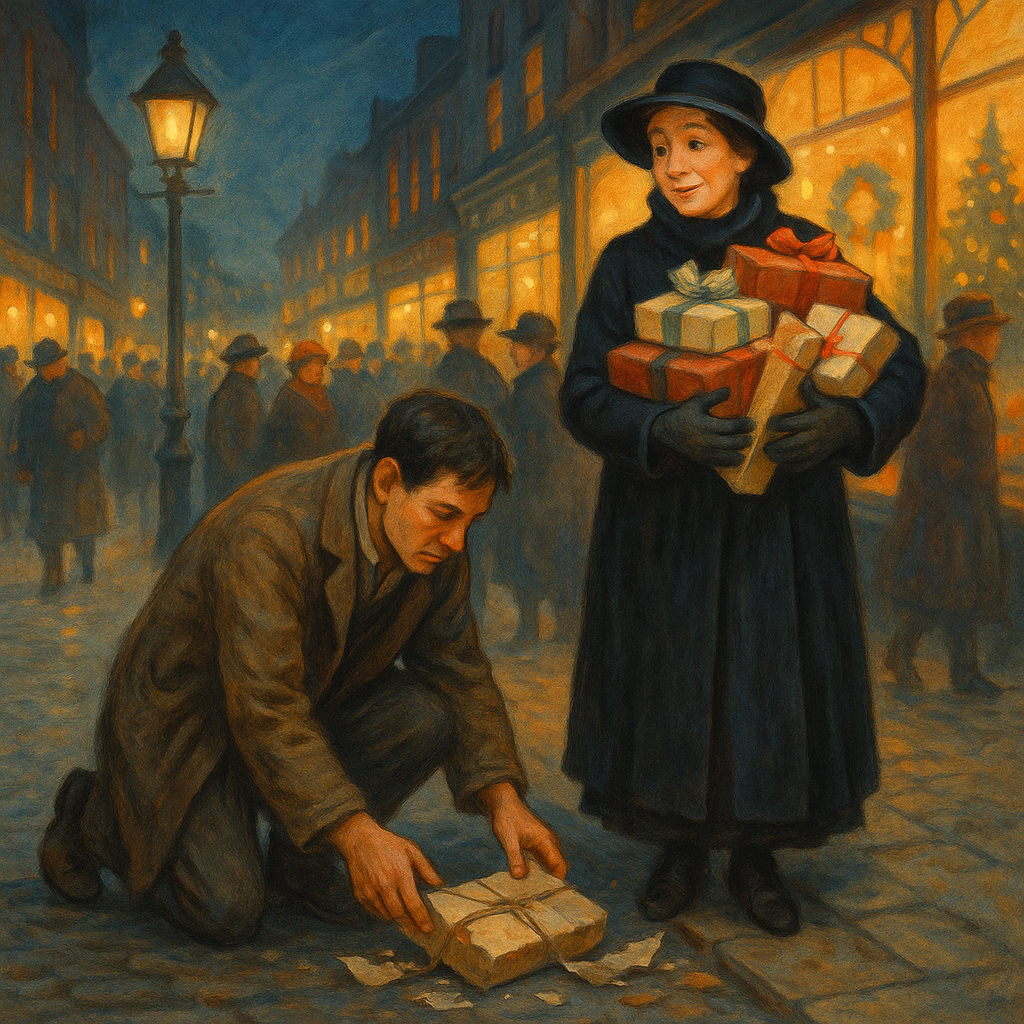
The lady thanked him for his kindness and accepted his offer, though she said she was only going as far as the next corner, where she could board her streetcar home. During the short walk, Jack learned that the broken doll had been meant for her little girl’s Christmas. Though the lady didn’t say so directly, he gathered from her manner that she was in straitened circumstances and would not easily be able to replace it.
At the corner, they found they had just missed the car and had ten minutes to wait for the next one. To fill the silence, Jack told the lady of his situation — that he had no friends here, and wondered if she might know where he could find a room with a private family.
On hearing his plight, the lady introduced herself as Mrs. Egbers. “I would be pleased to offer you a room and board,” she said, “though I must warn you both will be very simple and plain. I am poor, and I have three children to care for — two boys and a little girl.”
Jack accepted at once — and persuaded her, before they set off, to let him stop and buy a new doll for the little girl, to replace the broken one.
When they arrived, Jack found his new quarters in a snug little five-room cottage. His room was small and simply furnished, but extremely neat and homelike. He settled in with a lighter heart than he’d felt in years.
In the early morning he was roused by the delighted shouts of children discovering Santa’s gifts. He made his toilet hurriedly and joined the children, who received him shyly at first — but as healthy children do, they soon accepted him as a new playmate and competed good-naturedly to entertain him.
Rose, a little miss of six, had to exhibit her new dolly and demonstrate how it could open and shut its eyes, how its hair was curled, and all the other wonders that a small child can find in such a thing. Ted, a solemn nine-year-old, had a wonderful new box of paints to show, with charming childlike pride. And last, young Cal had a fine tool chest to proudly display. “Just see — a hammer, two saws, chisels, a plane, brace and bits, and a square! Why, he could certainly help his mother now. He would make her boxes to keep the groceries in so the mice couldn’t reach them, and — oh yes! — he’d fix the kitchen table!” Their chatter ran on and on. It was certainly a babble of sound, but to Jack Harley, after so many years cut off from all family life and its ordinary comforts, it sounded like music.
After breakfast, Mrs. Egbers asked whether he’d care to accompany the children to church. Jack, just then, was ready to go almost anywhere if it meant keeping the company of his new little friends. On the way home, he planned a trip to the moving pictures for them. They arrived back to find dinner waiting — and Jack would ever afterwards say it was the finest dinner he had ever eaten.
After the pictures, while he was out, Mrs. Egbers had called on a neighbor and happened to mention her new lodger. The neighbor’s husband let it drop that they were a man short at the Gale Cartage Company. She was told to send Jack around in the morning, and he would be put to work.
And so, after a single short and happy day, Jack Harley found he had to revise his darkest fears about being a stranger in a hostile world. He had enjoyed a warm and altogether pleasant Christmas, had secured a roof over his head, and would start a new job in the morning.
As he had in earlier, better days, he gave thanks for the many blessings he had received — and not the least of these was his freedom. And so it was that one more wanderer found his way back to the fold, on the anniversary of the day the world was given a reason to try again.