
A Letter
Lady,
I beseech you, for the love of Oxford, hire a Crier — I will see him paid for his pains — to cry old Father Christmas, and keep him with you (if you can meet with him and detain him) until we come to London, for we expect to arrive there shortly. Then we will have all things as they used to be, I warrant you. Hold up your spirits, and let not your old friends be lost out of your favour.
Your ever faithful servant, Jo. Woodcock
Lady: Honest Crier, I know you are acquainted with old Father Christmas. I am sent to you by an honest scholar of Oxford — one who has given me many a hug and kiss at Christmastime when we have been merry — to cry Christmas, for they hear that he is gone from hence, and that we have lost the poor old man. You know his marks, and you know how to cry him.
Crier: Who shall pay me for my pains?
Lady: Your old friend, Mr. Woodcock of Oxford. Will you take his word?
Crier: I will cry him, I warrant you, through the City and Country, and it shall go hard if I do not find him out. I can partly guess who can tell some news of him, if any people in England can, for I am acquainted with all his familiar friends. Trust me in this business; I will bring you word within a few days.
The Cry
Ho — yes! Ho — yes! Ho — yes!
Any man or woman — of whatever faith or station — that can give any knowledge, or tell any tidings, of an old, old, old, very old, grey-bearded gentleman called Christmas:
He was wont to be a very familiar guest, and visited all sorts of people, both poor and rich. He used to appear in glittering gold, silk, and silver at Court, and in all manner of spectacles at the Theatre in Whitehall, and brought ringing feasts and merriment to every place, both City and Country.
If you went to the Inns of Court, you might have found him there at In-and-In until many a gentleman had lost all the money from his pocket, and the butlers found the rest of it locked in their strongboxes. In almost every house you might have found him at cards and dice. The very boys and children could have tracked him. Beggars followed him from place to place and saw him walking up and down; and in every house, roast beef and mutton, pies and plum porridge, and all manner of good things spread around him, and everyone saluting merry Christmas.
If you had gone to the Queen’s Chapel, you might have found him standing against the wall, with the worshippers weeping before him and kissing his hoary head with tears of devotion — a spectacle surpassing all the plays of the Bull, the Fortune, and the Cockpit.
As for his age: this hoary-headed man was of great years and as white as snow. He entered the Church calendar time out of mind; he is as old as Father Methuselah himself. He looked fresh in the Bishops’ time, though their fall made him pine away ever since. He was full and fat as any of the great divines — he looked, beneath the bishop’s fine linen sleeves, as plump as a side of beef — just like Bacchus astride a barrel of wine, with grapes hanging shaking about his ears. But since the Catholic ale was taken from him, he has much wasted away; he has looked very thin and ill of late. The women who are so fond of him do not know how he is changed — he is not now like himself at all, but rather like a Jack-a-Lent.
Yet other marks by which you may know him: the women dote upon him. He helped them to so many new gowns, hats, handkerchiefs, and other fine gifts, for he carries a pack on his back well stocked with all sorts — besides the fine things he got from their husbands’ pockets for household provisions in his honour. He gave apprentices, servants, and scholars many a holiday, and was well loved by them all; he made everyone merry with bagpipes, fiddles, and other music, jigs, dances, and mummers’ plays. The young people had more merry days and hours while he stayed — twelve days in some houses, twenty in others, sometimes more, sometimes less — than in all the rest of the year put together.
Therefore, all of you who by diligent enquiry can tell me any tidings of this old man called Christmas, and tell where he may be found — whether in your streets or elsewhere, though in ever so tight a corner; in an apple-seller’s stall or a grocer’s currant tub, in a cook’s oven or a maid’s porridge pot, or crept into some corner of a cobbler’s shop where the cobbler was wont so merrily to chant his carols — whosoever can tell what has become of him, let them bring him back again into England, and they shall have:
A blessing from the Pope; a hundred oaths from the Cavaliers; forty kisses from the merry wenches; and a place as Herald-Pursuivant to the next Archbishop. The Royalists will send him a piece of brawn; every apprentice boy will stand him a pint of wine next Holy Thursday; the good wives will keep him tucked in some corner of their mince pies; and he shall be canonised in the next Reformation of the Calendar.
And so — God save Christmas.
Crier: Lady, I am come to tell you what answer I can give to the crying of old Father Christmas, which I have done, and am now here to report to you.
Lady: Well said, honest Crier. Mr. Woodcock will remember you for it.
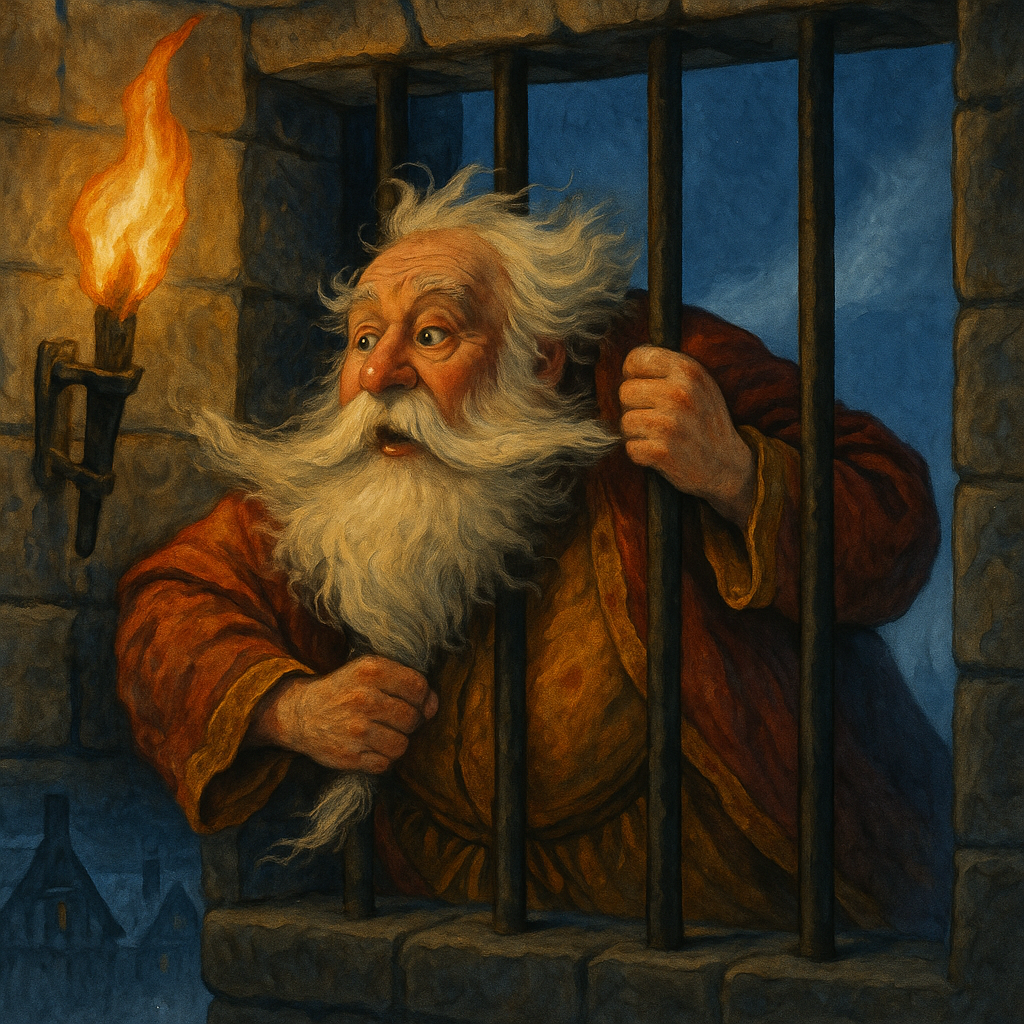
Crier: The poor old man, upon St. Thomas’s Day, was arraigned, condemned, and after conviction cast into prison amongst the King’s soldiers. Fearing to be hanged, or some other execution done upon him, he escaped through so narrow a gap between two iron bars of a window that nothing but his old grey beard and the hoary hair of his head was left behind, stuck in the bars — and nothing else of him to be seen. If you want those, you may negotiate for them, lest they be sold among the sequestered goods, or burned with the next lot of Popish pictures by the hand of the hangman.
Lady: But is old, good old Christmas gone? Nothing left but the hair of his good, grave old head and beard! Well, I will have that, seeing I cannot have more of him. One lock of it shall serve Mr. Woodcock for a keepsake. But what has come of his departure?
Crier: The poor are sorry for it. They go to every door begging as they were wont to do — “Good mistress, something for this good season!” — but times have changed. “Away, begone, there is nothing for you here.” And so they, instead of going to the alehouse to make merry, were made to work through all the holidays. The scholars came to the dining hall, where their hungry stomachs had hoped to find good brawn and Christmas pies, roast beef and plum porridge — but no such matter. “Away, you profane creatures — these are superstitious meats; your stomachs must be fed with wholesome doctrine.” Alas, the poor pale-faced chandlers — I met them mourning through the streets, complaining they could find no buyers for their mustard, for want of brawn to eat it with.
Lady: Well — if ever the Catholics or the Bishops rule again in England, they will set the church doors open on Christmas Day, and we shall have Mass at the High Altar, as was used when the day was first instituted — and not have the holy Eucharist barred out of school, as schoolboys lock their masters out against a holiday! What! Shall we keep our mouths shut to welcome old Christmas? No, no — bid him come by night over the Thames, and we will have a back door open to let him in. I will myself give him his keep for one year, to try his fortune this time twelve months. It may prove better.