Regina gazed despondently out of the window. A light snow was falling — glittering diamonds and pearls — but she saw none of it. Her Christmas tree hadn’t come.
It didn’t matter that the day was beautiful, that Christmas Eve was nearly here. Nothing mattered to Regina except the fact that she had promised her Sunday school class a glorious tree, and now there was none.
She told herself she should have known better than to rely on a New York shop to deliver a tree out to the suburbs on such short notice. But telling herself that didn’t help. The thought of facing twelve little girls whose smiles would crumple into disappointment was more than she could bear. The tears came, and fell.
When her vision cleared, she was looking directly at the little fir tree in the vacant lot next door. A rush of delight swept through her. After all — her children would have their tree.
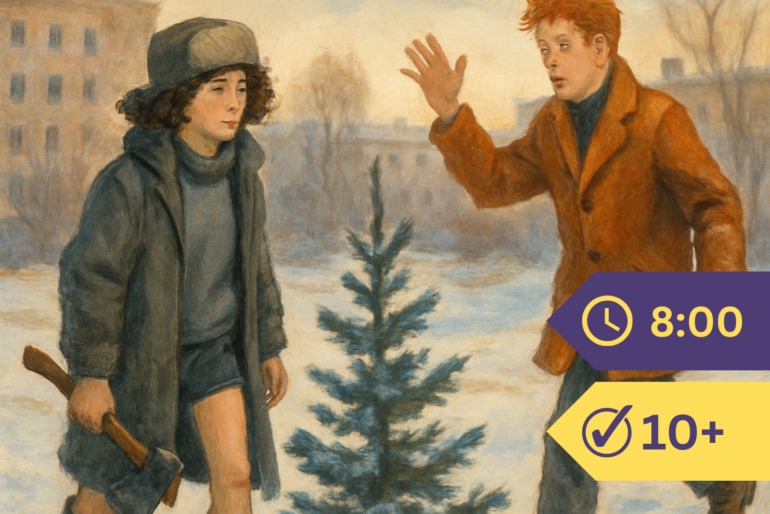
Fifteen minutes later, Regina appeared outside in full expedition costume: her gymnasium suit, high rubber boots, her father’s enormous overcoat. Over a riot of curls her snug fur cap fitted closely. She picked up a large tub in one hand, shouldered an ax with the other, and set off.
“You look exactly like your nickname,” her mother called after her, with some distress. “I do hope no one sees you.”
The nickname in question had been given by her father: Tommy. It stood for tomboy. Her mother found this undignified; her father was secretly proud of it, and with reason. Regina was distinctly capable. She could ride and swim, handle a shotgun and a casting rod, climb mountains and sail boats. She cared far more for the outdoors than for dances or social calls. Her idea of happiness was a camp in the woods.
“There’s no one for miles around,” Regina said cheerfully, and trudged off through the snow.
Her eyes were too intent on her mission to notice the thin curl of smoke rising from the chimney of the bungalow beyond the vacant lot.
She drew near the little tree and her heart expanded. “What a beauty,” she murmured. She set down the tub and began clearing the light snow from around the roots. Her cheeks were gloriously red.
When the snow was cleared, she swung the ax into the frozen earth. The ground barely yielded. She swung again.
“Hey! What are you doing to that tree?”
Regina dropped the ax and spun around. A man was standing on the bungalow veranda.
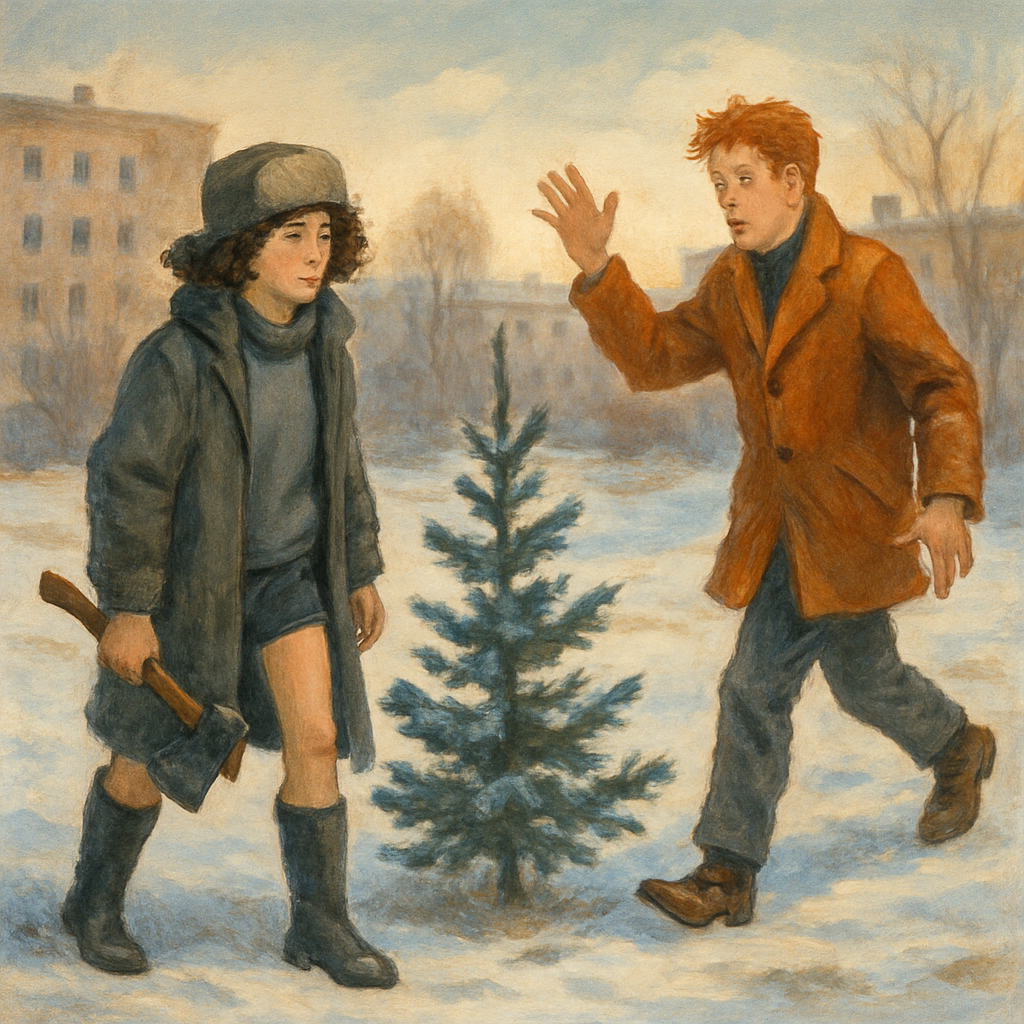
She picked the ax back up and swung it again, with great dignity.
“I say — that tree belongs to me!” He was coming toward her now.
“This is a vacant lot,” she said coolly.
The approaching man whistled, then quickened his pace. He made an involuntary movement to raise a hat that, in his haste, he’d forgotten to put on.
“I beg your pardon.” His voice had lost its gruffness. “I thought you were a man — but that tree is mine. I brought it up from my father’s garden in the South.”
David Langhorn spoke quickly. Regina’s face was rather startling in its beauty and he had a sudden wish to spare her embarrassment. “I’ve taken very special care of that tree.”
“Very special care,” Regina said coldly. “I’ve lived next door all summer and no one—”
“I’ve been away. Lately.”
“I don’t see why you leave small trees alone in vacant lots,” Regina said, the words coming in a rush, because she was on the edge of tears again and didn’t want him to see it. Her precious tree, snatched away.
“This is my lot,” Langhorn told her. “If you’d actually chopped it down—”
“I wasn’t chopping it down!” she said indignantly. “I was going to put it — very carefully — into this tub.” She pressed on, determined to make clear to this very good-looking man with the red hair that she was not a criminal. “I ordered a Christmas tree by express and it didn’t come. My Sunday school class — twelve little girls — are expecting a tree in my house tonight, and now—”
Words failed her. She bit her lip and looked up at him.
The man laughed, because it was the safest thing to do. “I’ve brought twelve little settlement boys down with the same promise — and not a tree have I got. I was counting on finding one in the village.”
Regina laughed, and the cold air rang with it. “I tried the department store.” She met his eyes. “I’m so sorry for the children. My class worked all last summer for this.”
“I once read about people who held Christmas outdoors,” David said. “Great bonfires, the tree hung with candles, and Santa Claus driving up over real snow. Couldn’t we do something like that?”
“With this tree! Oh, how perfectly glorious!” Regina began to clear a wider space around the roots. David took the shovel from her.
“My boys will do that — it’ll be the treat of their lives.” He looked at her seriously. “Go inside and warm up. This afternoon I’ll call properly. And this evening — Christmas Eve—” He didn’t finish with words. The hearts of both David and Regina were already overflowing with the same thought.
That evening, Santa Claus came driving through the crisp snow and flung open his great sacks before the little tree. It was a wonder tree there in the vacant lot, hung with a hundred electric bulbs. Six bonfires sent their flames leaping toward the sky, and around them danced and capered twenty-four joyful children.
They sang together in the cold clear air — their voices rising up, small and bright, toward the winter stars:
It came upon the midnight clear,
That glorious song of old,
From angels bending near the earth
To touch their harps of gold:
“Peace on earth, good will to men,”
From heaven’s all-gracious King.
The world in solemn stillness lay
To hear the angels sing.
When the moon was high and the spirit of Christmas had entered every heart, David and Regina gathered the children close and led the singing, song after song, until at last the voices trailed into silence and the fires began to settle, and the two found themselves simply looking at each other across the ember-glow.
“Don’t you think we should take the children in?” Regina said at last. “The fires are getting low.”
David was quiet for a long moment. Then he said, slowly:
“The fires will never burn low — Regina. This is the night when the great spirit of love was born into our world.”