Madam Angell was very old and Madam Angell was very poor. It had not always been so. Once she was young and fair, with all the joys and comforts of life around her; but one by one the joys and comforts had crept into the dark shadows of the past, and now all that was left to her was a shabby room in a corner of the old house that had once been all her own.
But in spite of everything that time had taken from her, there was one gift it had given her in return — a gift so beautiful that it is a pity time does not give it to us all — the gift of a contented and happy spirit.
As her losses had come to her she had had her cry, like every tender, loving woman, and then she had wiped away the tears and said in her gentle, quiet way that she was unworthy of the treasures the Lord had given her, and He could take care of them better than she could. Then she fell to counting the treasures she had left. So when the final blow came, and the house above her head was sold because she could not pay a bill or two, she spent the whole night wandering from room to room, thinking of joys that had gone. But when, next morning, the sun crept in at the windows, the smile crept back into Madam Angell’s eyes; and she cheerfully moved all that remained of her precious things into the corner room, and said it was quite the best thing that Mr. Crowdem should make the old place into a tenement-house. The neighborhood had gone down since she first came there, and the east room was quite big enough for her and her things, now that she was all alone. It would be more sociable, too, to have the house full of people.
And so she settled down in her one room, with her rag carpet, her patchwork quilt, her low rocker and a few odd bits of furniture and china, her Bible and her knitting needles — and grew poorer and more content and cheerful every year.
But in spite of the spirit of peace that brooded over her, there were some things that troubled Madam Angell.
Something troubled her today as she sat by her window and gazed out into the street.
It was December — and such a cold day. Madam Angell drew her faded shawl more closely about her. She had plenty of coal and wood, she said; oh, yes; but it was not necessary to keep a big fire, and she was quite comfortable with her shawl and a small blanket about her feet, thank you. So it was not the cold that was troubling Madam Angell. No; it was the thought of Christmas.
The windows of the little thread-and-needle store across the way were filled with all the gay odds and ends that announce the coming of Santa Claus — and against the glass, how many cold little noses were longingly pressed! How many blue fingers pointed out the dearest treasures!
Madam Angell’s heart ached for them.
“Poor dears! They won’t have much Christmas,” she said softly. “It makes me sad when I think of the Christmases my children used to have, and how they hung their stockings in the room the Mulligans occupy now. If only I had a little more than I have — just a little — how I would love to make a Christmas for those little ones!”
She looked sadly over at the shop window and shook her head. “Ah, no,” she sighed. “I have not been grateful enough for the Lord’s goodness to me, and He has taken away even the power of being useful to others. There is nothing I can do.”
She picked up her Bible and read the story of the widow’s mite.
“But I haven’t even a mite,” she said.
Then suddenly the smiles came back to her face with the warmth of winter sunshine, and she stretched out her hand for her workbag. True, she had no riches, not even a mite of money; but she did have her knitting needles.
She looked again across the street, and now there was not a shadow on her face. She could not give those shivering children the treasures in the shop window, but she could cover their blue pinched fingers with the power of her needles.
“I have all that red yarn that Miss Dawson gave me for a petticoat,” she said, making her way to a drawer in the old bureau. “I don’t really need the petticoat, I’m sure, and I know Miss Dawson won’t mind when I tell her. The poor dears need mittens so much, and children always like red.”
So Madam Angell put a scant half-shovelful of coal on her little fire, wrapped the blanket closer about her knees, and began to wind the yarn.
And so her Christmas work began. Day by day she sat smiling at her window, the knitting needles flying and the ball of red yarn growing smaller and smaller.
One morning Miss Dawson came in.
“So you’re knitting your skirt?” she asked, noticing the flying needles and the yarn.
Madam Angell paused, looking up a little guiltily over her spectacles.
“No, my dear, I’m not,” she admitted; and then, with many apologies, she made her confession.
“Now, you don’t mind, dear?” she asked at last.
Miss Dawson wiped her eyes.
“You needed the skirt,” she said. “But of course I don’t mind.”
So Madam Angell resumed her work cheerfully. Nearly every night she added to the little pile of mittens in the bureau drawer, and gave thanks for the happiness it brought her.
Christmas morning came, and the last bit of yarn had been used.
Madam Angell awoke to the chiming of church bells ringing in her ears. She arose and built her little fire and tidied her room and ate her very simple breakfast. Then she eagerly laid out the pairs of crimson mittens along the windowsill, and made ready to celebrate the day.
What a good time she was going to have! Her dear old face beamed as she wrapped the blanket about her and sat down by the window. People were passing on their way to church, and she watched their happy faces and wished she were strong enough to go too. Instead she took her Bible and read the story of the first Christmas again.
By and by the streets fell almost empty. That was what Madam Angell had been waiting for.
Pretty soon a little girl with an old shawl over her head came along and paused to look into the shop window. Then she turned away and crossed the street, as if in answer to the wish in Madam Angell’s heart.
The old lady quietly opened the window a crack and dropped a pair of mittens right at her feet.
The child started, picked them up eagerly, then looked anxiously — half fearfully — around her. Her eyes at last met Madam Angell’s, smiling kindly down from above.
“They are for you. Merry Christmas, dear!” called the sweet voice.
The child looked up in bewilderment, pulled the mittens on quickly, and hurried away — half laughing, half crying.
“Poor dear,” said Madam Angell softly. “She thinks it’s all a dream. Perhaps she has never had a Christmas gift before.” She would have liked to follow the poor child and comfort her.
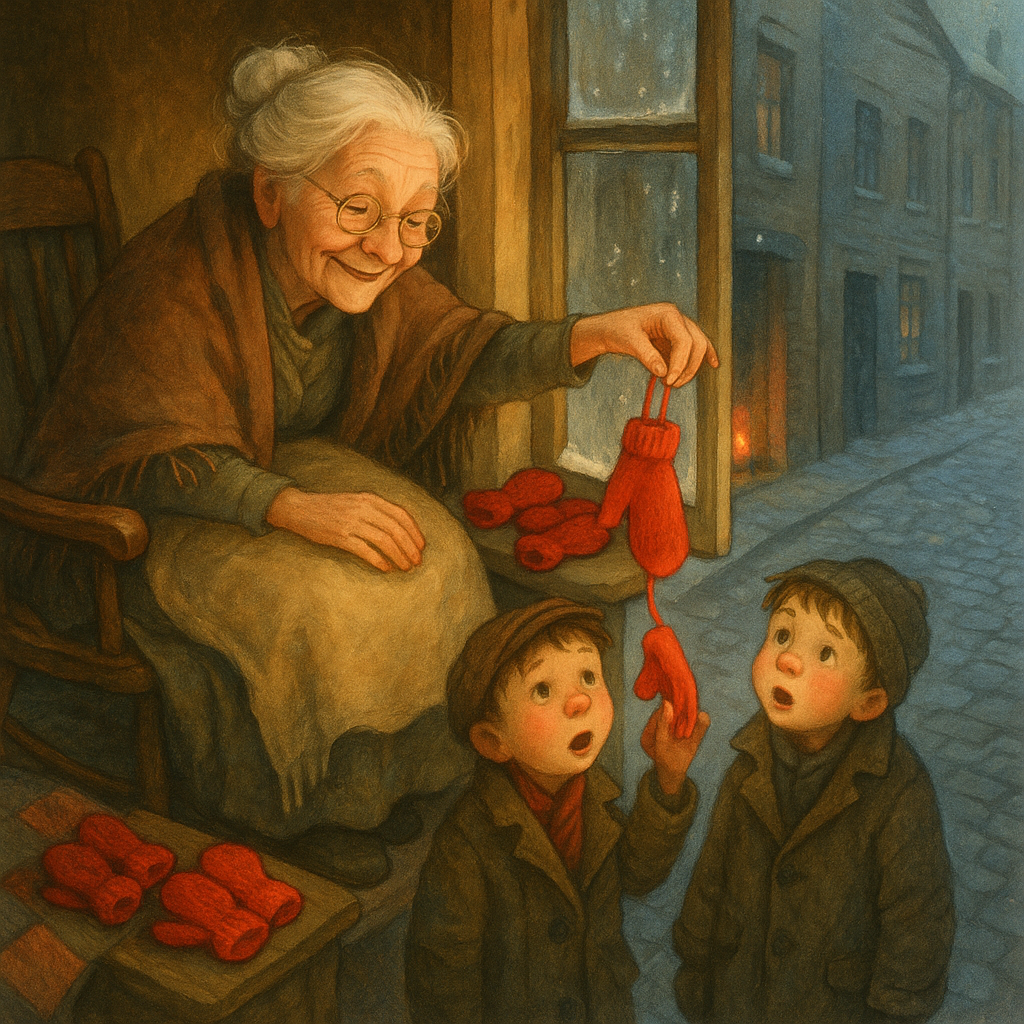
Soon two small boys came trudging up the street, their hands crammed deep into their pockets, their little noses purple with cold.
Madam Angell raised her window again, and dropped from it two pairs of mittens.
The boys came along and saw the crimson bundles lying on the pavement. They stopped in wonder; each gave a low whistle; then they picked them up and put them on. Suddenly there were two cries of delight, and the mittens were quickly pulled off again. Tucked in the thumb of each, the boys had found half a peppermint-drop!
They looked about in wonder and at last spotted Madam Angell nodding and smiling at them from her window.
“Merry Christmas, boys!” she called out.
“Oh, thank you, mum! Thank you! Merry Christmas!” shouted the lads joyfully.
Their shout attracted another boy, who ran across the street to see what was happening.
“Oh, Jim, isn’t this a bully Christmas!” cried one, holding up his crimson-covered hands; and before Jim could reply, a small crimson bundle fell at his feet too.
“Put ’em on, quick!” cried the others, as he looked about in astonishment. “See what’s in the thumbs!” — and they crunched their fragments of peppermint.
Jim obeyed, and another delighted cheer broke the Christmas stillness, and another beaming face was upturned toward Madam Angell’s window.
The dear old lady nodded and smiled again, and clapped her hands at the merry snowball battle that followed, telling herself that Christmas was a very happy day.
That afternoon, while Madam Angell was dozing in her rocker, she was startled awake by the soft sound of her door being closed — yet when she looked about, there was no one there. Then a gentle tap on the windowpane made her sit up straight in great surprise. There on the sill outside were two apples and a cracker.
How did they get there?
She looked out into the street, and from behind three trees she caught a gleam of crimson. A sudden mist dimmed her spectacles. She opened the window, took in the humble offerings, and smiled a heartfelt thank-you at the three trees.
The dusk settled and Madam Angell rose to put a handful of fuel on the dying fire. On her way back she stopped at the bureau, wondering if she had by any chance overlooked a pair of mittens. She opened the drawer — and started back in amazement. Where the yarn had lain a few weeks before, there now lay a beautiful warm crimson petticoat, fully knitted in a pattern so clever that Madam Angell could not this time convert it into mittens.
The old woman lifted it in her trembling hands and made her way back to her chair.
“A miracle,” she murmured, spreading it over her knees. “A miracle!” She covered her face with her hands and burst into happy tears.
By and by she leaned back, smiling calmly.
“Oh, what a happy Christmas!” she said, looking from the crimson skirt lying across her knees to the two apples and the cracker on the windowsill.
Then her eyes wandered out into the street, and she was not made the less happy by the sight of a small figure in an old shawl and crimson mittens gazing wistfully up at her window.
Madam Angell smiled down reassuringly, and the little face outside was lit, for a moment, with all the beauty that gratitude and love could give. Then it too vanished into the gathering darkness, and Madam Angell folded her gentle hands in prayer.
“Oh, how good God is to me,” she murmured. “Such a happy Christmas-day — such a happy day. How can Providence do so much for an old woman? I thank thee, I thank thee, Lord.”