It was on the twentieth of December that I received an invitation from my friend Mr. Phiggins, to dine with him in Mark Lane on Christmas Day. I had several reasons for declining. The first was that Mr. P. makes it a rule, at all festivals, to empty his counting-house into his little dining parlor; and one consequently sits down to dinner with six white-waistcoated clerks, let loose upon a turkey. The second was that I am not sufficiently well read in cotton and sugar to enter with any spirit into the conversation. And the third was, and is, that I never drink Cape wine.
But by far the most compelling reason remained to be told. I had been anticipating for some days—was hourly hoping to receive—an invitation to spend my Christmas Day in a most irresistible quarter. I was expecting, in short, the felicity of eating plum-pudding with an angel; and on the strength of my imaginary engagement, I returned a polite note to Mr. P., reducing him to the necessity of advertising for another candidate for Cape and turkey.
The twenty-first came. Another invitation—to dine with a regiment of roast-beef eaters at Clapham. I declined this also, for the above reason, and for one other: namely, that on dining there ten Christmas Days ago, it was discovered on sitting down that one little accompaniment of the roast beef had been entirely overlooked. Would it be believed! They had forgotten the horseradish.
The next day brought a neat epistle sealed with violet-coloured wax, from Upper Brook Street. Dine with the ladies—at home on Christmas Day. Very tempting, it is true; but not exactly the letter I was longing for. I began to debate within myself the wisdom of securing this bird in hand instead of waiting for the two still hopping about the bush—when the consultation was abruptly closed by a prophetic vision of the portfolio of drawings fresh from boarding-school (moths and roses on embossed paper), to say nothing of the album in which I stood engaged to write an elegy on a Java sparrow that had been the family favourite for three days. I rang for gilt-edged notepaper, pleaded a world of polite regret, and again declined.
The twenty-third dawned; time was getting on rather rapidly, but no card came. I began to despair and to repent my refusals. Breakfast was hardly over, however, when the servant brought up—not a letter—but an aunt and a pair of cousins from Bayswater. They would hear no excuse; family duty required me, and Christmas was no longer my own. Now my cousins kept no albums; they are really as pretty as cousins can be; and when white-gloved hands are laid on one, it is sometimes difficult to escape with becoming elegance. I could not, however, surrender my one great hope. We fought through fifty imaginary engagements. I showed them the Court Guide with ten names crossed out—those of persons who had neglected to ask me to mince-meat and mistletoe—and I ultimately gained my case by bestowing the remains of an infectious fever upon my aunt’s sensitive anxieties, and dividing a rheumatism and a sprained ankle between my sympathetic cousins.
As soon as they had gone, I walked out, sauntering involuntarily toward the only house in which I felt I could spend a truly happy Christmas. As I approached, a porter brought a large hamper to the door. A present from the country, thought I. Yes—they do dine at home; they must ask me; they know I am in town. A servant immediately appeared with a letter; he took the nearest way to my lodgings, and I hurried back by another street to receive the long-desired invitation. I was in a state of delirious delight.
I arrived—but there was no letter. I sat down to wait in a spirit of calmer enjoyment than I had felt for days; and in less than half an hour a note was brought to me. At last! The desired dispatch! It seemed written on the leaf of a lily with a pen dipped in dew. I opened it—and nearly fainted with disappointment. It was from a stockbroker who begins an anecdote about Mr. Rothschild before dinner and finishes it with the fourth bottle—and who makes his eight children stay up for supper and snap-dragon. In navigating a stray stone in one of his periodical Christmas puddings, I had once lost a tooth, and with it an heiress of some reputation. I wrote a most irritable apology and despatched my warmest regards in a whirlwind.
December the twenty-fourth. I began counting the hours and uttering poetical things about the wings of Time. No letter came—yes, one arrived, from a distinguished dramatist requesting the honour, etc. But I was too cunning for this, and practised wisdom for once. I happened to reflect that his pantomime was to make its appearance the very next night, and that his object was to rehearse the whole programme upon me at dinner. I immediately expressed regret that I could not have the pleasure of meeting the assembled literati.
My mind grew restless and agitated. I felt, amidst all these invitations, cruelly neglected. They served only to increase my uneasiness, opening prospects of happiness in which I could take no share—a most tempting dessert composed entirely of forbidden fruit. I took down Childe Harold and read myself into a sublime contempt of mankind. I began to perceive that merriment is only malice in disguise, and that the chief cardinal virtue is misanthropy.
I sat nursing my wrath until it scorched me, when another epistle arrived and charmed me from that state of delicious melancholy. I sickened as I surveyed it and trembled as I opened it. It was not the letter. In such a frenzy as mine—raging to imagine the object of my admiration condescending to invite me, perhaps to a tart made by her own ethereal fingers—how could I think of joining a “friendly party” where I should inevitably sit next to a deaf lady who had, as a little girl, been patted on the head by Wilkes or Lord North (she could not recollect which), had taken tea with the author of Junius but forgotten his name, and who once asked me whether Mr. Munden’s monument was in Westminster Abbey or St. Paul’s? I seized a pen. I hesitated—for the precariousness of my situation flashed upon me—but hope had still left me a thread to cling to, and I at last succeeded in resisting this terrible temptation.
After the first burst of excitement I sank into still deeper despondency. I could not eat; dinner was removed with the covers untouched. I went out. The world seemed to have acquired a new face; nothing was to be seen but raisins and rounds of beef. I wandered about like Lear—I had given up everything! I felt myself grated against the world like a nutmeg. It grew dark. Every chance seemed to have expired, and everybody seemed to have a delightful engagement for the next day. I alone was disengaged—I felt like the Last Man. Tomorrow had already commenced its career; mankind had anticipated the future; and coming mince pies cast their shadows before.
In this state of desolation I called—I could not help it—at the house to which I had so fondly anticipated an invitation. My protest must here be recorded: though I called in the hope of being asked, it was my fixed determination not to avail myself of so belated a piece of politeness. My triumph, had it come, would have been to crush them with an engagement made in September. With these feelings, I gave an agitated knock—they were busy stoning plums for the pudding and did not immediately attend. I rang. How unlike a dinner bell it sounded. A girl at last appeared and informed me, with a mouthful of candied peel, that the family had gone to spend their Christmas Eve in Portland Place.
I rushed down the steps, hardly knowing where. My first impulse was to find a wharf and inquire about vessels departing for America. But it was a cold night—I went home and threw myself on my miserable couch. In other words, I went to bed.
I dozed and dreamed away the hours until daybreak. Sometimes I fancied myself in a roaring circle roasting chestnuts at a blazing log; at others, that I had fallen into the Serpentine while skating, and that the Humane Society were piling upon me a very Vesuvius of blankets. I awoke a little refreshed.
Alas. It was the twenty-fifth of the month. It was Christmas Day. Let the reader, if he possesses the imagination of Milton, conceive my sensations.
I swallowed an atom of dry toast—nothing could calm the fever of my soul. I stirred the fire, then read from Zimmermann’s On Solitude, then stirred the fire again, alternately. Even reason—the last remedy one has recourse to in such cases—came at length to my relief: I argued myself into a philosophic calm. But just as that Lethean tide was at its height, my landlady broke in upon my lethargy and chased away every little comfort that had been prescribing balm for my wounds. She paid me the usual seasonal compliment, and then—“Do you dine at home today, sir?”—abruptly inquired she.
Here was a question. No Spanish Inquisitor ever inflicted such complete dismay in so short a sentence. Had she given me a Sphinx to expound, a Gordian knot to unravel; had she set me a lesson in algebra, or asked me the way to Brobdingnag; had she asked me to locate the North Pole, or explain the plot of a melodrama—any or all of these I might have accomplished. But to define my dinner—to inquire into its latitude—to compel me to fathom that sea of appetite now rushing through my frame—to ask me to become the prophet of pies and preserves!—My heart died within me at the impossibility of a reply.
She had repeated the question before I could collect myself. And then, for the first time, it occurred to me that my landlady was offering to invite me. “There will at least be the two daughters,” I whispered to myself. “And after all, Lucy Matthews is a charming girl, and touches the harp divinely. She has a very small, pretty hand, I recollect—only her fingers are much punctured from needlework, and I rather think she bites her nails. No: I will not even now give up hope. It was yesterday a straw—today it is thistledown—but I will cling to it to the last moment. There are still four hours left; they will not dine until six. One desperate struggle, and the peril is past.” The struggle was made. “I shall not be dining at home.” This was the only phrase available to me, for I could not say I should be dining out. I merely begged that if any letter arrived, it should be brought to me immediately.
The last plank had now given way. I was adrift with no hope but the chance of something almost impossible. I had passed one dinnerless day, and half of another; the promised land was as far from sight as ever. I recounted the chances I had missed. Mr. Phiggins and his six clerks—the Clapham beef-eaters—the charms of Upper Brook Street—my pretty cousins—the pantomime-writer—the stockbroker whose stories one forgets—the elderly lady who forgets her own: they all marched past me, a procession of apparitions. Even my landlady’s unborn invitation was not forgotten in the sum of my sacrifices.
And for what?
Four o’clock. Hope was perfectly ridiculous. I had been walking a hair-bridge over a gulf and could not reach Elysium after all. Despair was my only convenient refuge. No chance remained unless something should fall from the clouds—and in this last particular I was not disappointed, for on looking up I perceived a heavy shower of snow. Yet I was obliged to go out; for being supposed to have a dinner engagement, I could not remain at home. Where to go I knew not. I was like Adam expelled from Eden: the world was all before me. I flung my coat around me and hurried forth with the feelings of a bandit. At the foot of the stairs I staggered against two or three smiling rascals priding themselves on their punctuality, just arrived to dine on turkey. How I hated them. As I rushed past the parlour, a single glance showed me a blazing fire with Lucy and several lovely creatures arranged in a semicircle before it—and fancy, too, gave me a glimpse of mistletoe overhead. I vanished from the house like a spectre at daybreak.
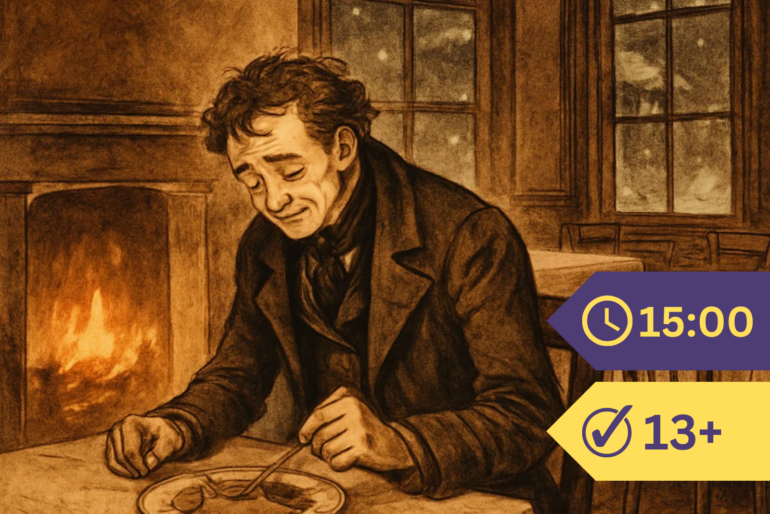
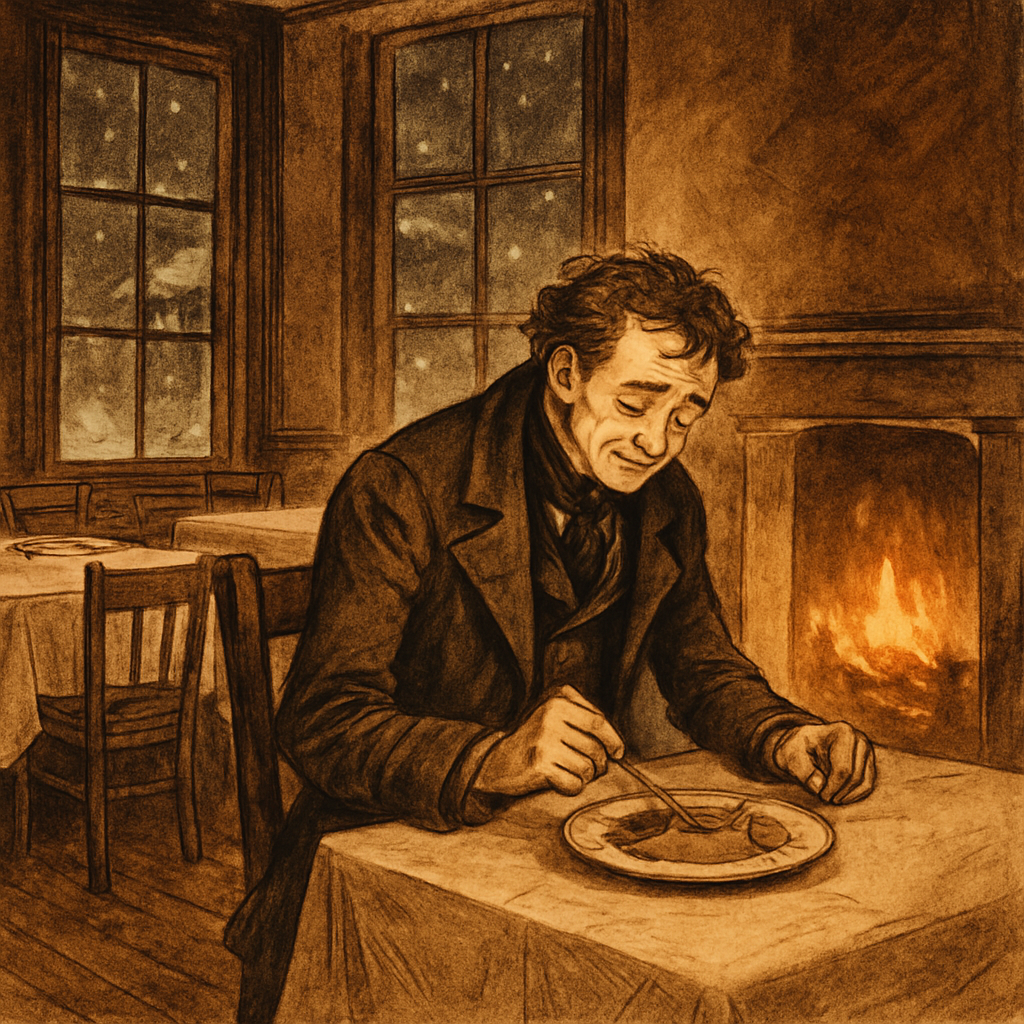
How long I wandered is uncertain. At last I happened to look through a kitchen window and saw a man with a fork in his hand throwing himself back in his chair, choked with ecstasy. Another feasted with a graver air, seeming to swallow a morsel of Paradise and criticise its flavour. This was too much for mortality—my appetite fastened on me like an alligator. I darted from the spot, and a few yards further discerned a house with an elegant exterior and some ham in the window that looked perfectly sublime. There was no time for deliberation—to hesitate was to perish. I entered; it was indeed a banquet-hall deserted. The very waiters had gone home to their families. But there I found a fire; and there—to sum up all my folly and felicity in a single word—
I DINED.