“My dear,” said Mr. Grapewine, over the dinner table, about a fortnight before Christmas, “how many days to Christmas?”
Mrs. Grapewine counted on her fingers, looked a little uncertain up towards the ceiling, and at last applied to the calendar on the wall behind her.
“Week and six days,” she announced. “Comes on Thursday.”
“True,” said Mr. Grapewine, and he fell to finishing the remains of his meal — a very savory mixture, which he swallowed with an amazing relish.
“There!” said he, after the last sip of coffee. “I believe I don’t want another thing to eat till Christmas Day. Mrs. G., you have the art of concocting the most appetizing meals. I never seem to get enough of them.”
“Two a day!” suggested Mrs. Grapewine, in her sharp manner.
“No, no, no! Mrs. G., you are an experienced cook, that I confess. But there is a delicacy in the thing which two such meals a day would utterly destroy. You misunderstand me. It is the expectancy — the snuffing up of the fumes beforehand, the very consciousness of your inability to cope with it — which makes such a meal delicious. Two a day would leave a man no chance to get properly hungry. That’s the point. It is the preparation, the deferred hope, which render a good dinner one of the completest luxuries of life. The hungrier one is, the more prolonged the satisfaction of the palate. I don’t think I have ever been hungry to the fullest extent of my capacity in my life.”
“Trip across Sahara!” put in Mrs. Grapewine.
“Yes, that would do, my dear; but I think we could accomplish it at home by artificial means. Fasting would not do — the appetite would at last grow unable to discriminate. Drugs would enfeeble it. (I’ll thank you for another cup of coffee, my dear. Ah — delicious cup of coffee!) There is really no direct stimulant that I know of; but I think we could intensify the appetite by a little course of diplomacy. Let us eat frugally — sandwiches, crackers and cheese, potted meats — for the next two weeks; and, if you please, cook us at each lunchtime, as a sort of stimulating accompaniment, some fragrant dish — roast beef, stuffed leg of lamb, roast turkey, codfish, anything with a fine smell — which we shall smell, but not taste. Don’t you see, madam?”
“No!”
“Don’t you see that our stomachs will yearn for these strong delicacies, and, going unsatisfied, will relish them all the more when we at last attack them?”
“No!”
“You have something to propose then, my dear. What is it?”
“Turkish bath!”
“What a woman you are. A Turkish bath! How, Mrs. Grapewine, can a Turkish bath tickle a man’s appetite? How can a Turkish——”
“Empty stomach.”
“Ah, now I begin to see: a Turkish bath on an empty stomach. Yes, yes — very good. But perhaps if we tried my plan and yours together, we should arrive at the ideal appetite. I think a Christmas feast composed of guests each with such an appetite would be nearly the greatest pleasure we can know. Well, well, madam, let us think of it,” and, saying this last to the tinkling of the little silver bell announcing that dinner was quite through, Mr. Grapewine got up from the table, untucked the napkin from his collar, and yawned, stretching his arms over his fat, rosy head as he made his way to the door.
Mrs. Grapewine’s step was like her conversation — sharp and decisive. She took her husband’s arm and led him, still yawning, to the sofa in the library, where she set herself opposite him, ready to hear his plans.
“Let us have a Christmas banquet, my dear,” said Mr. Grapewine, rubbing his eyes steadily.
“Who?” said Mrs. Grapewine.
“Why, Totty and his wife, and Colonel Killiam, and — and Dr. Tuggle and his lady, and old Mrs. Gildenfenny and — and——” Mr. Grapewine snored.
“Who?” said Mrs. Grapewine, rather more loudly.
“And — and — Pill.”
“Who’s Pill?”
“Why — oh, I mean your poor cousin Pillet. It would be a kindness to him, you know.”
“Yes,” said she.
“Will that be enough? Let me see — that is seven, nine with us two.”
“Quite enough,” said she.
And so Mr. Grapewine, rousing himself, rose from the sofa, put on his hat and coat, and went out to his business.
He was full of the idea. He talked about it to his clerks at the store. He peered into restaurant windows, humming a tune in the excess of his delight. He paused at bakers’ windows and confectionery shops, and a whiff of frying bacon from a little blind alley he passed almost set him dancing. Indeed, Mr. Grapewine was a man of juvenile impulse. In figure as well as character he seemed rather to have expanded into a larger sort of babyhood than to have left that stage of life behind him. His face was broad and rosy and clean-shaven, his hands round and dimpled, and his body chubby to a remarkable degree. Once an idea took possession of him, he was its slave until another conquered and enslaved him anew. But, really loving good cheer above everything else, his latest notion tickled him into laughter whenever it entered his mind. It was the happiest idea of his life.
“Why, sir,” he said to his bookkeeper, “I think if a man would practise my system he could easily eat a whole turkey — not to speak of other dishes — at a single meal. Magnificent idea, William! I wonder no one ever thought of it before. Wonderful!”
“A little bilious, sir,” said William.
“Bilious! Bilious! Why, my man, how can anything produce biliousness in an empty stomach? No — it may bring inertia, the Lotus does that, but never biliousness.”
In the evening, Mr. Grapewine visited the Turkish baths and learned all about them before he went home. He encountered another idea on his way there, and was captured by it without resistance. He could not — it would never do — it would not be courteous to eat so plentifully in the presence of guests whose appetites were merely natural. Nor could he well ask them to take the same stimulating course he proposed for himself. But they could take a Turkish bath, and it would be quite a neat social device to enclose a ticket for a bath with each invitation.
“There, madam!” he said to Mrs. Grapewine. “I think that’s perfect. We shall have the heartiest, merriest dinner on Christmas Day that man ever devoured. Bring pen and paper, and I’ll write to all the guests immediately.”
After a moment’s scratching of the pen, Mr. Grapewine leaned back in his chair and held the sheet at arm’s length, reading with strong emphasis as follows:
“Dear Captain Killiam — Mrs. Grapewine and myself would be most happy to have you join a small company of friends at our house on Christmas Day, for dinner, at one p.m. The affair will be quite informal, and, to add to the thorough enjoyment of it, I enclose a coupon for a Turkish bath, which please use on Christmas morning before the hour named.
“Yours, sincerely,
“George Grapewine.”
By the next morning, Mr. Grapewine’s invitations had found their way to the breakfast tables of all his expected guests.
Mr. Pillet’s breakfast table was the top of a flat trunk, and to find its way there the invitation had to climb three pairs of stairs. Mr. Pillet was a writer, and his income was by no means as great as his ability — a disparity he had often to point out in the lives of other writers, because this was his one way of accounting for his own want of success. He did not write books, to be sure. He only wrote poetical advertisements. But they were printed and paid for, and this gave him a sort of prestige among his less lucky friends. He was seedy, only moderately clean, and wholly unshaven, thus avoiding — by one happy invention — both soap and the barber. Fierce he was to look at, with his rugged beard and eyebrows, and fierce in his resentment of the world’s indifference. A Christmas invitation to the Grapewines’ made his eyes glisten with delight: a good dinner, guests to tell his tale to, and women — lovely women — who would sympathize with his unrequited hopes. He read on:
“I enclose a ticket for a Turkish bath——”
“Great heavens!” he cried. “What can this mean?”
He read the words again, and then read the coupon.
“Insulted! Insulted by a man I have ever befriended. He must apologize. I’ll shake the words from his throat. I’ll — I’ll not eat another mouthful till I have his apology! Turkish bath! Why——” and Mr. Pillet walked violently up and down the creaking floor of his apartment, gesticulating, with the open note in his hand. He did not finish his breakfast, but put on his hat — perhaps forgetting an overcoat — and hurried downstairs.
Colonel Killiam took breakfast at the Furlough Club. He perused Mr. Grapewine’s note with majestic condescension and decided to attend the dinner, where those present would naturally recognize his superior rank. Each sentence he read was sandwiched between two sips of chocolate, and he reached the closing clause only by slow degrees. When he got that far, the Colonel started to his feet and sternly summoned the waiter.
“Ask Major Fobbs to call at my table as soon as he can.”
The waiter obeyed, and Major Fobbs followed him back to the Colonel’s table.
“Major,” said the Colonel, “will you please read those words aloud?”
“T-u-r-k-i-s-h b-a-t-h,” read the Major. “Turkish bath.”
“Thank heaven, I am still rational!” said the Colonel. “I feared reason was dethroned. Thank you, Major. Good day,” and Colonel Killiam strode out of the room, rigid with indignation.
Old Mrs. Gildenfenny received her invitation at a breakfast table that stood against her bedside. The note was handed in by an aged servant, who then leaned over her mistress’s shoulder to help her read it. Mrs. Gildenfenny was an energetic old lady; but she loved, most of all things in the world, her idle hour in bed of a morning with a smoking meal of hot cakes and coffee at her elbow. She disliked, most of all things in the world, being robbed of this comfort, and she despised the person who committed such an offence with a vehemence that was her chief characteristic. The two old women read the note aloud in unison, with now and then a pleased comment. Mrs. Gildenfenny announced she would wear her green silk, and gave directions, as she read on, about her shoes, her hair, her linen, and twenty articles of her toilet that came into her mind at the mention of dining out.
“Lord a mercy!” says Mrs. Gildenfenny, when she had read a little further. “Lord a mercy! If I’m not decent, why does he ask me? Why doesn’t he say at once, ‘Please wash yourself before you come, and if you can’t afford soap and water, here’s a ticket’? Susan, help me up! Dress me right away — I must have this explained.”
“But your breakfast, ma’am,” says Susan.
“Eat? Eat? With such a thing on my mind? No! I’ll go to his house at once!” and in a few moments Mrs. Gildenfenny went out too.
Mr. and Mrs. Totty were served with their invitation over a breakfast table where meekness and humility were administered along with the rolls and poured out with the weak milky tea of the little ones. The meal was a solemn ceremony, where discourses on duty and against excess of the palate were often the only seasoning present.
Mr. Totty would paint the miseries of the glutton, and Mrs. Totty those of the dyspeptic, in words of such eloquence that milk-and-water acquired an air of priceless moral value — though they never succeeded in strengthening its nutritive effects. While the eldest Totty had answered the postman’s knock, Mr. Totty was warning his youngest son that butter on bread was a pitfall through which he must eventually arrive at a state of depravity too dreadful to be named. He opened the envelope very deliberately, supposing it to be a bill, but with a smile on his benevolent face that showed a spirit of patient forbearance. As he read the opening lines, the smile passed through the stages of surprise, gratification, appetite, eagerness — and then settled into doubt. He laughed in a gently sour way, and said:
“My dear, Mr. Grapewine invites us to a Christmas dinner, which, of course, we could not attend——”
“Why not?” exclaimed Mrs. Totty, eagerly.
“Which it would do gross injury to our principles to attend,” continued Mr. Totty. “I will call on him with our refusal this morning, myself.”
Mrs. Totty resignedly helped him on with his overcoat, and submitted to the mildly spoken decree that was law in the house of the Tottys. In a short time her husband went out with the invitation in his pocket and a look of unusual benevolence in his eyes.
Dr. Tuggle and his wife read the invitation together and fell to quarrelling so dreadfully about the purport of Mr. Grapewine’s singular request that the Doctor rushed from the house, threatening to pull Mr. Grapewine’s nose and to divorce himself forever from his hateful spouse.
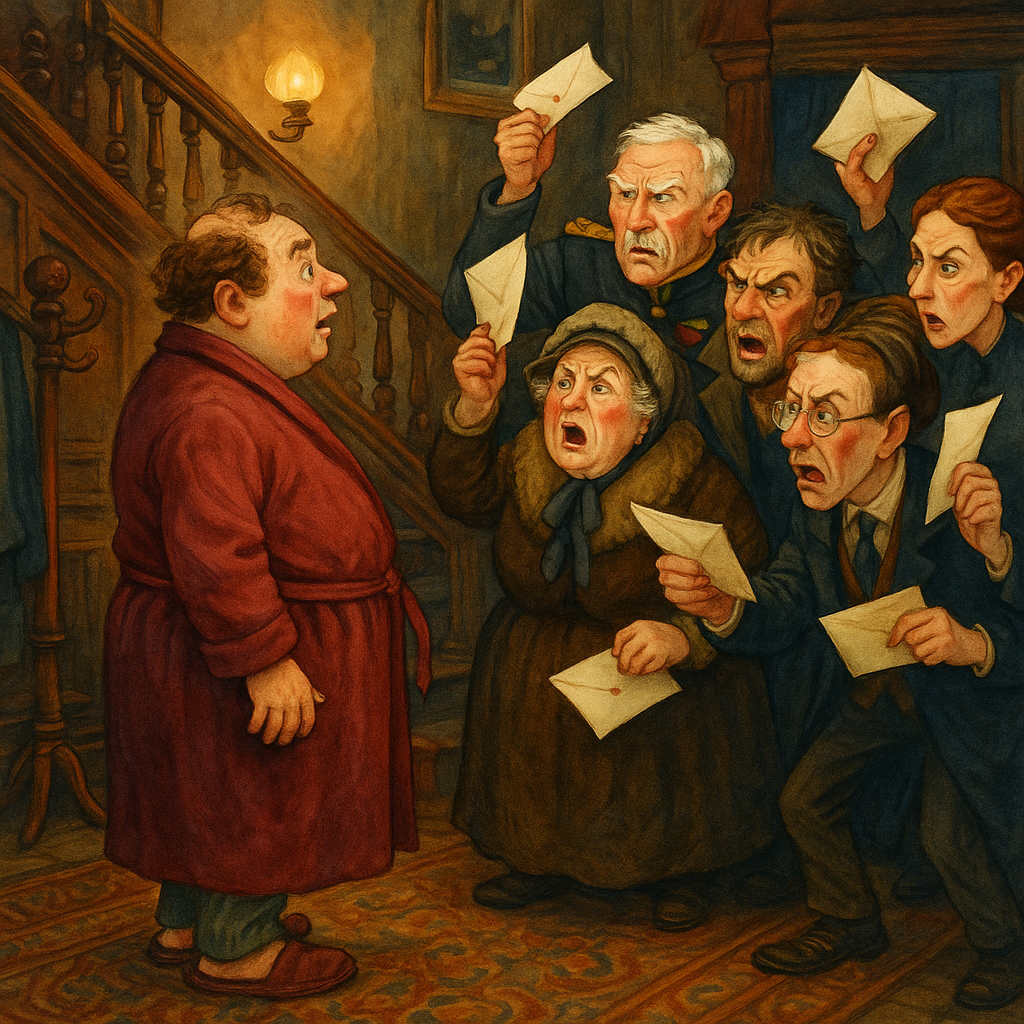
On this same morning, Mr. Grapewine’s bell was rung five times at very short intervals, in the most tremendously violent manner, and five loud altercations broke out in the hall between the servant and the five callers.
“Where is he?”
“Bring him down, or I’ll go up after him!”
“What does he mean by it?”
“Insult a respectable lady!”
“Let me catch him, that’s all!”
“Where has he gone?”
“I’ll send him a challenge by Fobbs!”
“Where’s his wife?”
This was what Mr. Grapewine, listening at the top of the stairs, heard in a confused tumult below. He could not understand it. He was extremely agitated, but the servant insisted on his going down, and he did so, clad in a loose morning robe and slippers. As he entered the parlor he was met by four furious gentlemen and an elderly lady, flourishing his invitations in their hands and crying hotly for explanations.
“What do you mean, sir? What do you mean by alluding to my — my personal hygiene in this impertinent manner?” demanded Colonel Killiam.
The light began to dawn on Mr. Grapewine’s puzzled understanding. He confessed his mistake at once, and would have urged them all to forget it and come to the dinner as if nothing had happened — but before he could do so he found himself alone in the room, with five rejected invitations on the floor at his feet, and nothing but the memory of one of the best ideas he had ever had in his life.