Long ago, and far from here, in a country with a name too hard to pronounce, there lived a little boy named Jean — which is only another way of saying John, and there are plenty of Johns in the world. Jean lived with his auntie, for his father and mother were dead. In some ways, that made him not so different from other boys. But his auntie was very, very cross, and she often sent him up the ladder to his little garret room to sleep on his pallet of straw without any supper, with nothing but a dry crust to take with him. His stockings had holes in the heels and toes and knees, because his auntie never had time to mend them. His shoes would have worn through long ago if they hadn’t been such strong wooden shoes — for in that country, all the boys wore wooden shoes. Jean chopped the wood and swept the paths and made the fires and ran the errands, but he never heard anyone say thank you.
Jean’s happiest days were at school, which stood beside the big church in the middle of town. His schoolmates wore better clothes and warm coats, but they never made fun of Jean — they all loved to play with him.
One morning Jean arrived at school and found the other children dressed in their finest, buzzing with excitement. “Won’t it be jolly tomorrow,” one boy said, “with the big tree full of oranges and popcorn and candy and candles?” And another called out, “Won’t it be wonderful to find the goodies in our shoes in the morning?” And a third smacked his lips and said, “We have a fat goose at our house, stuffed with plums and roasted brown as you please.”
Jean listened quietly. He thought about a beautiful tree and wished one would grow at his house. He thought about his wooden shoes and knew there would be no goodies in them in the morning. Then one of the boys asked, “Don’t you love Christmas, Jean?”
“Christmas?” Jean said. “Why — what is Christmas?”
But just then the teacher came in and said, “Boys, come into the church now and hear the music.” And so the children filed in one behind the other and took their seats in the great church. Jean thought it was the most beautiful place he had ever seen — the soft light, the warm air, the flowers, the marble altar. And then the music began. He had never heard music like that, and somehow, though he couldn’t have explained why, his heart grew warm and still as he listened to the voices singing: Peace on earth, good will to men.
The words began to sing themselves over and over inside him, those sweet words — Peace on earth, good will to men. When school was let out, the boys shouted, “Good-bye, Jean! Merry Christmas!” And though Jean still didn’t know what Merry Christmas meant, he walked home with that song in his heart, and he found he was glad — genuinely glad — that the other boys could have their trees and their geese and their wooden shoes full of goodies, even if he couldn’t.
The snow began to fall as Jean ran home, big soft flakes settling on his shoulders and cap and hands. But he didn’t mind the cold, for his heart was so warm.
Then, as he came down a street of tall houses, he stopped.
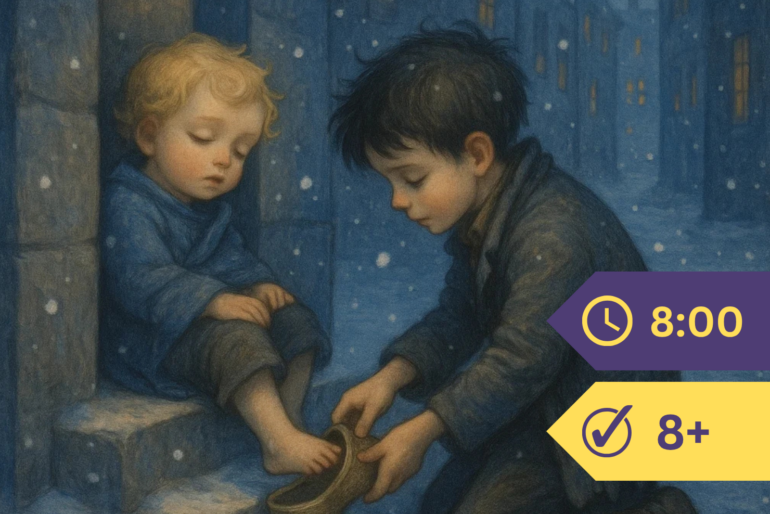
There on the bottom step of a stone stoop sat a little boy with soft curling hair and a beautiful face, leaning his head against the wall, fast asleep. Jean stood and looked at that sleeping face, and something in him grew very still and quiet. He stood there a long moment without moving, and then heard himself singing softly under his breath: Peace on earth, good will to men.
He looked down. The child was barefoot. His small feet were purple with cold.
Jean looked at the feet, and then at the lovely sleeping face, and thought about the song in his heart. I wish I could give him my shoes, he thought. I have stockings to keep me warm. But auntie would be so angry.
He stood there thinking, and the more he thought, the more he longed to give those shoes away. At last he made up his mind. I’ll give him one shoe and one stocking. Then he won’t be so cold.
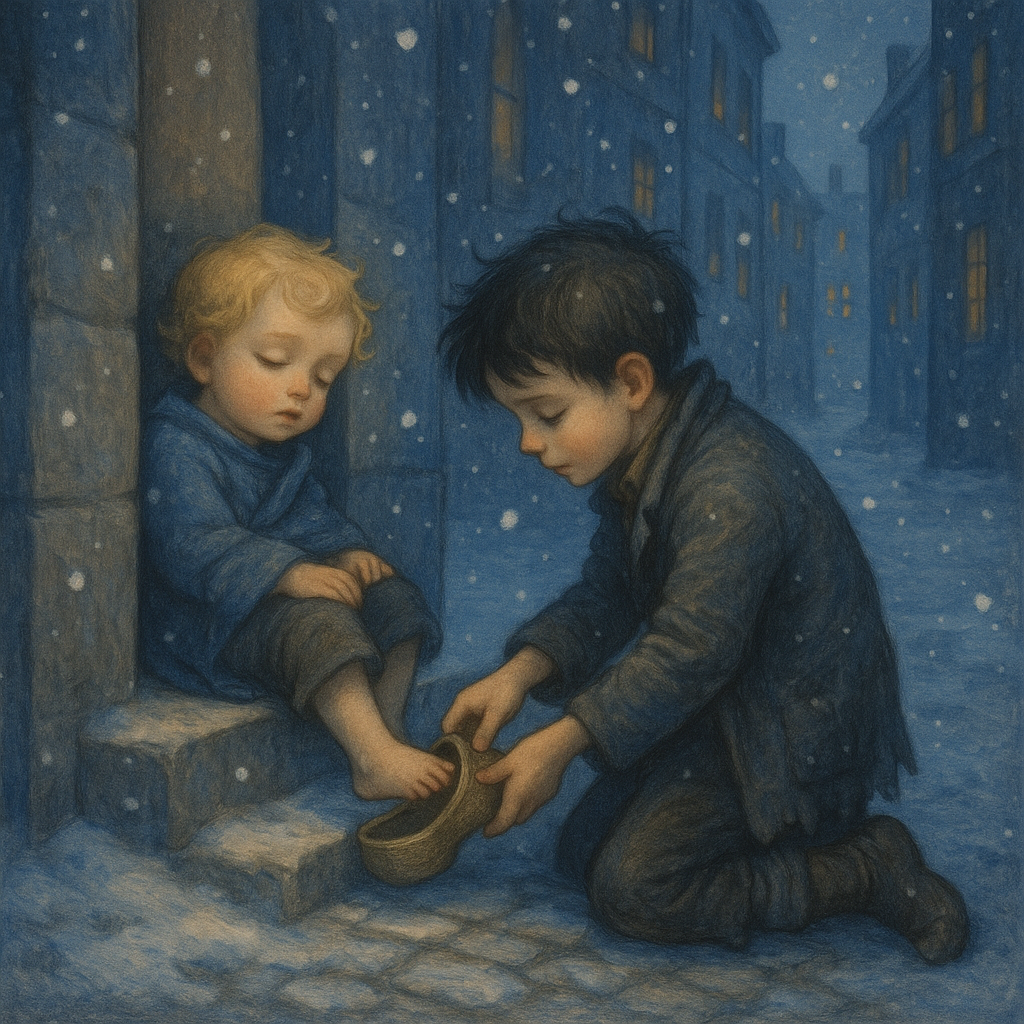
He could barely get them off fast enough. So gently did he lift the little cold foot and slip on the shoe, so carefully did he draw the stocking onto the other foot, that the sleeping boy never stirred. Jean stood up and took one last look at the lovely face. Then, before he knew it, he was singing aloud — Peace on earth, good will to men — and he hopped away home through the snow on one shoe and one bare foot, with the happiest heart he had ever known.
Now, I wish the story went differently from here. I wish his auntie had smiled when he told her what he’d done and said, I’m so glad, Jean. But she was a very cross woman, and she slapped him and sent him off to bed without supper, saying, “You had no right to give away that shoe and stocking — my money paid for them.”
Somehow Jean didn’t mind going without supper that night. He climbed his ladder and lay down on his straw and fell quickly asleep, and he dreamed a beautiful dream. He was still singing — Peace on earth, good will to men — and in his dream he saw again the little sleeping boy on the step, but the child had grown into a tall and gentle man with a radiant face, who walked to and fro in the dream, singing with him: Peace on earth, good will to men.
Then morning came. Outside his window, Jean heard children’s voices singing as they ran down the street. And he heard something else — something strange. His auntie’s voice, but soft and gentle, said: “Jean. Wake up. Come down and see what has happened.”
Jean came down the ladder. There was a wonderful tree, just like the ones the other boys were having today. There was a goose. And there by the fireplace stood his own wooden shoe — and beside it, the mate he had given to the sleeping child. In the distance the children’s voices floated through the winter air: Peace, peace on earth, good will to men.
The room grew very still. And through that stillness there came a voice — tender and loving, so gentle that the auntie’s eyes filled with tears and Jean wanted to listen forever — and the voice said:
Jean — inasmuch as ye did it unto one of the least of these, my brethren, ye did it unto Me.