It was very strange, thought old Joseph Golding, that he couldn’t master his own mind. He had lived a great many years, and neither remorse nor memory had ever been in the habit of disturbing him. But now it seemed as if the very foundations of his life were breaking up.
He was well through with his day’s work. He had dined comfortably. He sat in an easy chair in his luxurious drawing room, its crimson hangings shutting out the still cold of the December afternoon, with nothing to do but enjoy himself. Mr. Golding liked to enjoy himself at this season as much as anyone—it was Christmas Eve, after all. That he was in the habit of spending it alone was simply because he liked solitude. Or perhaps because nothing livelier had ever come his way, and he was too shy and proud to look for it.
For many a year on Christmas Eve he had sat balancing the accounts in his mind—the coffers accumulating at the bank, the business strokes he would make in future. Not so now. The year was drawing to a close, and some intruding voice kept whispering that his career was drawing to a close in the same way. He could not put the voice from him, try as he would. It reminded him of a time coming when his life’s work would be all done—even as his day’s work was done now—when he would sit down in the evening and look over the balance-sheet of his deeds, good and evil. Curiously, the old days came trooping in slow procession before him. He had been able to forget them for so very long.
His dead wife. He had not loved her much when she was alive, but how vivid was his memory of her now. He could see her moving through the house, noiseless as a shadow, never intruding after he had once or twice repulsed her gruffly, going on in her own quiet, meek ways with her face growing whiter every day. He began to understand, looking back, why her strength had failed; and when her baby came, she had been ready to float out on the tide and let it drift her into God’s haven. She’d had enough to eat and drink. But he saw now that he had left her heart to starve. Heaven—what a hard man he had been. He seemed to see her white still face as he had looked at it the last time, before they screwed down the coffin lid, with the dumb reproach frozen on it; the eyes that would never plead vainly any more, closed forever.
He recalled how passionately the three-days-old baby had cried in another room just at that moment, moving all the mourners gathered together with a pang of pity for the poor little motherless creature. She was a passionate, wilful baby, all through her babyhood; he remembered that. She wanted—and missed, without knowing what the lack was—the love and sustenance her mother would have given her, and protested against fate with all the might of her infant lungs. But as soon as she was old enough to understand how useless protest was, she had grown quiet too, just like her mother. He recalled her all through her girlhood: shy, still, always obedient and submissive, but never drawing very near to him. Why? Because he would have repulsed her as he had repulsed her mother. He could see that now. He had been a cold, hard man, without sympathy for any human being, absorbed utterly in the pursuit of money. And so the child, Amy, had grown up in shadow without him.
But suddenly, when she was eighteen, the old passionate spirit must have awakened again—for she fell in love, and wished to marry. To marry in defiance of his wishes. He remembered her standing proudly before him after one of their quarrels, when he had been harsh and bitter about the man she wanted to call husband. She had borne reproach of herself in silence; but not of the man who had become everything to her. Her words came back to the old man now.
“Father, do you know anything against Harry Church?”
“Yes,” he had answered, wrathfully. “I know that he is as poor as Job was when he sat among the ashes. He cannot keep a wife as a daughter of mine must be kept.”
“Anything else, Father?” She had looked him steadily in the eye.
“No, that’s enough. And I’ll tell you besides—if you marry him, you’ll lie in the bed you make. My doors will never open to you again. Never.”
He had met a will as strong as his own, that time. She did marry Harry Church, and went away from her father’s house. Mr. Golding had known the day the wedding was to take place, and disdained to stop it. He washed his hands of Harry Church, and of Amy his wife. She wrote home afterwards, over and over again, but Mr. Golding sent every letter back unopened. After that they disappeared from the town, and he had never heard what became of them. It was ten years ago now.
It seemed very strange that all this should have come back tonight to haunt him—and with a wild remorse, a pitying regret. He had done nothing to recall it. Could it be his sense of failing health that brought it back? If so, what sort of anguish might he not look for as he drew nearer and nearer to the end? He began to wish he knew what had been in those unopened letters—whether Amy had been suffering for anything that money could supply.
He turned it over in his mind. It was true that Harry Church had been only a clerk in his employ, but he was a well-educated gentleman who would rise with time—faithful, intelligent, persevering. He was rich then, Joseph Golding; he was far richer now. But what good were his riches bringing him? He was an old man, life running quickly on, and he was all alone. Who would take his gold when he was gone? He could not carry it along with him. All in a moment—he saw it clearly—the dreadful truth stood naked before him: his life and its object had been mistaken ones.
“All alone, all alone,” he kept saying to himself, in a sort of vague self-pity. “I’ve toiled and worked for nothing.”
But even as he sat there, a message of love was on its way to him. Perhaps Heaven had but been preparing his heart to receive it.
He heard a ring at the doorbell, and paid no attention to it. Rings were nothing to him; people did not come on business to his residence, and of visitors he expected none. His head sank lower and lower with the weight of thought.
Meanwhile two people were admitted into the hall below: a man and a little girl. The man had the appearance of a staid, respectable servant. He took off the child’s warm cloak and hood, and she stood revealed—a dainty, delicate creature of some eight years old, with golden curls drooping softly round her face, large blue eyes, and cherry lips. The admitting maid, not knowing what to make of this, called Mr. Golding’s housekeeper, old Mrs. Osgood. She came forward—and went into a tremor the moment she looked at the child’s face.
“It’s Miss Amy’s child!” she exclaimed to the man, hardly able to keep her voice steady. “I couldn’t mistake the likeness.”
“Miss Amy’s that was,” he answered. “Mrs. Harry Church she has been this many a year.”
“I know. It is as much as my place is worth to admit any child of hers here.” But she made no move to send the little girl away.
“You are Mrs. Osgood,” said the child, with a certainty that needed no answer. “Mamma said I should be sure to see you.”
“Hear the blessed lamb. And so she remembers me.”
“She talks of you often. She says you were always kind to her. Nobody but you loved her.”
“Well, I did love her. The old house has never been the same since she went out of it. What’s your name, my pretty one?”
“Amy.”
“Amy!” repeated the housekeeper, lifting her hands.
“And mamma said you would let me go up alone to grandpapa.”
“And so you shall,” decided Mrs. Osgood, after a moment’s hesitation. “I won’t stand in the way of it, let master be as angry with me as he will. He is up in the drawing room, all by himself.”
The man sat down to wait. And the child went up alone.
Opening the door, she went softly in, not speaking. Perhaps the stern-looking old man sitting there with bent head awed her to silence.
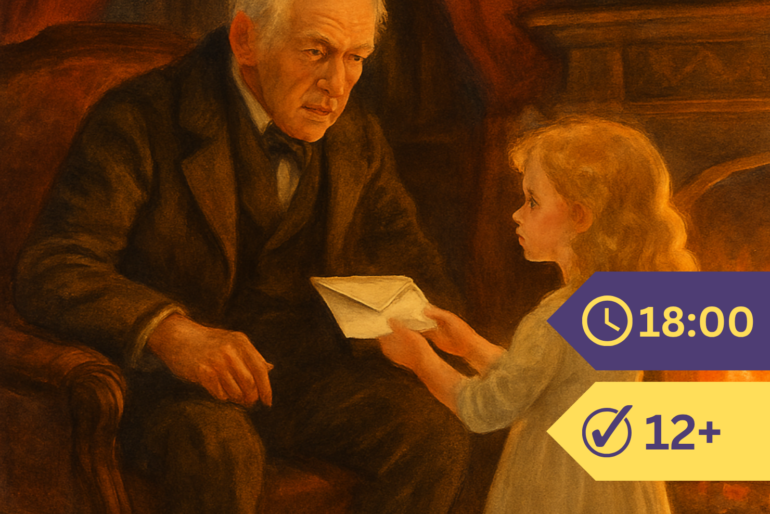
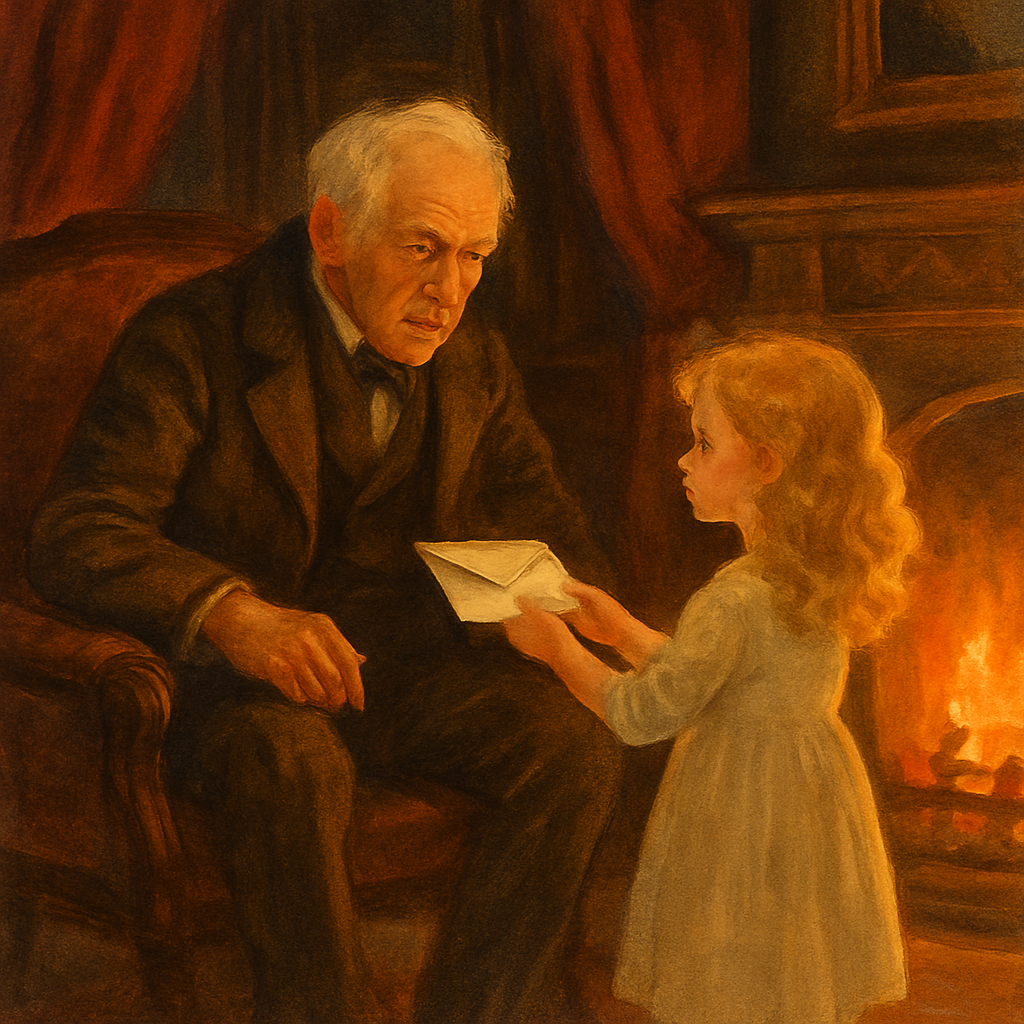
Joseph Golding, waking from his reverie, saw a letter held out to him. He took it mechanically, supposing its bearer was one of his waiting-maids standing behind the large chair. With a singular quickening of pulse, he recognized his daughter’s handwriting.
She had waited all these silent years, she told him, because she was determined never to write to him again until they were rich enough for him to know she did not write from any need of his help. They had spent these ten years in the West, and Heaven had prospered them. Her husband was a rich man now, and she wanted from her father only his love—wanted only that death should not come between them, and either of them go to her mother’s side without having been reconciled to the other.
“How did this come here? Who brought it?” demanded Mr. Golding, in his usual imperious manner.
“I did, grandpapa.”
He sprang up at the soft, timid voice as if some fright took him, and stared at the lovely vision standing there like a spirit on his hearthstone—her white face, her gleaming golden hair. Was it real? Where was he? Who could this child be? But as he looked, the likeness flashed upon him, and he grew hungry to hold her close. It was little Amy of the old days grown into beauty—for Amy had never been so fair as this.
“Come here, my child. Don’t be afraid. Tell me what your name is.”
“Amy, grandpapa.”
Another Amy. Grandpapa. He felt the sobs rising in his heart with a great flood of emotion, but he choked them back.
“What have they told you about me?” he said, after a long pause. “Have they bid you hate me?”
“They always told me you were far away toward where the sun rose,” she said, “and if I were good they would bring me to see you some day. Every night I say in my prayers, ‘God bless papa and mamma, and God bless grandpapa.'”
He could not speak for a moment.
“Why didn’t they bring you themselves? What made them let you come alone?”
“Mamma sent me with John to give you the letter,” was the simple answer. “The carriage is at the gate, waiting for me.”
“Where are they staying?”
“At the hotel. We only got here this morning.”
Mrs. Osgood, hovering in the hall, heard her master coming down the stairs, calling for his hat and coat, and leading the child by the hand. He got into the carriage with her, and it drove away into the cold December evening.
They arrived at last, and the child led him in, opening a door at the end of a long corridor.
“Mamma—here’s grandpapa. He said he would come back with me.”
Mr. Golding’s head swam. He sat down; and there were Amy’s arms—his own Amy’s—about his neck. Which of the two sobbed the most could not be told. Why had he never known, through all those vanished years, what he had lost?
“Father—are we reconciled at last?”
“I don’t know, my daughter, until you tell me whether you forgive me.”
“There should be no talk about forgiveness,” she said. “You went according to your own opinion of what was right. And perhaps I was to blame, too. Father, it is enough that God has brought us together again in peace. I thought that no one could resist my little Amy—least of all, her grandpapa.”
He looked up. The child stood nearby, silently, the firelight glittering on her golden hair, her face shining strangely sweet. He put out his arms and drew her close—closer than any child had ever nestled to him before, even his own. Oh, how much he had missed in life. He felt her clinging arms round his neck, her kisses on his face like pitying dew from heaven; and he—was it himself, or another soul in his place?
“Father, see.”
Amy’s voice had a full, cheerful ring in it. Her married life had been a happy one. Mr. Golding turned at the call.
“Here are Harry and the boys waiting to speak to you,” she said, in a less assured tone.
He shook his son-in-law’s hand heartily. Old feuds, old grievances, were over now, and all things were become new. In his heart—if he was honest with himself—he had always liked Harry Church. Then he looked at the two boys, brave merry little fellows, of whom he might be proud.
Explanations followed. Fortune had favoured Mr. Church; they had come back for good, and were already looking out for a house.
“No house but mine,” interrupted Joseph Golding. “It will want a tenant when I am gone. You must come home tomorrow.”
“Tomorrow will be Christmas Day,” said his daughter, half-doubtingly.
“All the better. If Christmas was never kept in my house, it shall be now. I shall not live to see another, Amy.”
She looked up at his changed, thin face, and could not contradict him. Some friend going out to the West Indies had told them how Joseph Golding was breaking; the news had caused them to hurry home before they’d planned. Amy had said to her husband that if her father died unreconciled to her, she would be full of remorse forever.
“You will all come home tomorrow,” repeated Mr. Golding. “And, Amy—mind you do not go away again.”
“But if the children should be too much for you, Father—”
“When they are, I’ll tell you,” he said, with a touch of the old gruffness. “The old house is large enough.”
He went out, and found his way to the shops—open to the last on Christmas Eve in the old town—looking for Christmas gifts. New work for him! But he entered into it earnestly. Perambulating the streets like a bewildered Father Christmas, he went home laden with books and toys and jewels and sweets. Mrs. Osgood lifted her hands and thought the end of the world must be coming.
“Help me put these things away, Osgood. Don’t stare as if you were moonstruck. And look here—there’ll be company to dinner tomorrow. Mind you send in a good one.”
“The best that ever was seen on a table, master—if it’s for them, I think it may be for.”
“Well, it is. Miss Amy is coming home again.”
“Heaven be praised, sir! The house has been but a dull one since she left it.”
“They are all coming. And they will not go away again, Osgood. If you want more servants, you can get them.”
“It’s the best Christmas box you could have given me, master.”
And they came. Amy and her husband and the lively boys were there; and, best of all, the sweet little girl with the golden hair, sitting next to grandpapa. It was too happy a party for loud mirth. And among them Joseph Golding saw—or fancied he saw—another face, over which, almost thirty years ago, he had watched the grave-sod piled. A face sad and wistful no longer, but bright with a strange glory. Close beside them she seemed to stand; and he heard, or fancied that he heard, a whisper from her parted lips, though it might have come only from his own heart—
“Peace on earth and goodwill toward men.”