Christmas is coming. Cold weather, snow in the streets, mince pies, and the children home for the holidays. Turkeys from the country; plums and candied citron in the grocers’ windows; hot elder wine; snap-dragon; hunt the slipper. The great anniversary gives signs of its approach, and with it the joyfulness and the unstarching of white neckties, and genial hand-shaking and good-fellowship that, at least once a year, dispel the fog of caste and prejudice. Christmas is coming, and in his jovial train come also the Pantomimes.
Goodness! Though we know them all by heart, how we love them still! Though we have seen the same Clowns steal the same sausages, and been asked by Pantaloon “how we were to-morrow?” for years and years, how we delight in the old routine. A pantomime can’t be anything aesthetic — it’s short on unities and long on chaos — yet it must have something good about it to make us roar at the ancient jokes, marvel at the ancient tricks, and be thoroughly delighted with the ancient spangled fairies and coloured fires.
Perhaps it’s the season. Perhaps something in the wintry jollity makes even churchwardens and hard men of business forget their taxes and water-rates for a few hours, and throw themselves into “Harlequin Fee-fo-fum; or, the Enchanted Fairy of the Island of Abracadabra.” Or perhaps it’s the shrill laughter and ecstatic hand-clapping of the children in the gallery. Those sausages and spangles may strike some long-forgotten chord, rummage up some long-hidden memory of when we too were little — when our jackets buttoned over our trousers and we wore frills at our necks. Else why should something like wateriness in the eye and huskiness in the throat come over us, amid the most excruciatingly comic portion of the comic business?
Hip, hip, hip for the Pantomime! Watch the Clown through his nefarious career; roar at Pantaloon tumbling; marvel at the “halls of splendour” and the “glittering coral caves of the Genius of the Sea” — until midnight comes and the green baize curtain rolls slowly down. Then, if you can spare half an hour, send the little ones home with the governess and stay awhile with me. I want to tell you what goes on behind that curtain — what has gone on, before the Clown could steal a single sausage, or the spangled Fairy change an oak into a magic temple, or the coloured fires light up the “Home of Beauty in the Lake of the Silver Swans.”
Let me try to give you some idea of the immense labour, industry, and perseverance — the precise ingenuity and patient mechanical skill — indispensable before Harlequin Fee-fo-fum can be put upon the stage. Let us watch the labours of the Ants behind the Baize. It is not an exaggeration: if ever there was a human ant-hill, the working department of a theatre is exactly that.
And I have another motive beyond entertaining you. I honestly think the theatrical profession is rather calumniated. People are too apt to call theatres dens of depravity and to set down all actors as a species of amusing vagabonds who learned their calling without study and practise it without labour. If it were better known how hard-working and industrious theatricals generally are — what actually has to be done behind the scenes, and how — we might look upon even poor Jack-pudding, when he has washed the paint off his face, with a little more charity.
The Reading
It is a bleak November morning at the Theatre Royal, Hatton Garden. The stage manager is reading the manuscript of the new grand pantomime — “Harlequin Fee-fo-fum” — to the assembled craftspeople. The performers will have their own separate read-through; this morning belongs to the working ants.
Around the room: the scene-painter, bespattered from head to foot with every colour in the spectrum, in a painted ragged blouse and slipshod slippers. You would be surprised to see him go home in the evenings dressed like a gentleman — as he is, and an accomplished one. Near him is the property man, similarly spattered, and strongly perfumed with a mingled odour of glue and turpentine. The carpenter twirls a battered hat between his fingers, his clothes embroidered with shavings. The orchestra leader is present. And on the edge of a chair sits the author — not necessarily the seedy long-haired type with a manuscript peeping from his coat pocket, but a well-dressed, rather nervous-looking gentleman, wincing slightly as the stage manager drones through his comic combinations and his best jokes are met with complete stoniness from the assembled company.
No wonder they don’t laugh. The scene-painter is mentally calculating “heavy sets” and “cut cloths,” not quips. The carpenter is cogitating on “sinks” and “slides,” “strikes” and “pulls.” The property man is ruefully counting the comic masks he will have to model and the coral branches to paint. The wardrobe master and mistress are silently totting up yards of glazed calico, silk, satin, and velvet. And in some dim corner, enthroned in awful magnificence, sits the Management — a portly gentleman with a white hat and a broad-ribboned eyeglass — occasionally throwing in a “Good!” (at which the author flushes with joy) or a “Can’t be done!” (at which he winces dreadfully).
When the reading is over, each craftsperson receives a “plot” — a detailed list of what they must manufacture within the next month or six weeks. Mr. Brush the painter has his: so many pairs of flats and wings, so many borders and set-pieces, so many cloths and backings. Mr. Tacks the carpenter has his, since it’s his department to build the canvases and machinery on which Brush subsequently paints. Mr. Tagg the wardrobe keeper gets his list of fairies’, demons’, kings’, and slaves’ costumes. Mr. Rosin the orchestra leader gets a full copy of the pantomime so he can arrange characteristic music. And poor Mr. Gorget the property man departs in a state of pitiable bewilderment, clutching a portentous list of properties needed — from regal crowns to red-hot pokers — and demanding indignantly, “How is it all to be done in a month?”
Done it will be, notwithstanding.
The Carpenter’s Shop
The carpenters have been at work since six in the morning; let us see how they are getting on.
We cross the darkened stage and mount a very narrow staircase at the back into the lower range of “flies” — a strange mixture of ship’s between-decks, a rope-walk, and old pier woodwork. Here are windlasses, capstans, ropes, cables, chains, and pulleys innumerable. Mind where you step: that device like an agricultural winnowing machine is used to imitate the sound of wind, and it stands close to the great sheet of copper that makes the thunder. The tin cylinder filled with peas, for rain and hail, is downstairs; but here you may see the wires — called “travellers” — used by flying fairies, and the huge counterweights and lines that work the curtain and the act-drop.
Up again, into flies No. 2: more pulleys and windlasses, bridges crossing the stage, lines working the borders, gas-pipes with coloured screens called “mediums” to throw moonlight effects on battle scenes. Another rope ladder to climb — and now we are close to the roof of the theatre, in the main carpenter’s shop.
What a noise of sawing and chopping, hammering and chiselling! Twenty or thirty men are at work putting together the wooden frameworks of “flats” and covering them with canvas. Some are constructing the long rollers used for painted backdrops; others, on their knees, are following with a handsaw the outline of a rock or tree — marked in red lead by the scene-painter on thin profile wood — for a set piece. Mr. Tacks is in his glory with his “power of nails and screws” all around him. He pounces on the stage manager immediately: he must have more nails, more hands — spreading his own out emphatically. The stage manager pacifies and promises. Stand clear: four brawny carpenters are rushing through with the “Pagoda of Arabian Delights,” looming dimly through canvas and whitewash.
A curious fraternity, these theatrical carpenters. Some of them growl bits of Italian operas as they work. They are full of traditional lore of the great theatres of days gone by, and their fathers and grandfathers were theatrical before them — it is rare to find an ordinary carpenter at stage work, or a stage carpenter doing ordinary work. Rivals in the building trade whisper that their constructions never last and are “only fit for a theatre” — which is true, since a theatre is precisely what they are built for. There is a legend that a stage carpenter, commissioned once to build a coffin, constructed it after the Hamlet manner and ornamented it with scroll-work.
These men labour from six in the morning until six in the evening, and during a heavy pantomime like Fee-fo-fum, often until the performances end. At night, lying flat on the floor of the flies, you can peer through the planking and hear the orchestra below and catch glimpses of the performers on stage, marvellously foreshortened. On our visit, a rehearsal is in progress, and a hoarse command floats up from below to “stop that hammering” while Mark Antony pronounces his oration over the dead body of Caesar.
The Painting Room
From the carpenter’s shop we descend to the painting room — a long, rather narrow apartment, very lofty, with half the roof skylight. Running close to one wall is the “cut”: a slot in the floor half a foot wide and perhaps seventy feet deep, in which hangs a wooden frame. On this frame the scene to be painted is fixed, and by means of a counterweight and a windlass it is worked up and down the slot as the painter may require — the sky thus as convenient to his hand as the lowest stone or bit of foliage in the foreground. When a scene is finished, a signal is given to “stand clear” below, the bar is removed from the windlass, and the frame slides with tremendous speed down the cut to stage level. The carpenters below remove the flats or wings, and the empty frame is wound back up.
Mr. Brush — more bespattered than ever, a “double-tie” brush in hand — is knocking the colour about bravely, with five or six assistants. One sits at a table before a miniature model of the stage itself, cutting out tiny bits of pasteboard to form a scale model of the scene for the carpenter’s guidance. Another is fluting columns with a thin “quill tool” and a long straight-edge.
Watch the process from beginning. The primed scene looks like a gigantic sheet of coarse cartridge paper on a stretcher. First, Mr. Brush hastily scrawls the outline with a charcoal stick cleft into the end of a long pole. Then he and his assistants “draw in” a finished outline with a small brush and ink. Then the “labourer” — the whitewater man — is summoned to “lay in” the great masses of colour: sky, wall, foreground, with huge brushes. Then the shadows are picked in by assistants, and finally Mr. Brush himself enters with a sketch in one hand and brushes in the other, and finishes — with a delicacy of touch that rather surprises anyone who imagined that scenes are painted with mops and scenic artists are a superior grade of house-painter.
For a fifty-foot-wide cornice line, two labourers hold a charcoal-rubbed string tightly across the canvas at the right height, then lift and smartly snap it back — leaving a perfect straight mark along the full width. For a repeating scroll-work pattern on a wall, a sheet of brown paper perforated with pin-holes is laid against the canvas and beaten with a worsted bag of powdered charcoal, which penetrates through the holes to leave a dotted outline. This is called “pouncing.” Repeat it by shifting the pattern sideways, and an elaborate wall can be decorated in minutes.
For a grand pantomime, the finished scene will also be enriched with foil paper and Dutch metal. One assistant cuts foil into narrow strips; another catches them and glues them; another claps them onto the canvas; the scene is foiled. Then Mr. Brush applies “mordant” — a warm composition of Burgundy pitch, rosin, glue, and beeswax — with a camel-hair brush, delicately outlining the parts to be gilded. Half a dozen assistants rush forward with books of Dutch metal, and within moments three-quarters of the scene is covered in squares of glittering gold. The superfluous particles are rubbed off with a dry brush, and amid a Danaean shower of golden fragments the mordant outlines — to which the metal has adhered — emerge as a glittering network.
Around the room hang pounces and stencils like brown-paper patterns in a tailor’s shop. A long ledge holds pots of colour ground in water and tempered with size, which simmers in a huge cauldron over the fireplace. The colour-grinder himself stands at a stone slab, lustily grinding Dutch pink with a marble muller. The painter’s palette is not the oval kind — it is a four-legged table, its edges divided into compartments each holding a dab of a separate colour, the centre serving to mix and graduate the tints. The whitewashed walls are scrawled over with charcoal sketches and memoranda, while a choice engraving here and there, a box of watercolours, some flowers in a glass, and a piece of velvet drapery pinned to the wall all hint that in this size-and-whitewash-smelling workshop there is Art as well as Industry.
It is only lately, mind you, that scene-painters have been recognised as artists at all. They were called daubers and whitewashers by the kind of artists for whom the velvet cap, the turned-down collar, and the ormolu frame were the marks of their calling — the same gentlemen who thought it beneath the dignity of art to paint porcelain or design for wood engravers. Gradually these men discovered that scene-painters made better architects, landscape painters, and professors of perspective than they did. They remembered, eventually, that Salvator Rosa, Inigo Jones, and Philip de Loutherbourg had been scene-painters; and that in their own time, one Stanfield had not disdained size and whitewash, nor a certain Roberts thought it beneath him to wield the double-tie brush. Scene-painting thereafter looked up, and even the heavy portals of the Academy moved on their hinges for distinguished professors of scenic art.
The Property Room
Shade your eyes as we enter — after the dark passage, the gaslight is sudden. This is the property room: a vast, long, low space where all the stage furniture and paraphernalia required during a performance is manufactured.
Look around and wonder. Shylock’s knife and scales, Ophelia’s coffin, Paul Pry’s umbrella, Macbeth’s truncheon, the witches’ cauldron, Harlequin’s bat, Norma’s sickle, Mambrino’s helmet — swords, lanterns, banners, daggers, wooden sirloins of beef, Louis XIV chairs, papier-mâché goblets, pantomime masks, stage money, spears, lutes, drums, cocked hats, bugle-horns — all strewn about without the slightest attempt at classification. Tilted against one wall is a banqueting table, very grand indeed: white marble top and golden legs. At this table noble knights and ladies will feast richly off wooden fowls and brown-paper pies, quaffing deep potations of toast-and-water sherry from golden goblets full of nothing at all. Some of the goblets, together with elaborate flasks of exhilarating emptiness and dishes of magnificent wax fruit, are nailed to the festive board itself.
The whole thing invites a small meditation. The meat is a sham, and the wine is a sham, and the money is a sham — but are there no other shams besides those of the footlights? Have I not dined with my legs under sham mahogany, illuminated by sham wax-lights? Has not a sham hostess helped me to sham boiled turkey? Has not my sham health been drunk by sham friends?
(There is one piece, and one only, in which a real banquet is provided. That piece is “No Song, No Supper.” However small the theatre, however low the state of the finances, the tradition is respected and a real leg of mutton graces the board. Once — the chronicle goes — there was a heartless monster in property-man shape who substituted a dish of mutton chops for the historical leg. Execration, abhorrence, and expulsion followed, and he was from that day a property-man accursed.)
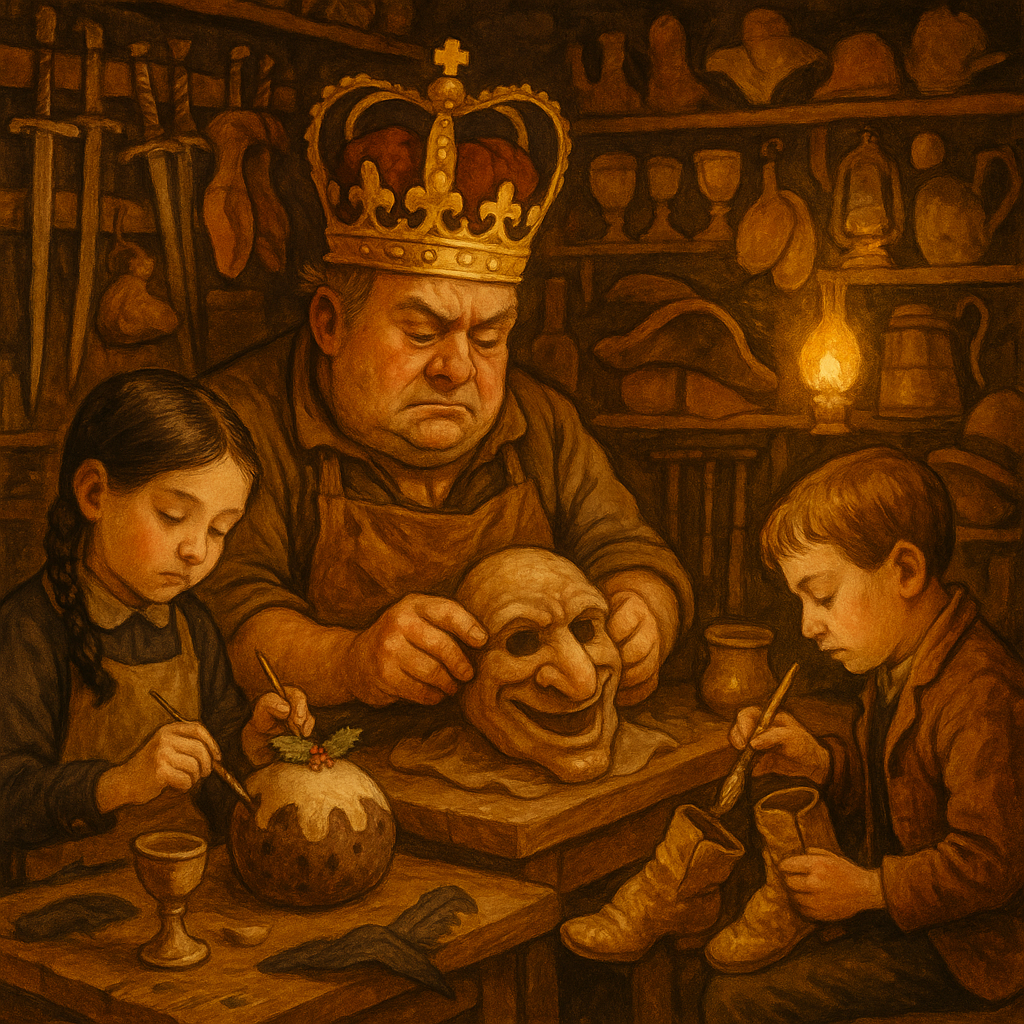
Mr. Gorget, the property master, works with almost delirious industry. He has an imperial crown on his head — recently gilded, placed there to dry — while his fingers shape the matrix of a monstrous pantomime mask from a lump of clay on the table before him. How quickly he moulds the hideous physiognomy: squeezing the eyelids, flattening the nose, elongating the mouth, furrowing the cheeks. When finished, this clay model will be oiled, and a cast taken from it in plaster of Paris. Into the cast — oiled again — strips of brown paper, well glued and sized, will be pasted until the right thickness is reached. When dry, the cast is removed, and the hardened paper mask is ready for colouring. At this work sits an assistant, his nose and cheeks richly enriched with Dutch metal and splashes of glue, liberal with rose pink to the noses, black to the eyebrows, and white to the eyes. Then Mrs. Gorget, a mild little woman who has been assiduously spangling a demon’s helmet, adds huge masses of oakum and horsehair — red, brown, and black — which will serve as coiffure.
Other assistants are painting tables, gilding goblets, and manufacturing the bewilderingly miscellaneous articles required in the comic business: the sausages for the Clown to purloin, the fish, eggs, poultry, warming-pans, pint pots, butcher’s trays, and legs of mutton incidental to his chequered career. Mr. Gorget’s youngest daughter, a bright-eyed girl, is gravely speckling a plum-pudding; her brother, a stalwart rogue of eleven, sits on a stool painting a dozen pairs of hunting boots with bright yellow ochre. They will gleam tonight on the legs of the Hospodar’s huntsmen, who will stamp their soles on the merry greensward and wave tin porringers supposed to contain Rhine wine.
What a range of skills the property man must command, though he does not receive uncommonly liberal remuneration. He must be a passable upholsterer, carpenter, wig-maker, painter, decorator, and sculptor — accurate in historical propriety, skilled in modelling, facile at carving, tasteful in embroidery. He must know something of pyrotechnics, a good deal of carving and gilding, and a little of mechanics. For this, he gets perhaps fifty shillings a week.
The Wardrobe
Mr. Easter and a long row of seamstresses are busily stitching in a room crowded with heavy presses crammed with the costumes of the establishment. He has overhauled his stock — the crimson velvet noblemen, the green-serge retainers, the spangled courtiers, the glazed-calico slaves. He has held last year’s Clown’s costume up to the light and shaken his head at the rents and tatters into which it has been reduced. Clown must clearly be entirely new this year. His forewoman is busy spangling Harlequin’s patchwork dress; elsewhere, sprites and genii, slaves and evil spirits are in various stages of completion. In the ladies’ wardrobe, Miss de Loggie and her assistants stitch frantically at sea-nymphs’, sirens’, and elves’ costumes, while Miss Mezzanine, who is to play Columbine, is agonisingly inquisitive about the fit of her skirt and spangles.
The Final Push
Work, work, work everywhere — in the bleak morning when playgoers from the night before have scarcely finished their first sleep; at night, to the sound of the orchestra below and the hot glare of the gas. Mr. Tacks carries screws in his waistcoat pockets. Mr. Gorget grows absolutely rigid with glue. The staircase is blocked by frantic waiters carrying chops and stout for Mr. Brush and his assistants. All day long the management’s private door is besieged by emissaries: more nails from Mr. Tacks, more Venetian red from Mr. Brush, more velvet from Mr. Easter, more glue from Mr. Gorget.
The management shifts uneasily. “Great expense,” it says. “If it should fail?”
“Give us more nails, hands, Venetian red, velvet, and glue, and we’ll not fail,” chorus the ants behind the baize.
Nor are the performers idle. Every day the comic scenes are rehearsed on a stage lit by a single gas jet, while a melancholy man called the répétiteur — the rehearsal musician — conjures doleful music from his fiddle. The pantomimists, in linen over-suits, tumble, dance, jump, and perform gymnastic exercises in the gloom until their bones ache and the perspiration streams from their limbs.
Work, work, work — and Christmas Eve arrives. No snap-dragon for Mr. Tacks, no hunt-the-slipper for Mr. Gorget. Just pleasant Christmas greetings and general conviction that the pantomime will be a “stunning” one. Christmas Day itself brings no proper Christmas dinner — only cook-shop food, or the covered basin that little Polly Bruggs carries to stalwart Bill Bruggs, the carpenter who is popularly supposed to be able to carry a pair of wings beneath each arm. Incessant fiddling from the répétiteur. Work on the canvas-covered stage. Work in the flies. Work in the mezzanine floor beneath the stage, where the cellarmen are slinging the mechanisms for traps and trapdoors, and greasing every hinge. Huge masks leer at you from narrow passages; pantomime wheelbarrows and barrel-organs beset you at every step. So all Christmas night.
Boxing Day
Hurrah for Boxing Day! Tommy and Billy, suffering slightly from indigestion, stand with their noses glued to the window-panes, watching the rain in the puddles or the snow on the rooftops. Little Mary’s mind is filled with radiant visions of spangled fairies. John the footman is escorting the housemaid to the pit; even the man who sells cauliflowers at the corner will treat his wife to a gallery seat for the first performance of Harlequin Fee-fo-fum.
At last — the final clink of the hammer, the last stroke of the brush, the last stitch of the needle. It is six o’clock. The Clown, Signor Brownarini of the Theatres Royal, has a jug of barley water made — his only beverage during his tumbling — and anxiously assures himself that a red-hot poker has been written into the comic business. “Else,” says he, “the pantomime is sure to fail.” It is astonishing what a close connection there is, in the Clown’s mind, between the success of a pantomime and a red-hot poker.
Seven o’clock — one last frantic push. The families arrive in flies, broughams, and cabs. The footman and housemaid are smiling in the pit. The music strikes up. And then, at last: “Harlequin Fee-fo-fum, or the Enchanted Fairy of the Island of Abracadabra.” Fun, frolic, and gaiety; splendour, beauty, and blue fire. “How are you to-morrow?” May there be success and crowded houses till the middle of February, for the sake of the author, the management, and the Theatre Royal, Hatton Garden, generally.
The ants behind the baize have worked well. They have their reward in the glorious success of the pantomime they laboured so hard at. They may wash their faces and have their boots cleaned now — and who shall say they do not deserve their beer tonight and their poor salaries next Saturday?
As Christmas approaches, pause a little before condemning these play-acting people as profligates and vagabonds. Consider how hard they work, how precarious their employment, how honestly they try to earn their living. Admit that there is skill, industry, and perseverance in all this — not misdirected, if it promotes harmless fancy and innocent mirth.
Perhaps it’s the season. Perhaps something in the wintry jollity makes even churchwardens and hard men of business forget their taxes and water-rates for a few hours, and throw themselves into “Harlequin Fee-fo-fum; or, the Enchanted Fairy of the Island of Abracadabra.” Or perhaps it’s the shrill laughter and ecstatic hand-clapping of the children in the gallery. Those sausages and spangles may strike some long-forgotten chord, rummage up some long-hidden memory of when we too were little — when our jackets buttoned over our trousers and we wore frills at our necks. Else why should something like wateriness in the eye and huskiness in the throat come over us, amid the most excruciatingly comic portion of the comic business?
Hip, hip, hip for the Pantomime! Watch the Clown through his nefarious career; roar at Pantaloon tumbling; marvel at the “halls of splendour” and the “glittering coral caves of the Genius of the Sea” — until midnight comes and the green baize curtain rolls slowly down. Then, if you can spare half an hour, send the little ones home with the governess and stay awhile with me. I want to tell you what goes on behind that curtain — what has gone on, before the Clown could steal a single sausage, or the spangled Fairy change an oak into a magic temple, or the coloured fires light up the “Home of Beauty in the Lake of the Silver Swans.”
Let me try to give you some idea of the immense labour, industry, and perseverance — the precise ingenuity and patient mechanical skill — indispensable before Harlequin Fee-fo-fum can be put upon the stage. Let us watch the labours of the Ants behind the Baize. It is not an exaggeration: if ever there was a human ant-hill, the working department of a theatre is exactly that.
And I have another motive beyond entertaining you. I honestly think the theatrical profession is rather calumniated. People are too apt to call theatres dens of depravity and to set down all actors as a species of amusing vagabonds who learned their calling without study and practise it without labour. If it were better known how hard-working and industrious theatricals generally are — what actually has to be done behind the scenes, and how — we might look upon even poor Jack-pudding, when he has washed the paint off his face, with a little more charity.