“There’s a fine state of things!” Alice Chetwynd’s usually bright face looked nearly as gloomy as the picture she’d called up. “We’ve run short of candles for the tree, and of course the shops will be shut tomorrow and the day after. A Christmas tree in semi-darkness — can anything be more dismal?”
“What’s the trouble?” cried her schoolboy brother Bertie, planting two good-natured if somewhat grubby hands on her shoulders. “You looking downcast — now that’s something new. Can’t you cut the big candles in two and stick them about? Here’s Cousin Mildred — ask her. She’ll think of something.”
“No, don’t bother her,” Alice whispered, giving him a warning nudge as a pretty girl some years older than themselves came into the room. “She’s been so hoping for a letter today and none has come — it’s quite spoiled her Christmas. Don’t say I told you.”
“What mischief are you two plotting?” Cousin Mildred tried to speak cheerfully and to turn her face so they wouldn’t see the traces of tears about her pretty blue eyes, but there was a small quiver in her voice that gave her away.
In a moment Alice’s arm was round her neck and Bertie was consoling her in his rough-and-ready fashion.
“Cheer up, Cousin Milly! I’ll bet anything you’ll get a letter tomorrow.”
“I’m afraid not, Bertie — the postman doesn’t come on Christmas Day.”
“Doesn’t he? What a beastly shame! I’ll speak to Father—”
“No, no — your father knows all about it, and it’s quite right. I’m glad the poor old man has one day to spend comfortably with his family. I don’t quite know why Cecil hasn’t written — but worrying won’t do any good. Now let’s talk of something else. Alice, when you can be spared from the tree, Mother wants all the help she can get decorating the church.”
“Is she down there now? I’ll come in two minutes. Isn’t it a nuisance about these candles? The shops will certainly be shut in Appleton the day after Christmas, and the poor schoolchildren will be so disappointed if we have to put off the tree.”
“Oh, that would be a pity! But candles — I don’t know how we can do without them. Is it really impossible to send to Appleton today?”
“Father said this morning there was no one to go. Coachman’s away for a holiday, Sam is as busy as he can be, and one can hardly ask anyone to trudge five miles and back through the snow — though it isn’t very deep yet.”
“There’s more coming, I fear,” said Mildred, looking out at the grey, heavy sky. “Awfully cold. Ah — there’s a feeble little ray of sunshine struggling through! Well, I must go back to measuring flannel for the old women’s winter petticoats — at least it’s warm on the fingers. And Ally, tell Mother I’ll join her at the church as soon as I can. The keepers brought us the most wonderful holly from the woods — you’ve never seen such a wealth of berries. The wreaths will be splendid this year.”
And Mildred went away humming a little Christmas carol, bravely trying to forget the gnawing anxiety in her heart — for the faraway soldier she’d hoped so much to hear from that day.
“Isn’t she a trump?” said Bertie, watching her go. “I know she’s been half crying when she was by herself, but she didn’t want us to see it. I say, Alice — I’m going to have another try for that letter of hers, and get your candles into the bargain. Grey Plover’s been shod for snow and he’s as sure-footed as a goat. The snow’s not deep enough to matter. I’ll trot over to Appleton and be back before you know it.”
“Oh, Bertie, don’t! Cousin Mildred said a storm was coming — you might get lost like people in the mountains—”
“Or the babes in the wood, eh? You little silly — don’t you think I’m man enough to take care of myself?” And Master Bertie, who was fifteen and a sturdy, blue-eyed, curly-haired English lad, drew himself up with great dignity and looked down at his little sister.
Alice subsided, but she felt uncomfortable qualms of conscience when it became clear she was to be the only one admitted to his confidence.
“Don’t go bothering poor Mother — she always gets into a terrible fuss, as if no one knows how to look after themselves. And not a word to Cousin Mildred — I want to surprise her by bringing her letter back with me. And if Father asks where I am — oh, that’ll be all right, I’ll be back before he’s home from shooting.” And Bertie was gone before his sister had time to form the protest she’d been struggling to find words for.
He’ll miss his dinner, poor dear, she thought compassionately — then consoled herself with the memory of an excellent pastry-cook’s shop in Appleton where the gingerbread was sure to be extra plentiful on Christmas Eve of all days in the year.
“A real old-fashioned Christmas, Father calls it!” thought Alice as she went to the window and looked out at the whitened landscape, the leafless branches of the trees standing out like the limbs of blackened giants against the snow. The little birds she’d been befriending all winter came hopping familiarly to the ledge, and one bold robin pecked at the glass as if to say a fresh supply of crumbs would be welcome. Alice searched her pocket, found some fragments, scattered them on the sill, promised a better meal by and by, gave a last worried glance at the half-dressed Christmas tree with its insufficient candles, murmured that Bertie really was the dearest boy in the world, and ran off to help her mother in the old village church.
Meanwhile Grey Plover was bearing his rider swiftly over the half-frozen snow. He was a handsome, strong-built pony — the Squire’s birthday gift to his son — and they made a fine pair, at least in the fond father’s eyes. If either Mr. Chetwynd or his steady old coachman had been at home, Master Bertie would not have found it quite so easy to get his horse saddled for a ten-mile ride with the sky full of snow.
There was a keen north-easterly blowing, but Appleton lay to the west, so for the present the wind only came at the back of his neck. Bertie turned up his collar and trotted bravely on, whistling and talking by turns to his pony and to a wiry little terrier who was technically Cousin Mildred’s property but, like most animals, was deeply devoted to Bertie.
“Steady, lad, steady,” he said, checking Grey Plover as they descended a steep incline bordered by high hedges, the northern one half-buried in snow.
“I never thought it could have grown so deep in the time,” he muttered. “I hope it won’t snow again before tonight or I’ll have a job getting home. What’s the time? Just two — all right, two hours of daylight yet. Good day, John! Merry Christmas to you!” — this to the village carrier, his cart laden with Christmas parcels, leading his old horse carefully up the hill.
“The same to you, Master Bertie, and many of them! How are the Squire and Mrs. Chetwynd, and—”
“All well, thank you, John, but I can’t stop to go through the list. I’ve got to get to Appleton and back as fast as I can.”
“To Appleton! Laws, Master Bertie, don’t you do anything of the kind. As sure as I’m alive there’s awful weather coming, and you and that little pony will never get back if you don’t mind.”
“Little pony indeed, John! Grey Plover is nearly fourteen hands — and do you suppose I care for a snowstorm?”
Old John pointed to the wall of grey cloud advancing steadily from the north-east.
“You just look yonder, Master. If that doesn’t mean the worst storm we’ve known for many a long year, my name’s not John Salter.”
“Well then, I must make all the more haste. If I don’t turn up by church time tomorrow, you and old Moss will have to come and dig me out! Come along, Nettle!” — and whistling to the terrier, who had been making friends with the carrier’s old collie, Bertie cantered on.
“I don’t think I can find time to go home for lunch,” said Mrs. Chetwynd, casting an anxious eye round the half-decorated church. Two of the columns were beautifully wreathed with glossy dark holly, shining laurel, and graceful ivy; the third stood quite bare. “Mildred, when you come back, would you and Alice bring me some biscuits? I can eat in the vestry. The days are so short, and today seems darker than usual — we shall have to work very hard to finish in time.”
“I’ll stay with you,” said her cousin, “and Alice can bring provisions for us both” — and in this way the secret of Bertie’s absence from the early dinner went unnoticed.
It was snowing heavily when Alice, in fur cloak and snow-boots, made her way back to the church, a quarter of a mile from the house. She was beginning to be very anxious about her brother and bitterly regretted the promise of secrecy he had extracted from her.
“We’re getting on nicely,” said Mrs. Chetwynd, glancing round. “I wonder whether your father will stop by on his way back from shooting. I suppose Bertie must have gone out to join him — we haven’t seen the boy all afternoon. I hope they won’t be late; the snow’s getting quite deep.”
A sharp knock at the church door made Alice start and turn so pale that her cousin laughed at her for getting the jitters. But before they could open it the visitor made his own way in, and proved to be the stable-lad, with a face so white and frightened that the alarm spread at once to Mrs. Chetwynd.
“Milly,” she said faintly, “there’s been some accident — ask him — quick — Herbert’s gun—”
“No, no,” said her cousin, bent on reassuring her. “Speak up, James — can’t you see how you’re frightening your mistress?”
“If you please, ma’am, Grey Plover’s come home alone, and—”
“The pony! Master Bertie wasn’t riding?”
“Yes, ma’am — he set out to ride to Appleton about half-past one o’clock—”
“To ride in such weather!”
“Yes, ma’am — he would go, and with the Squire away I couldn’t stop him — and now the pony’s galloped into the yard and—”
“Mary, darling, don’t look so frightened,” cried Mildred, fearing her cousin was about to faint. “I’m sure he got down to walk and warm himself and the pony broke free — Bertie rides so well, he’s not likely to have had a fall—”
“But the snow! Isn’t it very deep in places, James?”
“Six or seven feet in the drifts, they say, ma’am — though most of the road was fairly clear this morning. But it’s been snowing hard these two hours and more, and nearly as dark as night — and Grey Plover must have been down at some point, for when he came in the saddle was caked with snow.”
Mrs. Chetwynd gave a gasp. For a moment her cousin thought she was going to faint, but with a brave effort she gathered herself.
“James, you and the gardeners had better set off at once — two of you take each road to Appleton to meet Master Bertie. Alice dear, run up to the house and fill your father’s flask with brandy, and see that they take it, and a blanket — and send someone to find your father. He’ll know best what to do. I must go myself to look for my boy — God help me — what shall I do if he’s come to harm?”
“You can’t walk, darling,” said Mildred gently, leading her to a pew and taking her cold hands. “Don’t imagine the worst before it comes. Bertie is sure to have taken one of the dogs with him, and they’d have come home to tell us if anything were badly wrong.”
“There was only little Nettle at home,” Mrs. Chetwynd answered with a sigh. “Jerry and Nell are out with Herbert, and the new dog’s no use. Oh, Milly — my bright, bonny boy — where can he be? See how dreadfully dark it’s grown, and the cold — think if he should be lying helpless in the snow!”
At about the same time that afternoon, a young man was climbing down from the one-horse omnibus that the George Hotel — a small third-rate inn, albeit the best in Appleton — sent down to meet the afternoon train from London. He was tall and soldierly, with bright dark eyes and a brisk, confident manner that commanded attention even from the surly landlord.
But when, instead of asking for lunch or any comfort for himself, the traveller demanded a horse and trap to take him to Mr. Chetwynd’s house five miles distant, the host demurred.
“Impossible! The omnibus horse is the only one with snow shoes on, and he’s been out twice already today. Besides there’s a heavy fall coming before nightfall — even if a horse and trap could get to Edenhurst, there’d be no getting back before dark.” Mine host was very sorry to disoblige the gentleman, but it was out of the question.
The young man, clearly unaccustomed to flat refusal, began to chafe, his dark eyes flashing. But he forced himself to speak quietly and reasonably, and even resorted to bribery, so anxious was he to reach Edenhurst by Christmas Eve.
The landlord remained unmoved. A large commercial dinner at five o’clock made him even less inclined to spare any of his men.
“Well, hang it all!” cried the young man at last. “Then I’ll get there on my own legs.” He swung his bag over his shoulder. “You’ll have to find some means of sending my other things over tomorrow morning at latest. It would be too maddening,” he added to himself, “after coming two thousand miles to see her, if we couldn’t spend Christmas Eve together after all.”
And turning a deaf ear to the landlord’s warnings, he set off briskly on a road that was well known to him, though he hadn’t walked it in two years.
“Dear girl,” he said to himself as he strode through the snow. “What a surprise it’ll be! I’m half sorry I didn’t write — perhaps she’ll be startled — but I don’t believe sudden joy ever hurt anyone. I wonder if she’ll be changed. I hope not — the little face couldn’t be sweeter than it was. And Herbert Chetwynd is a first-rate fellow. What a welcome I shall get from him and his kind wife. It’s almost worth two years of toiling in India to come home for such a Christmas. I wonder if young Bertie’s grown much — capital boy, I remember. How far have I come? Just past the second milestone. The snow’s getting plaguy deep and I can barely see ten yards ahead. I can’t say it’s pleasant travelling — but how I shall appreciate the fire in the great hall at Edenhurst. They’ll be burning the Yule log tonight. How I shall enjoy taking up all the old customs again. I wonder if the carol singers still come round? What a wretch I used to feel, lying snug in bed listening to the poor little shivering figures singing outside in the frosty early morning — though I believe Herbert’s wife and Milly always made sure they had a warm breakfast at the kitchen fire afterwards — but hulloa! What little dog are you, out alone in the snow on this lonely stretch of road? Lost your master, have you, poor little thing? Never mind — you’d better follow me home to Edenhurst for tonight. They wouldn’t refuse a welcome to a stray dog on Christmas Eve. I say, you are pressing in your attentions, my friend — sniffing and prancing around me like that. I’m not your master, nor have I the honour of that gentleman’s acquaintance, unless — by Jove, if it isn’t little Nettle — the dog I gave Mildred when I left for India! What on earth is she doing out here alone? And what does she want me to do?” — for the terrier, beside herself with delight at being recognised, was dancing round him, catching his hand and the skirts of his coat gently in her teeth, then running ahead and looking back to see if he was following. “Lead on — I’ll follow thee — is that what you want, little Nettle? All right then!” And the traveller’s long legs managed to keep pace with the terrier’s four short ones, though the poor little creature occasionally plunged into a drift softer than the rest and vanished from sight entirely for a moment.
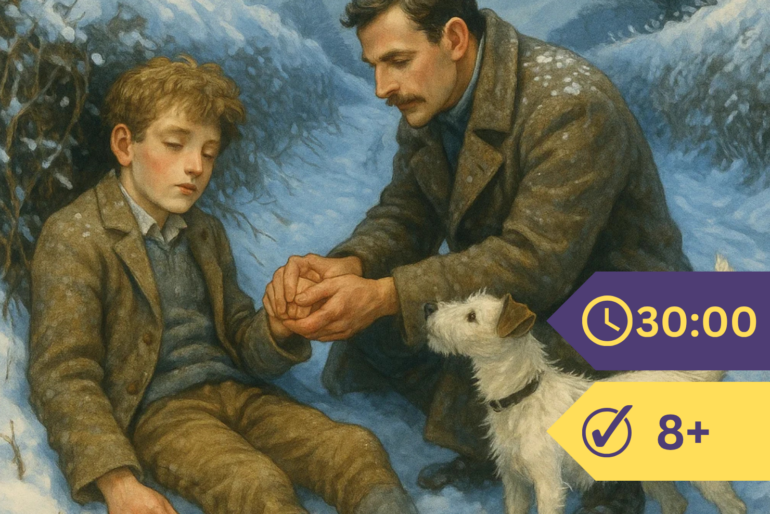
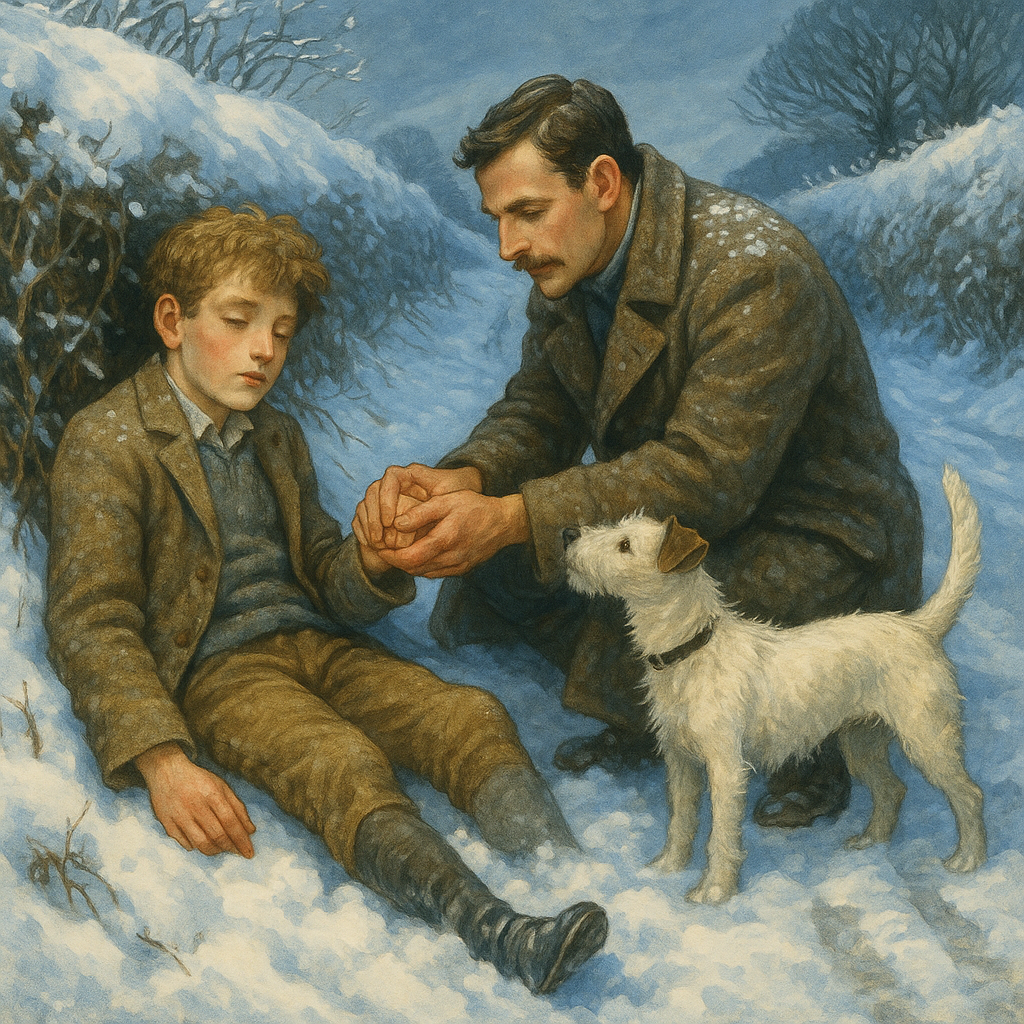
Presently she scurried ahead and stopped, with a triumphant bark, before a dark shape that was half sitting, half lying in a hollow of partly-melted snow under the hedge — which, on closer inspection, proved to be a slight curly-headed boy in a heather-coloured jacket, his cap fallen off, his eyes nearly closed, leaning back against the snow with an expression of half-conscious suffering on his young face.
“Come, this won’t do!” exclaimed the traveller with surprise and concern. “I say, young sir — have you forgotten this is December, and not exactly the season for sleeping outdoors?”
The boy’s eyes opened drowsily and scanned the keen, brown-moustached face bending over him, but he neither moved nor spoke. The traveller laid a hand on his shoulder and spoke again, more firmly.
“Get up, young one — do you hear? Do you want to freeze to death?”
His tone was rough but his manner was not — dropping on one knee in the snow, he began to chafe the cold, unresponsive hand that the boy slowly tried to lift. The boy pointed to his left foot, stretched out at an uncomfortable angle, and his rescuer quickly saw that a badly sprained ankle was the trouble. It was much swollen.
A serviceable knife was produced and the boot deftly slit open, bringing instant relief to the injured foot. The boy let out a long breath of satisfaction and murmured, “Thank you,” as he made an unsuccessful attempt to sit up.
“Careful — let me give you a hand. Poor little chap—” as the patient collapsed again. “Here, have some of this.” He produced a small restorative from an inner pocket. “That’s better. You’ll be able to tell me everything in a moment. Nettle, little lass — it’s a pity you can’t talk, isn’t it?”
“How do you know the dog’s name?” the boy asked, almost roused into curiosity.
“How do I know it? Because she was mine for six months before I went to India, and then I gave her to the lady who I hope, now that I’m back, will consent to be my wife.”
“What — are you Cecil Gordon?”
“The same — at your service, ‘Cousin Cis,’ as your little sister used to call me — if, as I rather think, you’re my old friend Bertie. Two years have made quite a difference in your size, my lad, and the cold has turned your face a blue sort of colour that threw me off at first. Now tell me — what reckless nonsense have you been up to, to end up in this state?”
“I rode Grey Plover to Appleton this afternoon to get — some things the girls wanted. And the storm came on, and it got horribly dark, and somehow we stumbled into a drift. I’d noted the bad patches on the way out and thought I could avoid them, but the darkness confused me and the snow got in my eyes. We went down together and my foot caught in the stirrup and wrenched dreadfully — though it’s ever so much better now you’ve cut the boot open.”
“And the pony made off, I suppose.”
“Yes. I felt very sick when I got up, but I had just enough sense to crawl out of the drift — I didn’t fancy being smothered. I can’t have been lying here very long before you came, or I’d have been frozen.”
“Well, the first thing is to get you home as fast as possible — though the snow is getting so deep it won’t be pleasant going. Can you put that foot to the ground at all? No? Then don’t try. My legs will have to do for both of us.”
“Oh, I’m too heavy — you can’t possibly carry me through this snow.”
“Nonsense. If you keep making difficulties I shall have to treat you like the story goes one of our fellows treated a wounded sergeant in Zululand.”
“What happened?”
“The enemy were right behind them. The officer — call him B — was determined to get the wounded sergeant out, whose horse had been killed. He told the sergeant to get up behind him on his horse, and the sergeant refused and said to save himself and leave him. And B said, ‘If you don’t obey orders at once, I shall punch your head.'”
“Don’t punch mine today,” said Bertie, with a rather feeble laugh. “It feels so strange and heavy. You have my permission to try when I’m properly well again.”
“Good. Now — will you ride in the ordinary fashion, or the way I’ve seen soldiers carry each other at what they call ‘chummy races’ — lengthwise across the shoulders?”
Bertie preferred the ordinary method and, with some difficulty, was hoisted into position.
“How is everyone at home?” asked Captain Gordon, after they’d made some progress in silence.
“Very well — and very cheerful — except that today Cousin Milly was out of spirits, because—”
“Well? What?” The tone was sharp.
“Because you hadn’t written, and she did so want a letter for Christmas. I thought there might be one by the afternoon post — there sometimes is.”
“And that’s why you took that mad ride through a snowstorm?” The brisk voice was very gentle now. “My dear boy — I’m sorry to have been the cause of all this trouble.”
“Oh, never mind — it was partly for Alice’s candles too, for the Christmas tree. By the way — I hope they haven’t fallen out of my pocket. No, here they are, all right.”
“I’m afraid you found no letter at the post office after all. Our orders to come home arrived rather suddenly, and when I found I could be in England almost as soon as a letter could reach, I didn’t write. I’m so sorry it worked out this way.”
“You had real fighting out there among the Afghans, didn’t you?”
“Yes — I’ll tell you all about it someday. Just now I need my breath for something more useful than talking. How deep the snow is between these hedges!”
“Yes — if we could get across into the fields it would be better — and there’s a short cut too.”
“Can we find it?”
“I’ll try — but my head feels so strange and slow — don’t I hear someone behind us?”
As Bertie spoke a young labouring man came up, glanced with some surprise at the odd pair, and answered Captain Gordon’s question about the nearest way to Edenhurst with a surly grunt.
“Why Jack, you can show us!” cried Bertie, impatient.
“There’s a stile somewhere that leads past your mother’s cottage, and then we can cut across Higgins’ fields.”
“If there’s a cottage I’d very much welcome five minutes by the fire,” said Cecil, who was getting decidedly short of breath.
“Jack Brown is a surly fellow,” Bertie whispered — not quite low enough, for the man caught the last words.
“Surly! And who wouldn’t be, young master, in my place? Didn’t the Squire have me up for poaching? Didn’t I get three weeks in gaol for snaring a few pheasants? And much anyone would have cared if my old mother had starved while I was gone!”
“For shame!” Bertie flared up with surprising energy for someone being carried. “As if Mother and Mildred didn’t go to see the old woman nearly every day and make sure she wanted for nothing!”
“Well, well,” interrupted Cecil. “Don’t rake up old grievances on Christmas Eve. Forgive and forget — peace and goodwill — that’s what the bells always seem to me to be saying. I’m sure your mother would let the young master sit by her fire for a few minutes, after he’s come very close to getting himself buried riding out through the snow on his sister’s errand.”
A shadow of a smile crossed Jack’s grim face. He led the way over a difficult stile, helping to lift Bertie across with more care than might have been expected. Then he strode before them through the fields, where the snow lay more evenly and was easier to wade through, until he stopped at the door of a little thatched cottage, opened by a tidy old woman.
Bertie was soon settled in the high-backed wooden armchair by the fire, drinking hot if slightly hay-scented tea, and feeling very much better as his new friend attended properly to the injured foot.
Meanwhile, Christmas Eve was turning sad at Edenhurst. The Squire had come home to confused reports of Bertie’s disappearance, and when he was shown the riderless pony and the snow-soaked saddle he too grew seriously alarmed and set off at once for Appleton without even stopping to change his wet things. Messengers had already been sent in several directions, but the hours passed and no news came — no one had thought of the short cut, or of old Mrs. Brown’s cottage. The village bells had fallen silent; the ringers couldn’t bear to ring them while their dear mistress was in such distress.
Mrs. Chetwynd tried hard to force herself to believe it couldn’t be as bad as it seemed. No one had the heart to carry on with Christmas preparations, but she insisted the poor people’s gifts should be sorted — and so Mildred and Alice dutifully checked over and labelled the parcels of warm clothing, tea, and sugar, though their spirits were elsewhere. At last Alice could bear the waiting no longer. She wrapped a cloak round her shoulders and slipped out into the avenue.
The air was clearer now and the snow had stopped falling. The earth lay under a brilliant white sheet, and overhead the winter stars were coming out one by one in the deep blue vault. The still frosty air cooled her hot cheeks, and the stars looked down with their silent, ancient greeting of peace.
Glad tidings of great joy — the Christmas message of nearly nineteen centuries — surely it could not be that heartbreak was coming to them tonight, of all nights in the year. A prayer formed in her heart, on her lips — and in that very moment, as if in answer, there burst out the most joyful sound Alice had ever heard: their own village bells, pealing out a Merry Christmas. It had been agreed that this would be the signal that Bertie was found and safe. Louder and louder the sound rang out, and eager, tearful congratulations were exchanged among the anxious watchers inside. Mrs. Chetwynd wanted to run and meet her boy, but Mildred gently held her back and reminded her that his father must be with him.
Nor was it long before a happy group came into view along the lane.
There was Bertie — who had insisted on putting his injured foot to the ground rather than let his mother see him carried — hopping bravely along on his father’s arm, with faithful little Nettle trotting close beside him. And Jack Brown, with whom the Squire had shaken hands and exchanged a Merry Christmas, slouching cheerfully behind. But whose was the tall figure on Bertie’s other side? Cousin Mildred knew — and it was perhaps as well that the kind darkness of the winter evening threw a friendly veil over the joyous blushes and the happy, thankful tears that marked that meeting.