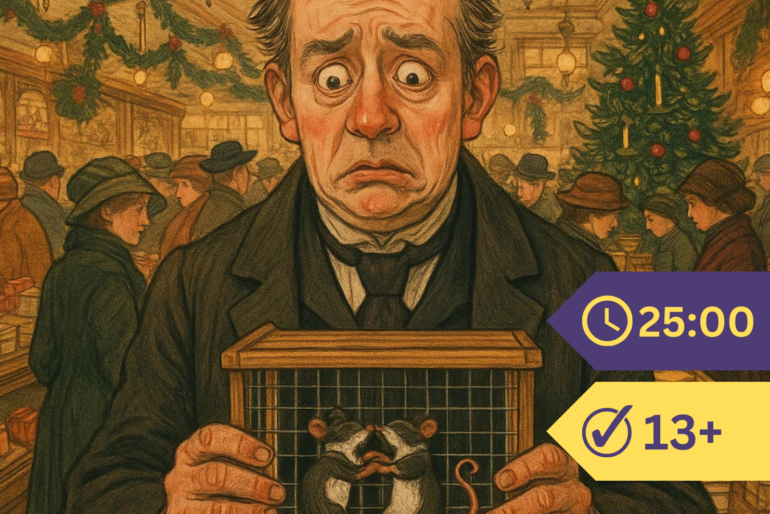
At the office of Hawkins & Hawkins, system was everything. Even the office boy was kept to a strict orbit that left no room for marbles or mischief, and the stenographer went about her work like a well-oiled machine. It was not strange, then, that Jasper Hawkins, senior partner, was particularly incensed by the chaos that Christmas always brought to his home.
For years he had borne — with such patience as he could muster — the nervous collapse that regularly, on the twenty-sixth of December, laid his wife upon a bed of exhaustion. But when the signs appeared that this year the collapse would precede the holiday entirely, he burst the bonds of self-control and spoke his mind.
It was the morning of the twenty-first.
“Edith,” he began, in what his young daughter called his now-mind voice, “this thing has got to stop.”
“What thing?”
“Christmas.”
“Jasper!” — as if she thought he had the power to sweep goodwill itself from the earth. “Christmas — stop!”
“Yes. My dear, how did you spend yesterday?”
“I was — shopping.”
“Exactly. And the day before? And the day before that? You needn’t answer; I know. And you were shopping for —” He paused expectantly.
“Presents.” Something quite outside herself had forced the answer.
“Exactly. Now, Edith, surely it needn’t take all your time for a month before Christmas to buy a few paltry presents, and all of it for two months afterward to recover from buying them!”
“But, Jasper, they aren’t few, and they’re anything but paltry. Imagine giving Uncle Harold a paltry present!” retorted Edith, with some spirit.
The man waved an impatient hand.
“Very well — magnificent, then,” he conceded. “But even so, with the countless stores full of beautiful and useful articles, and a list properly tabulated, and sufficient money—” An expressive gesture finished his sentence.
The woman shook her head.
“I know; it sounds easy,” she sighed, “but it isn’t. It’s so hard to think up what to give, and after I’ve thought it up and bought it, I’m just sure I ought to have got the other thing.”
“But you should have some system about it.”
“Oh, I had — a list,” she replied wearily. “But I’m so tired.”
Jasper Hawkins squared his shoulders.
“How many names do you have left to buy for?” he demanded briskly.
“Three — Aunt Harriet, and Jimmy, and Uncle Harold. They always get left till last. They’re so — impossible.”
“Impossible? Nonsense! And I’ll prove it to you. Give yourself no further concern about Christmas, Edith — just consider it done.”
“Do you mean — you’ll get the presents for them?”
“Most certainly.”
“But, Jasper, you know—”
An imperative gesture silenced her.
“My dear, I’m doing this to relieve you, and that means you are not even to think of it again.”
“Very well — er — thank you,” sighed the woman; but her eyes were troubled.
Not so Jasper’s. His eyes quite sparkled with anticipation as he left the house some minutes later.
On the way downtown he made his plans and arranged his list. He wished it were longer — that list. Three names were hardly sufficient to demonstrate his theories and display his ability. As for Aunt Harriet, Jimmy, and Uncle Harold being “impossible” — that was nonsense, as he had said. Before his eyes rose a vision of the three: Aunt Harriet, a middle-aged spinster, poor, half-sick, and chronically discontented with the world; Jimmy, a pale-faced lad who was always reading a book; and Uncle Harold, red-faced, red-headed, and — red-tempered. Jasper smiled to himself at that last thought. “Red-tempered” — that was good. He would tell Edith — but not others. Witticisms at the expense of a rich bachelor uncle whose heir was a matter of his own choosing were best kept to oneself. Edith was right about one thing, though: Uncle Harold could not be given a paltry present. He must have something fine, expensive, and desirable — something one would like oneself. And immediately there popped into Jasper’s mind a certain exquisitely carved meerschaum pipe he had seen in a shop window and greatly coveted. As for Aunt Harriet and Jimmy — their case was too simple for even a second thought: to one, a pair of bed-slippers; to the other, a book.
Some minutes later, Jasper Hawkins tucked into his wallet a neat slip of paper:
Presents to be bought for Christmas, 1908:
Aunt Harriet, spinster, 58(?) — Bed-slippers.
Uncle Harold, bachelor, 65 — Pipe.
Jimmy, boy, 12 — Book.
In the office that morning, however, the senior partner found a man waiting for him — an emissary in connection with a “deal” then looming large on the horizon of Hawkins & Hawkins. The neat slip of paper had no part in the day that followed.
Mrs. Hawkins greeted her husband with eager interest that evening.
“Well — what did you get?” she asked.
The man of business lifted his chin triumphantly.
“Not everything we asked for, to be sure,” he began, “but we got more than we expected—” He stopped abruptly. The expression on his wife’s face reminded him that she could not possibly know what he was talking about. “Er — what do you mean?” he demanded.
“Why, Jasper, there’s only one thing I could mean — the presents, you know!”
A curious something clutched at Jasper’s breath and held it suspended for a moment. Then he throttled the something and raised his chin even higher.
“Time enough for that tomorrow,” he replied lightly. “I didn’t promise to get them today, you know.”
“But, Jasper, tomorrow’s the twenty-second!”
“And three whole days before Christmas.”
“Yes, but they must be sent on the twenty-fourth.”
“And they’ll be sent, my dear,” declared Jasper, in a tone that was a cold dismissal of the subject.
On the morning of the twenty-second, Jasper told himself he would not forget the presents this time. He decided, however, that there was no need to spend the whole day selecting a pipe, a book, and a pair of slippers. There would be quite time enough after luncheon. And he smiled to himself in a superior way as he thought of the dizzying rush that always marked his wife’s shopping expeditions. He was still smiling happily when he sallied forth at two o’clock that afternoon, leaving word at the office that he would return in an hour.
He decided to buy the meerschaum first. With unhesitating steps he sought the tobacco shop. The pipe was gone. There was no other in the place that quite suited him, though he spent a full half-hour trying to find one. He would try the department store where he intended to buy the book and the slippers as well. It was better, anyway, to do all his shopping under one roof. More systematic.
The great clock in the department-store tower had just struck three when Jasper stalked through the swinging doors. Window displays had allured him; dawdling throngs of shoppers had forced his feet to a snail’s pace. He drew a sigh of relief. He had reached his destination; he would make short work of his purchases. With a dignified stride he turned toward the nearest counter.
At once, however, he found himself caught in a swirl of humanity that swept him like a helpless chip and flung him against a counter much farther down the aisle. With what dignity he could summon, he righted himself and addressed the smiling clerk behind it.
“I’m looking for pipes,” he announced, severely. “Perhaps you can tell me where they are.”
She shook her head.
“Ask him,” she suggested, nodding toward the far aisle.
Jasper, looking in the direction indicated, saw a frock-coated man standing like a rock where the streams of humanity broke and surged around him. By some maneuvering, Jasper managed in time to confront this man.
“Pipes,” he panted — reduced now to a single word.
“Annex; second floor. Elevator to your right.”
“Thanks,” fervently breathed the senior partner of Hawkins & Hawkins, muttering as he turned away, “Then they have got some system in this infernal bedlam!”
The crisp directions had sounded simple, but proved anything but. Like a shuttlecock, Jasper was tossed from clerk to clerk until by the time he reached his destination he was confused, breathless, and cross.
The pipes, however, were numerous and beautiful, and the clerk behind the counter was both pleasant and attentive. Pipes did not happen to be popular that day, and the corner was a small paradise of quietness and rest. The man drew a long breath of relief and bent to his task.
In his mind was one thought uppermost: he must select just such a pipe as he himself would like. For long minutes he pondered whether this one or that one or another would best please him. So absorbed was he in this phase of the question that he had made his selection and taken out his money — when the sickening truth arrived.
Uncle Harold did not smoke.
To Jasper it seemed incredible that he had not thought of this before. But not until he pictured his purchase in his uncle’s hand had he realized that the thing was not for himself, after all, but for a man who not only did not smoke, but who thoroughly abhorred the habit in others.
With a muttered something the clerk could not hear, Jasper thrust his money back into his pocket and rushed blindly away from the pipe counter. Long minutes later, out in the street, he adjusted his tie, jerked his coat straight, and looked at his watch.
Four o’clock. He must go back to the office before going home. There was still another whole day before him, and it was really very simple to buy a book and some slippers, and then look around for something for Uncle Harold. In the morning he would doubtless light upon the very thing. With this comforting thought, he dismissed the subject and went back to the office.
Mrs. Hawkins did not question her husband that night. Something in his face kept the words on her lips.
Jasper went early to the office the next morning, but it was fully eleven o’clock before he could begin his shopping. He told himself there was quite time enough; and he stepped off briskly toward the department store, having decided he preferred it to the uncertainties of a new one. Besides, he was very sure there would not be so many people there now.
Here, however, Jasper was disappointed. Not only was everyone who had been there the day before still present, but most of them had brought friends. In dismay, Jasper clung to a post near the door while he rallied his courage for the plunge. The frock-coated man was still his rock in the surging current; and after a long wait and a longer struggle, Jasper stood before him once more.
“I want slippers — bed-slippers for women,” he muttered.
“Fourth floor, front. Elevator to your left,” the man declaimed. Jasper felt a glow of awe at the thought of a mind so stupendous that it could locate every shelf and counter in this vast domain of confusion.
He had been swept to the right on the crest of a particularly aggressive wave formed by the determined shoulders of a large woman who wished to go that direction; so it was some time before he could stem the current and make for the elevator on the other side of the store. It was then that he suddenly decided to “look about a little to find something for Uncle Harold” — and it was then that he was lost, for no longer had he compass, captain, or port in view; oarless and rudderless, he drifted.
Then did the department store, in all its allurements of glitter and show and competing attractions, burst upon Jasper’s eyes, benumbing his senses and overthrowing his judgment. For long minutes he hung entranced above a tray of jeweled hair combs, and for other long minutes he weighed the charms of a spangled fan against one that was merely painted — before he suddenly awoke to the realization that he was looking for something for Uncle Harold, and that Uncle Harold wore neither hair combs nor gauze fans.
“Where do you keep things for men?” he demanded aggrievedly of the clerk behind the counter; and it was while on the ensuing frantic search for “things for men” that he stumbled upon the book department.
“To be sure — a book for Jimmy,” he muttered, and confidently approached a clerk who was already trying to wait on three customers at once.
“I want a book for a boy,” he observed; and was surprised that no one answered.
“I want a book for a boy,” he urged, in a louder tone.
Still no one answered.
“I want a book — for — a — boy,” he said distinctly; and this time the clerk flicked her ear as at an annoying insect.
“Juveniles three aisles to your left,” she snapped; and after a puzzled moment, Jasper concluded this was meant for him.
In the juvenile department, he wondered why everyone in the store had chosen that particular minute to buy a book for a child. Everywhere haste and confusion. Nowhere was there anyone who paid the least attention to him. At his right, a pleasant clerk chatted fluently about this, that, and another “series”; at his left, a severe-faced woman with spectacles discoursed on the great responsibility of selecting reading for the young, and uttered fearsome prophecies of the dire evil that was sure to result from careless buying.
Her words were not meant for Jasper’s ears, but they reached them. The man shuddered and grew pale. With soft steps he slunk out of the book department. To think that he — he, who knew nothing whatever about books for boys — had nearly bought one of the risky things for Jimmy! To Jasper’s alarmed imagination it almost seemed that Jimmy, pale and sad-eyed, had already gone wrong — and through him.
He looked at his watch and decided it was time for luncheon.
Afterward he could look around for something else for Jimmy.
It was six o’clock when Jasper, flushed, tired, and anxious, took account of stock.
He had a string of beads and a pair of skates.
The skates were for Jimmy. He was pleased with those. It was a helpful young clerk who had found him in the toy department, confusedly eyeing a row of flaxen-haired dolls, and who had gently asked the age of the boy for whom he wished a present. He thought of that clerk now with gratitude.
The string of beads was less satisfying. He was not entirely sure how he had come to buy them. He had a dim recollection that they had looked wonderfully pretty with the light catching sparkles of green and gold, and that the clerk who tended them happened to have nothing to do but wait on him. So he had bought them. They were handsome beads, and not cheap. They would do for someone, he assured himself. Not until he had dropped them in his pocket did it occur to him that he was buying presents for only a boy, a bachelor, and a middle-aged spinster. Manifestly a string of beads would not do for Jimmy or Uncle Harold — so they must do for Aunt Harriet. He had meant to buy bed-slippers for her, but perhaps she would prefer beads. At all events, he had bought them, and they would have to go.
As yet he had nothing for Uncle Harold. The more he searched, the more undecided he grew. The affair of the pipe had frightened him, and sown distrust in his heart. He would telephone Edith that business detained him, eat dinner quickly, and then buy Uncle Harold’s present. And with this decision, Jasper wearily turned his steps toward a telephone booth.
Jasper went home at ten o’clock. He still had nothing for Uncle Harold. The stores had closed before he could find anything.
But there was still until noon the next day.
Mrs. Hawkins did not question her husband. In the morning she only reminded him, timidly:
“You know those things must go by twelve o’clock, Jasper.”
“Oh, yes, they’ll go all right,” he replied, in a particularly cheery voice. Jasper was not cheery within. A terrible fear had clutched his heart. He started downtown at once, going straight to the stores.
Conditions were worse than before. Everyone seemed to have an Uncle Harold for whom was being frenziedly sought the unattainable. If at nine o’clock Jasper had been nervous, at ten he was terrified, and at eleven he was nearly frantic. All power of decision had deserted him, and he stumbled vaguely on and on, scarcely knowing what he was doing. It was then that his eye fell on a huge sign:
Just the thing for Christmas! When in doubt, buy me!
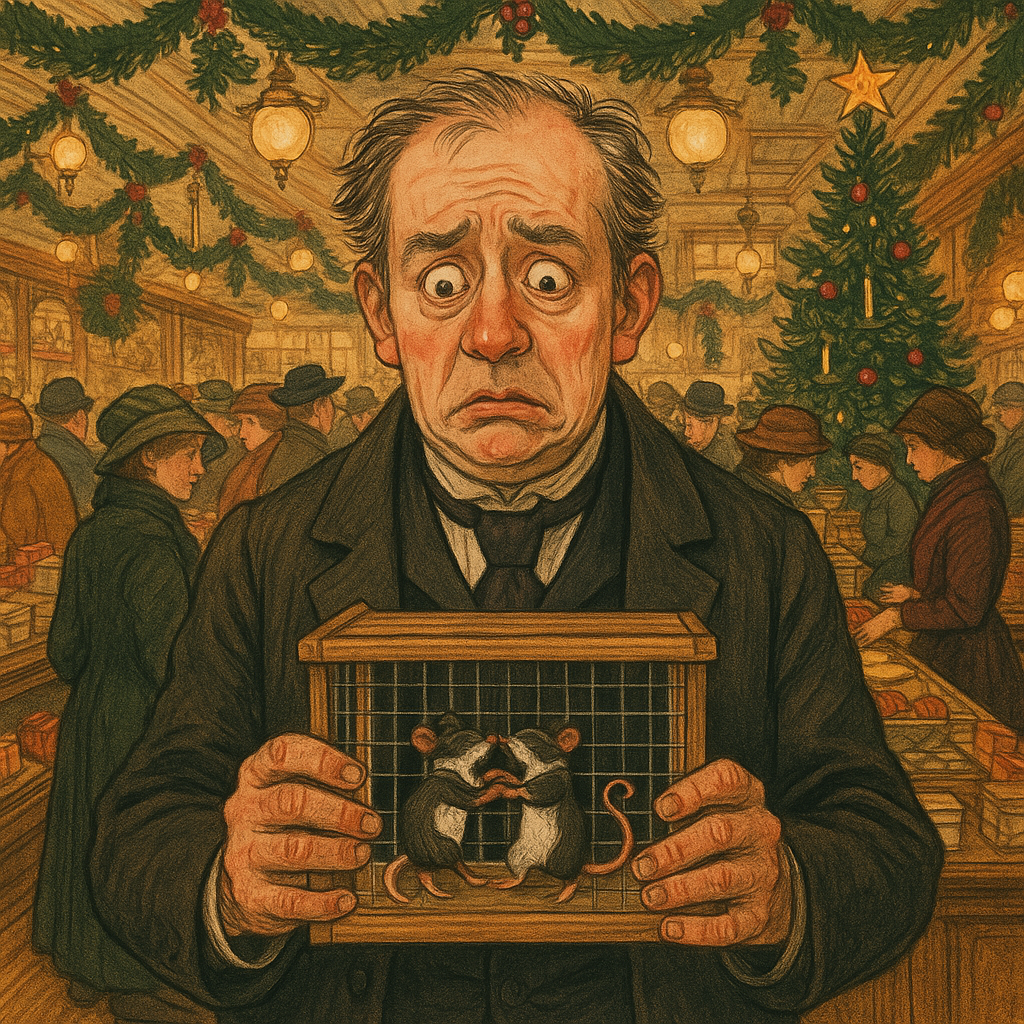
There was a crowd before it, but Jasper knew now how to use his elbows. Once at his goal, he stared in amazement. Then the tension snapped, and he laughed outright — before him were half a dozen cages of waltzing mice.
For a long time the curious whirls and antics of the tiny creatures in their black-and-white coats held his gaze in a fascinated stare. Then, obeying an impulse he scarcely understood himself, the man made his purchase, gave explicit instructions as to when and where it was to be sent, and left the store.
Then, and not until then, did Jasper Hawkins fully realize that to his Uncle Harold — the rich old man who must be petted and pampered and never by any chance offended — he had sent, as a Christmas present, a cage of dancing mice.
That night Mrs. Hawkins asked her questions, and her husband answered them. He had determined to assume a bold front.
“Presents? Of course! They went today with our love,” he answered gaily.
“And what — did you send?”
“The simplest things in the world: a string of handsome beads to Aunt Harriet, a pair of skates to Jimmy, and a cage of the funniest little waltzing mice you ever saw to Uncle Harold. You see it all resolves itself down to a mere matter of system—” He stopped. At the real agony in his wife’s face, all bravado deserted him. “Why, Edith!”
“Jasper — you didn’t send skates to Jimmy!”
“But I did. Why not?”
“But, Jasper — he’s lame!”
Jasper fell back limply. All the bravado fled from his face.
“Edith, how could I — how could I — forget a thing like that,” he groaned.
“And beads for Aunt Harriet! Why, Jasper, I never saw a bead on her neck! You know how poor she is, and how plainly she dresses. I always give her useful, practical things!”
Jasper said nothing. He was still with Jimmy and the skates. He wished he had bought a book — any book; anything would be better than those skates.
“And mice — mice for Uncle Harold!” wept Edith. “Why, Jasper, how could you? Dirty little creatures that Uncle Harold can only feed to his cat! And I had hoped so much from Uncle Harold. Oh, Jasper, Jasper — how could you!”
“I don’t know,” said Jasper dully, as he got up to leave the room.
It was not a happy Christmas for Jasper. There were those three letters of thanks to come, and he did not want to read them.
As it happened, they all arrived the same day — the twenty-eighth. They were addressed to Mrs. Hawkins, and naturally she read them first. When Jasper came home that night they lay waiting for him on his desk. He saw them, but decided not to read them until after dinner. He felt he needed all the fortification he could obtain. He hoped his wife would not mention them, and yet felt a vague disappointment when, as time passed, she did not.
Dinner over, further delay was impossible. Very slowly he picked up the letters. He singled out Aunt Harriet’s first.
Dear Niece and Nephew [he read — and sat suddenly erect]. However in the world did you guess that beads were what I wanted more than anything else? And these are such handsome ones! Ever since beads and chains have been worn so much, I have longed for one all my own; but I’ve tried to crush the feeling and hide it, for I feared it might be silly — and me so old and out-of-date! But I know now that it isn’t, and that I needn’t be ashamed of it any more, for of course you and Jasper would never give me anything silly! Thank you ever and ever so much!
With a slightly dazed expression, Jasper laid down Aunt Harriet’s letter and picked up the one from Uncle Harold. As he did so he glanced at his wife; but she was sewing and did not appear to be noticing him.
Well, well, children, you have done it this time! [read Jasper, with fearful eyes]. The little creatures came on Christmas morning, and never have I [Jasper turned the page and relaxed suddenly] stopped laughing since, I believe! How in the world did you happen to think of a present so original, so charming, and so everlastingly entertaining? The whole house, and I might say the whole town, is in a fever over them — I’ve got the little devils where they can best be seen and appreciated!
There was more, much more, all in the same vein; and again, as Jasper laid the letter down, he glanced at his wife, only to find a demure, downcast gaze.
But one letter now remained, and in spite of what had gone before, Jasper picked it up with dread. Surely, nothing could reconcile Jimmy and those awful skates. He winced as he opened it and saw that Jimmy’s mother had written — and then he stared in unbelieving wonder at the words, and read them over and over, lest he had somehow misconstrued them.
My dear sister and brother [Jimmy’s mother had written], I wish you could have seen Jimmy when your beautiful skates arrived. He will write you himself and thank you, but I know he can’t half make you understand what that present means to him, so I am going to write and tell you what he said.
And let me say right here that I myself have been blind all these years. I haven’t understood. And what I want to know is, how did you find out — what Jimmy wanted? How did you know? When I, his own mother, never guessed! Why, even when the skates came on Christmas Day, I was frightened and angry, because you had been so “thoughtless” as to send my poor lame boy skates! And then — I could hardly believe my own eyes and ears, for Jimmy, his face one flame of joy, was waving a skate in each hand. “Mother, mother!” he was shouting. “See, I’ve got a boy present, a real boy present — just as if I was like other boys. I’ve always had books and puzzles and quiet presents! Everybody’s thought about that when they thought of me!” he cried, thumping the crutches at his side. “But this is a real present — now I’ve got something to show, and to lend — something that is something!” And on and on he chattered, with me staring at him as if I thought he was out of his head.
But he wasn’t. He was happy — happier than I’ve seen him since he was hurt. And it still lasts. He shows those skates to everyone, and talks and talks about them, and has already made plans to let his dearest friends try them. Best of all, they have given him a new interest in life, and he is genuinely better. The doctor says that at this rate he’ll be using the skates himself one day.
And now, how can I thank you — you who have done this thing, who have been so wise beyond his mother? I can only thank and thank you, and send you my dearest love.
Your affectionate sister,
Bertha
The senior partner of Hawkins & Hawkins folded the letter very hurriedly and tucked it into its envelope. There was a mist in his eyes, and a lump in his throat — two most unwelcome phenomena. With a determined effort he cleared his throat and began to speak.
“You see, Edith,” he observed pompously, “your fears were quite groundless, after all. This Christmas shopping, if reduced to a system—”
He paused suddenly. His wife had stopped her sewing and was looking straight into his eyes.