‘Twas the night before Christmas, and all through the house not a creature was stirring, not even a mouse.
Bobby and Alice and Pink had hung their stockings by the living-room mantle and, though it was very, very early, they decided to go to bed. They always wanted to go to bed early on Christmas Eve. Morning seemed to come so much more quickly when they went early. They would not even wait for a story. They would just say good night to Grandma and go right to bed.
“Why!” exclaimed Grandma in surprise, when they had explained their intentions to her. “You mustn’t go to bed so soon. You’d be awake in the morning before daylight! Come in and visit with me a while, and I’ll see if I can think up a story to tell you — the same as on other nights.”
So they went in and sat down on their stools in front of the fire. Grandma put on her spectacles, but instead of her knitting, she took up her Bible. The children were very still while she read the story of the first Christmas — how in a stable in Bethlehem the baby Christ was born, and how an angel appeared to the shepherds who were watching their flocks by night and told them about the Savior’s birth, and then a host of angels came and praised God, saying, “Glory be to God on high, and on earth peace, good will toward men,” just as we sing today on Christmas.
“I think,” said Grandma, “that I will tell you tonight about a Christmas treat at our school. When I was a little girl, we had a custom handed down from pioneer times called ‘barring out.’ A few days before Christmas, the teacher would arrive to find the schoolhouse door securely fastened. Before he was admitted, he would have to sign a paper promising to ‘treat’ his pupils.”
“In those days we didn’t have much store candy, and we looked forward for weeks to the Christmas treat we got at school. You wouldn’t think much of it today — six sticks of red and white striped candy apiece, wintergreen and sassafras and clove and maybe one of horehound. My, but it tasted good to us! We didn’t eat it all up at once, either. No, indeed!”
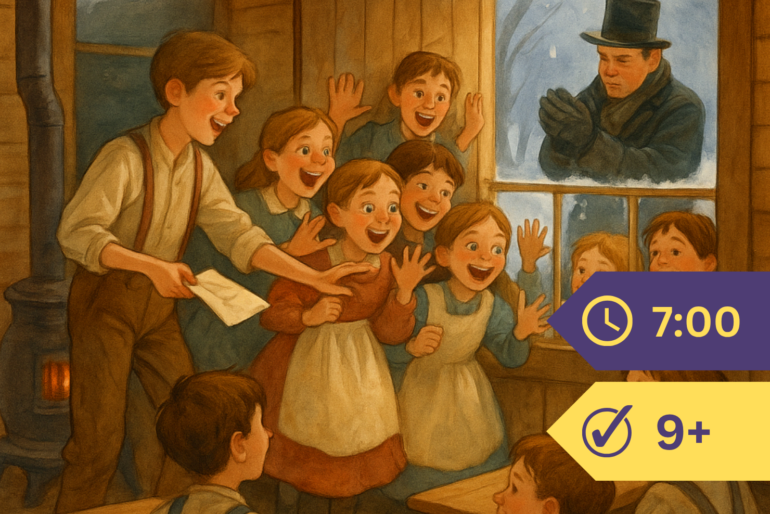
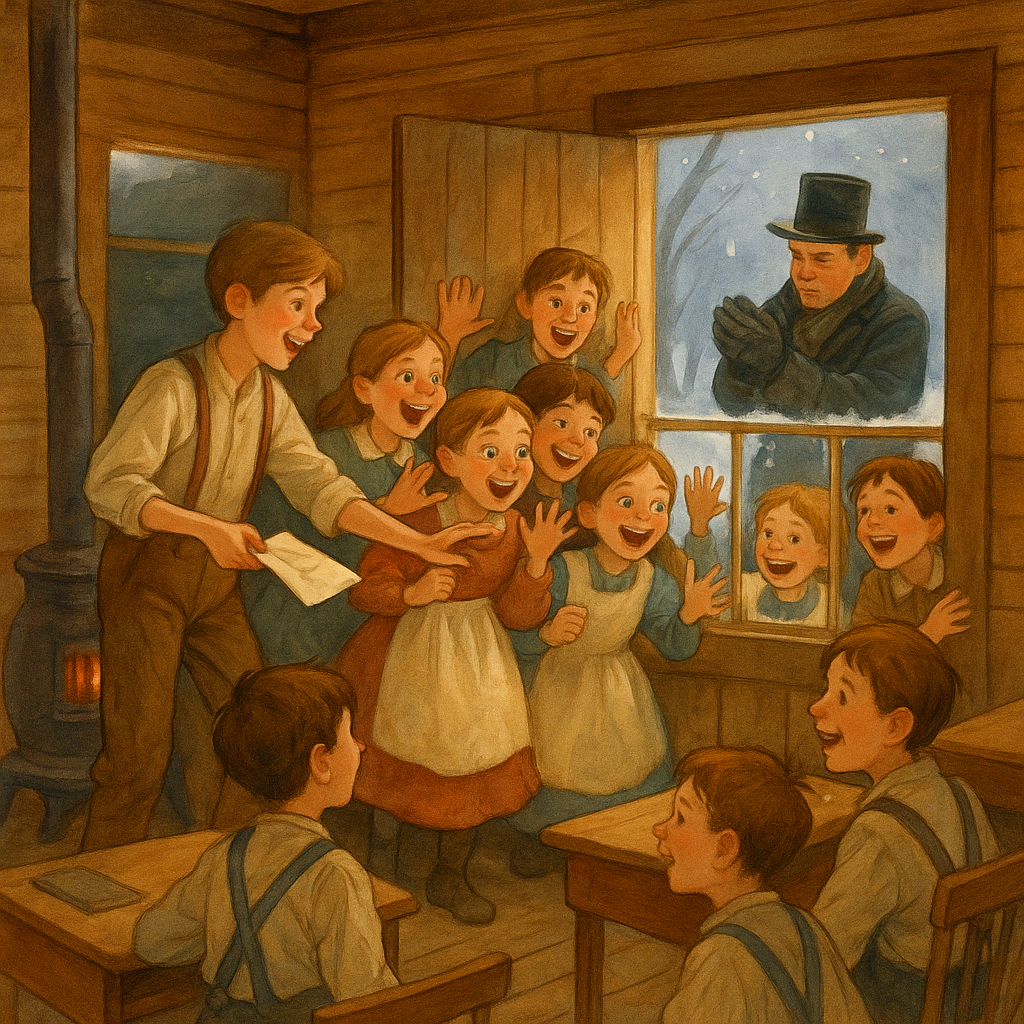
“But one year we didn’t know whether to look for a treat or not. The teacher, a Mr. Hazen, was from Clayville, and he had been heard to say that he did not believe in barring out or in being forced to treat his pupils. Nevertheless, we all came early to school one morning and locked him out.
“While we all cried ‘Treat! Treat!’ at the tops of our voices, William Orbison opened the window a tiny bit and thrust out the paper they had prepared for the teacher to sign. But he refused to touch it.
“This was not alarming at first — most teachers stayed out for an hour or two just for fun. We played games and had a good time. But by the morning intermission, the older pupils had begun to get anxious. Could it really be that Mr. Hazen didn’t mean to treat? At noon he was still out, walking up and down the playground, clapping his hands together, stamping his feet, and rubbing his ears to keep warm. We were truly worried now. The wood box was empty and the fire was getting low. There was no water in the water bucket, and the younger children were begging for drinks.
“No teacher in our recollection had ever refused to treat. There was an old rule that if the teacher persisted in refusing, he was to be ducked in the nearest stream of water. We had heard of instances when this had been done, but no one wanted to try it. The older pupils stood around in frightened little groups, and some of the smaller children were crying openly, when the teacher knocked loudly on the door and asked that the paper be handed out to him.
“But the paper had disappeared! We searched all over the room, but it was nowhere to be found. Again the teacher knocked and asked, rather impatiently, for the paper.
“Then William Orbison sat down at his desk and hurriedly wrote out another paper and handed it out the window to the teacher. Mr. Hazen looked at it in a puzzled way for a little while, smiled a queer smile, and without a word signed the paper and handed it back to William. Then he was admitted and took up books — but all afternoon he kept smiling to himself, as if he knew a joke on someone. We felt uneasy, though we couldn’t say why.
“After school that evening, my brother Truman asked William Orbison to let him see the paper the teacher had signed. When he read it, he gave a long whistle of astonishment.
“And what do you think William had done? In the fuss and excitement of writing out the second paper, he had left out the word treat. The teacher had promised nothing! That explained his smiles. We were a disappointed lot of children, I can tell you.
“We were sure now there would be no Christmas treat. After the way Mr. Hazen had talked about barring out, no one thought he would treat if he could help it — and here was a way out for him. The next day we were perfectly certain of it, for when William Orbison left out a word in his reading lesson, the teacher said, ‘Watch yourself, William. Leaving out words is getting to be quite a habit with you.'”
“Other years we could hardly wait till the day before Christmas. We wore our best clothes, and right after dinner we would speak pieces, have spelling and ciphering matches, sing songs, have our treat, and play games the rest of the afternoon. Lots of the older brothers and sisters would come to visit, and the teacher would play with us, and we would have lots of fun.
“But this year I should rather have stayed home and watched the Christmas preparations at our house. There wouldn’t be much fun at school without any treat.
“It was a cold, windy morning, and Father took us to school in the sled. We had lessons in the morning as usual, and in the afternoon there were recitations and songs and a little play the teacher had helped us prepare. Truman gave ‘Hamlet’s Soliloquy,’ and did it very well. And Charlie had a piece, but he forgot all but the first verse. We were so caught up in it all that we almost forgot about the treat — and you can imagine how surprised we were when the teacher, instead of dismissing us, said that we would now have an unexpected but very welcome visitor.
“The door opened, and in came old Santa Claus with a white beard and a red coat and on his back the biggest bag! You should have seen our eyes pop! Of course it wasn’t the really, truly Santa Claus who comes in the night and fills the stockings. Oh, no — this was just a pretend Santa.
“He put his bag down on the teacher’s platform, and after he had made a little speech he opened it up.
“And what do you suppose was in that bag? Candy! Cream candy and chocolate drops and clear candy, red and yellow, shaped like animals and horns and baskets — such candy as we had never seen before. A sack for each pupil.
“As we went up, one by one, the smallest first, to get our treat, Santa asked each of us to recite something for him. The smaller children knew verses out of their readers, and some of us recited the pieces we had said earlier in the afternoon. But how we all laughed when Longford Henlen, who was the tallest boy in school, couldn’t think of anything to say but,
‘I had a little dog, his name was Jack,
Put him in the barn, he jumped through a crack.’
“And now to bed, to bed, and go right to sleep. I’ve heard that if Santa Claus comes and finds children awake, he goes away and comes back later. That is, he means to come back later — but he has been known to get so busy he forgot to come back at all. So say your prayers and go to sleep.”