‘Oh whence do you come, my dear friend, to me,
With your golden hair all fallen below your knee,
And your face as white as snowdrops on the lea,
And your voice as hollow as the hollow sea?’
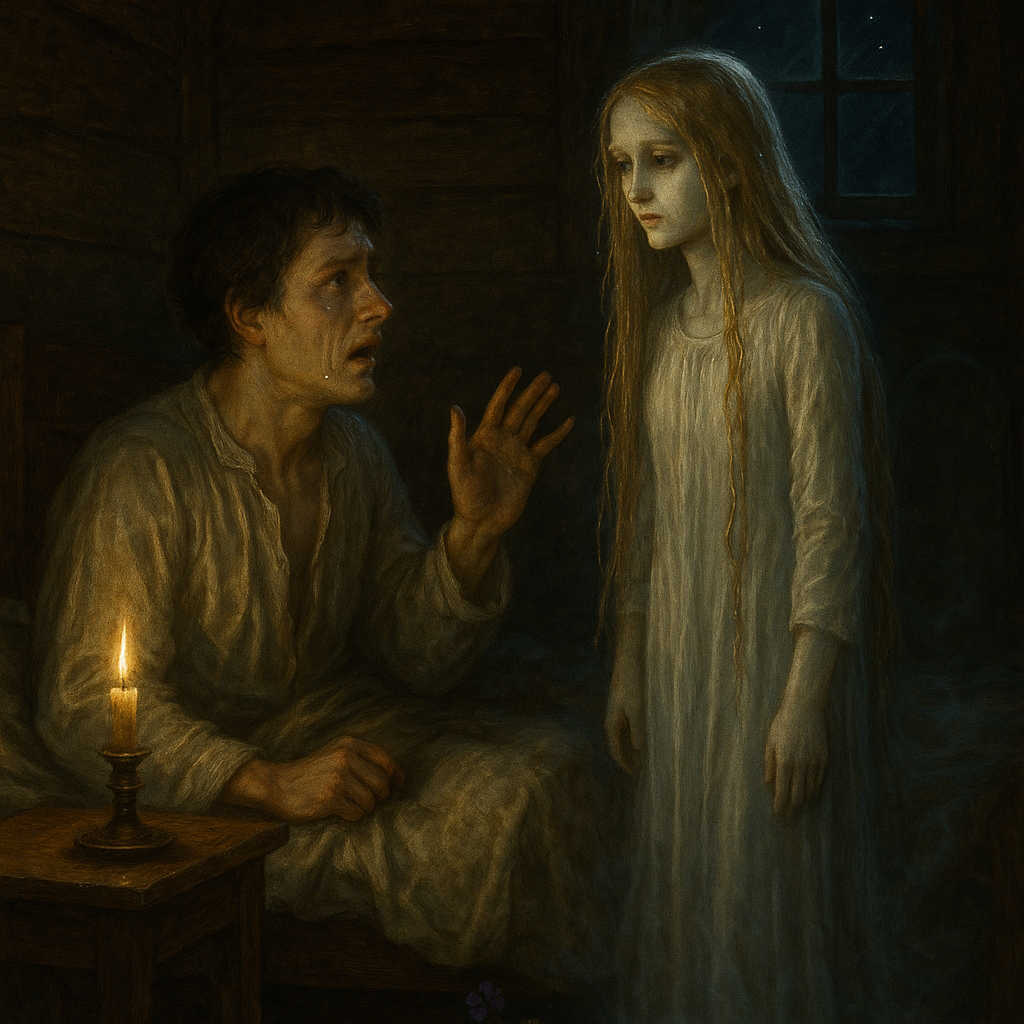
‘From the other world I come back to you:
My locks are uncurled with dripping drenching dew,
You know the old, whilst I know the new:
But to-morrow you shall know this too.’
‘Oh not to-morrow into the dark, I pray;
Oh not to-morrow, too soon to go away:
Here I feel warm and well-content and gay:
Give me another year, another day.’
‘Am I so changed in a day and a night
That mine own only love shrinks from me with fright,
Is fain to turn away to left or right
And cover up his eyes from the sight?’
‘Indeed I loved you, my chosen friend,
I loved you for life, but life has an end;
Through sickness I was ready to tend:
But death mars all, which we cannot mend.
‘Indeed I loved you; I love you yet,
If you will stay where your bed is set,
Where I have planted a violet,
Which the wind waves, which the dew makes wet.’
‘Life is gone, then love too is gone,
It was a reed that I leant upon:
Never doubt I will leave you alone
And not wake you rattling bone with bone.
‘I go home alone to my bed,
Dug deep at the foot and deep at the head,
Roofed in with a load of lead,
Warm enough for the forgotten dead.
‘But why did your tears soak through the clay,
And why did your sobs wake me where I lay?
I was away, far enough away:
Let me sleep now till the Judgment Day.’