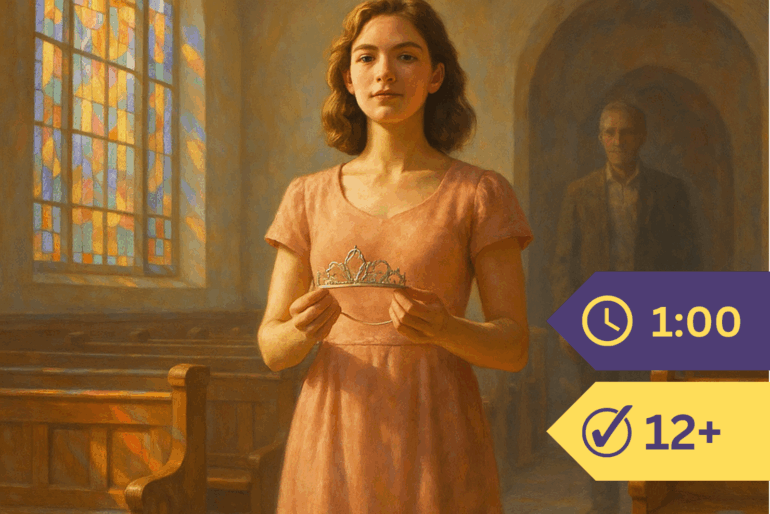
Love’s Baptism

Summary


In Love's Baptism, a poem by Emily Dickinson, a young woman declares that the name given to her at a country church font no longer belongs to her. She sets it beside her dolls and spools of thread, then steps into a second, conscious baptism of her own choosing. Part farewell to childhood, part coronation, the verse moves from a "half unconscious queen" in her father's arms to a woman with the will to choose, and the throne she claims.

Read Online

I’m ceded, I’ve stopped being theirs;
The name they dropped upon my face
With water, in the country church,
Is finished using now,
And they can put it with my dolls,
My childhood, and the string of spools
I’ve finished threading too.

Baptized before without the choice,
But this time consciously, of grace
Unto supremest name,
Called to my full, the crescent dropped,
Existence’s whole arc filled up
With one small diadem.

My second rank, too small the first,
Crowned, crowing on my father’s breast,
A half unconscious queen;
But this time, adequate, erect,
With will to choose or to reject,
And I choose—just a throne.


Add Ririro as a Preferred Source on Google


Credits

Emily Dickinson was a 19th-century American poet from Amherst, Massachusetts, celebrated for her compact, daring verse and unconventional dashes. Here she turns the language of the church ceremony toward love, setting a childhood christening against a self-chosen consecration.