Witlaf, a king of the Saxons,
Ere yet his last he breathed,
To the merry monks of Croyland
His drinking-horn bequeathed, —
That, whenever they sat at their revels,
And drank from the golden bowl,
They might remember the donor,
And breathe a prayer for his soul.
So sat they once at Christmas,
And bade the goblet pass;
In their beards the red wine glistened
Like dew-drops in the grass.
They drank to the soul of Witlaf,
They drank to Christ the Lord,
And to each of the Twelve Apostles,
Who had preached His holy word.
They drank to the Saints and Martyrs
Of the dismal days of yore,
And as soon as the horn was empty
They remembered one Saint more.
And the reader droned from the pulpit,
Like the murmur of many bees,
The legend of good Saint Guthlac,
And Saint Basil’s homilies;
Till the great bells of the convent,
From their prison in the tower,
Guthlac and Bartholomæus,
Proclaimed the midnight hour.
And the Yule-log cracked in the chimney
And the Abbot bowed his head,
And the flamelets flapped and flickered
But the Abbot was stark and dead.
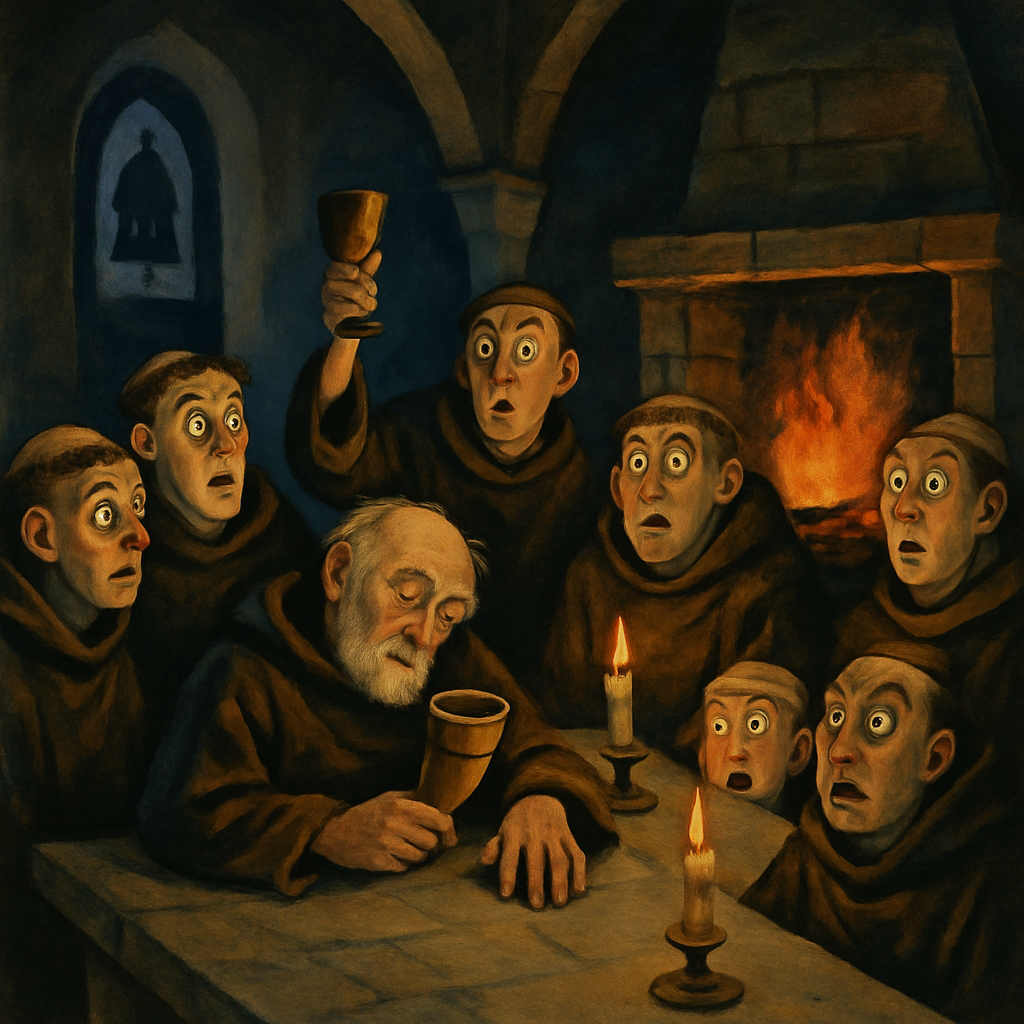
Yet still in his pallid fingers
He clutched the golden bowl,
In which, like a pearl dissolving,
Had sunk and dissolved his soul.
But not for this their revels
The jovial monks forbore,
For they cried, “Fill high the goblet!
We must drink to one Saint more.”