A Christmas Carol (Poem)

Summary


"A Christmas Carol" by Christina Rossetti opens in a frozen, silent midwinter landscape before drawing the reader into the nativity scene, where the almighty Christ child rests in a manger, attended by angels, cherubim, and adoring animals. At its heart, the poem asks a quietly urgent question: what can an ordinary, poor person offer such a king? Rossetti's answer is deeply personal — not a lamb, not gold, but the gift of one's own heart. The spare, hymn-like verses carry both cosmic wonder and tender intimacy.

Listen to audio


Read Online

In the bleak mid-winter
Frosty wind made moan,
Earth stood hard as iron,
Water like a stone;
Snow had fallen, snow on snow,
Snow on snow,
In the bleak mid-winter
Long ago.

Our God, Heaven cannot hold Him
Nor earth sustain;
Heaven and earth shall flee away
When He comes to reign:
In the bleak midwinter
A stable-place sufficed
The Lord God Almighty
Jesus Christ.

Enough for Him, whom cherubim
Worship night and day,
A breastful of milk
And a mangerful of hay;
Enough for Him, whom angels
Fall down before,
The ox and ass and camel
Which adore.

Angels and archangels
May have gathered there,
Cherubim and seraphim
Thronged the air;
But only His mother
In her maiden bliss
Worshipped the Beloved
With a kiss.
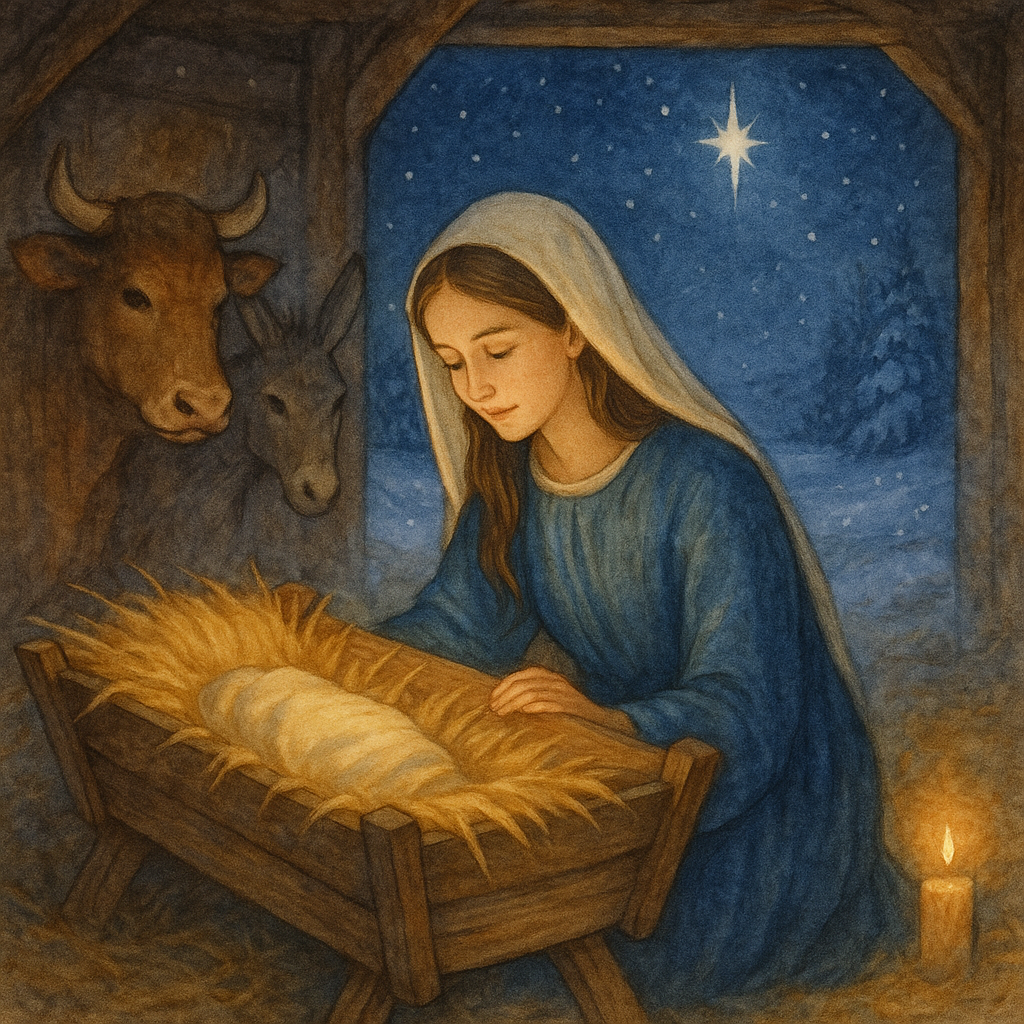
Mary kneeling over the manger in a snowy stable, illustrating A Christmas Carol by Christina Rossetti

What can I give Him,
Poor as I am?
If I were a shepherd
I would bring a lamb,
If I were a Wise Man
I would do my part,—
Yet what I can I give Him,
Give my heart.
Credits

Christina Georgina Rossetti was a 19th-century English poet celebrated for her devotional and lyrical verse, and one of the most important female voices of the Victorian era. "A Christmas Carol" — also known by its opening line "In the Bleak Midwinter" — was first published in 1872 and later set to music, becoming one of the best-loved Christmas hymns in the English-speaking world.