Did you ever hear of the golden apples that grew in the garden of the Hesperides? Those apples would fetch a fortune by the bushel if any could be found in orchards today. But I don’t suppose there’s a single graft of that wonderful fruit on any tree in the wide world. Not so much as a seed of it is left.
Even in the old, old days, before the garden was overrun with weeds, plenty of people doubted that any tree could really bear apples of solid gold. Everyone had heard of them, but nobody could remember seeing one. Children listened with their mouths hanging open to stories of the golden apple tree, and promised themselves they’d find it when they were big enough. Adventurous young men set out in search of it, hoping to do something braver than anyone else. Many never came back, and none of them brought home any apples. No wonder! It is said that a dragon lay under the tree, a dragon with a hundred terrible heads. Fifty of them kept watch while the other fifty slept.
Young people who were tired of too much peace and quiet often went off to look for the garden of the Hesperides. One day a hero tried it who had known very little peace or quiet since the day he was born. He was wandering through the pleasant land of Italy with a mighty club in his hand and a bow and quiver slung across his shoulders. Over those shoulders he wore the skin of the biggest, fiercest lion anyone had ever seen. He had defeated that lion himself, and though he was kind and generous and noble, there was a good bit of the lion’s fierceness in his heart.
All along the road he asked whether he was headed the right way to the famous garden. But nobody knew anything about it. Many of the country people looked as if they’d have laughed at his question, if only he hadn’t been carrying such a very big club.
So he journeyed on and on, until at last he came to the bank of a river where some beautiful young women sat weaving wreaths of flowers.
“Can you tell me, pretty maidens,” asked the stranger, “whether this is the way to the garden of the Hesperides?”
They dropped their flowers on the grass and stared at him in astonishment.
“The garden of the Hesperides!” cried one. “We thought people had grown tired of looking for it after so many disappointments. And what, brave traveler, do you want there?”
“A certain king, who happens to be my cousin,” he replied, “has ordered me to bring him three of the golden apples.”
“Do you know,” asked the first young woman, “that a terrible dragon with a hundred heads guards the tree?”
“I know it well,” the stranger answered calmly. “But since I was a baby, dealing with serpents and dragons has been my business, and almost my pastime.”
The young women looked at his enormous club and the shaggy lion’s skin, and at his powerful arms and legs. They whispered to each other that this was someone who might do things far beyond what other people could manage.
“Go home!” they all cried. “Your mother will weep for joy to see you safe and sound, and what more could she ask, however great your victory? Forget the golden apples! Forget your cruel cousin the king! We don’t want the dragon with a hundred heads to eat you up.”
The stranger grew impatient. He lifted his club as if it were nothing and let it drop on a rock half-buried in the ground nearby. That idle tap shattered the great rock to pieces.
“Do you think,” he asked, smiling, “that a blow like that would crush one of the dragon’s hundred heads?”
“But you know,” said one of the young women, “the dragon has a hundred heads.”
“Even so,” replied the stranger, “I’d rather fight two of those dragons than a single hydra.”
Then he told them how he’d once chased a very swift stag for a whole year without stopping to catch his breath, until he finally caught it by the antlers and carried it home alive.
“Is that supposed to be wonderful?” one young woman asked, laughing. “Any farmhand could have done that much.”
“Perhaps you’ve heard of me,” he said modestly. “My name is Hercules.”
“We guessed as much,” they said, “because your deeds are known all over the world. It’s no surprise that you’re looking for the golden apples. Come, sisters, let’s crown the hero with flowers!”
They flung wreaths over his head and his mighty shoulders until the lion’s skin was nearly buried in roses. They took his heavy club and wound it round with so many soft, sweet-smelling blossoms that not a finger’s width of oak showed through. Then they joined hands and danced around him, singing words that turned into poetry all by themselves, a song in honor of the great Hercules.
“Dear maidens,” he said, when they paused for breath, “now that you know my name, will you tell me how to reach the garden?”
“We’ll give you the best directions we can,” they replied. “Go down to the seashore and find the Old One, and make him tell you where the golden apples grow.”
“The Old One!” Hercules laughed. “And who might the Old One be?”
“Why, the Old Man of the Sea, of course,” said one. “He’s a seafaring sort of person, and he knows all about the garden, because it’s on an island he often visits.”
Hercules asked where he was most likely to find him, and the young women told him, and he thanked them for their kindness. But before he was out of earshot, one of them called after him.
“Keep a firm hold of the Old One when you catch him! Don’t be surprised at anything that happens. Just hold on tight, and he’ll tell you what you want to know.”
Hercules thanked her again and hurried on.
“We’ll crown you with our loveliest garlands,” they called, “when you come back with the three golden apples and the dragon beaten!”
He traveled over hill and valley and through lonely woods, never stopping and never looking back, until he heard the sea roaring in the distance. He walked faster. Soon he came to a beach where great waves tumbled onto the hard sand in a long line of white foam. At one end was a pleasant spot where green shrubs climbed a cliff and softened its rocky face. A carpet of grass and sweet clover filled the narrow space between the cliff and the sea. And there, fast asleep, lay an old man.
But was it really an old man? At first glance, yes. But looking closer, it seemed more like some creature of the sea. His arms and legs were covered in fish scales. His hands and feet were webbed like a duck’s. His long greenish beard looked more like a tuft of seaweed than a beard. Hercules knew at once that this must be the Old One.
Thanking his lucky stars for finding the old fellow asleep, Hercules crept up on tiptoe and seized him by the arm and the leg.
“Tell me,” he cried, before the Old One was properly awake, “which is the way to the garden of the Hesperides?”
The Old Man of the Sea woke up in a fright. But he was no more astonished than Hercules was a moment later. All at once the Old One seemed to vanish out of his grasp, and Hercules found himself holding a stag by the front and back legs! But he held on. Then the stag disappeared, and in its place was a seabird, fluttering and screaming, while Hercules clutched it by wing and claw. The bird couldn’t get away either. Next came an ugly three-headed dog, growling and barking and snapping at the hands that held it. Hercules didn’t let go. In another moment the dog turned into Geryones, the six-legged monster, kicking out with five legs to free the sixth. Hercules held on. Then there was no Geryones, only a huge snake, like the ones Hercules had strangled in his cradle, but a hundred times bigger. Hercules wasn’t discouraged for an instant. He squeezed the great snake so hard that it began to hiss with pain.
You see, the Old Man of the Sea could take any shape he liked. When Hercules grabbed him so roughly, he had hoped to scare the hero into letting go with these sudden changes. If Hercules had loosened his grip even a little, the Old One would have dived down to the very bottom of the sea.
But Hercules only squeezed tighter at every change. Finally, since it was hurting rather a lot, the Old One decided to turn back into himself.
“What do you want with me?” he gasped as soon as he could breathe.
“My name is Hercules!” roared the mighty stranger, “and you’ll never get out of my grip until you tell me the nearest way to the garden of the Hesperides.”
The old fellow had heard of Hercules, of course, and of his famous deeds, and of how he always finished whatever he started. So he stopped trying to escape and told the hero how to find the garden.
“Go on this way and that way,” said the Old Man of the Sea, “until you come to a very tall giant who holds the sky on his shoulders. If he happens to be in the mood, he’ll tell you exactly where the garden lies.”
Hercules thanked him and begged his pardon for squeezing him so hard, and went on his way. He had a great many strange adventures, which would be well worth hearing if I had time to tell them properly. He was captured in Egypt and had to fight his way out. He crossed the deserts of Africa as fast as he could go, until at last he reached the shore of the great ocean. Unless he could walk on top of the waves, it seemed his journey must end there.
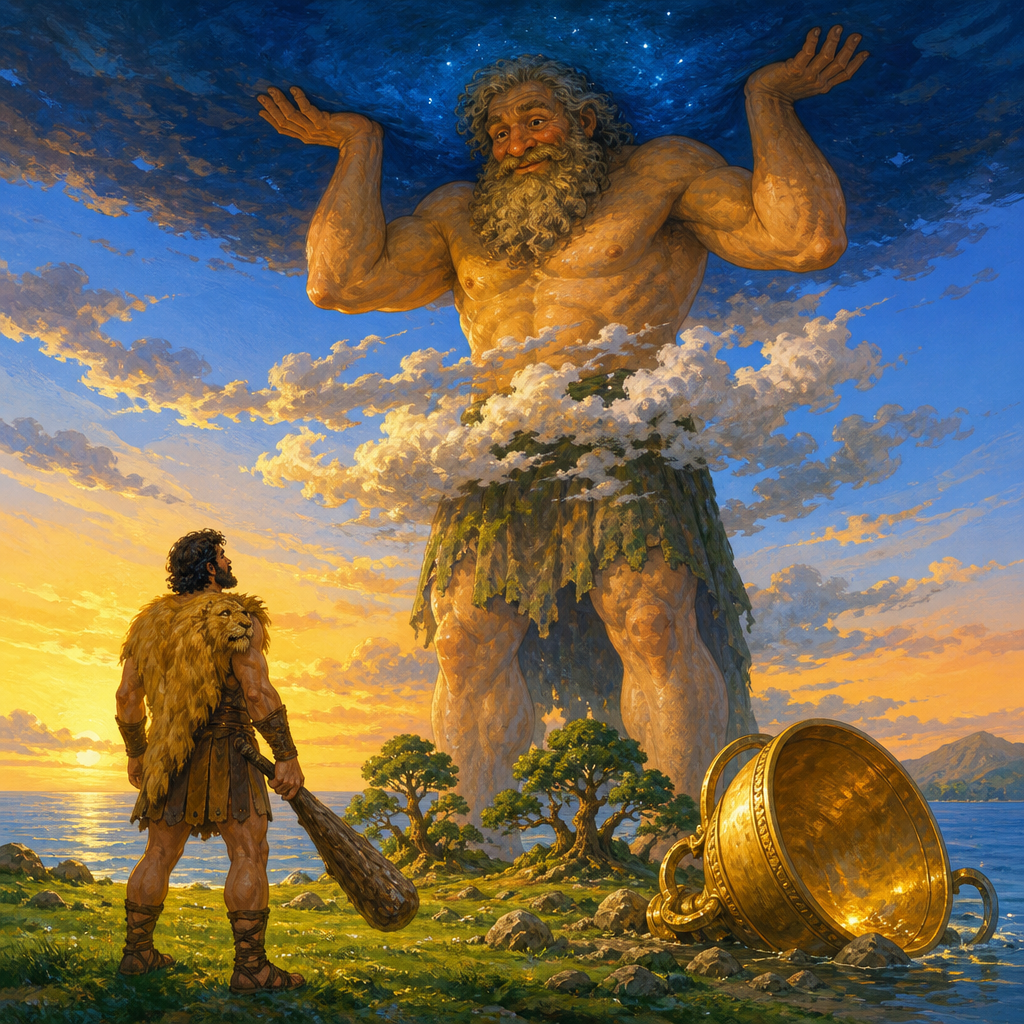
Nothing lay ahead but foaming, crashing, endless water. Then suddenly, far off on the horizon, he saw something that hadn’t been there a moment before. It gleamed as bright as the sun when it rises or sets over the edge of the world. It was coming closer, and the closer it came, the bigger and brighter it grew. Finally Hercules saw that it was an enormous cup or bowl, made of gold or polished brass. How it had come to be floating on the sea, I can’t tell you. There it was, rolling on the waves, tossed up and down, with foamy water slapping its sides, but never a drop splashing over the rim.
“I’ve seen a lot of giants in my time,” thought Hercules, “but never one who’d need a cup like that for his wine.”
And what a cup it was! It was as big as, well, I’m afraid to say how big. Let’s just say ten times larger than a great mill wheel. Yet, for all its metal, it floated over the waves more lightly than an acorn cup down a stream. The waves tumbled it toward shore until it bumped against the beach just a few steps from where Hercules stood.
He knew at once what to do. It was clear as daylight that some unseen power had sent this marvelous cup to carry him across the sea to the garden of the Hesperides. So he climbed over the rim and slid down inside. The waves rang pleasantly against the golden sides, and the cup rocked so gently that Hercules was soon rocked to sleep.
He had probably slept a good while when the cup bumped against a rock and rang out like a hundred church bells. The noise woke Hercules. He jumped up and looked around, wondering where he was. The cup had carried him across a good part of the sea and was nearing the shore of an island. And what do you think he saw there?
No, you’ll never guess it, not if you tried fifty thousand times! It was the most amazing sight Hercules had ever seen in all his travels. It was a bigger marvel than the nine-headed hydra whose heads grew back twice as fast as they were cut off, or the six-legged monster, or anything anyone has ever seen before or since. It was a giant!
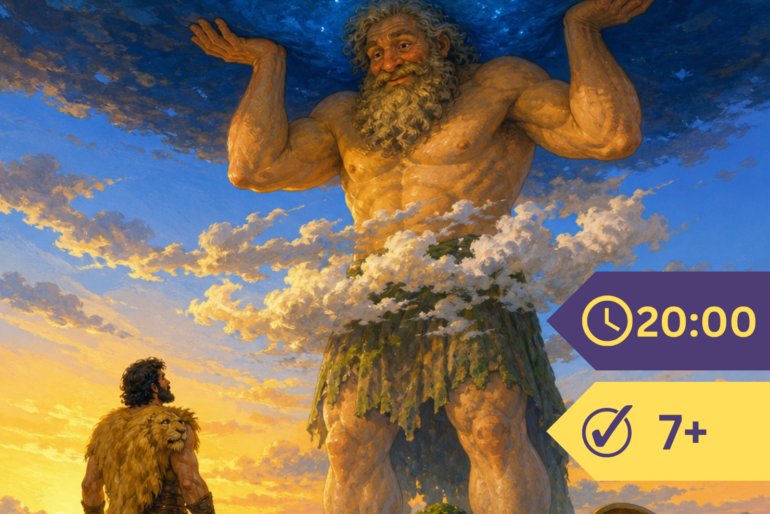
And such a giant! He was as tall as a mountain. Clouds wrapped around his middle like a belt, and hung from his chin like a gray beard, and drifted in front of his huge eyes so that he could see neither Hercules nor the golden cup. Most amazing of all, the giant held up his enormous hands and seemed to be holding up the sky, which rested on his head! It’s almost too much to believe.
The bright cup floated on and finally touched the shore. Just then a breeze blew the clouds away from the giant’s face, and Hercules saw all his enormous features: eyes as big as a lake, a nose a mile long, and a mouth just as wide.
Poor fellow! He had obviously been standing there a very long time. A whole forest had grown up and died around his feet. Oak trees six or seven hundred years old had sprouted from acorns and squeezed in between his toes. He looked down from far above, saw Hercules, and roared:
“Who are you, down there at my feet? And where did you come from in that little cup?”
“I am Hercules!” the hero thundered back. “And I’m looking for the garden of the Hesperides!”
“Ho! ho! ho!” the giant roared with laughter. “That’s a clever adventure, I’m sure!”
“And why not?” cried Hercules. “Do you think I’m afraid of a dragon with a hundred heads?”
Just then black clouds gathered around the giant’s middle and burst into a tremendous thunderstorm. The racket was so loud that Hercules couldn’t make out a word. He could see only the giant’s enormous legs rising into the storm, and now and then a glimpse of his whole shape wrapped in mist. The giant seemed to be talking the whole time, but his deep, rough voice blended with the thunderclaps and rolled away over the hills.
At last the storm blew over as suddenly as it had come. There was the clear sky again, and the weary giant holding it up, and sunshine glowing on his great height against the dark clouds behind him. His head was so far above the shower that not one hair had even gotten wet.
When the giant saw Hercules still standing on the shore, he roared again:
“I am Atlas, the mightiest giant in the world! And I hold the sky on my head!”
“So I see,” said Hercules. “But can you show me the way to the garden of the Hesperides?”
“What do you want there?” asked the giant.
“Three of the golden apples,” Hercules shouted, “for my cousin the king.”
“Nobody but me,” said the giant, “can go into the garden of the Hesperides and pick the golden apples. If it weren’t for this little business of holding up the sky, I’d take a few steps across the sea and fetch them for you.”
“That’s kind of you,” said Hercules. “But can’t you rest the sky on a mountain?”
“None of them is quite tall enough,” said Atlas, shaking his head. “But if you stood on the top of that nearest one, your head would be just about level with mine. You look strong. What if you took my load on your shoulders while I go on your errand?”
“Is the sky very heavy?” Hercules asked.
“Not especially, at first,” said the giant, shrugging. “But after a thousand years it gets a little tiresome.”
“And how long,” asked the hero, “would it take you to get the apples?”
“Oh, only a few moments!” cried Atlas. “I take ten or fifteen miles at a stride. I’ll be there and back before your shoulders even begin to ache.”
“All right, then,” said Hercules. “I’ll climb the mountain behind you and take over.”
The truth is, Hercules had a kind heart. He thought he’d be doing the giant a favor by giving him a chance to stretch his legs. And besides, he thought it would be even more glorious to say he’d held up the sky than to do something as ordinary as beating a hundred-headed dragon. So the sky was shifted from the shoulders of Atlas to those of Hercules.
The moment it was done, the giant stretched. Then he slowly lifted one foot out of the forest that had grown around it, and then the other. Then he began to leap and dance and caper for joy at being free, flinging himself heaven knows how high into the air and landing with a thump that shook the earth. He laughed, “ho! ho! ho!”, a thunderous laugh that echoed from mountain to mountain. When his joy had settled a bit, he stepped into the sea: ten miles at the first stride, which brought the water to the middle of his legs; ten miles at the second, and the water was just above his knees; ten more at the third, and he was in nearly to his waist. That was the deepest part of the sea.
Hercules watched until the giant’s shape faded completely from view. Then he began to worry. What if Atlas drowned? What if the dragon with a hundred heads stung him to death? How would he ever get rid of the sky? And, by the way, the weight was already starting to be a little annoying on his head and shoulders.
“I really feel sorry for the poor giant,” he thought. “If it tires me this much in ten minutes, how tired he must have been after a thousand years!”
I don’t know how long it was before, to his enormous relief, he saw the giant’s huge shape far off on the edge of the sea, like a cloud. As Atlas came nearer, he held up his hand, and in it Hercules saw three magnificent golden apples as big as pumpkins, all hanging from one branch.
“I’m so glad to see you again!” Hercules shouted when the giant was within earshot. “So you’ve got the golden apples?”
“Certainly, certainly,” said Atlas, “and very fine apples they are. I took the best ones on the tree, I promise you. It’s a lovely place, that garden of the Hesperides! And the dragon with a hundred heads is a sight worth seeing. Honestly, you should have gone for the apples yourself.”
“Never mind,” said Hercules. “You’ve had a nice walk, and you’ve done the job as well as I could have. Thank you for your trouble. And now, since I have a long way to go, and the king my cousin is waiting for these apples, would you kindly take the sky off my shoulders again?”
“Well, as to that,” said the giant, tossing the golden apples twenty miles into the air and catching them on the way down, “I think you’re being a little unreasonable. Couldn’t I carry the apples to your cousin the king much faster than you could? If his majesty is in such a hurry, I’ll promise to take my longest strides. And besides, I have no wish to take the sky back just now.”
Hercules lost his patience and gave a great shrug of his shoulders. It was twilight, and if you’d been looking up, you’d have seen two or three stars tumble out of place. Everyone on earth looked up in alarm, afraid the sky might fall next.
“Oh, that won’t do!” cried Atlas with a great roar of laughter. “I haven’t dropped that many stars in the last five hundred years. After you’ve stood there as long as I did, you’ll learn some patience.”
“What!” shouted Hercules, furious. “Do you mean to make me carry this forever?”
“We’ll see about that one of these days,” said the giant. “Either way, you shouldn’t complain if you have to carry it a hundred years, or maybe a thousand. I carried it much longer, backache and all. After a thousand years, if I’m in the mood, maybe we’ll trade places again. People will talk about you for ages, I promise you that.”
“Pish! A fig for their talk!” cried Hercules, hitching up his shoulders. “Just take the sky on your head for a moment, will you? I want to fold up my lion skin as a cushion. It’s rubbing me raw, and it will be awfully uncomfortable over so many centuries.”
“That’s only fair, and I’ll do it,” said the giant. “Five minutes, then. Only five minutes, remember. I have no wish to spend another thousand years like the last one. Variety is the spice of life, I always say.”
Ah, the thick-witted old rogue of a giant! He dropped the golden apples and took the sky back onto his own head and shoulders, where it belonged. And Hercules picked up the three golden apples, each as big as a pumpkin or bigger, and set off for home without paying the slightest attention to the thundering voice of the giant, who bellowed after him to come back. Another forest sprang up around the giant’s feet and grew old there, and once again you could see oak trees six or seven hundred years old, grown between his enormous toes.
And there stands the giant to this day. At least, there stands a mountain as tall as he was, and it carries his name. When thunder rumbles around its peak, we can imagine it’s the voice of Giant Atlas, bellowing after Hercules.