PART I.
Conscious waves, astutely, Rejoiced, tumultuous surging; By the seashore, mutely Sat the lonely Virgin; While thy murmurs, Ocean, Sported with the breezes, Music of their motion Making — such as seizes Spirits when they feel inspired —
Thus sitting, unadmired, To watch the foam Adona seemed, While it mantled, rolled, and creamed; Its spray once shed, ’tis shed for ever, Flowing away, returning never; And where it broke, and tumbled o’er, Another still, for evermore, Grows to a ridge, and froths and frets, And melts to vapour; all regrets Forestalling for the passing, by The coming — borne with ecstasy, In endless series, like a chase — Each eager for the former’s place.
In maiden meditation, she (Adona) sat; and, fancy-free, Felt like a weed upon the shore, Flung from that sea, unclad, forlorn.
What mortal, girt with regal vest, Crowned with the myrtle for a crest, With springy step, now treads the lea, As pleased with sand, and sky, and sea? Who knows him not? Adonis — he Who is just what he seems to be — The glorious Monarch of the Isles (O happy band! O joyous troop!) That bask within the summer smiles, And make with this a sister group.
What stays his step? In mute amaze, That maiden shape arrests his gaze. But, as he looked, a darkness lowered, And shadows deepened on her brow; With terror or with shame overpowered, She turned to flee — but where and how? She turned to flee, but, worn and weak, Sank on the beach, and could not speak. Then, in thy heart, Adonis! sprang Pity, and, like a fountain, sang — A soft and clear and silvery song, Running its pebbly bed along, Which, save in stillness and in shade, No sound unto the ear had made. That royal soul the whisper heard, And, soon to love by pity stirred, The Monarch scanned the maiden’s face, With marvel at the expressive grace That life to every lineament Significance and lustre lent.
Then words he spoke, to soothe and cheer, And healed her soon of shame and fear; And heard her simple tale, in part — The rest he guessed at, by the heart.
“On some fair isle, hid in the deep, Couched on a bank of flowers asleep, A pirate crew, with purpose dark, Had seen, and then on board their bark Conveyed her, meaning to enslave: Pursued, they tossed her to the wave; And hither, floating with the tide, More like a corpse than living creature, The billows bore her, in their pride, Uninjured or in form or feature.”
Her voice, her air, the Monarch moved. He looked, he listened, and he loved.
PART II.
On golden throne, in marble hall, Adona sits, Adonis by; — It is a day of festival, Of masquing and of revelry. Adoniá they call the day, Whereon who would might idly play, And sport his jest, and boast his say, Follow his fancy, and have his way; There was none to chide with nay — The world was a fair, and all were gay Ever at this Adoniá.
In royal robes the bride was seen Adona — all-elected Queen. Beside her, and not far above, An image of immortal Love, Adonis, with his eyes of fire, Lit up in hers his own desire; And, while her cheeks with blushes glowed, Her beauty awed the ignoble crowd. There were his altars, there his shrine; And all he worshipped was divine. The likeness of himself he saw, And in the mirror looked with awe.
And, thus caressed, and worshipped so, The woman to a goddess grew, And greater felt than she might know — The lovely and the deathless too!
Her eye of pride Adonis read, And, filled with more of love than dread, Exulting said: “Now, by the Sun! Whate’er thou wilt, That shall be done, Or grace or guilt — Speak! have thy will, my goddess-bride!”
“I see the wine-cup by thy side, The liquor mantles to the brim, The beads upon its surface swim, Each globule is a world of pleasure, They run a race, they dance a measure, And, like the planets in the sky, Have their own stellar harmony. Merrily, merrily the dimples laugh; And fain — how fain — would I the goblet quaff!”
A gloom upon Adonis fell — “This goblet wouldst thou taste? ‘Tis well! The shoulders fit them to the yoke — An oath once vowed who dare revoke? The draught be thine; I will not tell The magic charm, the wizard spell, That mingles there, lest thou shouldst lose One joy, and deem that I refuse. My love to me is more than life — My mistress, bride, my queen, my wife!”
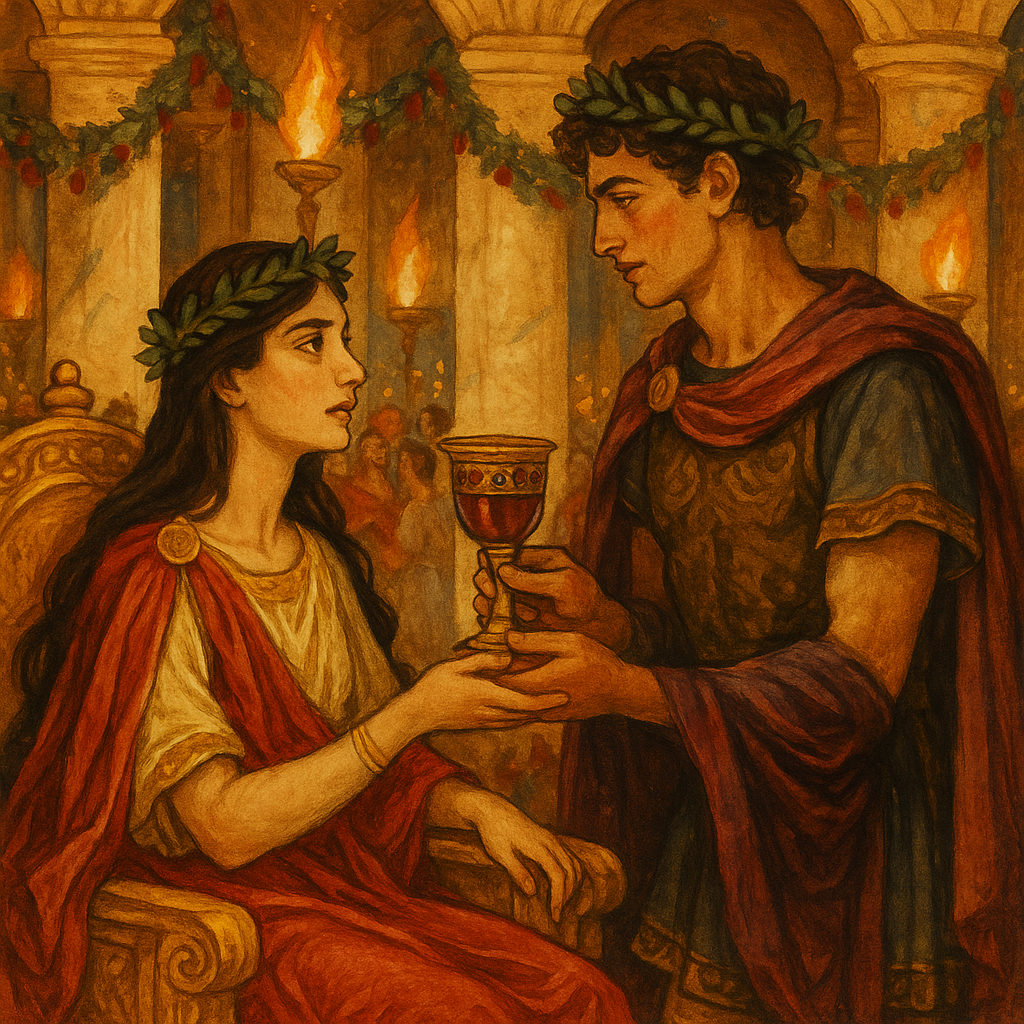
Then in his arms Adonis took Adona, and upon her lips Impressed a kiss, and shed a look Into her eyes they scarce might brook, Bright as the sun’s before his eclipse.
This done, for Love had made him brave, The wine-cup to her hand he gave, And smiled well-pleased — so best might he Her bosom of all doubt set free.
Within her small white hand Adona took the cup, And held it to her lip so bland, Then drank the red wine up — O the rapture! all a-tremble, She the joy would fain dissemble; When, from her unsteady grasp, Escaped the bowl, and sudden fell — Oh, late ’twas whole, within her clasp! Now, broken, lo! the fragments tell — What? that Adonis loved too well! He knew, not she, the oracle.
PART III.
“When the bowl shall be broken, Ere the rite can be spoken, On the Deathless the deadly shall be wreaked!” — These were the words the Flamen aloud Exclaimed, advancing before the crowd Into the presence.
The sound appalled. Adona’s senses were all enthralled, And pale she stood in the midst of throngs. Ceased on the sudden their sports and their songs, While the stern Priest said, in the silence dread:
“One moment, and religious wont,
- With ceremonial order fitting,* Had taken from the holy font,
- The while your hands in bonds were knitting,* The sacred chalice, and to thee Presented it with sanction free. But thy impatience has outrun The pious rite, and evil done, That had been good, the form been so — Wherefore the bridal we forego. Wake from thy trance, too much adored Adona! look upon thy Lord!”
Obedient now too late, thus chid, As she was bid, Adona did; And looked upon Adonis, whom Some horror seemed to wrap in gloom.
It passed, but left within his eye A wildness, as of phrensy, And forth his trembling lips there came Breathing thoughts and words of flame, Like the lightning from a cloud. “To the chase!” he cried aloud; “The deep-mouthed bay of the hounds I hear! The sound in my soul is a sound of fear! For they are the hounds of hell, I wis, And their prey they never miss. Ha! which of us are they pursuing? They goad the boar to my undoing — Hold back! hold back! Oh, fatal zeal! His tusks within my side I feel! No rescue! none! By Heaven’s decree, Adona! thus I die for thee!”
While thus he raved, his visage, act, In agonistic gestures fit, Symbolled to every sense the fact His words described, performing it. And when he ceased to speak, he fell, As smitten by a sudden spell.
Adona looked upon her Lord; Adona, the too much adored, Gazed, as her eyes, that would not weep, Might from their stiffened spheres outleap. But, in the madness of that hour, The Flamen’s words had healing power:
“On thy dead Lord thou lookest here,
- Whom love for thee has slain;* Whose absence thou must learn to bear
- Till his life come back again.* His love than death is stronger far; Yet doomed with doom to be at war, He still shall conquer, but to be Again subdued, for ever and aye; Six moons on earth restored to thee, Six moons spent with Proserpina.”
Adona heard; then stooped, embraced In her two loving arms her Lord, And wept the tears her beauty graced, Too much beloved, too much adored. Wherefore it is that, evermore, When Winter, like the furious boar, Slays the bright Sun, and Nature all Wears a white shroud, a snowy pall, The Syrian damsels mourn thy death, Adonis! but with hope and faith, Expectant of thy resurrection; When Earth, because of thy affection, Anew shall blossom and shall bear; Dying and living every year.