Why the Shamrock Is Worn on St. Patrick’s Day

Summary


"Why the Shamrock Is Worn on St. Patrick's Day" retells the Irish legends surrounding St. Patrick through vivid, almost mythic vignettes. Shamrocks bloom where snakes can no longer slither, footprints mark harbor rocks, and a chieftain's sword arm freezes mid-strike until he swears obedience to the saint. The story builds to a tense confrontation inside an idol-worshippers' hall, where St. Patrick faces a gilded stone pillar surrounded by twelve idols — and acts with unwavering conviction.

Listen to audio


Read Online

It is said that shamrocks grow where snakes cannot live — and since St. Patrick drove all the snakes out of Ireland, shamrocks spread across the land in their wake.

But there are older stories about St. Patrick still told in Ireland.

His footprints, some say, can still be seen on the rocks by the harbor at Skerries. And once, a chieftain named Dichu drew his sword to strike the saint down. At the very moment he raised his arm, it went rigid and would not move — and it stayed that way until Dichu swore obedience to St. Patrick. Then St. Patrick taught him to be kind.

Another legend tells of the idol-worshippers. St. Patrick walked into their hall and found them gathered around a tall stone pillar, the chief idol at the top covered all in gold and silver, twelve more idols arranged in a circle around it. St. Patrick struck the chief idol with his crozier — and it crumbled to dust.
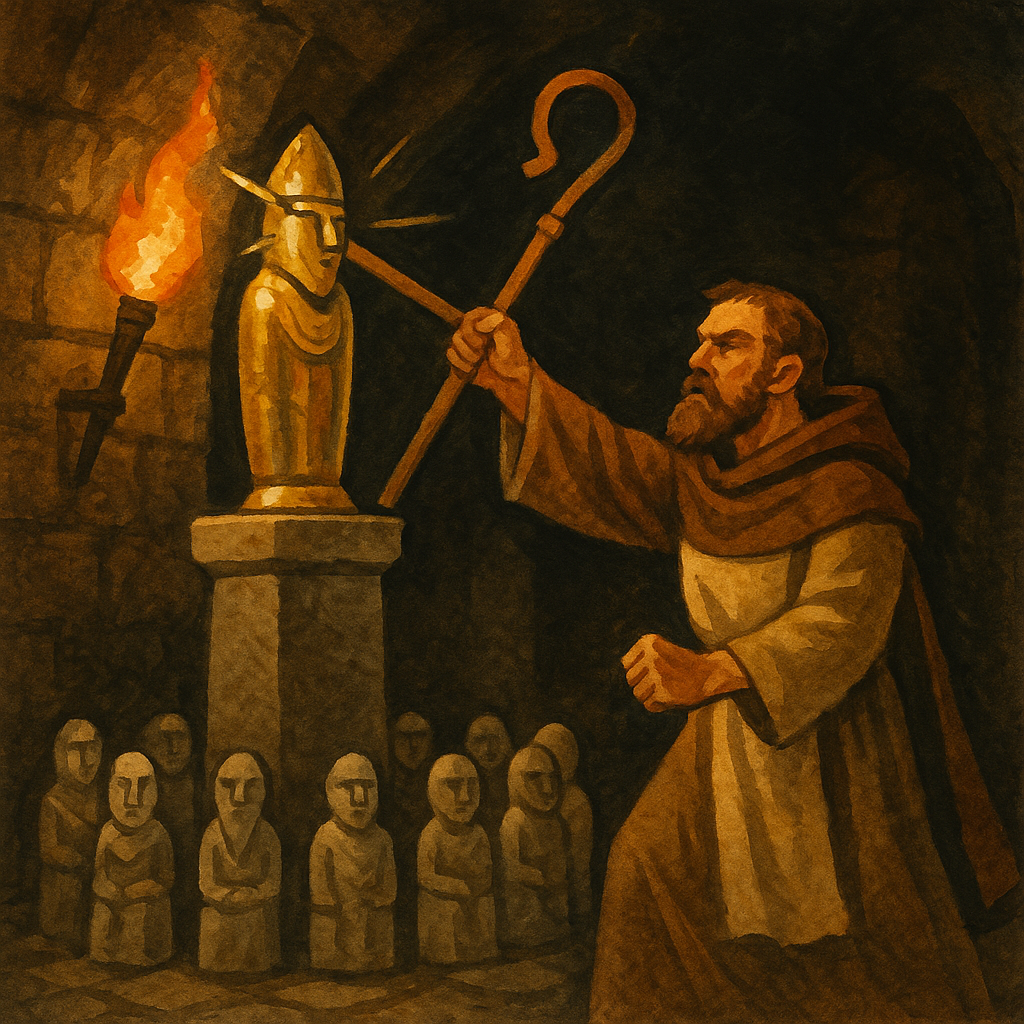

St. Patrick strikes a golden idol with his crozier in a stone hall, illustrating Why the Shamrock Is Worn on St. Patrick's Day.

Add Ririro as a Preferred Source on Google


Credits

Mary Graham Bonner was an American author of the early twentieth century best known for her collections of children's stories, poems, and holiday tales. This piece draws on authentic Irish oral tradition, weaving together several distinct legends — including the story of the chieftain Dichu — into a single compact retelling.