“Good King Wenceslaus looked out
On the Feast of Saint Stephen,
When the snow lay round about,
Deep and crisp and even.”
King Wenceslaus sat alone in the turret chamber of his palace, watching the last of the sunset hang in the western clouds before fading over the blue hills. The cold settled in quickly after the light left. A freezing haze crept across the land. The moon brightened in the southwest, and the leafless trees in the castle gardens — along with the turrets and spires of the castle itself — threw long, dark shadows over the unmarked snow.
Still the king looked out. The ground sloped away from the castle toward the forest, and here and there on the hillside a few grey-mossy bushes broke the white. As his eye moved that way, he noticed a poor man making his way to those bushes, pulling something from the branches.
“Otto,” he called. A young page entered at once. “Come stand with me. Do you see that man on the hillside? Go down and find out who he is, where he lives, and what he’s doing. Come back and tell me straightaway.”
Otto set off while the king watched. The frost sharpened. An east wind came down from the dark mountains, and the snow grew harder underfoot. In a few minutes the page returned.
“Well? Who is he?”
“Sire, it’s Rudolph the swineherd — he lives down by the Brunweis. He has no fire and no food. He was gathering what sticks he could find before his whole family froze in the night. It’s bitter out there, my lord.”
“This ought to have been seen to,” said the king quietly. “A fault — a serious one. But it shall be put right now. Go to the pantry, Otto, and bring the best of what we have.”
“Bring me flesh and bring me wine,
Bring me pine logs hither;
Thou and I will see him dine,
When we bear them hither.”
“Is Your Majesty going out himself?” asked Otto, astonished.
“Yes — to the Brunweis. Have everything ready and meet me at the wood-stacks by the little chapel. Be quick about it.”
“Please, Sire — let some of the men-at-arms go instead. The wind is freezing, and the place is a good league from here.”
“Nevertheless, I go,” said the king. “Come with me if you like, Otto. If not, stay. I can carry the provisions myself.”
“God forbid I should let you go alone, Sire. But I beg you to think again.”
“Not in this,” said King Wenceslaus. “Meet me where I said. And not a word to anyone.”
In the great hall, the noblemen of the court sat before a roaring fire, its shadows leaping across the high dark rafters. They laughed and joked and tossed fresh logs onto the blaze, agreeing with one another that they’d never known such bitter cold. But out in the midst of that freezing night, the king went forth.
“Page and Monarch forth they went,
Forth they went together;
Through the rude wind’s wild lament,
And the bitter weather.”
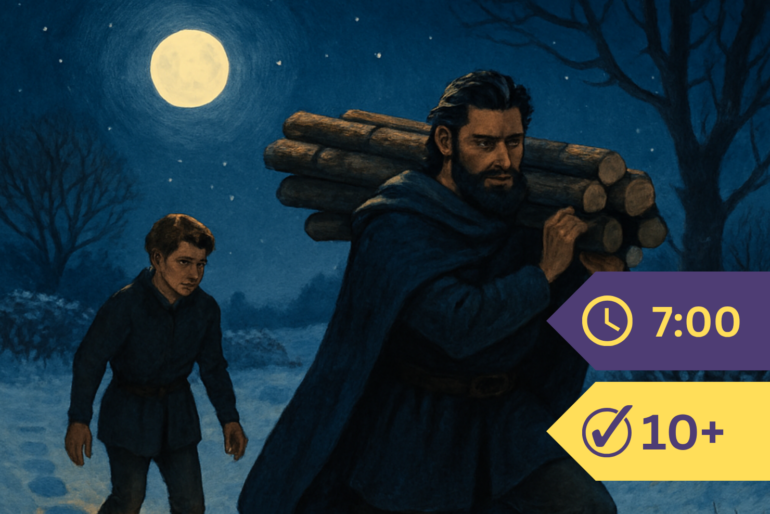
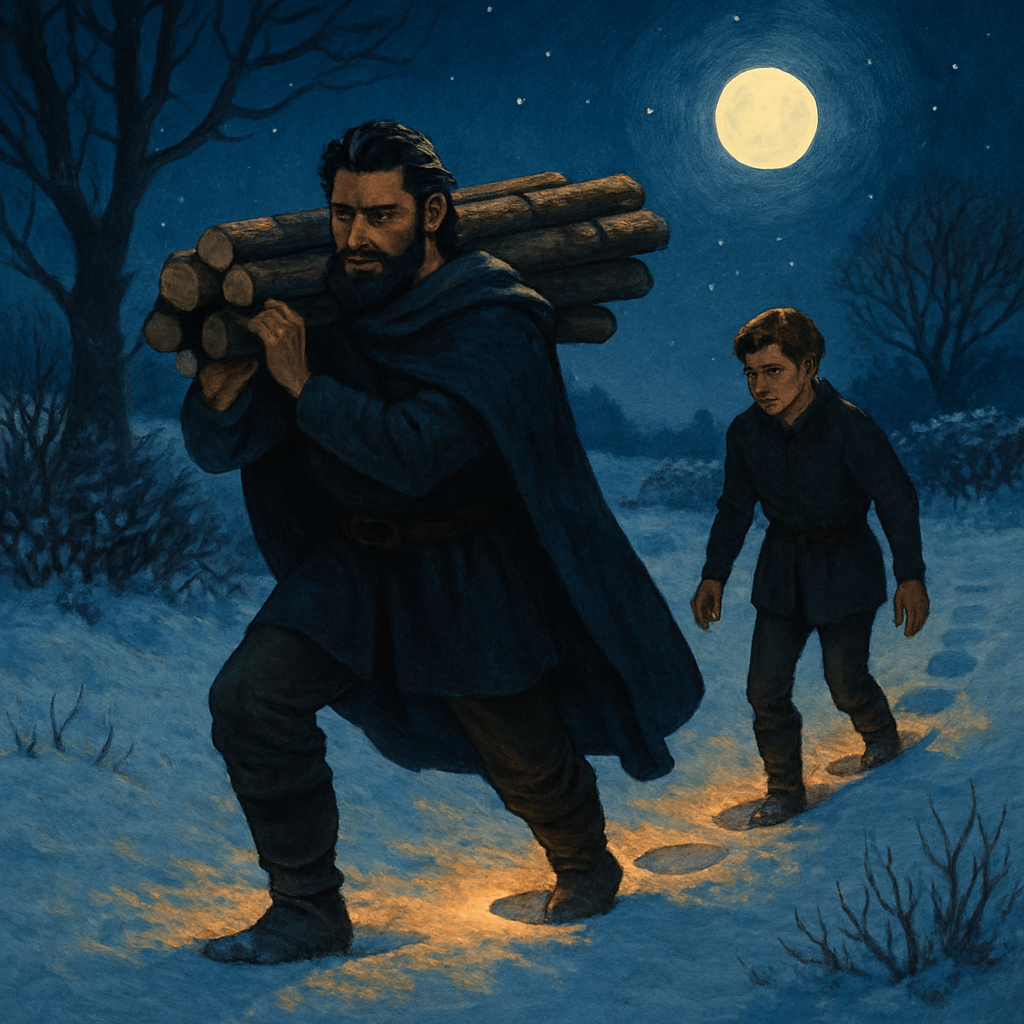
The king had put on no extra clothing against the cold. He wanted to feel what the poor felt, so that he might truly feel for them. He loaded a heap of logs onto his own shoulders for the swineherd’s fire and set off at a brisk pace. Otto followed behind with the food, having followed his master’s example and gone out in his ordinary clothes. Together they walked — over crisp snow, across fields, down lanes where the hedgerow branches sagged white, past the frozen pool, over the stile where the hoarfrost clustered thick, and out onto the open moor, where the snow lay unmarked and the wind cut to the bone.
Still the king pressed on, and still Otto followed. Wenceslaus found it no great thing to walk out into the frost and dark — thinking of One who had once come into the cold night of this world; a king who had not disdained to go to the poor, for had not the King of Kings sought out those even lower? Who had not grudged carrying a burden on his shoulders, for had not the King of Kings borne heavier still?
But with every step, Otto’s courage ebbed. Shame kept him going — how could he turn back while his master walked on? Yet when they came out onto the wide, bleak moor, he cried out at last:
“My lord, I cannot go on. The wind is freezing my blood. Please — let us turn back.”
“Is it so bad?” the king asked gently. “Stay with me a little longer. Put your feet in my footprints. It will be easier, I promise.”
Otto had learned to take his master’s word. He looked down carefully and stepped into the prints Wenceslaus had made in the snow.
“In the master’s steps he trod,
Where the snow lay dinted;
Heat was in the very sod
Which the saint had printed.”
And so great was the warmth of love burning in the king’s heart that as his servant followed in those footsteps, life and heat flowed back into him. Otto no longer felt the wind. He no longer dreaded the frost. The master’s prints seemed to glow with a gentle fire, and he followed gladly — all the way to Rudolph’s door, on the king’s errand of mercy.