Once upon a time there lived a good king whose throne was taken by an enemy. A few faithful knights and servants fled with him into a forest, where they found shelter in deep, rocky caves.
They had left the palace in such a hurry that they could carry only a few things for the king’s comfort. It was early autumn, and the king feared they would have to hide all winter. He was glad, then, when his knights unpacked warm blankets and robes. He praised them for their foresight. Then a young page stepped forward.
“Your Majesty,” he said, “I didn’t bring clothing. But I brought as many candles as I could carry.”
“Candles!” The king laughed, not unkindly. “You lit my throne beautifully in the palace, lad, but I’m afraid we’ll have little use for candles in the forest.”
“Sire, I thought you might wish to hold council in the evenings,” said the page. “I could light your throne seat, just as I did at home.”
“My throne seat will be nothing but a rocky ledge for some time,” said the king. “But look, there is a good one in the inner cave. So long as the candles last, my faithful page, you shall not have to hold council in the dark.”
So long as the candles last, the page repeated to himself. I hope the king’s soldiers find help and drive the enemy away before they run out.
The little band soon settled into life in exile. By day they gathered food in the woods. In the evening they met in the deep cave, and the king sat on his rough stone throne, lit by two candles.
But the page watched the candles shrink, and his heart sank with them, until the night came when there were none left. In a dark corner of the cave he sat grieving, because he could no longer see his king’s face.
One misty morning he wandered to the edge of the woods, where the road ran between the glowing autumn trees and a wide meadow. An old woman stood on the roadside, a big sack on her bent shoulders. She set it down and gazed at the meadow, then at the deep ditch between it and the road.
“May I help you across?” asked the page.
“Thank you, my lad, but I’d never get back up again,” she said. “Still, I’d dearly love some of those tall mullein spikes. None in my sack are as fine as those.”
“I’ll fetch them,” said the page.
He leaped the ditch and came back with his arms full. The old woman was delighted. “They make such fine winter candles,” she said, tucking them into her sack.
“Winter candles?” said the page.
“Aye. Dip them in tallow, a thin coat will do, and you have candles fit for a king.”
“We are in great need of candles where I live,” said the page slowly. “But we have no tallow.”
“Then come home with me,” said the old woman. “I can spare you a lump.”
So he carried her heavy sack all the way to her cottage, and she gave him a large lump of tallow. On the way back he leaped the ditch again and gathered another armful of mullein. At the cave he melted the tallow and dipped each spike, one by one.
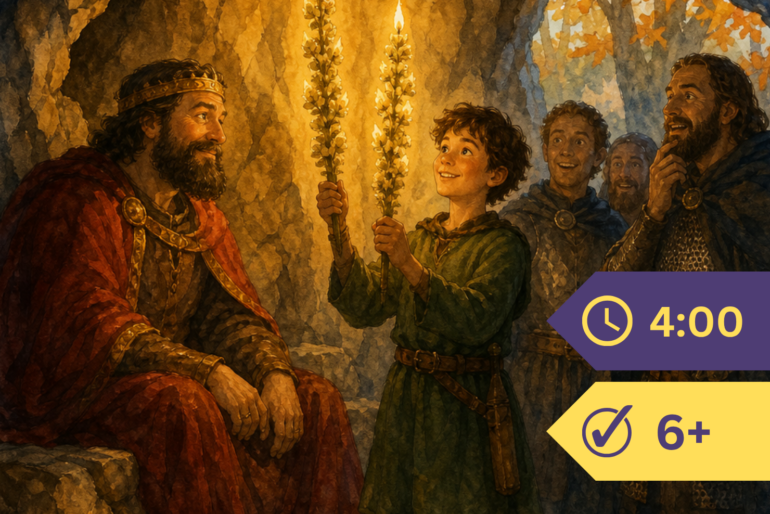
That evening, when the king and his company came back, two tall candles stood on the rocky throne.
“Look!” cried the page. “We have more candles!”
“Wherever did you find them?” asked the astonished king.
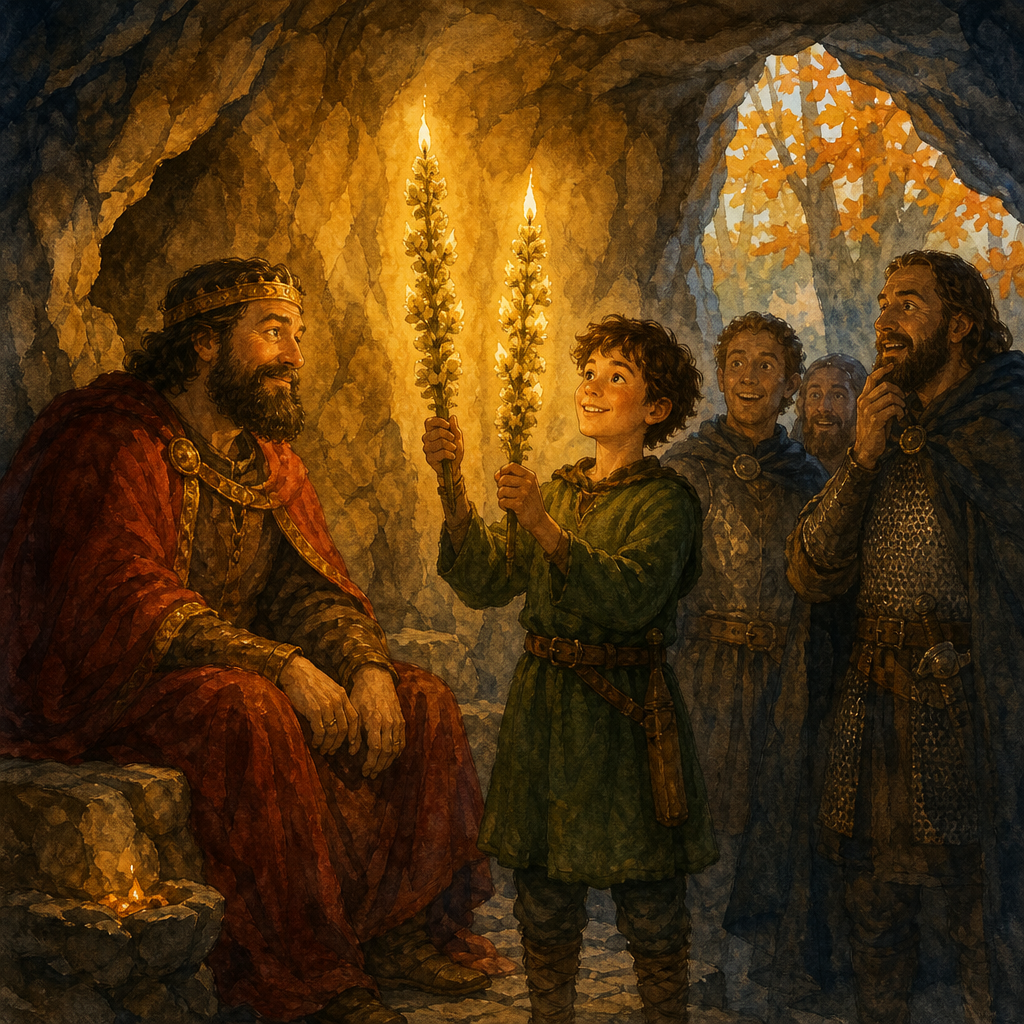
“They’re made from mullein, the weed that grows in the meadow,” said the page, and he told the king about the old woman and the ditch.
“Then the mullein shall have a new name,” declared the king. “From now on it will be called the King’s Candle.”
A few days later, the king gathered his followers around his throne. “News has come,” he said. “The enemy has been driven out of our country. Tomorrow we feast in the palace, and the tables shall be lit by King’s Candles.”
And so the story goes that every autumn, when the king holds his harvest festival, the banquet tables glow with mullein spikes dipped in tallow, still called the King’s Candles.
Optional epigraph (omit unless the source is found):
“The mullein’s yellow candles burn / Over the heads of dry, sweet fern.”