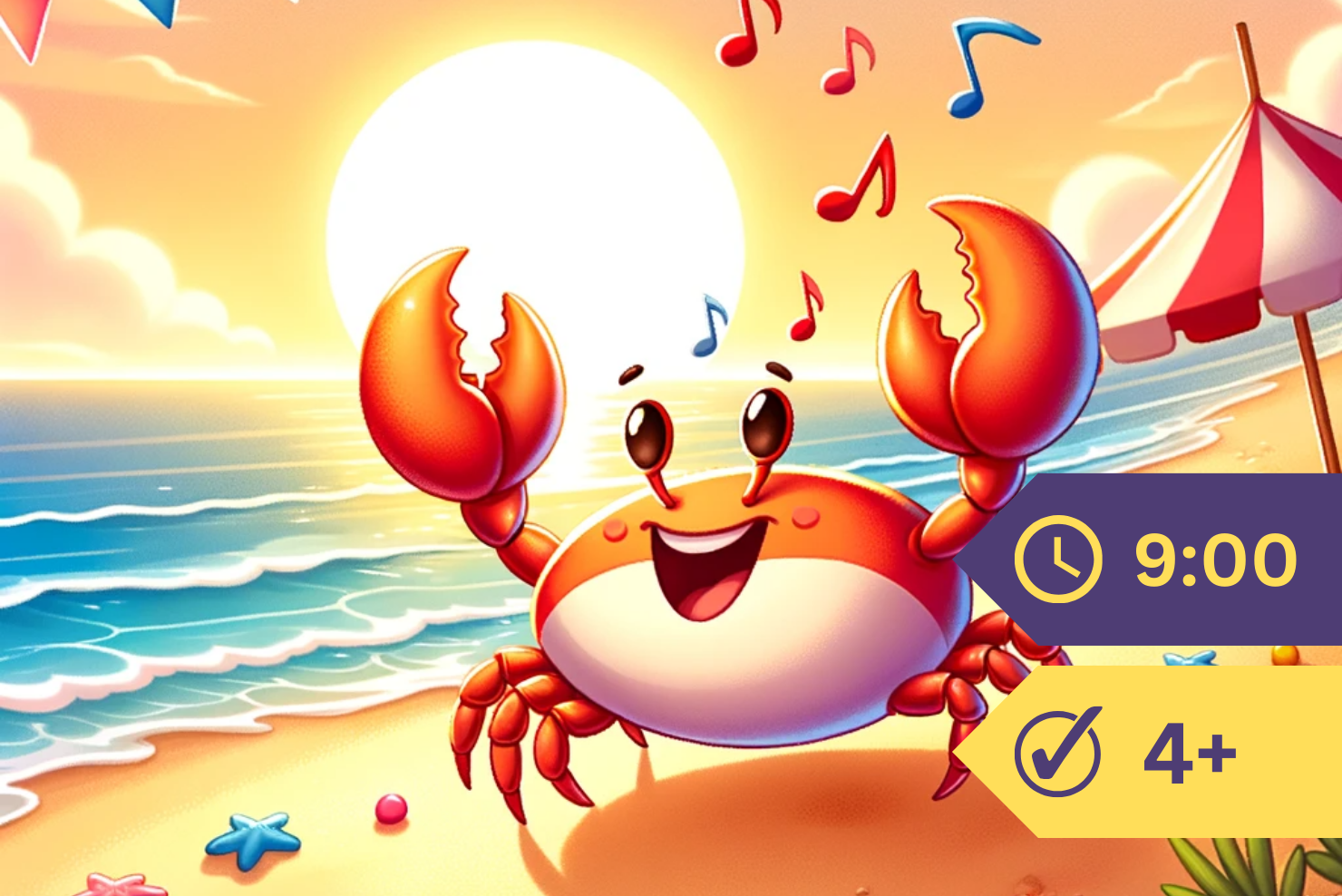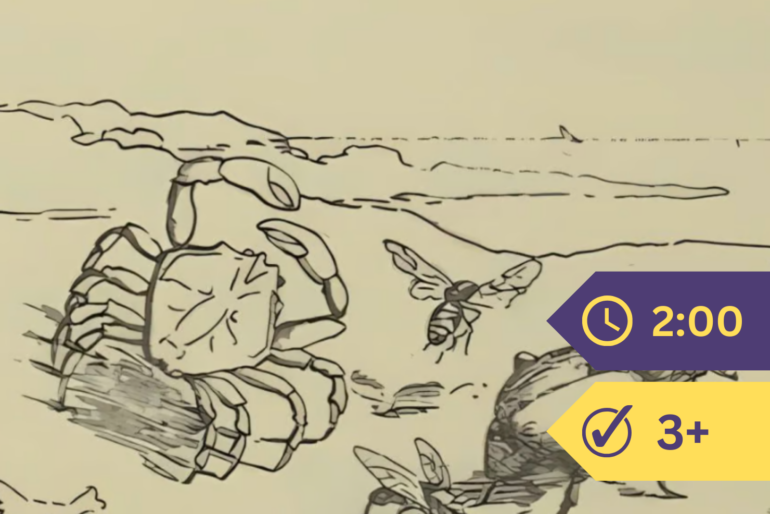
The crab that has one large claw has many names. Some call him the Fighting Crab, he is so cross. Others name him the Calling Crab, because, when he runs, he holds his big claw high, as if he called, “Come! come!”
Most people call him the Fiddler Crab, and say that his big claw is his fiddle. I think that is the best name for him.
He can, and does, play a tune on that hand. It is his violin, as well as his hand, his spade, and his sword. Do you see a row of little knobs on the inner edge of his big claw?
He rubs those knobs on the edge of the shell that covers his back, and the sound is his tune. He uses that tune to call his mate.
Mrs. Crab thinks it fine.
Mr. Crab has friends upon the beach, as well as down deep in the sand and in the water. When he walks along the sand, he meets big flies with two wings.
He is glad to see them. Why?
They put their grubs, or young ones, in the sand, and Mr. Crab knows that he can find them to eat.

Mr. Crab also meets a great, green tiger beetle. He does not fight him. He knows that he shall find the beetle’s grubs in the sand and eat them.
While he is digging down below, he meets a little fat, round crab, with big eyes, and a thin, gray shell.
He is glad to see him. If the crab has not food enough to eat while the tide is high, he will creep along in the sand, and catch and kill this small crab for his dinner.
Mr. Crab also meets, deep down, long worms, green, red, or brown.
They are making houses for themselves. He does not trouble them.
Out in the sea, Mr. Crab finds some small shell-fish called limpets.
He likes them so much that he lets them live on his shell.
They take fast hold on his back, and he does not pull them off.