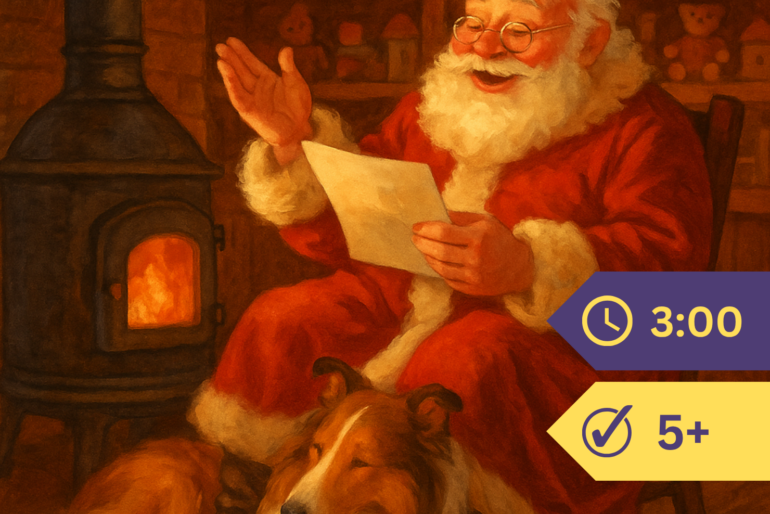
“Still the letters keep coming,” chuckled Santa Claus to himself.
He was sitting in his workshop beside the great stove, his collie, Boy of the North, stretched out on the floor with his chin resting against Santa’s boot. Santa read aloud, because he loved to hear the sound of the children’s words and to picture each one of them writing.
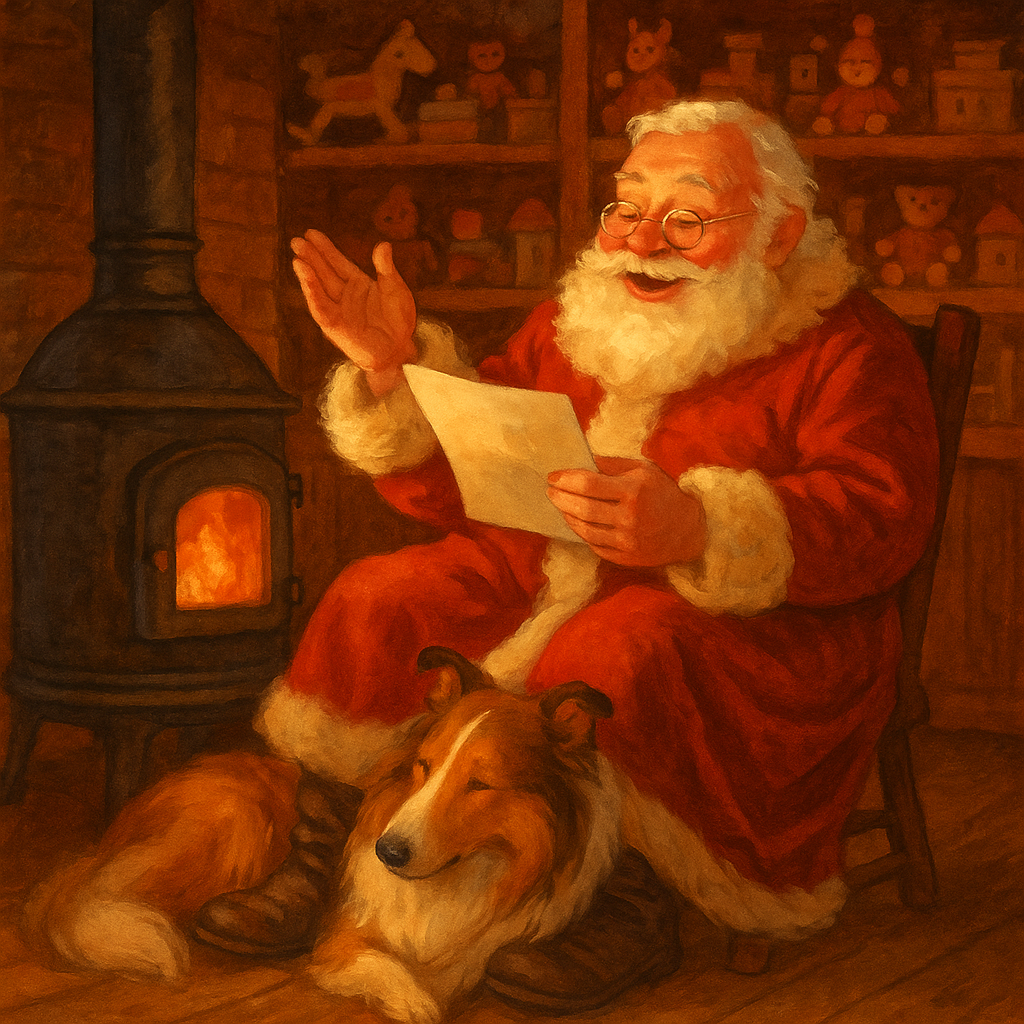
“And every year it seems to me I’ve received more letters than ever before,” he went on. “But it can never be too many for Santa Claus.
“The precious dears! What memories they have. They know exactly what they want and they don’t forget. They think old Santa remembers too — even when they drop him a quick postscript without explaining what their last letter was about. They think he can keep them all straight. And they think he can remember their names from year to year.”
He stroked his beard.
“And they’re right. Yes, the blessed little things are right.”
Nearly every letter began Dear Santa Claus, though some began Dear, dear Santa Claus, and some You precious old Santa Claus, and other nice things like that. Each one made him happy, and every letter was a little different — which Santa liked very much.
“I hope you remember me,” he read aloud from one, “for I wrote to you last year and the year before. The year before that I was too young to write, but my brudder wrote for me. Do you remember my brudder’s letter? He said that he guessed next year I could write you a letter myself, because I could then write my name. And my brudder was right, and the next year I did.”
The spelling wasn’t quite like this, Santa acknowledged to himself — but this was how it sounded as he read it aloud.
He didn’t mind about the spelling. “They must learn at school, of course,” he said to Boy of the North, “and they’ll be glad of it when they grow up. But when they’re writing to Santa Claus, they can take a little holiday. And even when they make a blot and write next to it that it’s a kiss — I know they do mean it as a kiss, even if the blot itself was accidental.”
He read on:
“My brudder won a gold medal at school the other day. He is getting to be so smart, dear Santa, and I know you’ll be pleased to hear it. You sent me a picture once, Santa, when I was very little — of a boy on his way to school in the cold, with his coat pulled up tight around him. And coming home that same day after he won the gold medal, the picture showed the boy with his coat hanging wide open, and the medal pinned right on — and he didn’t feel the cold at all. Do you ‘member, Santa? Brudder was like that the other day.”
Santa set the letter down for a moment. He did remember the picture. And he was so pleased to think about that boy — a boy he had always liked — winning his gold medal.
He read on through the others. Some were full of family news: what everyone was doing, what was planned, how many new sisters and brothers had arrived since the last letter. They all told him what they hoped he would bring, and they all — every single one — said they hoped he wouldn’t get too tired, and that they loved him, and wished him a Merry Christmas too.
And that, more than anything else, made Santa Claus very, very happy.