Once upon a time, in the days when fairies still walked the world, there was a king with three daughters. All three were young, clever and lovely, but the youngest, Miranda, was the prettiest and the best loved.
Her father gave her more dresses and jewels in a month than he gave the others in a year. Miranda was so generous that she shared everything with her sisters, and the three of them were as happy and as fond of one another as sisters could be.
Now, the King had some quarrelsome neighbours who grew tired of peace and began to make war on him so fiercely that he feared he would lose everything. So he gathered a great army and rode off to fight, leaving his daughters in a castle with their governess. News came every day: a town taken, a battle won, and at last that his enemies had been driven out of the kingdom altogether and he was hurrying home to see his dear little Miranda.
The three princesses had satin dresses made for the occasion, one green, one blue and one white, with jewels to match. The eldest wore emeralds, the second turquoises, and the youngest diamonds. Dressed like this, they went out to meet the King, singing verses they had written about his victories.
He embraced them all tenderly, but he gave Miranda more kisses than the others.
A splendid banquet followed. The King believed that everything had a hidden meaning, so as they ate he said to his eldest daughter, “Tell me why you chose a green dress.”
“Sire,” she said, “when I heard of your victories, I wore green for my joy and for my hope that you’d soon be home.”
“Well answered,” said the King. “And you, my second daughter, why blue?”
“To show that we always hoped for your success, sire, and that the sight of you is as welcome to me as the sky full of stars.”
“Such wise answers!” said the King. “And you, Miranda, why did you dress all in white?”
“Because, sire, white suits me better than anything else.”
“What?” said the King sharply. “Is that all you thought of, vain child?”
“I thought you’d be pleased with me,” said Miranda. “That was all.”
Because he loved her, the King let it pass, and even pretended to be glad she hadn’t given all her reasons at once.
“Now,” he said, “I’ve dined well and it’s not yet bedtime, so tell me what you dreamed last night.”
The eldest said she’d dreamed that her father brought her a gown whose jewels and gold embroidery outshone the sun. The second said she’d dreamed that he brought her a spinning wheel so that she could spin him some shirts.
But Miranda said, “I dreamed that my second sister was getting married. On her wedding day, Father, you held a golden bowl and said, ‘Come, Miranda, and I’ll hold the water so you can wash your hands.’”
The King was furious. His face twisted so horribly that everyone knew how angry he was, and he rose and went off to bed in a hurry. But he couldn’t forget the dream.
“Does the proud girl mean to make a servant of me?” he muttered. “No wonder she dressed in white without a thought for me. She doesn’t think me worth her notice! I’ll soon put an end to her airs.”
Before it was even light, he sent for the Captain of his Guard.
“You heard Princess Miranda’s dream? It means something dreadful against me. Take her into the forest and kill her, and so that I know it’s done, bring me her heart and her tongue. If you try to deceive me, you’ll die.”
The Captain was horrified, but he didn’t dare argue. If he refused, the King might send someone else. So he said he’d do as he was told, and went to Miranda’s room. They were reluctant to let him in at that hour, but he said the King had sent for her, and she got up at once and came out. Her young maid Patypata carried her train, and her pet monkey, Grabugeon, and her little dog, Tintin, ran along behind.
The Captain asked Miranda to come down to the garden, where the King was supposedly taking the morning air. When they got there he pretended to look for him.
“His Majesty must have strolled into the forest,” he said, and he opened the little gate and led her through.
By now it was getting light. Miranda looked at the Captain and saw that his eyes were full of tears.
“What’s wrong?” she asked kindly. “You seem so sad.”
“Princess,” he said, “how could I not be? The King has ordered me to kill you here and bring him your heart and your tongue. If I refuse, I lose my life.”
Miranda turned pale and began to cry softly. She looked up at him with her lovely eyes. “Will you really have the heart to do it? I’ve never harmed you. I’ve always spoken well of you to the King. If I had earned my father’s anger I’d bear it without complaint, but it’s unjust. I’ve always loved and respected him.”
“Don’t be afraid, Princess,” said the Captain. “I’d much rather die myself than hurt you. But even if I’m killed you won’t be safe. We have to make the King believe you’re dead.”
“But how?” said Miranda. “Unless you bring him my heart and my tongue, he’ll never believe you.”
They were so deep in talk that they hadn’t noticed Patypata, who had heard everything. Now she threw herself at Miranda’s feet.
“Madam, take my life! I’d be glad to die for such a kind mistress.”
“Patypata, no!” cried Miranda, kissing her. “Your life is as precious to me as my own, especially after a proof of love like that.”
“She’s right to value you, Princess,” said Grabugeon, hopping forward, “but I’m the one who should do it. I offer you my tongue and my heart gladly. I want to make a great name for myself in Goblin Land.”
“No, no, my little Grabugeon,” said Miranda. “I couldn’t bear it.”
“A good little dog like me can’t let either of them die,” cried Tintin. “If anyone’s to die for her, it should be me.”
Then a great quarrel broke out among the three of them, each insisting on the honour. In the middle of it, Grabugeon, who was quickest, scampered up the tallest tree nearby and flung herself down, head first. When they reached her, she was dead.
Miranda grieved, but the deed was done, and the Captain gently examined what could be used. It was hopeless. A monkey’s tongue is a tiny thing, no bigger than a thumb, and the King would never be fooled by it.
“Oh, my little monkey!” cried Miranda. “I’ve lost you and I’m no better off than before.”
“The honour of saving you is mine,” said Patypata. Before anyone could stop her, she had taken the Captain’s knife and given her life too.
But once again, when the Captain looked at what he could offer the King, he shook his head. It was no use.
“Am I so unlucky?” wept Miranda. “I lose everything I love and I’m none the better for it.”
“If you’d accepted my offer,” said Tintin, “you’d only have had me to mourn, and I’d have had all your gratitude.”
Miranda kissed her little dog, crying so hard that at last she had to turn away and walk into the forest. When she looked back, the Captain was gone, and she was alone with Tintin and the bodies of her friends. She couldn’t bear to leave them. She buried Patypata and Grabugeon together in a mossy hollow at the foot of a tree, and carved their names on the bark, and how they had died to save her.
Then she began to think about where she could go. The forest lay so near her father’s castle that the first passer-by might recognise her. And it was full of lions and wolves, who’d snap up a princess as easily as a stray chicken. So she walked as fast as she could, but the forest seemed endless, and the sun was hot, and she was nearly dead of heat and fear and weariness. Every few minutes she imagined she heard the King running after her. Thorns scratched her and tore her pretty dress to rags. She cried as she went, with no idea which path to take.
At last she heard a sheep bleating.
“There must be shepherds nearby,” she thought. “They can show me the way to a village where I can live as a peasant girl. Oh, kings and princes aren’t always the happiest people in the world! Who’d have thought I’d have to run and hide because my father wants to kill me for no reason at all?”
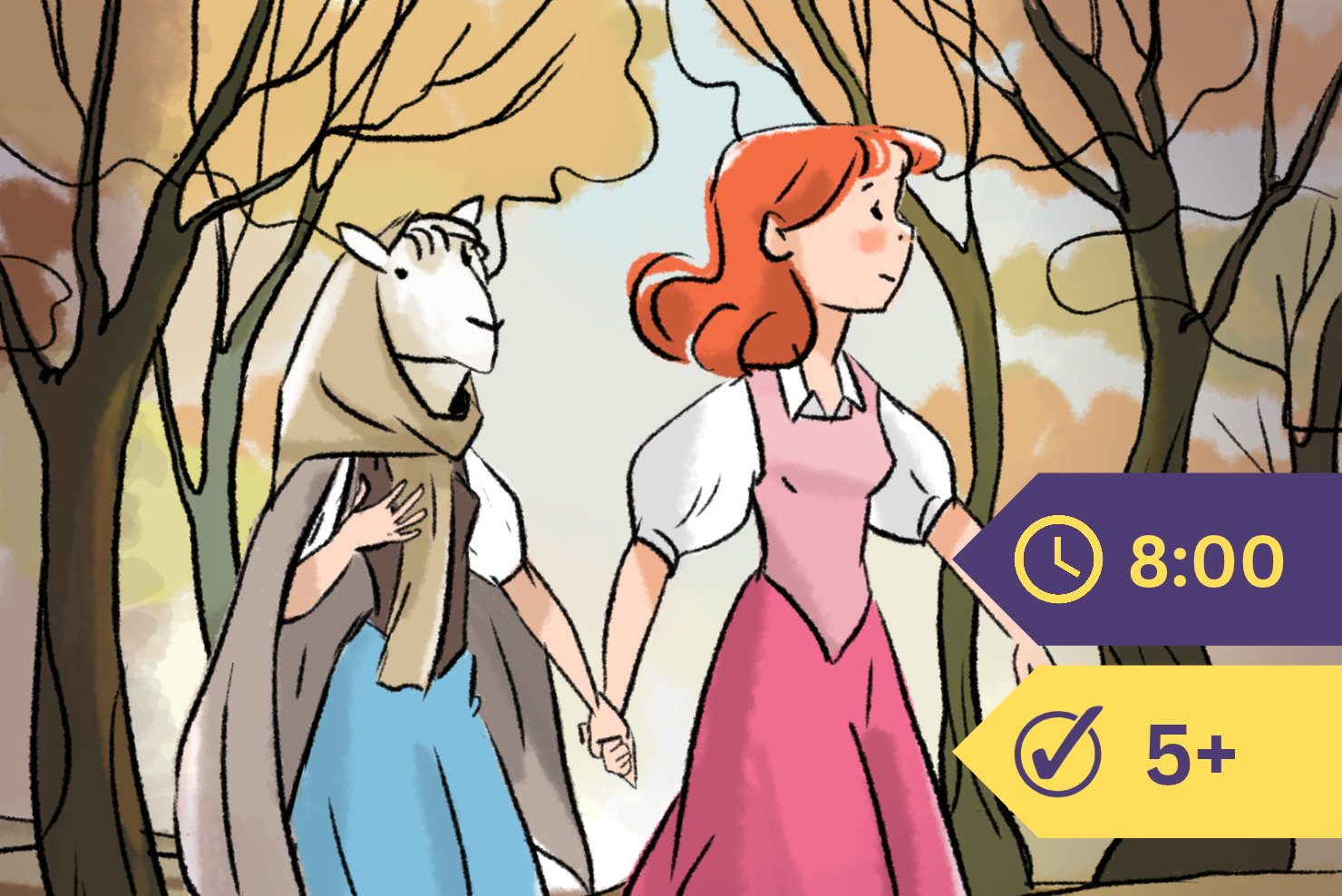
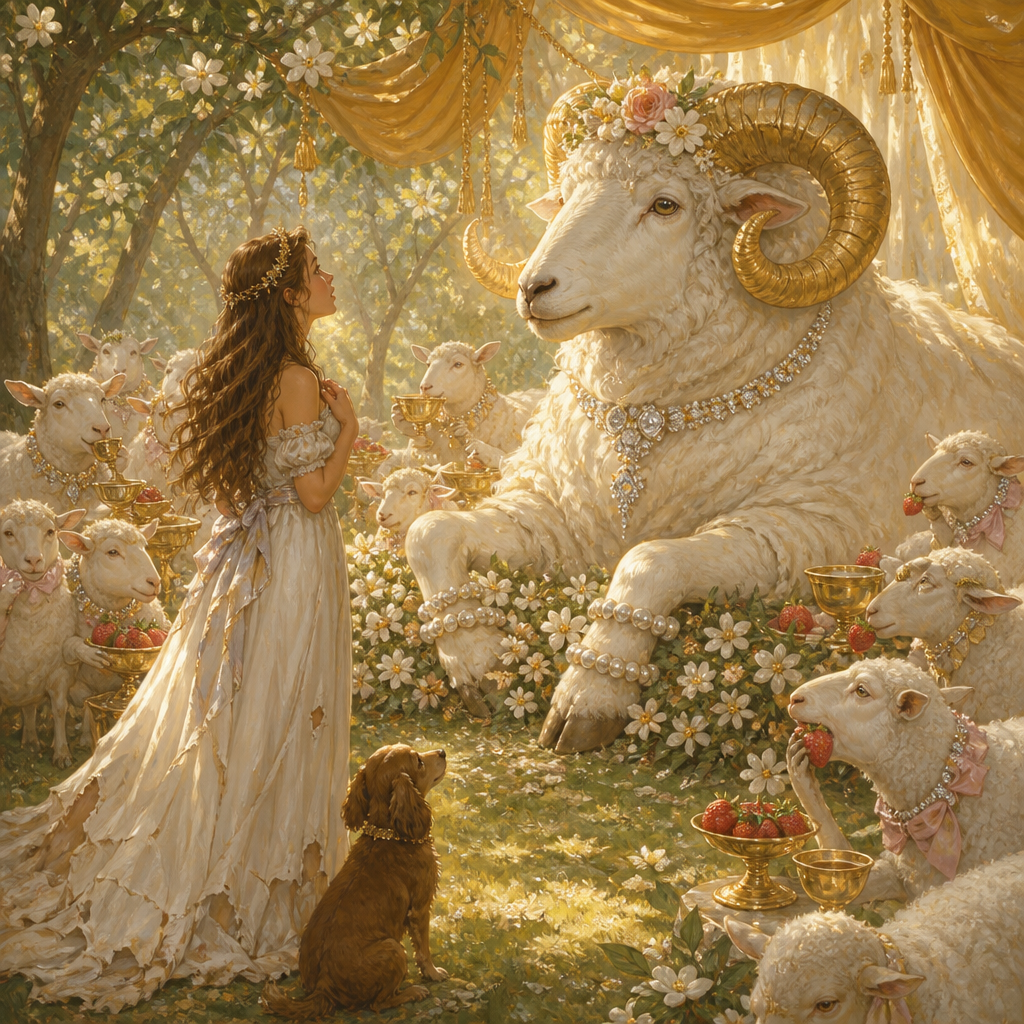
She followed the sound and came to a lovely little glade ringed with trees. There, on a bank of orange blossom under a canopy of cloth of gold, lay an enormous sheep. His wool was white as snow, his horns shone like gold, and he wore a garland of flowers, strings of great pearls around his legs, and a diamond collar. Nearly a hundred more sheep were scattered about, and none of them was eating grass. Some sipped coffee, lemonade or sherbet. Others ate ices, or strawberries and cream, or sweets. Others played games. Many wore golden collars set with jewels, and flowers and ribbons.
Miranda stopped, astonished, and was looking around for the shepherd when the beautiful sheep came bounding up to her.
“Come closer, lovely Princess,” he said. “You’ve nothing to fear from gentle creatures like us.”
“A sheep that talks!” gasped Miranda, stepping back.
“Your monkey and your dog could talk, madam,” said the Sheep. “Are we more astonishing than they were?”
“A fairy gave them the gift,” said Miranda. “So I was used to it.”
“Perhaps the same thing happened to us,” he said, with a rather sheepish smile. “But what brings you here, Princess?”
“A thousand misfortunes, Sir Sheep. I’m the unhappiest princess in the world, and I’m looking for shelter from my father’s anger.”
“Come with me,” said the Sheep. “I can offer you a hiding place that only you will know about, and you’ll be mistress of everything you see.”
“I can’t walk another step,” said Miranda.
The Sheep with the golden horns sent for his carriage, and a moment later six goats appeared, harnessed to an enormous pumpkin, big enough for two to sit in and lined with velvet and down cushions. Miranda climbed in, much amused by such a carriage. The King of the Sheep sat beside her, and the goats raced off and stopped only at the mouth of a cave blocked by a great stone. The Sheep touched it with his hoof, and it toppled over.
Ordinarily, nothing could have made Miranda enter such a cave. But she was so afraid of what lay behind her that she’d have jumped down a well. So she followed the Sheep, down and down and down, until she began to wonder whether they’d come out the other side of the world, or even into Fairyland.
At last she saw a great plain carpeted with flowers, whose scent was sweeter than anything she’d ever smelled. A broad river of orange-flower water ran round it, and fountains of every kind of wine made little waterfalls and brooks. There were avenues of trees where roast partridges hung from every branch. If you preferred pheasant, quail, turkey or rabbit, you only had to turn left or right. In some places the air was thick with a rain of lobster patties, sausages, tarts and sweets, or with gold and silver coins, diamonds and pearls. This place would surely have drawn crowds, if its master hadn’t been so serious. Everything suggests he was as solemn as a judge.
It was the loveliest time of year, so the only palace was a long row of orange trees, jasmine, honeysuckle and musk-roses, their branches woven into rooms hung with gold and silver gauze, with great mirrors, candlesticks and beautiful paintings. The Wonderful Sheep begged Miranda to consider herself queen of everything she saw. He said that for years he had been sad and in trouble, and that she had the power to make him forget his grief.
“You’re so kind, noble Sheep, that I can’t thank you enough,” said Miranda, “but it’s all so strange I don’t know what to think.”
Just then a troop of lovely fairies came up and offered her amber baskets of fruit. But when she reached for them, they slid away, and her hands touched nothing.
“What are they?” she cried. “Who am I with?” And she began to weep.
The King of the Sheep rushed back, so distressed to see her in tears that he could have torn out his wool.
“What is it, lovely Princess? Has anyone been rude to you?”
“Oh no,” said Miranda. “But I’m not used to ghostly sprites and talking sheep, and it all frightens me. It was kind of you to bring me here, but I’d be more grateful still if you’d take me back up into the world.”
“Don’t be afraid,” said the Wonderful Sheep. “Be patient and hear the story of my misfortunes.
“I was once a king, and my kingdom was the most splendid in the world. My subjects loved me, and my neighbours envied and feared me. Everyone respected me, and people said no king ever deserved it more.
“I loved hunting. One day I was chasing a stag and left my attendants far behind. The stag leapt into a pool, and I rashly spurred my horse after it. But instead of cool water I felt a terrible heat. The pool dried up, a great gulf opened, flames shot up, and I fell helplessly to the bottom of a pit.
“I thought I was lost. Then a voice said, ‘Ungrateful prince! Even this fire is hardly enough to warm your cold heart.’
“‘Who complains of my coldness in this dreadful place?’ I shouted.
“‘Someone unhappy who loves you without hope,’ said the voice. And at that moment the flames flickered and went out, and I saw a fairy I had known all my life and whose ugliness had always made me shudder. She was leaning on the arm of a lovely young girl who wore gold chains on her wrists and was plainly her prisoner.
“‘Why, Ragotte,’ I said, for that was her name, ‘what is all this? Did you put me here?’
“‘And whose fault is it,’ she said, ‘that you never understood me until now? Must a great fairy explain herself to someone who’s no more than an ant beside her, though he thinks himself a king?’
“‘Call me what you like,’ I said impatiently. ‘What do you want? My crown, my cities, my treasure?’
“‘Treasure!’ she said scornfully. ‘I could make any scullion of mine richer than you. I don’t want your treasure.’ Then, softly: ‘But give me your heart, marry me, and I’ll add twenty kingdoms to yours. You’ll have a hundred castles full of gold and five hundred full of silver, and anything else you ask.’
“‘Madam Ragotte,’ I said, ‘when a man is at the bottom of a pit, expecting to be roasted alive, he can hardly propose to a lady. Set me free, and then I’ll hope to give you a proper answer.’
“‘Ah,’ she said, ‘if you truly loved me you wouldn’t care where you were. A cave, a wood, a fox-hole, a desert would do just as well. Don’t think you can fool me. You imagine you’re about to escape, but you’re staying here, and your first task will be to mind my sheep. They’re good company, and they talk as well as you do.’
“She led me to this plain and showed me her flock, but I hardly looked at it, or at her. The truth is that I was lost in admiration of the girl who served her. Ragotte saw it and turned such a terrible look on the girl that she fell lifeless to the ground.
“I drew my sword and rushed at the fairy, and I’d have cut off her head if she hadn’t chained me to the spot by magic. I couldn’t move. When I threw myself to the ground in despair, she smiled coldly.
“‘I’ll make you feel my power,’ she said. ‘At the moment you’re a lion. I mean you to be a sheep.’
“She touched me with her wand, and I became what you see. I kept my speech, and I kept the power to feel how wretched I was.
“‘For five years,’ she said, ‘you’ll be a sheep, and lord of this pleasant land. I won’t be able to see the face I loved, and so I’ll be better able to hate you as you deserve.’
“Then she vanished. I was too unhappy to care.
“The other sheep welcomed me as their king. They told me they were unlucky princes who had offended the vengeful fairy in various ways and been added to her flock for a number of years. From time to time one of them regains his shape and goes back to the upper world. The other beings you saw are Ragotte’s rivals and enemies, and she has imprisoned them for a hundred years or so, though they too will go free in the end. The girl I mentioned is one of them. I’ve seen her often, and it has been a comfort. She never speaks to me, and if I came near her I know I’d find only a shadow. I also noticed that another of my fellow prisoners was very attentive to her. I learned he had been her sweetheart, and Ragotte had torn them apart long ago. After that I thought of nothing but how to win my freedom.
“I have often been in the forest, and that’s where I’ve seen you, lovely Princess. Sometimes you were driving your own chariot, with all the grace and skill in the world. Sometimes you rode to the hunt on a horse so spirited that no one else could have managed it. Sometimes you raced on the plain with the princesses of your court, and you ran so lightly that you always won. Oh, Princess, I’ve loved you so long, and yet how dare I say so? What hope can there be for an unhappy sheep?”
Miranda was so surprised and confused that she hardly knew what to say. She managed a little speech that certainly didn’t forbid him to hope. She added that she wouldn’t be afraid of the shadows now that she knew they would come to life again one day.
“If only my poor Patypata, my dear Grabugeon and my little Tintin,” she sighed, “who all gave themselves for me, could be as lucky, I’d have nothing left to wish for.”
Prisoner though he was, the King of the Sheep still had some power. “Go,” he said to his Master of the Horse, “and find the shadows of the maid, the monkey and the dog. They’ll cheer our Princess.”
A moment later Miranda saw them coming toward her. It gave her great joy, though they never came near enough to touch.
The King of the Sheep was so kind and funny, and loved her so dearly, that in time she began to love him too. A sheep so handsome, polite and thoughtful was hard not to like, especially when she knew he was really a king whose strange imprisonment would soon end. So the days passed gaily. With the help of the whole flock he put on balls, concerts and hunting parties, and even the shadows joined in, pretending to be their real selves.
One evening the couriers arrived. The King sent for news with great care, and they always brought the best kind. They announced that Miranda’s sister was to marry a great prince, and that the wedding would be magnificent.
“How unlucky I am!” cried Miranda. “I’ll miss all those lovely things. I’m shut up underground with nothing but sheep and shadows, while my sister is dressed like a queen and surrounded by people who adore her, and everyone but me can go and wish her joy.”
“Why complain, Princess?” said the King of the Sheep. “Did I ever say you couldn’t go? Go whenever you like. Only promise to come back, because I love you too much to live without you.”
Miranda thanked him and promised faithfully that nothing in the world would keep her away. He had an escort made ready, and she dressed splendidly, forgetting nothing that could add to her beauty. Her chariot was mother-of-pearl, drawn by six dun-coloured griffins fresh from the far side of the world, and her guards, all at least eight feet tall, had come from far and wide to ride in her train.
She reached her father’s palace just as the ceremony began. When she came in, everyone was struck by her beauty and the splendour of her jewels, and she heard gasps of admiration on all sides. The King looked at her so hard that she was afraid he’d know her. But he was so sure she was dead that it never crossed his mind.
Afraid of being caught, she slipped out before the wedding was over. As she hurried away she left behind a little coral casket set with emeralds. On it, in diamond letters, were the words “Jewels for the Bride.” When they opened it, there seemed no end to the lovely things inside. The King, who had hoped to speak to the mysterious princess and find out who she was, was bitterly disappointed. He ordered that if she ever came again, the doors were to be shut so she couldn’t leave so easily.
Her absence had been short, but to the King of the Sheep it had felt like a hundred years. He was waiting by a fountain in the thickest part of the forest, with the ground strewn with presents to show his joy at her return. When he saw her, he ran to meet her, leaping like a lamb. He kissed her hands, threw himself at her feet, and told her, so eloquently that she was charmed, how anxious he had been while she was gone.
Some time later word came that the King’s second daughter was to be married. Miranda begged the Sheep to let her go again. It made him very sad, as if something terrible must come of it, but his love was stronger than his fear, and he couldn’t refuse.
“You want to leave me, Princess,” he said. “It’s my unhappy fate, and you’re not to blame. I’ll let you go, but believe me, I can give you no greater proof of my love.”
Miranda promised to stay only a very short time, as before, and begged him not to worry. She would be just as upset as he was if anything kept her.
So she set out with the same escort and arrived as the ceremony began. Everyone was delighted to see her, and thought she must be a fairy princess, and the young princes couldn’t take their eyes off her.
The King was happier than anyone to see her back, and as soon as she arrived he gave orders to shut and bolt every door. When the wedding was almost over, Miranda rose quietly, hoping to slip away through the crowd. To her dismay, every door was fastened.
Then the King came and asked her, with great courtesy, not to run off so soon but to do him the honour of staying for the feast. He led her into a magnificent hall full of the court, took up a golden bowl of water himself, and offered it so she could rinse her fingers.
At that, Miranda couldn’t hold back any longer. She threw herself at his feet. “My dream has come true after all! You’ve held the water for me to wash my hands on my sister’s wedding day, and it hasn’t troubled you at all.”
The King knew her at once. In fact he’d thought several times how like his poor Miranda she was.
“Oh, my dear daughter,” he cried, kissing her, “can you ever forgive my cruelty? I ordered you killed because I thought your dream meant I’d lose my crown. And so it did, for now both your sisters are married and have kingdoms of their own, and mine will be yours.” He set his crown on her head and cried, “Long live Queen Miranda!”
The whole court shouted it after him. Her sisters came running to hug her and kiss her a thousand times, and there was such laughing and crying and talking all at once. Miranda thanked her father and asked after everyone, especially the Captain of the Guard, to whom she owed so much. To her great sorrow, she learned that he was dead.
At the banquet the King asked her to tell them everything that had happened since that terrible morning. She told it with such spirit that every guest listened breathlessly.
But while she sat there happily with her father and sisters, the King of the Sheep was waiting for her. The hour of her return came and went, and no Princess appeared, and his worry grew until he couldn’t bear it.
“She’s not coming back,” he cried. “My wretched sheep’s face displeases her. Without Miranda, what have I left? Oh, cruel Ragotte, my punishment is complete.”
He mourned like this for a long time. Then, as it grew dark and there was still no sign of her, he set off as fast as he could for the town. At the palace he asked for Miranda. By now everyone had heard her story, and nobody wanted her going back to the King of the Sheep, so the guards sternly refused to let him in. He begged and pleaded, and his cries might have melted a heart of stone, but they didn’t move the guards. At last, quite broken-hearted, he fell dead at their feet.
Meanwhile the King, knowing nothing of this, suggested that Miranda ride in her chariot round the town, which was lit up with thousands of torches in windows and balconies and squares. But at the very gate of the palace she saw a sight that stopped her. Her dear, kind Sheep lay silent and still on the pavement.
She leapt from the chariot and ran to him, weeping. She understood that her broken promise had cost him his life, and for a long, long time she was so unhappy that they feared she’d die too.
So you see that even a princess isn’t always happy, especially when she forgets to keep her word. And the greatest misfortunes often arrive just when people think they’ve got everything they wanted.