The Fir-tree had just finished his story, and the whole forest had settled into a deep, contented silence. Not a sound remained but the brook, splashing steadily against stones and roots — the eternal clock of the forest. In the sunlight it glittered and murmured, and gradually its monotonous sound shaped itself into words, though few were listening except the flowers and trees.
These heard with great attention.
“Do you know where I come from?” said the Brook. “Do you know my origin? The source of the meadow-brook is well known enough — a cheerful little spring that bounds over hill and stone, growing wider until its thin ribbon of water grows too narrow for the grass-blades, and then it finds its way into a river. The mountain-torrent’s source is plain too: high above lies the snow, the mountain’s perpetual cap, and the glaciers sparkling with dark blue light. But I — I, the forest-brook — where do I come from?”
No one answered. So the brook began to tell its own story.
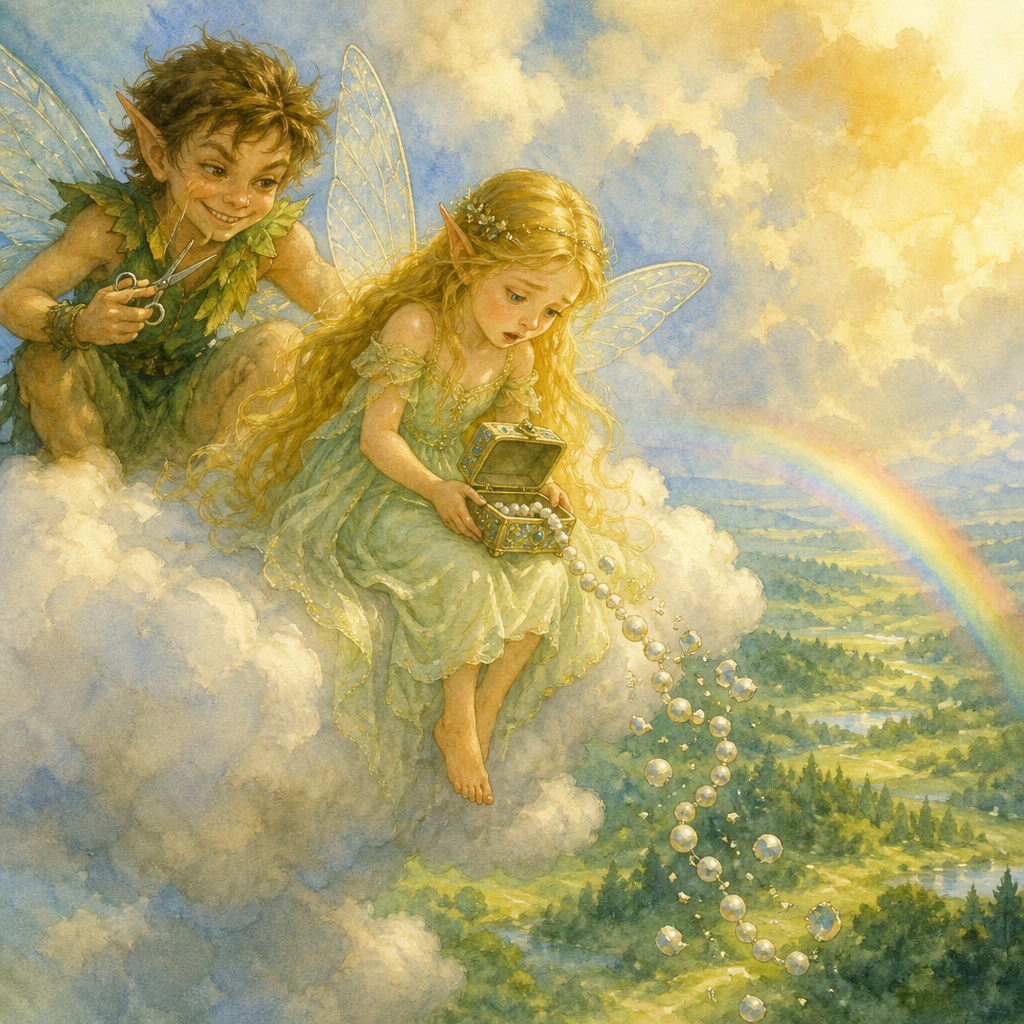
“On a bright cloud drifting gently over the fields, there sat a delicate little fay — the favourite attendant of the elfin queen Titania, arranging her mistress’s jewels. From a casket she drew a long string of costly pearls, a gift from the sea. Titania had told her to handle them carefully, for the tears of the sea were her favourite ornament.
“Pearls, you should know, are the tears of the sea — the ones the fishermen bring up from the depths at great peril. They are firm and hard to the touch, but they always resemble eyes that have been long weeping. The fay held up the string to see whether the pearls might shine brighter in the sunlight.
“But behind her sat the rogue Puck, who teases both men and fairies — and while she was admiring them, he quietly cut the string. The pearls rolled down from the cloud, falling first onto the open fields, and then into the forest.
“The fay was startled, and nearly frightened, but she gathered herself and flew after them. As she fell through the air, she saw them rolling and sparkling in every direction. She was about to despair when she looked down and saw green fields covered in tiny glistening points — dew, resting on the grass and in the flowers.
“‘These are not pearls,’ she thought, ‘but the tears of the sea they may still be — dewdrops, the tears of the flowers, collected by sorrow.’
“And so, with a heavy heart, she began to gather them — the tears of mothers stooped over dying children, the tears of those who loved and lost, the tears that overflow from hearts too full — and the casket grew heavier and heavier, for tears are by no means light.
“She flew from cloud to cloud, disconsolate, and as she flew her grief spread to all who loved her. They sent their messenger, the rain, down to earth to search for the lost pearls, but the rain only streamed and flowed and weighed down the trees and washed away the dew — it could not find what had never truly been there.
“Then the rogue Puck felt the anguish of the poor fay. He had not meant to grieve her, only to tease her, and so he dove into the depths of the earth and brought up, with the help of gnomes and goblins, lumps of glittering spangled ore, which he laid at her feet. ‘There,’ he said, ‘you have all your gewgaws back again — and better and brighter than ever.’
“The fay was delighted, and the clouds stopped weeping. But when she looked more closely at the gift, she found it was glittering rubbish. In her rage she seized the bowl it sat in and flung it so hard that the fragments scattered across the whole horizon — and this was the first rainbow, which the sky has worn ever since whenever the clouds weep. For Puck fetches his spangles whenever the skies are sorrowful, and the spectacle begins again.
“Our fay sat mournfully on her cloud, taking no pleasure in the rainbow she had made herself. Titania came to her, and — because she happened to be in a good humour — forgave her at once. Perhaps it was easier to forgive since a spirit of the sea, whose heart the fay had won, had promised her another pearl necklace.
“But the heavy casket of tears — what was to be done with it?
“‘Bring it to the most secret spot in my forest,’ said Titania, ‘and pour those drops among the most fragrant plants. They shall remain as tears; but they shall flow united — one large tear of the forest.’
“The attendant obeyed. And from this arose the first forest-brook.
“And so — now you know my source. I am like the tears of human beings: the heart. When sorrow, pain, or melancholy moves this heart, its tears flow forth. In summer, when so many children of the forest are broken down by heat, I flow softly and ceaselessly. In autumn, when all fades, I weep in silent anguish for the blossoms the wind tears away. In the gloomy solitude of winter I am congealed, and my tears become like the suppressed grief of the sea — pressed down, quiet, and cold. Then do I cleave to the roots and stones with the faint glimmer of eyes that have been long faded with weeping.
“But in the spring — when a sense of infinite longing is kindled in every heart — the tears of the wood burst forth in mingled emotions of melancholy and joy, swelling up, and I overflow my borders to greet as far as I can the flowers and the herbage. Often, too, I am touched by sympathy, and I swell when the clouds shed their tears of rain, or the flowers shed their tears of dew.
“Can you not feel, from my whole appearance — from the soft breath of sympathy with which I greet you — that my source is the heart of the forest?”
The melancholy reed pressed close to the brook’s banks, and wherever it flowed, the forget-me-not looked up gently like a faithful blue eye in the hour of parting. The weeping willow dropped its branches into the waves in endless grief. The very stones the brook coursed over — immovable, untouched by time — shed bright tears whenever the water touched them. And among all the things in the forest, the brook’s kisses were the only thing they could not resist.