A king and queen once lost one child after another, until only a single little daughter was left. The queen was desperate to find a truly good nurse for her, so a herald blew a trumpet at every street corner, calling the best nurses in the world to the palace. So many came that the queen said she could only see them one at a time, in a shady wood near the palace.
The nurses curtsied and lined up for her inspection. Most were plump and charming, but one was a strange old woman who spoke a language nobody understood. The queen wondered how she dared apply, and sent her away. The woman muttered something and slipped off, but she hid inside a hollow tree to watch.
The queen chose a pretty, rosy-cheeked nurse. At that very moment a snake in the grass bit the nurse’s foot, and she fell as if dead. The queen picked a second nurse, and an eagle dropped a tortoise on her head. She picked a third, who ran into a branch and was blinded by a thorn. “Some evil force is working against me,” cried the queen, and she turned to go home.
Behind her she heard peals of nasty laughter. The old woman had come out of her tree and was making fun of everyone, especially the queen. The queen was about to have her arrested when the old woman, who was a fairy, struck the ground twice with a wand. A chariot of fire pulled by winged dragons appeared, and off she flew, shrieking threats.
“That was the fairy Carabosse!” groaned the king. “She’s held a grudge against me since I was a boy and put sulphur in her porridge for fun.”
The queen began to cry. “If only I’d known, I’d have tried to make friends with her!”
So the king called his counsellors. They shut every door and window and stuffed up every keyhole so no one could overhear, and decided to invite every fairy within a thousand leagues to the christening, keeping the day secret so Carabosse couldn’t find out.
The queen and her ladies prepared presents for each guest: a blue velvet cloak, an apricot satin petticoat, high-heeled shoes, sharp needles, and a pair of golden scissors. Only five fairies could come. The first promised the baby would be perfectly beautiful. The second gave her the gift of understanding anything the first time it was explained. The third said she would sing like a nightingale. The fourth promised success in everything she tried. The fifth was just opening her mouth when a rumbling came from the chimney, and Carabosse, covered in soot, tumbled down the flue.
“I say she will be the unluckiest of the unlucky until she is twenty years old!”
Everyone begged her to think again. The old fairy only grunted. The last fairy, who hadn’t yet given her gift, tried to soften things by promising the princess a long and happy life once the twenty years were over. Carabosse laughed unpleasantly and climbed back up the chimney.
The oldest fairy advised the king to shut the princess away with her attendants until she turned twenty, so she would never see anyone else. The king built a tower with no windows, lit by candles, reached only by an underground passage with iron doors every twenty feet and guards at every turn.
The princess was named Mayblossom, because she was as fresh as spring. She grew tall and lovely, and everything she said and did was charming. Her nurse told her about the world outside, and thanks to the second fairy’s gift, she understood it all perfectly, though she had never seen it. “We outwitted Carabosse after all,” the king would say, and the queen laughed until she was tired.
In four days Mayblossom would turn twenty. Her portrait had been sent to the neighbouring courts, and now news came that King Merlin was sending an ambassador, the splendid Fanfaronade, to ask for her hand on behalf of his son. The nurse described the ambassador’s grand arrival so vividly that the princess was wild to see it.
“What a miserable creature I am!” she cried. “I’ve never seen the sun or the stars, or a horse or a lion except in pictures. They say I’ll be free at twenty, but I think they only say that to keep me quiet!”
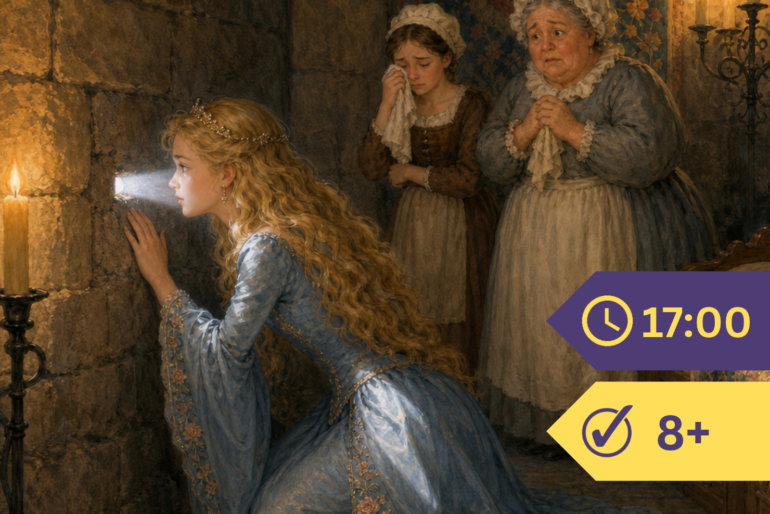
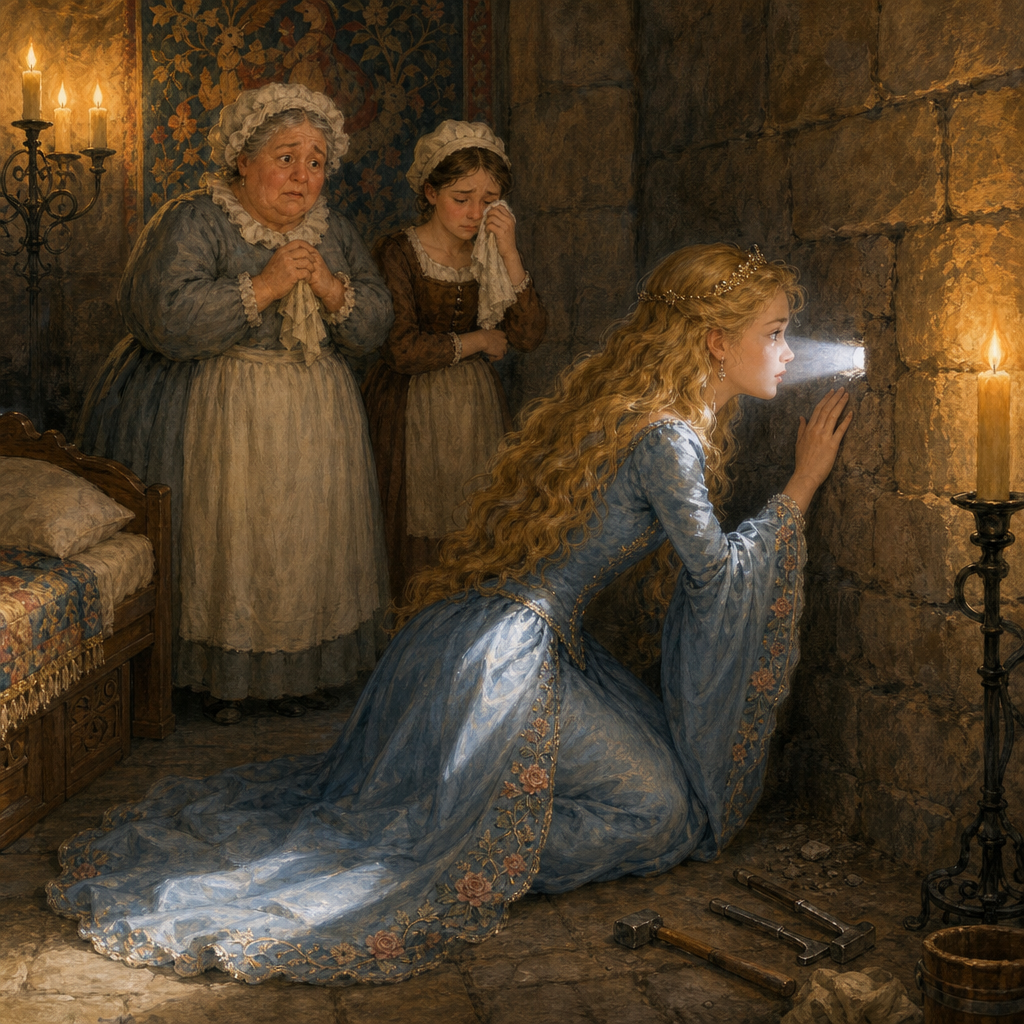
She cried, and her nurse cried, and the nurse’s daughter, and the cradle-rocker, and the nursery-maid all cried for company. Then Mayblossom announced that she would starve herself unless they found some way for her to watch the procession. At last, in tears, they agreed to make a tiny hole in the tower wall facing the city gates.
After scraping all day and night, they made a hole just wide enough to push a needle through. There the princess saw daylight for the first time. She didn’t move for hours, until the ambassador’s procession came into view.
At the head rode Fanfaronade on a white horse that pranced to the trumpets. His coat was embroidered with pearls and diamonds, his boots were pure gold, and scarlet plumes floated from his helmet. Mayblossom lost her head. “His master can’t possibly be half so handsome,” she decided. “I’m not ambitious. After a life in this dreary tower, even a little cottage would be wonderful. Bread and water with Fanfaronade would be better than roast chicken with anyone else.”
Her attendants told her it was impossible for a princess of her rank, but she wouldn’t listen.
When the ambassador reached the palace, the queen set out to fetch her daughter. Carpets were spread along the streets, and ladies leaned out of windows with baskets of flowers and sweets. Just as the princess was being dressed, a dwarf arrived riding an elephant, with gifts from the five fairies: a crown, a sceptre, a golden gown, a petticoat embroidered with butterfly wings, and a casket of jewels. Mayblossom hardly looked at them. She was thinking only of Fanfaronade.
The procession of princesses made its stately way along the streets. Suddenly the sky darkened, thunder rolled, and rain and hail crashed down. The queen threw her mantle over her head, and so did the others. Before Mayblossom could do the same, a croaking of crows, ravens, and screech owls filled the air. A huge owl swooped down and flung over her shoulders a scarf of spider webs embroidered with bats’ wings. Then came peals of mocking laughter. Carabosse again.
The queen tried to pull the scarf off, but it stuck as if nailed. “What good was it sending her fifty pounds of sweets and two Westphalia hams?” she lamented. “She’s as angry as ever!”
While everyone stood soaked, Fanfaronade appeared before the princess. He was usually never at a loss for words, but she was so much lovelier than he expected that he forgot the speech he’d rehearsed for months. He bowed again and again. She curtsied half a dozen times, and finally said kindly, “I’m sure everything you meant to say was lovely. But let’s get inside. It’s pouring cats and dogs, and Carabosse will laugh to see us dripping.”
Fanfaronade found his tongue and gallantly said the fairy had foreseen the flames the princess’s bright eyes would kindle and sent a flood to put them out. As he offered his hand, she whispered:
“I must tell you plainly, Sir Fanfaronade: since I saw you ride into town, I’ve wished you were speaking for yourself instead of for another. If you feel the same, I’ll marry you instead of your master. I know you’re not a prince, but I’ll love you all the same, and we’ll live in some cosy corner of the world and be happy.”
The ambassador thought he must be dreaming. He squeezed her hand so hard it hurt her little finger, but she didn’t cry out.
At the palace the king kissed her on both cheeks. “My little lamb, will you marry King Merlin’s son? That’s why this ambassador has come.”
“If you please, sire,” said Mayblossom, curtsying.
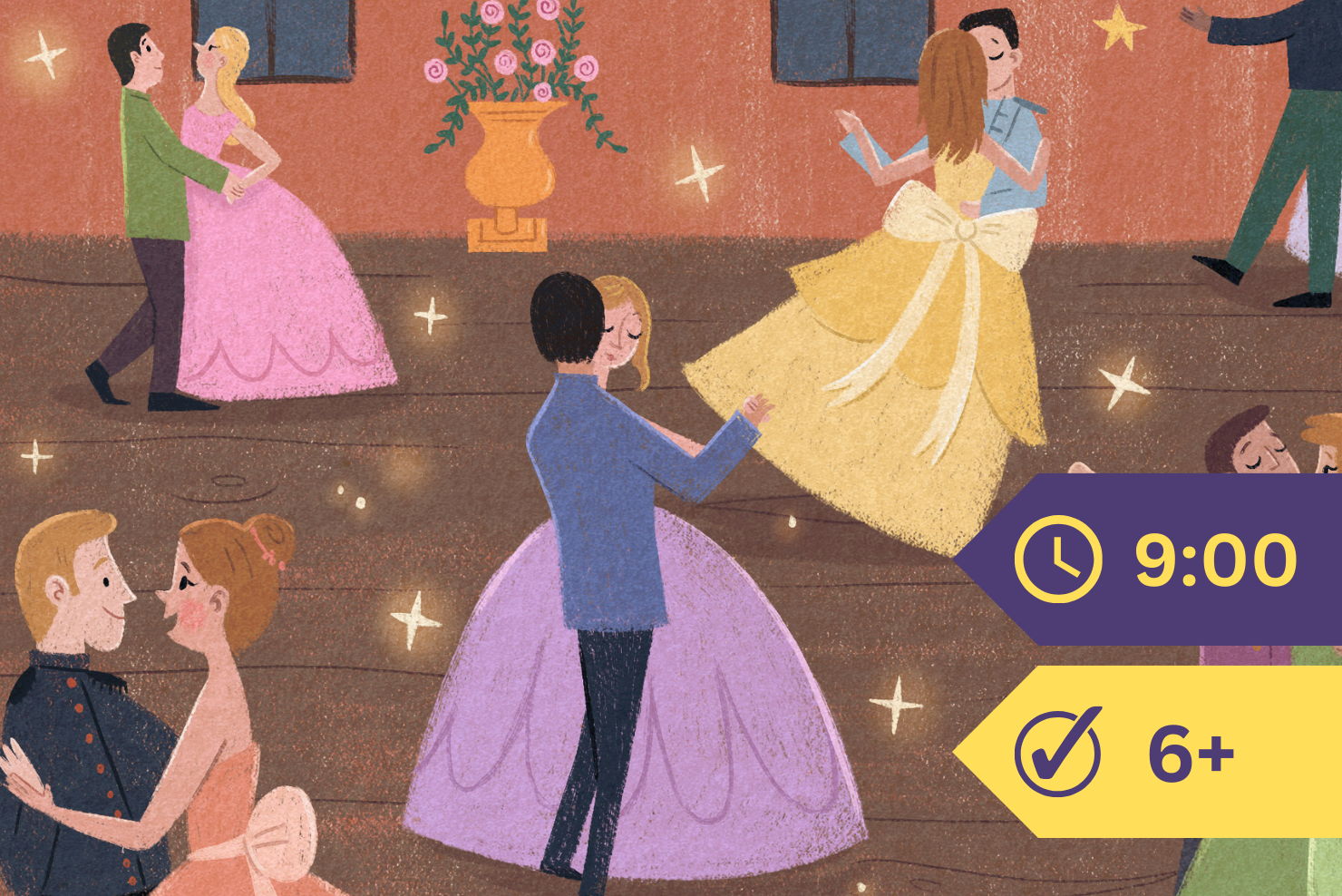
A banquet was ordered, followed by a ball and a ballet, and by the end everyone had fallen asleep where they sat. Only Mayblossom and Fanfaronade were awake as mice. “Let’s run away now,” she said. “We’ll never have a better chance.”
She took the king’s dagger from its diamond sheath and the queen’s neckerchief, which held a carbuncle that glowed like fifty torches. Fanfaronade carried a lantern. They crept into the muddy street and down to the shore, where an old boatman was asleep in a little boat. When he woke and saw a lovely princess in diamonds and a scarf of spider webs, he obeyed her at once. Fanfaronade asked where she wished to go.
“Anywhere, as long as you’re with me.”
“I dare not take you to King Merlin’s court,” he said. “He would have me hanged.”
“Then to Squirrel Island. It’s lonely, and too far for anyone to follow.”
At dawn, the palace woke. The queen asked for her neckerchief, the king for his dagger, and a frantic search began. They opened chests whose keys had been lost for a hundred years, but found neither. The king tore his beard and the queen tore her hair, for those were the two most valuable things in the kingdom. “Never mind,” said the king. “Let’s get the wedding over before anything else vanishes.” Where was the princess? The nurse said she’d been looking for two hours.
The queen shrieked and fainted, and two barrels of eau-de-cologne were poured over her to revive her. A page was sent to fetch Fanfaronade, who was also gone.
The king called his council and, having had no time to prepare a speech, ordered three hours of silence to think, then said: “Listen, great and small! My daughter is lost, the queen’s neckerchief and my dagger are gone, and worst of all, Ambassador Fanfaronade is missing. King Merlin will think we made mincemeat of him. And the wedding has ruined me financially. What shall I do?”
The prime minister said they were all sorry to see him so sorry, but frankly, he’d noticed Fanfaronade and the princess admiring one another. The queen snapped that Mayblossom was far too well brought up to fall in love with an ambassador. Then the nurse fell to her knees and confessed everything about the needle hole.
The queen scolded the nurse, the cradle-rocker, and the nursery-maid until they shook in their shoes. Then Admiral Cocked-Hat cried, “Let’s chase this good-for-nothing!” Everyone cheered. Some went to sea; others raced from kingdom to kingdom, beating drums and shouting, “Whoever tells us where Fanfaronade has hidden Princess Mayblossom will get a beautiful doll, all sorts of sweets, a pair of little scissors, and a golden robe!”
The sailors saw a light burning over Squirrel Island like a great fire. It was the carbuncle. The old boatman, rowing away with a hundred gold coins and a promise of silence, bumped straight into the fleet. The coins were fresh from the wedding mint, so the admiral guessed he’d been paid by the princess. The boatman pretended to be deaf, but when the admiral threatened him, he told what he knew. The admiral ordered the fleet to surround the island.
Meanwhile on the island, sleepy Mayblossom lay down on a grassy bank. Hungry Fanfaronade woke her crossly. “How long do you mean to stay here? There’s nothing to eat. Your charms don’t feed me.”
“But you’re here with me! Aren’t you happy?”
“Unhappy! I wish you were back in your tower.”
“Darling, don’t be cross. I’ll find some fruit.”
“I hope a wolf eats you,” he growled.
The princess ran all over the woods, tearing her dress and scratching her hands on thorns, and found nothing. Next day it was the same. “I wouldn’t mind being hungry myself if I could find something for you,” she said.
“I wouldn’t mind that either,” said Fanfaronade.
“You’d let me starve? You said you loved me!”
“That was when I wasn’t hungry. It changes your ideas, being starved on a desert island.”
Mayblossom sat down under a white rose bush and cried. “Lucky roses. You just bloom in the sun and nobody is unkind to you.” Her tears fell on the roots, and the bush rustled. A tiny voice from the prettiest bud said, “Poor princess! Look in that tree trunk. There’s a honeycomb. But don’t share it with Fanfaronade.”
She found the honey and carried it to him. “I could have eaten it myself, but I wanted to share.” He snatched it and ate every bit, and when she asked for a taste, he said it was too sweet for her teeth.
She sat sadly under an oak. “Take heart,” said the oak, rustling. “Here’s a pitcher of milk. Drink it, and leave none for Fanfaronade.” But she thought of how thirsty he must be after fifteen pounds of honey and ran back. “Drink some, but save a little for me.” He drank it all and smashed the pitcher on a stone. “You’ve eaten nothing, so you can’t be thirsty.”
“I’m well punished,” she wept, “for disobeying my parents and running away with a man I didn’t know.”
She wandered into the thickest wood and sat under a thorn tree where a nightingale was singing. “Look under the bush, princess. There’s sugar, almonds, and tarts. But don’t be silly enough to share with Fanfaronade.” This time she took the advice and ate by herself. Furious, Fanfaronade chased her. She hastily held up the carbuncle, which made people invisible when they were in danger, and from her hiding place gently scolded him for being unkind.
Meanwhile, the admiral sent a courier to the king with news. The king pulled out an enormous book, each page eight ells long, describing the whole earth, and found that Squirrel Island was uninhabited. “Tell the admiral to land at once!” So the fleet prepared for battle. The noise carried to Mayblossom, who rushed to protect Fanfaronade. He gladly let her.
“Stand behind me. I’ll hold the carbuncle, and with the king’s dagger I’ll protect you.”
When the soldiers landed, they could see no one. The princess touched them one by one with the dagger, and they fell unconscious on the sand. The admiral sounded the retreat.
Alone again, Fanfaronade decided that if he could get rid of her, he could take the carbuncle and dagger and escape. As they walked along the cliffs, he gave her a hard shove toward the sea. She stepped aside so quickly that he lost his balance, tumbled over the edge, and sank like lead. He was never seen again.
While she stared after him in horror, she heard a rushing noise overhead. Two chariots were racing toward each other from opposite directions. One, drawn by swans and peacocks, held a fairy as radiant as sunlight. The other, pulled by bats and ravens, carried a tiny, ugly old woman in a snakeskin dress with a toad on her head for a hood. The chariots crashed together in mid-air and a fierce battle began, the beautiful fairy with a golden lance, the other with a rusty pike. Soon the beautiful one had the better of it, and the old creature turned her bats and fled.
The shining fairy came down to the princess. “I’ve routed Carabosse for good! She wanted to claim authority over you forever, because you left the tower four days before the twenty years were up. I think I’ve settled her. I hope you’ll be happy and free.”
Mayblossom thanked her. The fairy sent a peacock to her palace for a fresh robe, since Mayblossom’s was torn to shreds by thorns, and another peacock to tell the admiral it was safe to land. He came ashore with all his men, even Jack-the-Chatterer, who happened to pass the spit where the admiral’s dinner was roasting, snatched it up, and brought it along.
The admiral was astonished to find a golden chariot and two lovely ladies under the trees. He recognised the princess and knelt, overjoyed. The fairy suddenly said, “I do smell a delicious dinner!”
“Here it is, madam,” said Jack, holding up the spit of pheasants and partridges. They feasted merrily under the trees. The fairy dressed Mayblossom in green and gold brocade embroidered with pearls and rubies, with her hair tied up in diamonds and emeralds, and brought her aboard the admiral’s ship. She told Mayblossom to tell the queen she was the fifth fairy of the christening. Then the fleet sailed home.
The king and queen received their daughter with such joy that she couldn’t get a word in to say how sorry she was for running off with such a poor ambassador. After all, it must have been Carabosse’s doing. And just then King Merlin’s son arrived with a thousand horsemen and thirty guards in gold and scarlet, anxious about his ambassador. He was a hundred times handsomer and braver than Fanfaronade, and the princess found she liked him very much. The wedding was held at once, with so much pomp and happiness that all earlier misfortunes were forgotten.