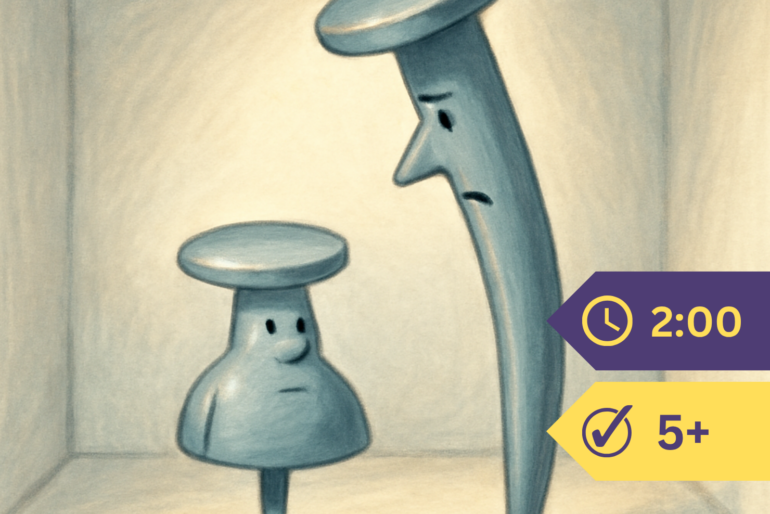
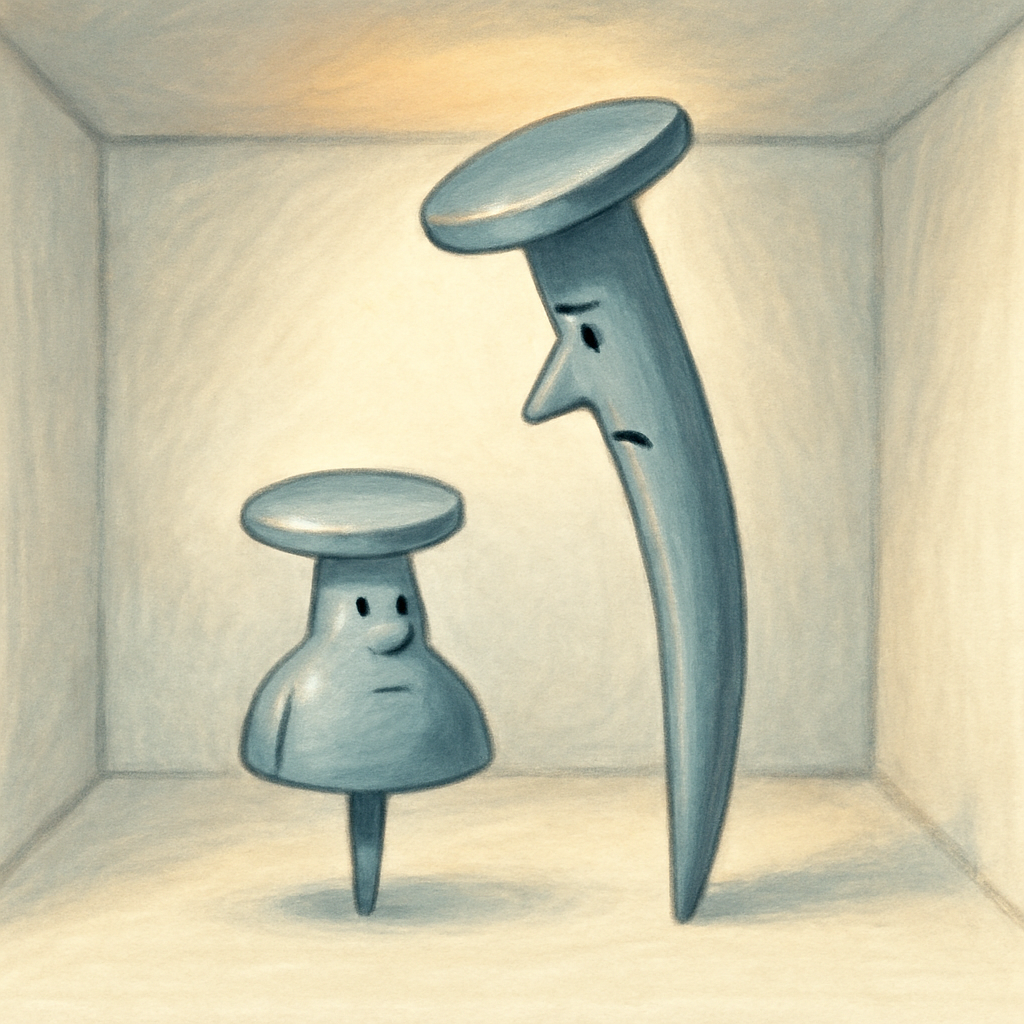
“I have something unpleasant to tell you,” said the Nail.
The Tack, who was quite small, looked up at the Nail, who was quite large. They lived together in a big white box with dozens of their relations.
“Well, tell me then,” said the Tack.
“The Master said today that he had a head like a tack.”
“Did he?” said the Tack. “What of it?”
“Do you understand what that means?” said the Nail, in its cold metallic voice. “He meant his head was small and not very useful for remembering things. That’s the saying. And you — you, little Tack — are what people mean by it.”
There was a pause.
“I see,” said the Tack.
“There has never been such a saying about a Nail,” the Nail added.
“Perhaps not,” said the Tack. “But I hang just as many pictures as you do. You hang large ones; I hang small ones — the photographs, the watercolours, the little favourites. I do exactly as much work as I’m made for, and I’m glad of it.
“But here’s what I want to say to you. You and I are relations — a nail and a tack are the same kind of creature. You came here to tell me something that can only make me feel small. What does that do for me? I can’t change my head. I can’t change the saying. You haven’t helped me at all.
“And what’s more — it’s worse to repeat a cruel thing than to say it yourself. When you say it, you own it. When you carry it to the person it’s about and deliver it to their face, you’re handing them someone else’s cruelty and walking away feeling righteous. Think about that.”
The Nail moved to the far side of the box and stayed there for a long time, quite still, thinking.