In the cellar, the vegetables were debating their origins.
The onion spoke first, and at length. “My family,” it announced, “came originally from Egypt. The Land of the Pyramids. Ancient, mysterious, full of history. I myself have never seen that far country, but my ancestors were there at the very beginning of civilisation.”
“Hear, hear,” murmured the other vegetables, politely.
“The Radish family traces to China,” the onion continued. “The Horse-Chestnut came from Asia. Mulberry from Persia, Cucumber from the East Indies, Spinach from Arabia. We are all, in our way, citizens of distant and glorious places.”
“How very fine,” said the potato, in a voice that might have meant anything.
“Isn’t it?” said the onion, not noticing. “Of course, there are some among us without such ancestry. The potato, for instance. Plain creatures with no particular family tree to speak of.”
The potato was quiet for a moment.
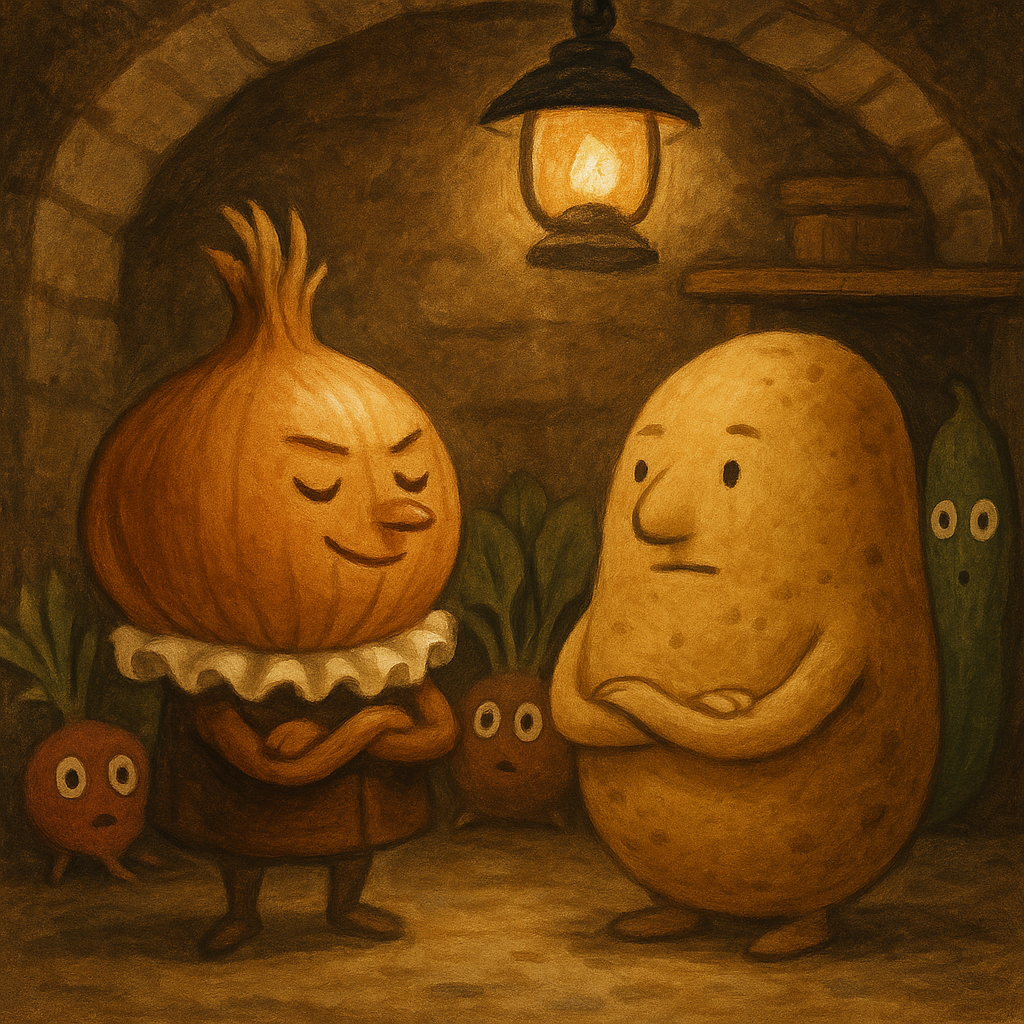
“Tell me something,” it said at last. “Suppose I were a bad potato. Which I am not, thankfully. Would it matter one bit where my great-great-grandfather came from?”
The onion hesitated.
“Not in the least,” the potato went on. “What matters is what a vegetable actually does in the world. I can be boiled, baked, roasted, fried. I can feed a family, warm a cold evening, turn up in soup or bread or stew. That is what counts. Being something yourself. Doing your part. Not boasting about what your ancestors managed on the other side of the world.”
A silence settled in the cellar.
“I do try to be useful,” said the onion, quietly. “I season things. I improve almost everything I’m added to. I know I’m sometimes complained about, but I do my best.”
“Of course you do,” said the potato, more gently. “And that is exactly the speech you should be giving. Not the one about Egypt.”
After that, the onion’s speeches changed. And when it was eventually cooked, everyone who tasted the soup said the same thing: “What a wonderful onion must have gone into this.”