Among the marbles there was a great and beautiful blue one that had cost five whole cents, and a number of small ones bought five for a cent. The big Marble let the others know this at every opportunity.
“You cost next to nothing,” it told the nearest small marble. “Not even a whole cent.”
“But a cent bought me,” said the little marble.
“A cent bought you and four others,” said the big Marble. “Now, as for me — it took five cents just for me alone. My master’s friends will trade everything just to have me.”
The children arrived. But they didn’t seem to want to trade everything for the big marble after all. “It’s beautiful,” said one, “but it’s not nearly as nice to play with as the smaller ones. If I gave up all my little marbles for the big one, I’d never be able to have a real game.”
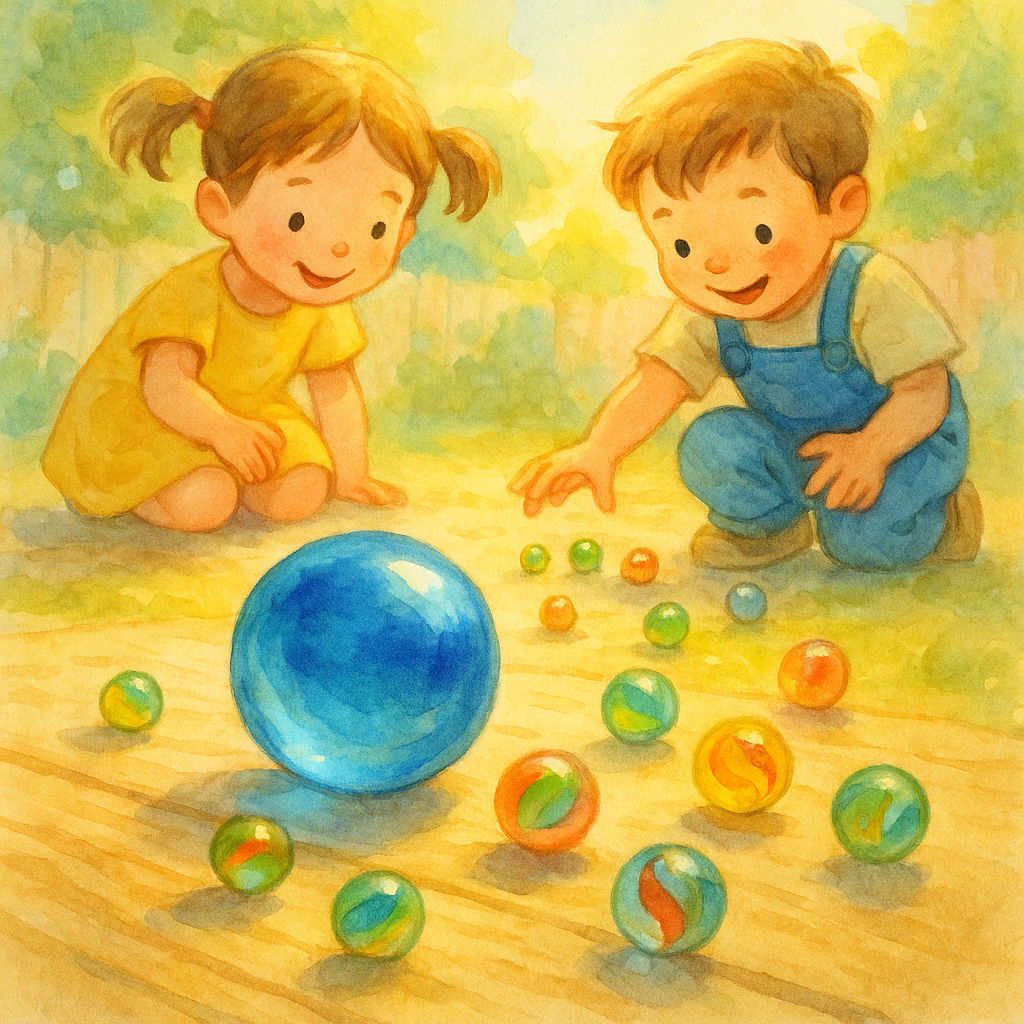
All the other children agreed. The big Marble, furious, kept rolling at wrong angles, and nobody admired it much.
When the game was over and everything was put away, one of the small marbles spoke up.
“You may be handsome and expensive. But you’re not nearly as much fun as we are. Sometimes the cheap things give more pleasure.”
“I’m glad I don’t have to be used all the time,” said the big Marble stiffly. “I’m too fine for ordinary games.”
But the little marbles were happy, because they were the ones the children wanted.