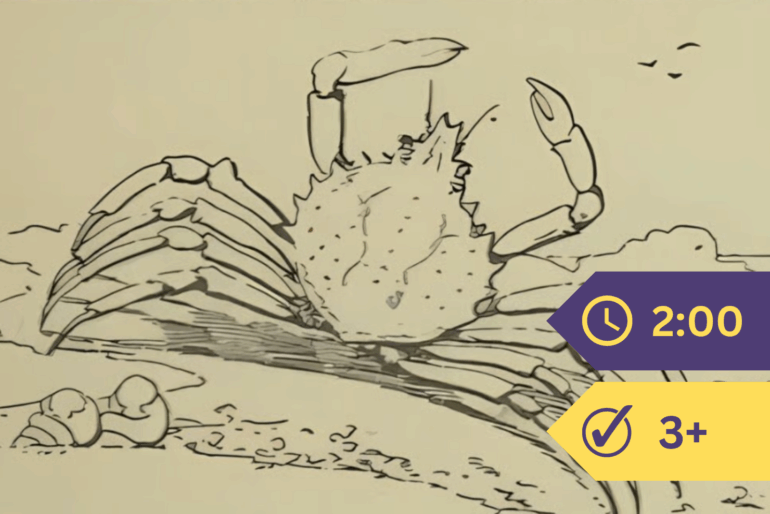
Your skin is soft and fine. As you grow more and more, your skin does not break. Your skin gets larger as your body grows. But Mr. Crab is in a hard shell.
The shell will not stretch. It gets too tight, and what can Mr. Crab do then?
What do you do when your coat is too small?
Now I will tell you a strange thing.
When Mr. Crab finds that his shell is too small, he takes it off, as you take off your coat. He pulls his legs, his hands, and his back, out of his shell. He does that in his house. You do not undress out of doors. You go to your room.

So does Mr. Crab.
He slips out of his shell. He pulls out his feet and hands, as if he took off his boots and his gloves.
Then he is a poor, soft, cold thing. But over all his body is spread a skin, soft as paste, like glue and lime. In a few days it gets hard. It is as big as Mr. Crab, and just fits his shape. It is a good, new shell!
It has the right colors,—blue, brown, red, or gold. It has spots and rings.
When Mrs. Crab changes her shell, Mr. Crab stays near, and tries to keep her from being hurt.
The young crabs have to change their shells often, they grow so fast.
Crabs that live in dark mud have dark brown or green shells. Some crabs have sand-colored shells, —pale gray or brown shells, with close, fine specks like sand on them.
There are more kinds of crabs than you could count. They live in all parts of the world.