
Emily Brontë
Dive into Emily Brontë’s complete works and poems — read them online for free, filter to discover your favorites, and explore our article to learn more about the author.
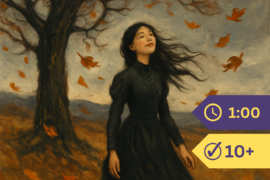
Emily Brontë (1818–1848) was an English novelist and poet, widely regarded as one of the most singular voices in nineteenth-century British literature. Born in Thornton, Yorkshire, and raised on the wild moorlands of Haworth, she was the third of the three literary Brontë sisters, alongside Charlotte and Anne. Despite living only thirty years, her output — slender in volume but immense in force — secured her an enduring place in the literary canon.
Emily is best known for her only novel, Wuthering Heights (1847), published under the pseudonym Ellis Bell. The book is a study in extremity: extreme landscape, extreme passion, and extreme revenge. Its central figures, the brooding Heathcliff and the headstrong Catherine Earnshaw, move through a story shaped as much by the Yorkshire moors as by human will. The novel’s structure — a story nested within a story, narrated by unreliable witnesses — was unusual for its time and contributed to early critical puzzlement, though later readers and critics came to regard it as a work of remarkable psychological and structural sophistication.
Beyond fiction, Emily Brontë was a poet of considerable power. Her verse, much of it connected to the imaginary world of Gondal she developed in private, deals with themes of freedom, death, nature, and spiritual defiance. Poems such as “No Coward Soul Is Mine” and “Remembrance” display a voice that is direct, unornamented, and philosophically serious. A selection of her poems appeared in 1846 in the joint collection Poems by Currer, Ellis, and Acton Bell, though the volume attracted little attention at the time.
Her relationship to the natural world — particularly the exposed moorland of West Yorkshire — runs as a constant thread through both her poetry and her prose. Wind, storm, heather, and open sky are not merely settings in her work but active presences that reflect or amplify the inner states of her characters. This quality gives her writing an atmospheric density that distinguishes it from much of the domestic fiction of the Victorian period.
Emily Brontë died in December 1848, just a year after the publication of Wuthering Heights. Her literary reputation grew steadily through the twentieth century, and she is now studied as a foundational figure in English literature — a writer whose single novel and collected poems continue to be read, taught, and debated around the world.