
Thomas Moore
Dive into Thomas Moore’s complete poems and ballads, and read them online for free — filter to discover your favorites, or explore our article to learn more about the author.
Thomas Moore (1779–1852) was an Irish poet, songwriter, and entertainer, widely regarded as Ireland’s national bard. Born in Dublin, he studied at Trinity College and later moved to London, where he became one of the most celebrated literary figures of the Romantic era. He was a close friend of Lord Byron and Percy Bysshe Shelley, and his work earned him a prominent place in early nineteenth-century literary circles across Britain and Ireland.
Moore is best known for his Irish Melodies, a celebrated series of songs that set original verse to traditional Irish tunes, helping to shape a sense of Irish cultural identity at a time of significant political tension following the Act of Union. His writing combined lyrical beauty with emotional directness, often exploring themes of love, loss, memory, and national longing. His style was noted for its musicality — his poems were frequently composed with the intention of being sung rather than simply read.
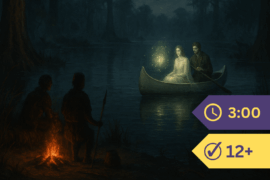
Among the works collected here is A Ballad: The Lake of the Dismal Swamp, a haunting narrative poem inspired by a real geographical location in Virginia, which Moore visited during a tour of North America in 1803. The poem tells of a young man who loses his sanity after the death of his beloved and vanishes into the swamp in pursuit of her ghost. It is a striking example of Moore’s ability to blend Gothic atmosphere with Romantic sentiment, drawing on local legend and landscape to produce verse of genuine emotional weight.
Beyond his poetry, Moore also wrote the enormously popular Oriental romance Lalla Rookh (1817) and a biography of Lord Byron, as well as a life of the Irish patriot Robert Emmet, with whom he had been acquainted. His political sympathies were consistently with Irish Catholic emancipation, and these convictions quietly informed much of his creative output. Though his reputation faded somewhat in the twentieth century, scholars of Romanticism and Irish literary history continue to recognise his considerable influence on both traditions.