
Mary Wollstonecraft (Godwin) Shelley
Dive into Mary Shelley’s complete books and stories — read them online for free, filter to discover your favourites, and explore our article to learn more about the author.

Mary Wollstonecraft Shelley (1797–1851) was an English novelist widely regarded as one of the most significant writers of the Romantic era. Born in London to the philosopher William Godwin and the pioneering feminist writer Mary Wollstonecraft, she grew up in an intellectually charged household that shaped her thinking profoundly. She is best known for producing one of the most influential works in the history of Western literature, a novel that is frequently cited as the origin point of modern science fiction.
Shelley wrote Frankenstein or the Modern Prometheus (Full book) when she was just eighteen years old, completing it in 1818 during a famously stormy summer spent near Lake Geneva with her future husband Percy Bysshe Shelley and the poet Lord Byron. The novel tells the story of Victor Frankenstein, a driven young scientist who creates life from assembled body parts, only to abandon his creation and face devastating consequences. The narrative unfolds through a layered epistolary structure — opening with a series of letters from the explorer Robert Walton — before plunging into Victor’s own harrowing account. Themes of ambition, responsibility, isolation, and the ethics of creation run throughout the book, giving it a philosophical depth that set it apart from earlier Gothic fiction.
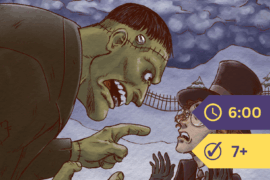
The story has proven remarkably adaptable across audiences and formats. Alongside the original novel, a Frankenstein (Short Kids Version) retells the core narrative in accessible language, following the curious young Victor Frankenstein as he grapples with the consequences of his discoveries. This retelling preserves the emotional and moral core of Shelley’s story while making it approachable for younger readers.
Beyond Frankenstein, Shelley wrote several other novels during her lifetime, including The Last Man (1826), an early work of apocalyptic fiction, and Valperga (1823), a historical novel set in medieval Italy. She also edited and promoted the works of Percy Bysshe Shelley after his death in 1822. Her broader literary output, though less widely read today, reflects the same preoccupations found in Frankenstein: the limits of human knowledge, the cost of ambition, and the tension between the individual and society. Mary Shelley’s place in literary history rests not only on the enduring power of her most famous creation, but on her role as a writer who helped define what speculative fiction could do.