Old Pietro the milkman came rattling up the street in his cart, his round face beaming out from beneath a huge fur cap pulled well down over his ears. He stopped at the door of a shabby little building, where young Gladys Earle stood waiting with her bowl and her usual bright smile — the smile that, as Pietro once said, “warmed him up for the rest of his round, no matter how cold the morning.”
Today he had a surprise for her, and Gladys had long since stopped expecting surprises.
“A goose for the young lady’s Christmas,” he announced, setting a parcel on the kitchen table. “My wife fattened it specially for you. In the old country, the goose is the bird we honour most at Christmas. There’s a legend that when the three kings followed the star to the stable in Bethlehem, it was the goose — of all the animals gathered there — who waddled politely forward to welcome them. But she’d caught a cold in the wintry wind, and her voice came out all hoarse and honking. And that,” he laughed, “is why she sounds that way to this very day.”
Before Gladys could even thank him, Pietro was off again, his cart rattling into a finer part of the city. He stopped next at a comfortable house full of warmth and good cheer.
“I’d like to see Miss Clementine,” he said, after handing over the milk.
“And here she is, good Pietro,” called a cheerful voice, as a rosy-cheeked girl appeared in the hall.
“I’ve brought you some sheaves of wheat,” he said, “to hang from your attic windows for the birds — a Christmas gift to them, the way we did it back home.”
“How lovely! Do tell me what else they do there at Christmas, Pietro,” Clementine said, gathering the golden bundles into her arms.
“The kind families always invite someone poorer than themselves to share the great Christmas supper — they call it the share of the good God. They break the Christmas loaf with someone less fortunate. But the best part of all,” he added, “is that we’re taught kindness must reach everywhere. Those who will not forgive cannot sit down to the Christmas meal together. Many an old family quarrel has been healed that way.”
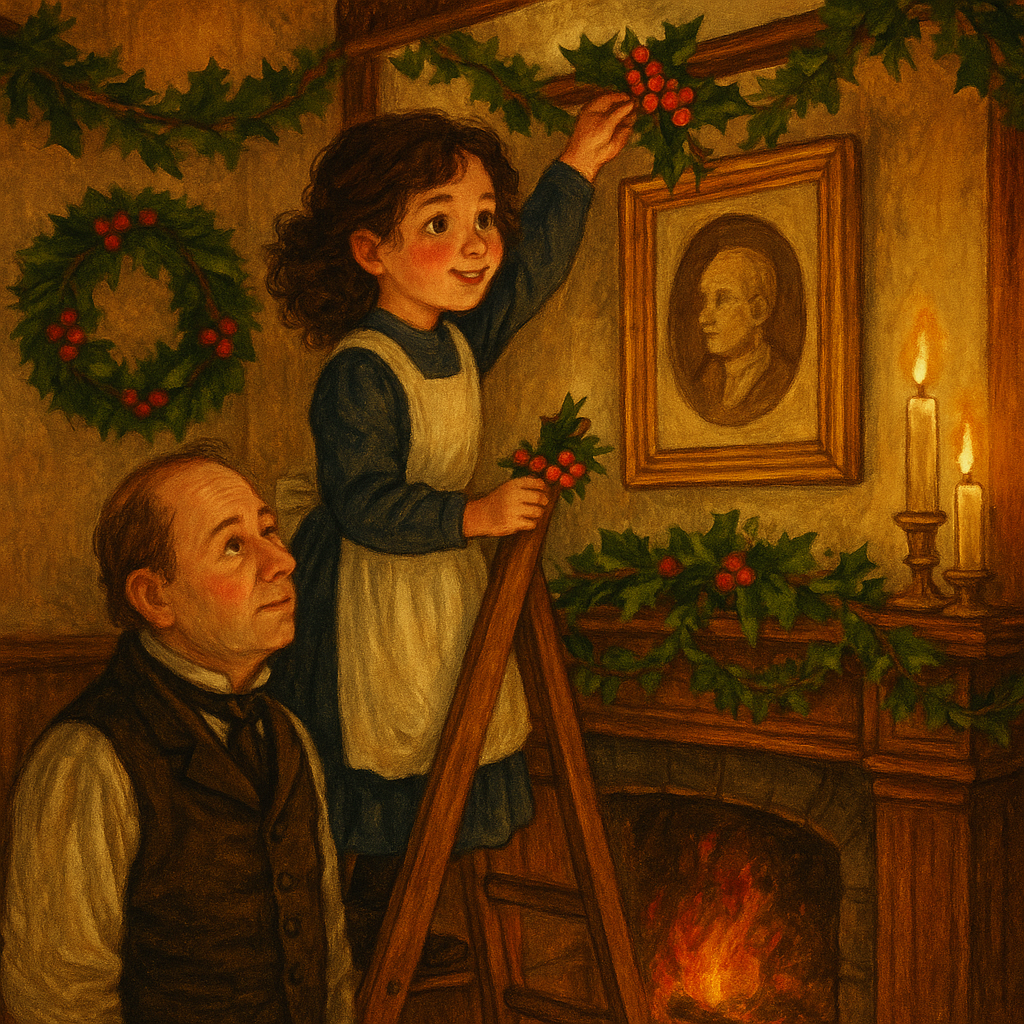
Clementine thought hard about the old milkman’s words as she went from room to room, hanging holly boughs and wreaths for the coming day. Forgiveness, she decided, shouldn’t stop at your own family — it should reach your friends too, for there was meant to be peace on earth and goodwill to all. And she was glad she held no unkind feelings toward anyone.
As she climbed a ladder to hang a sprig of holly over her own portrait on the wall, her uncle came into the room, singing merrily:
“So now is come our joyful feast,
Let every heart be jolly;
Each room with ivy leaves be dressed,
And every post with holly.”
Clementine paused on the ladder, and when he finished she sang sweetly back:
“Let sinned-against and sinning
Forget their strife’s beginning,
And join in friendship now.
Be links no longer broken,
Be sweet forgiveness spoken
Under the holly bough.”
“Is there anyone you haven’t forgiven, Uncle Max?” she asked, half teasing, half serious.
Uncle Max didn’t answer. He left the room with a shadow on his face. But the song stayed with him all morning, and again and again he found himself murmuring, “Be sweet forgiveness spoken, under the holly bough.”
When they met again later, he asked how much money her Christmas giving would need this year — for his purse was always open to his beloved niece.
“A great deal this time, Uncle Max,” she said. “I have a dear friend my own age — we were both born on Christmas Day, and she’s just my size. But she has no kind uncle, no wealthy father, and no mother, the way I do. Some of the girls at school look down on her. One day they pointed at her stocking poking through a hole in her shoe that she’d tried to colour in with polish. Another time her apron was so patched and mended that I slipped mine off and tied it over hers when no one was looking. But she thanked me so prettily and said, ‘My apron is clean, and beautifully mended — my mother taught me to sew neatly before she died, so I could keep Papa and myself tidy. I’d be more ashamed to take your apron than to wear my own old one.'”
Clementine went on, “She’s the cleverest girl in the whole school, and everyone loves her except a few unkind ones. She keeps house for her father, and it’s always spotless. I’ve never met him, but she adores him. She says his employer’s business collapsed, and he’s out of work. They used to be well-off, but he once vouched for a friend’s debt and lost a great deal when it went bad. Then his wife died, his health failed, and — oh, Uncle, I don’t think they’ll have any Christmas at all.”
“Well then, Clementine,” said Uncle Max, “you and I shall call on them this very evening, and see what they might need.”
Clementine was overjoyed.
At the appointed hour they set out. And at that same moment, across the city, Gladys was perched on her father’s knee, telling him about the fine Christmas dinner Pietro’s goose would give them.
“I’m glad for you, my sweet,” her father said. “It’s hard for me to feel that even Christmas Day can’t be a bright one for you. But as for me — as long as I have you, it’s Christmas all year round.” And he held her close.
A knock at the door interrupted them. Gladys opened it to find her friend Clementine, and a gentleman beside her.
The two men stood face to face — and for a moment neither could speak.
“Max!”
“Reginald!”
Those were the only words spoken as they clasped hands.
“Let the past be forgotten,” said Max.
“I was more sinned against than sinning,” Reginald replied — but his heart was already softening.
“We were once the closest of friends,” Max explained to the two astonished girls. “We quarrelled, and we’ve been strangers for far too long. Now we’re reunited — and I hope never to part again.”
As it happened, Max knew of a position that his old friend could fill perfectly, and just like that, the future opened up bright and hopeful for Gladys and her father.
Next door to Clementine’s home stood an empty flat that belonged to Uncle Max. By nightfall the very next day, they had it fully furnished and hung with holly, and had invited their two friends to move in and make it their home. And there, on Christmas Day, the goose was roasted by a cheerful little cook and served warm and golden — under the holly bough.