On Christmas Day in the year after the Revolution ended, a post-rider threw a copy of the Boston Gazette from his horse as he rode past the Cutts house in old Newbury, Massachusetts. General Samuel Cutts — back from seven years of war with rheumatism he would carry forever and paper money worth nothing — tore off the wrapper and ran his eye down the columns with a hand that was not quite steady.
“Here it is! Here it is! — Fifth, 219-7. Sybil, my darling! It is so! 219-7!”
And he sat down and buried his head in his hands and cried.
The Massachusetts Commonwealth, drowning in war debts, had been distributing its lands in Maine by lottery — every ticket-holder received a parcel of land, and the prizes were the best parcels. Number five was two thousand acres on Tripp’s Cove, described in the programme as a harbor where fifty ships of the line could lie in safety, site of the future Mercantile Metropolis of the North.
Samuel Cutts did not believe a word of the prospectus. But Tripp’s Cove was something else entirely. His dream — since he’d seen it was no use farming in the Merrimac valley when what he knew was how to lead men — had been to gather the best officers and veterans of his old regiment, the Fighting Twenty-seventh, and take them somewhere they could stand by each other as they’d stood at Valley Forge and on the Carolina roads. The Western Reserve hadn’t felt right. But a cove on the Maine coast, where his fishing and coasting men could use the skills they actually had?
“Tripp’s Cove is our Christmas present,” said Sybil Cutts to her husband as they went to bed. The habit of celebrating Christmas was not yet established in that part of New England, so no one else had thought of it.
Samuel Cutts did not found a mercantile metropolis. He founded something better: a village with a common history, a common loyalty, and a quality of mutual help that comes only when people have been through the same fire. He lived there fifty years and died honored and loved. His son and grandson carried on what he’d built, and when 1861 came with its call to every house, Tripp’s Cove — all twenty-five of its families — went into it with one heart.
The one young man left in the village that Christmas of 1861 was Tom Cutts, the General’s great-grandson, and he was only there because he had leave. He had been at Bull Run; had hidden under a corn crib while the retreat poured past; had come into Washington a week after his regiment. He had enlisted for three years when most men were still enlisting for ninety days. He had come home to raise a new company, had drilled them into soldiers out beyond Fairfax Court-House, and had earned enough goodwill at brigade headquarters that when a request for leave came up the chain — Colonel to General to Adjutant-General, all the way to the top Major-General’s headquarters — every officer along the way recommended it be granted. It was understood that Cutts was going home to be married to the prettiest and best girl in eastern Maine.
That Christmas Eve, Laura Marvel stood up with Tom Cutts in Moses Marvel’s parlor before Parson Spaulding, and she was a blushing bride and not a fainting one. Tall, dark-haired, with those startling blue eyes that you kept expecting and kept being surprised by — but none of that was why Tom loved her, and nobody in Tripp’s Cove thought about her looks much when there were so many other things to notice. She had led all the girls in the village since she was fourteen, not because they were told to follow her but because they loved her. She was the one who built the rafts when the mill-pond flooded. When the war came, she ran the sewing circle, packed the Sanitary Commission boxes, corresponded with the State Adjutant’s office. From morning to night, the village ran to Laura — because she was the kindest, truest, most helpful person any of them had ever known.
Tom’s leave was twenty days. Five to come, five to go. Seven days together, and then he kissed her goodbye with tears in both their eyes and went back to the war.
Christmas Eve, 1863.
Moses Marvel drove out his bays to meet the stage at Fordyce’s. In the back seat, wrapped in furs, was a rosy baby who had never seen his father.
The stage swept in, and there was Laura, and there was Tom — pale, thinner, but smiling with his whole face when he saw her. He climbed down with her help, and bent over his baby with his one arm — the left sleeve was pinned neatly closed — and old Moses Marvel, taciturn as he was, cried openly in the cold air. And then Jem Marvel stepped out of the stage — Laura’s brother, who everyone had thought was in the West Indies chasing blockade-runners on the Greywing — and there was a second eruption of screaming and tears.
What an uproarious Christmas that was. Tom monopolized the baby all evening, showing a remarkable talent for nonsense and infant management. Parson Spaulding came, and his wife. Then everybody in Tripp’s Cove came, because there was not one household that was not owed news from the fleet or the army, and this was Christmas Eve besides.
But afterward it was hard going.
A hero with a pinned sleeve who walks with a limp quickens every feeling of gratitude and compassion. What he can’t easily do is find work. Tom had lost his position when he went to the front, and he could not get it back. He and Laura lived on Moses Marvel’s goodwill and Tom’s pension, and though Moses Marvel never once complained and said “good luck for us” when the subject came up — which were many words for Moses — Tom was a proud man, and it ground him down.
Jem put his prize money into a bark, which they named the Laura, and took her to sea on a charter for San Francisco. Tom and Laura came back to Moses Marvel’s house, and Tom stood in the parlor and thought it looked smaller than ever.
Then things went worse. Moses held his lumber through a falling market until the bank would not renew his notes, and he had to sell at the bottom rather than let the sheriff sell it for him. Poor Moses — he had the Cutts bad luck and the Marvel stubbornness in the same person.
Then the Laura went silent. She had made California in fine time, discharged cargo perfectly, taken a charter for Australia and England — and then the letters stopped. Eight months, nine months, ten months, and no port in Christendom had seen Jem’s face or the Laura‘s private signal.
Tom’s father was brought home speechless one day, found on the road where he had fallen, his oxen waiting nearby. He lay month after month, smiling faintly when they brought him food, unable to recognize his own wife.
Yet Laura was as cheerful and buoyant as ever. Tom was ashamed to brood when he saw her. She put the children one on each side of Moses Marvel’s chair at tea and made him less taciturn. She brought warmth into both broken households as naturally as sunlight. When this Christmas came — the tree would be the first Tripp’s Cove had ever seen, such customs being new to that part of New England — she simply bade them all help her fit it up with decorations for all the village children, and they obeyed her, because with Laura they always did.
And she had her reward. Job Stiles, the stage driver, came to the door with a letter from Ellsworth. Tom read it and called Laura, and she left the children and sat at the kitchen table with him.
DEAR TOM, — I am just back from Washington. I have failed. The collectorship was promised to Waters before the old man’s death — Waters has but one leg, you know — and it must go to him. The surveyorship belongs to Plumptre, who hates me and hates your wife’s father even more. So I could do nothing there.
But this: if you would take the Bell and Hammer Light-house while we look round, you may have the place tomorrow. Exile in winter, I know. But in summer it is lovely. Your own house, stores, two men under you — they are double lights — and a thousand dollars a year. I have held it for you. Send your answer by special messenger.
Merry Christmas to Laura and the babies. Yours, JOHN WILDAIR. Portland, Dec. 24.
“Thank God,” said Laura. “Could anything in this world be better?”
And so it was that early March found Tom and Laura Cutts on the Bell and Hammer light, off the Maine coast.
That summer was the happiest time of their married life. Old Mipples — another son of the Fighting Twenty-seventh — would watch the babies while Laura and Tom walked the island together. They were cut off from the world in the best possible way, needing nothing but each other and the work and the water.
But summer ends. November came, and December, and they banked the house with seaweed and put the storm-doors on and waited for the Osprey, the government supply vessel, to bring their winter stores of colza oil.
The Osprey did not come. A letter arrived from Boston: the Osprey had broken her mainshaft and might not be repaired before the fifteenth of January. Mr. Cutts was directed to obtain oil from the light at Squire’s on the mainland, for which an order on the keeper was enclosed.
They could wait. But Jotham Fields, the second assistant, came down with a fever that Laura could not manage, and she asked Tom to take him ashore on the first fine day.
“And what will you do?” said Tom.
“Do? I’ll wait till you come home. Start after the last beat, take poor Jotham to Squire’s, and bring back your oil if you want. I’ll have your dinner hot.”
Tom doubted. But the next day Jotham was worse. The south wind was soft and steady — a fine day, clearly. They would be there and back in four hours. All three men had to go; no two of them could manage both the boat and Jotham. And so, an hour before daylight on Christmas Eve, they left.
Half an hour after sunrise they were at Squire’s. And the sun had risen red.
Before Jotham was carried up the cliff, the wind had swung northwest and the air was white with snow. They could not see the house from the boat. They could not see the foremast from the stern. They left Jotham with the keeper and ran for the boat and headed northeast, determined to beat back to the Bell and Hammer before it got worse.
Tom said to Mipples: “Will it hold up?”
Mipples said: “God grant it may.”
Laura saw the sun rise red. She put out the near light, told little Tom not to leave his crib, ran the two hundred yards to the far tower and put out that one, and was back before the babies had missed her.
For an hour or two she pretended to herself that this was only a snow flurry. By ten o’clock she knew it was a full northwester, and that Tom and Mipples were on the far side of it. She was alone with two children on an island.
She did not brood. It crossed her mind that it was Christmas Eve, and that the girls at Tripp’s would be dressing the meeting-house for Parson Spaulding. It crossed her mind — as it always did in moments of difficulty — that speech of Parson Spaulding’s at all weddings: As you climb the hill of life together, my dear young friends— and poor Laura, as she kissed the baby, had courage enough to repeat it aloud to both children. They opened their great eyes wide.
She took a hatchet and went to leeward of the house and cut a savin bush and brought it in and spent an hour turning its branches into an evergreen frame for the portrait of old General Cutts. She did this so Tom would see, when he got home, that she had not been frightened.
When he got home. At the very bottom of her heart was the other word: if.
She knew Tom. She knew Mipples. She knew they had not spent two minutes at Squire’s after leaving Jotham — they would have put straight back out into the storm. And she knew that if they hadn’t missed the island, they would have been home before eleven. By one o’clock she could no longer doubt they had lost the island in the blizzard and were somewhere in the bay, trying to find it.
And then she thought: the lanterns.
Strange to say, because it was wholly outside her daily routine — the men always tended the lamps — she had not thought of it until now. And it was after one.
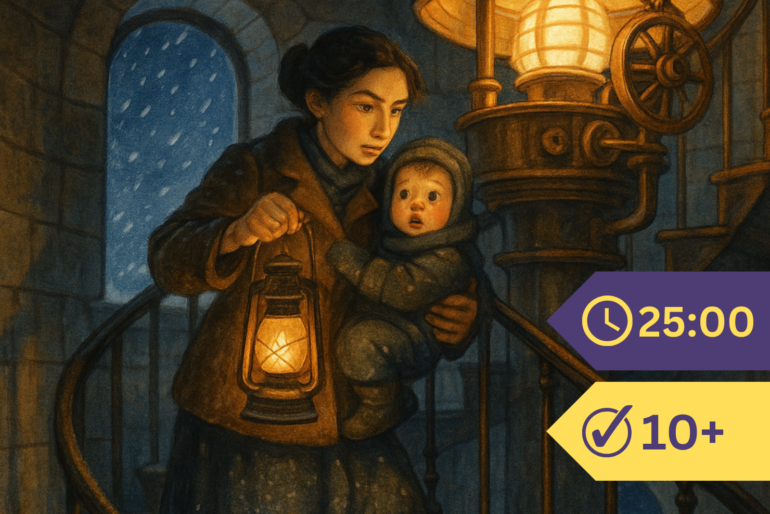
She bundled little Tom into his storm clothes and took him up into the near tower. He had never been up before. He was never frightened when he was with her. He was amazed by the whiteness everywhere — snow on the lee side, snow on the weather side, snow in clouds on every quarter. Snow and nothing but whiteness.
Laura trimmed the burned wicks quickly. She wound up the clockwork carriages. She drew oil and filled the reservoirs. As she worked, an old text came into her mind, and she led little Tom down into the nursery and opened the Bible Parson Spaulding had given her for a wedding gift and read aloud:
But the wise took oil in their vessels with their lamps. While the bridegroom tarried, they all slumbered and slept. “Dear Tommy, dear Tommy — we will not sleep, will we? And at midnight there was a cry made, Behold, the bridegroom cometh, go ye out to meet him. We will go, my darling, we will go — if he comes at the first hour, or the second, or the third.”
For there were the far lamps to trim as well, and she dared not leave the boy alone. She tucked Matty safely in her crib and took Tommy round into the storm.
How it raged and howled. She seized the boy and turned her back to the wind and worked along sideways, step by step — Tommy crying, Laura talking to him: One minute more, dear. Tommy shall carry mamma’s great scissors up the stairs. Don’t cry, my darling.
She reached the far tower. She trimmed those lamps too, wound the clockwork, filled the oil. And she lit them then, rather than make another trip at sundown. The yellow light flared on the white snowflakes and dazzled them both as it flashed from the reflectors.
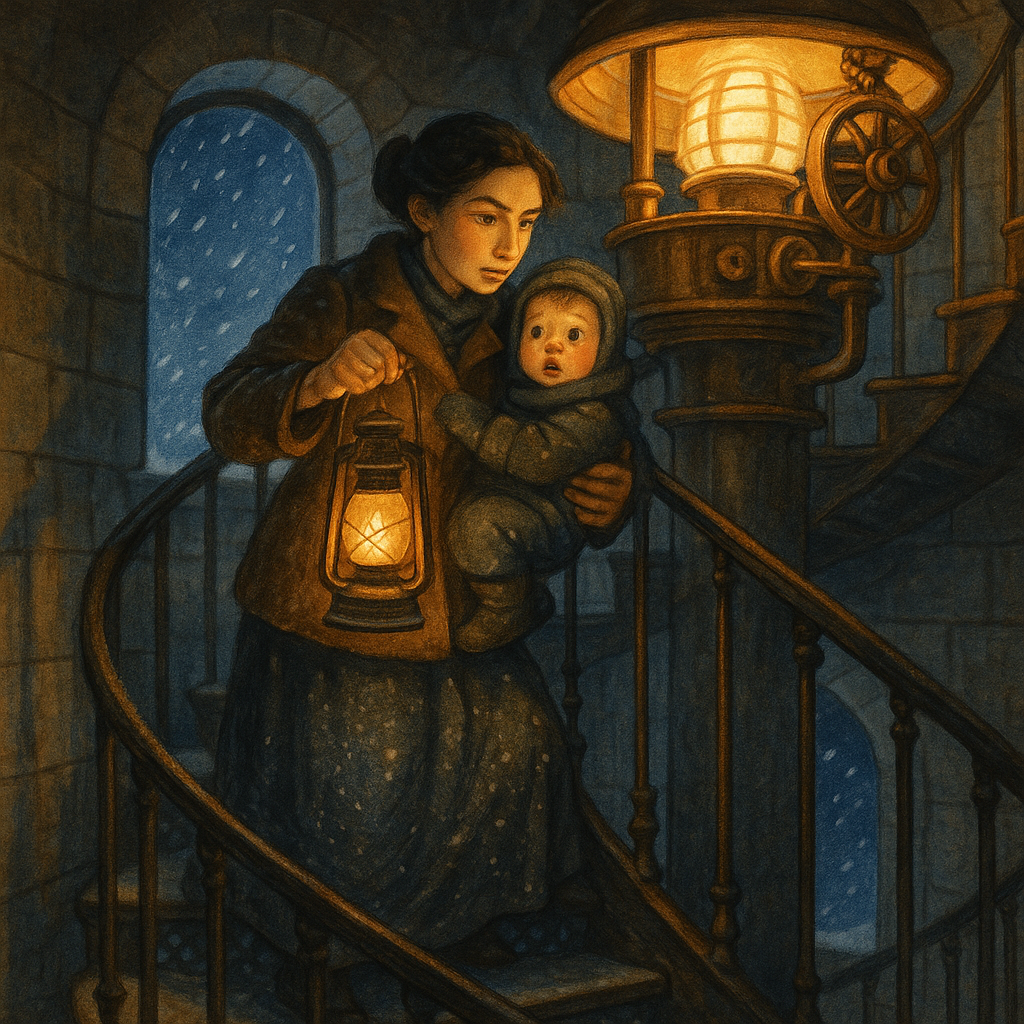
“Will anybody see it, mamma?” said the child. “Will papa see it?”
And from some untouched corner of Laura’s memory, four lines of Leigh Hunt appeared:
Then at the flame a torch of fire she lit,
And, o’er her head anxiously holding it,
Ascended to the roof, and, leaning there,
Lifted its light into the darksome air.
“Our torch shall not go out, Tommy,” she said aloud. “Come down with mamma.”
But all through the afternoon the follow-up lines from Schiller kept surfacing unbidden — In the gale her torch is blasted, beacon of the hoped-for strand — and she kept pulling herself back: Come, Matty. Come, Tommy. Once there was a little boy, and he had two kittens, and he named one Buff and one Muff—
Sundown. She and Tommy climbed the near tower and she lit that lantern. Through the storm she could see the far lantern burning steadily. That was all she could see in the sullen whiteness.
The children had supper — oatmeal and ginger-snaps, because it was Christmas Eve. Tommy asked if Santa Claus would come in the boat with papa, and Laura kept her face steady. She lingered over the bedtime ritual, loitering over buttons and flannel nightgowns. Tommy kissed her and — ah, me — gave her one more kiss for papa. In two minutes they were asleep.
Now she was really alone. Seven o’clock. The far clockwork had been running five hours; it was meant to be wound every four. She put on her storm clothes, took one more look at her darlings, and went out again into the gale.
The wind had shifted another point north. She fell once in the drifts. The snow pile against the far tower door was three feet deep, but her numbed hand worked through to the latch and it gave way. She wound the mechanism. Can these lights be of any use to anyone this night? O my God, grant that they may be of use to him.
She made her way home, falling twice more, keeping her bearing by the light above her own house. And now to wait five hours, and then to wind that light again — at midnight.
And at midnight there was a cry made — “Oh dear. If he would only come. I would not ask for any cry.”
She took down the inlaid box that Jem had brought her from sea — her treasure box. And she did the best thing she could have done. She took out everything in it.
You know what was in it. Every letter Tom Cutts had ever written her — from the first boyish note: Laura, these hedgehog quills are for you. I killed him. TOM. She read them all, each one twice, and put them back in their order without folding.
At ten she wound the near clockwork again. The snow was as steady as ever, though she tried to persuade herself otherwise. She went back to the kitchen and read more letters — the soldier diary that John Wildair had saved and sent home after Tom was wounded. She read it through.
The clock struck twelve. Christmas Day.
And at midnight there was a cry made, Behold, the bridegroom cometh. Laura said it aloud. She dressed for the fight thoroughly — she was used to it now. She ran in and let herself kiss the sleeping children. She went out into the storm one more time to wind the far clockwork.
Did the surf beat less fiercely? The tide was very low. She could not be sure. She wound the mechanism, wiped the glazing, felt her way down the stairs, and looked up at the steady lamp above her own home.
And the Christmas text came back to her — not the midnight parable this time but the older, wider one: The people who sat in darkness saw a great light, and to them who sat in the region and shadow of death, light is sprung up.
“Grant it, merciful Father — grant it for these poor children.” And she ran through the heavy drifts back to her tower.
Her darlings had not moved.
After this, Laura was at rest. She took down her Bible and read the Christmas chapters — and it was as if she had never understood before what darkness truly was, or what the Light meant when it came. She read all the Christmas hymns. She read Keble’s Advent poems. She set herself to memorizing a Christmas ode by Bishop Ken:
Celestial harps, prepare
To sound your loftiest air;
You choral angels at the throne,
Your customary hymns postpone—
She kept herself occupied until three. She went up and wound the near lamp again. The wind had hushed. The snow fell as steadily as ever. Back down. One more look at the children. Up and down her small kitchen, repeating the verses she had learned—
You with your heavenly ray
Gild the expanse this day—
You with your heavenly ray
Gild — the expanse — this day—
You — with — your — heavenly—
Dear Laura. Bless God. She is asleep.
Her head rested against the wing of grandmother’s tall chair, her arms lay quiet on its arms, her lips were parted in a smile. As the sky began to go gray, Tom — white with snow to his waist, holding the boat lantern before him — stole into the kitchen, crossed the room, and looked down at her. What a shame to wake her. He bent down and kissed her.
Dear child — how she started. “At midnight there is a cry made, Behold, the bridegroom cometh — why, Tom! Oh, my dearest, is it you?”
“Have I been asleep on duty?” That was her first word when she came fully to herself.
“Guess not,” said Mipples from the doorway, shaking snow from his coat. “Both lanterns was burning when I come in. Time to put ’em out, Major.”
“Is the north light burning?” said Laura, and she looked guiltily at her clock.
“Darling,” said Tom quietly, “if it were not burning, we should not be here.”
And Laura took her husband to see the babies, not willing to let his hand leave hers, nor he to let hers leave his. Old Mipples thought himself one too many and went off wiping his eyes to the far tower. “Time to extinguish it,” he said.
But before Tom and Laura had noticed he was gone, he was back again, calling up from below.
“Major! Major! An English steamer is at anchor in the cove and sending her boat ashore!”
Tom and Laura rushed to the window. The snow was done, and they could see the ship lying half a mile out. “Where would they be, Mrs. Cutts, if somebody hadn’t wound up those lamps at midnight? Guess they said Merry Christmas when they saw ’em.”
Tom and Mipples ran down to the beach to direct the landing. Laura watched them go, holding her breath when she thought what might have been. She saw them shaking each man’s hand as he came ashore. She saw them hurrying toward the house together.
Steps on the landing. Steps on the stairs. The door opened — and not Tom this time, but her dear lost brother Jem, in the flesh and a heavy pea-coat.
“Merry Christmas, Laura.”
At Christmas dinner, Jem said: “Laura, what do you think I thought of, when I heard the anchor cable run out and rushed up and saw your yellow lanterns through the snow?”
“How should I know, Jem?”
“The people that sat in the shadow of death — upon them the light hath shined.“
He paused.
“I didn’t know it was you, though, Laura.”