Yesterday was my birthday. A number of friends who have never actually met me wrote to congratulate me on reaching the age of eighty. They are mistaken — I am not quite that old. A few years more or less may matter very little to them, but they make all the difference in the world to me. I am still well short of the dignity of an octogenarian; yet I confess I am very old, and at my age one does like to go back to one’s earliest childhood.
It is well known that old people — and it seems I am old, which infuriates me; I believe I should scarcely realize it if others didn’t take such particular care, out of pure kindness no doubt, to remind me of it at every moment — it is well known, I say, that old people recall the first scenes of their lives with remarkable accuracy. I once heard Chevreul speak of being present in the Place de la Révolution at the very moment Louis XVI was executed. His nurse had brought him there, the wretch! He neither saw nor understood anything, but he remembered every word of a garde nationale who scolded the woman for bringing a child to such a place. “He delivered a perfect sermon on the spot,” Chevreul used to say, “and I remember every word of it.” But let us not speak of tragedies.
I want to take you with me to Brittany — not without first warning you against myself, however. Do not take me too literally when I describe the customs of that country. My descriptions are perfectly faithful, but they represent Brittany as it was between 1815 and 1830. I went back there this summer after an absence of half a century and recognized nothing but the scenery. The men are all civilized now, far more Parisian than I. To restore them to what I remembered, I would have had to drive them back into their old national dress, which they gave up so foolishly.
I will take you back, therefore, to the year 1822.
You would not doubt it for an instant if you could follow me into my father’s study. The walls were papered with Republican banknotes. He had accepted them in exchange for good money during the Revolution; when they turned out to be worth no more than waste paper, he decided they should at least be of some use to him. Their chief usefulness, I fancy, was to remind him of the fragility of human things. The walls were also decorated with portraits of the royal family, from the King down to Monsieur de Villèle, all pinned up with tacks. But these portraits were not to be trusted: turned upside down, by some ingenious trick of printing, they revealed the Ogre of Corsica, the King of Rome, and the Empress Marie Louise. They were suited to every taste and every opinion.
This extraordinary study was on the first floor — for ours was the only house in the borough that had a first floor at all, which filled me with considerable pride. It also had a slate roof. It looked out upon the street that circled the graveyard, and I may as well confess at once that there was no other street in Saint-Jean-Brévelay. This view and this neighborhood would not strike you, with your modern sensibilities, as particularly attractive; but in Brittany we like graveyards. I might even say that we like sadness. And in that graveyard stood the church — an imposing church, with a vault on which hell was faithfully represented on one side and heaven on the other. Near our window stood also a great fir tree, worth a whole forest in itself, sheltering a formidable colony of crows.
If, in spite of these twin attractions, one found no pleasure looking that direction, there was always the other façade to turn to, opening onto an immense and magnificent garden. There one could look down upon patches of cabbage, French beans, peas, carrots, and potatoes. We had flowers too — so many flowers, so many vegetables, so much fruit, that we made free distributions of them every Sunday. Besides our apple trees, bowed down under the weight of their fruit, we had pear trees, cherry trees, and plum trees.
My father had traveled considerably, particularly in the South, and prided himself on his enterprising spirit. Every year, once the plums were picked, he collected them into great piles; from these piles the best were chosen, arranged on a kind of sieve-rack, and set out in the sun. This was intended to make prunes. The plums rotted in a few days; the birds and other animals ate them; and soon nothing was left but the stones. These were thrown into the street, where we children picked them up to build little piles and stick a flag in the top. The following year, my father set about making prunes in precisely the same manner.
We were proud of our rose bushes, which supplied roses for the altars, and of our apple trees, from which we made an excellent cider. We had our wine press, our kneading trough, our bread oven, and our laundry basins. We had pastures for our cows, fields of wheat, buckwheat, and rye. We sowed just enough to meet our own needs. There was no mill in the village, so we sent our grain to Pontécouvrant to be ground, then brought the flour home and baked it into very good rye bread for daily use. We also made one large loaf of white wheat bread each week, kept for the soup.
Every morning my father set out with a gun on his shoulder — in those days there were no rural police or gendarmes nearby, and one could hunt all year round. He came home at noon for dinner and at six o’clock for supper. My greatest delight was running to meet him and looking into his game bag. I never found any game, but it often held a fine trout or some splendid eels. We discovered eventually that the hunting was merely a pretext, and that his true passion was fishing. He was extremely taciturn — as all his children have been after him — and I believe this is one of the essential qualities of an angler.
At dinner he never breathed a word. In the evenings, when he had been lucky, he described the day’s events at supper. We ate our meals in the kitchen, which was vast and spotlessly clean. There were twenty of us at the table, sometimes more, thanks to the legendary Breton hospitality. The table was a long rectangle. My mother sat at one end with my sisters and me; my father sat alone at the other; and the two long sides were reserved for the servants — no fewer than twelve of them: the gardener, the ploughman, the shepherd, the stable boy, and the maidservants. This may give you the impression of a wealthy farmer’s household. Not at all. In the lovely borough of Saint-Jean-Brévelay there was neither butcher, baker, nor grocer. The only merchants I ever knew there were a draper and a tavern keeper. For everything else, one was compelled to send seven leagues to Vannes, or live like Robinson Crusoe on his island.
I learned later that the ploughman, our most skilled farmhand, earned thirty francs a year. You may judge the rest accordingly. It was a poor country, and one could live in perfect comfort on an income of twelve hundred francs. One of our chief pleasures was the care of the garden. My mother had her own little bed where roses, tulips, pansies, and daisies flourished abundantly. She was particularly fond of mignonette and honeysuckle. The hedge around the kitchen garden was thick with honeysuckle, elder, and a whole family of sweet-smelling creepers over which our bees hovered and hummed.
There was hardly a day when we didn’t walk around the garden at least once, and it was quite a journey. We had another daily habit that I never quite understood: walking around Colas’ field after dinner — that is, at one o’clock. We would first go down a sunken lane where the mud was plentiful after rain, though in summer the flowers were plentiful too; we walked under a true vault of blossoms. The lane led to the blacksmith’s shop, where I always found something to admire — the great bellows, the glowing iron, the sparks flying from the forge like joyful fireworks.
Next to the blacksmith’s shop stood Marion’s house, the last house at the end of the village. Marion was a girl of twenty who had lost her mother when she was eighteen. Everyone had advised her to go into service; but she had preferred to engage herself to my mother as a seamstress, by the year. The house — “Marion’s house,” as it was always spoken of — belonged to her. It was not a great estate. It consisted of two rooms under a thatched roof and a little yard where she kept her chickens. She had been warned about the dangers of living alone at her age in a comparatively isolated spot; but she was a fearless and rather unsociable girl. She had found, somewhere — in one of the neighboring farms, perhaps — a widow who was only too happy to occupy one of her rooms rent free, and who served as company and protection when Marion came home after her day’s work.
Colas’ field began at Marion’s door. It was certainly not what one would call beautiful. We walked straight ahead and returned to our starting point after an hour, having seen nothing but apple trees and furrows. On Sundays, when this task was accomplished, we would find Marion in her yard among her chickens, waiting to go to vespers with us. I always took her hand, and she told me stories of Poulpiquets — small mischievous fairy-folk of Breton legend.
I led a joyful life. My mother too seemed happy. Her chief occupation was nursing the sick, and her heaviest expense was providing them with broth and medicine, the latter sent for from the apothecary at Bignan. I never saw a doctor until I went to Lorient to enter school. When she faced a puzzling case, she called my father in for consultation. As he had been a soldier, nothing surprised him; his remedy was invariably bleeding. On one occasion he undertook to vaccinate the entire population, and succeeded by offering five centimes to all those willing to trust him. This philanthropic operation must have made quite a hole in the household budget.
We had a library containing a full twenty volumes. My sisters spent their time taking books out of my mother’s room, and my mother spent hers taking them out of their hands. The library contained Célina, or the Child of Mystery and Love; Alexis, or the Wooden Cottage; The Helmet and the Square Cap, or Both Suited Him. We also had Evenings at the Château by Madame de Genlis, The Yellow Tales, and Robinson Crusoe. I was, naturally, not permitted to touch the novels. I was allowed Robinson Crusoe, The Yellow Tales, and The Evenings at the Château, and I availed myself of this permission eagerly, being always a great reader. Robinson Crusoe delighted me above all, and I read it three or four times a year. I had a tender feeling for Célina too, which I only half understood. It represented, in the first place, forbidden fruit; and in the second place, it had pictures. I never reached the ending, because my mother, seeing I was incorrigible, resolved to burn the cuerpo del delito — the evidence of the crime, as the Spanish say.
If I add that in rummaging through closets and wardrobes I had also found a copy of Montesquieu’s Spirit of the Laws and a stray volume of the Abbé Raynal’s Political and Philosophical History of the Two Indies, and that I read them, you may conclude I am trying to make myself out an infant prodigy. Quite the reverse: I preferred Raynal to Montesquieu, and what charmed me most in Raynal was some extravagant passage about a mistress he had lost, named Catchinka, who somehow formed a part of his History of the Two Indies. This strange library produced a veritable chaos in my poor little brain, over which Robinson always floated supreme.
But what I loved better than Robinson, better than Célina, better than the garden, better than the endless walks around Colas’ field — was the church service on religious festivals, the “pompous grandeur of its ceremonies.” Yes, pompous grandeur — I will not take it back. Since then I have seen Saint Peter’s, the cathedrals of Cologne and Toledo, and I believe all the finest churches in the world; yet I have never attended a service anywhere without thinking of the poor little church of Saint-Jean-Brévelay. The difference between a king’s palace and a peasant’s thatched cottage is far greater than the difference between the grandest basilica and the poor, tottering chapel of a Breton village. May the architects forgive me: a church, however small and plain, is still a church. Four bare walls, a wooden cross on a table, windows so coated with dust they barely admit the light — all of these speak to the soul of prayer and contemplation.
I do not know what the population of Saint-Jean-Brévelay was. It could not have been more than two hundred; but on Sundays people came to High Mass from the four corners of the vast and populous parish. Every farmhouse and thatched cottage emptied itself at the first light of dawn. You could see families making their way into the village along every road — the men walking ahead in silence, the women following in cheerful talk among themselves. They first scattered through the graveyard, each family stopping at the family tomb. Then friends and relatives gathered in groups, and the men made more than one escape to the tavern. At the last bell for High Mass, everyone rushed to the church doors, pushing, jostling, pressing, until the building was full from end to end. The graveyard — one might say the whole village — was now a perfect desert. The men, standing and pressed close together, filled the front of the nave; the women, kneeling, filled the rear. All, without exception, joined in the singing. The great bass wind instrument called the serpent was unknown to us, but we managed with our voices alone to make a formidable noise. The people were happy to be there — not because, as Voltaire put it, “High Mass is the opera of the poor,” but because, as the Church has always said, religion is the consolation of the afflicted. The rector preached his sermons in Low Breton, and they were never anything but a paraphrase of that word of the Gospel: Love one another. And surely those simple, unlettered people did love one another. They could not read, but they knew how to love. They understood gratitude too. My mother was almost an object of worship.
The greatest festival of the year, after the feast of Saint Louis, was Christmas. The King first and God second — such is the order of precedence under most governments. Our poor peasants might well have reversed it, had they been free to say so.
I must note, to be fair, that what they loved best about Christmas was the midnight Mass — which may seem a poor enjoyment to you city people, fond of your warm beds. But what is a sleepless night to a peasant? Even when they had to tramp through mud or snow, not an old man, not a woman hesitated. Umbrellas were then unknown in Saint-Jean-Brévelay — or at least ours was the only one ever seen there, and it was naturally an object of much wonder and admiration.
The women gathered up their skirts with pins, threw a plaid kerchief over their lace headdresses, and set off bravely for the parish church in their wooden shoes. Sleep, indeed! Who could have slept even wanting to? The church bells began the night before, immediately after the evening Angelus, and rang every half hour until midnight. The hunters, to contribute to the general festivity, kept up a steady fusillade. My father supplied the powder. The small boys joined in too, at the risk of maiming themselves, whenever they could lay hands on a gun or a pistol.
The rectory was a short half-league from the village. The rector came over on his old horse, which the quinquiss — the beadle — led by the bridle. A dozen peasants escorted him, firing their pistols beside his ears all the way. This did not disturb him in the least. He was an old Chouan — a royalist fighter from the revolutionary wars, with, by his own reckoning, more than one Republican soldier on his conscience — and yet he was the kindest and most compassionate of men, now that the king had returned and he had become a priest once more.
That night, great preparations were underway at home. Telin-Charles and Le Halloco measured the fireplace and the kitchen door with as much earnestness and ceremony as if they hadn’t known their dimensions by heart for years. The task was to bring in the Yule log — and to bring in the largest one possible.
A great tree had been felled for the purpose. Four oxen were harnessed and the log dragged to the house. It took eight or ten men to lift and carry it in; it barely fit in the fireplace. Once in place, it was adorned with garlands, propped with the trunks of saplings, and crowned with an enormous bunch of wildflowers and live plants. The long kitchen table was removed and we ate our light supper standing. The walls were hung with white tablecloths and sheets, as they are for the feast of Corpus Christi, and on them were pinned drawings by my sisters Louise and Hermine — the Virgin, the Christ-Child, and other holy scenes. There were inscriptions too: Et homo factus est — “And was made man.” All the chairs were removed to make room for our visitors, who were accustomed to sitting on nothing better than their own heels. One chair was left for my mother and one for my Aunt Gabrielle, who commanded much deference on account of her eighty-six years.
She was the one, my children — Aunt Gabrielle — for stories of the Terror! But then everyone around us had lived through those years, my father most of all, had he only chosen to speak. He had been a Blue — a Republican soldier — and his stubborn silence on the subject was no doubt prudence in a region so full of former Chouans.
The confusion in the kitchen was extraordinary, with everyone wanting to help carry in branches of fir, broom, and holly; the noise was deafening — hammering, the clatter of pots and kettles — and then from outside a great clamor of bells, gunfire, songs, conversations, and the clack of wooden shoes, as if a country fair were at the height of its excitement. At half past eleven, the cry rang out all along the street: “Eutru Person! Eutru Person!” — “The rector! The rector!” The cry was taken up in the kitchen, and all the men went out at once. The women alone remained with the family.
When the rector reached our door, a moment of deep silence fell. He dismounted. It was my honor to hold his horse by the bridle — or so it was supposed; someone always did it for me. Heaven knows the poor old beast had no inclination to go anywhere anyway.
Monsieur Moizan climbed the three steps to the landing, turned toward the crowd below — all of them standing hatless — removed his own hat, made the sign of the cross, and said: “Angelus Domini nuntiavit Mariæ.” A thousand voices answered. (The opening words of the Angelus prayer: “The Angel of the Lord announced to Mary.”)
When the prayer was done, he came inside, spoke warmly to my father and mother, to Monsieur Ozon, the mayor, who had just arrived from Pénic-Pichon, and to Monsieur Oillo, the blacksmith, who also served as the justice’s clerk. Then he proceeded to the blessing of the Yule log.
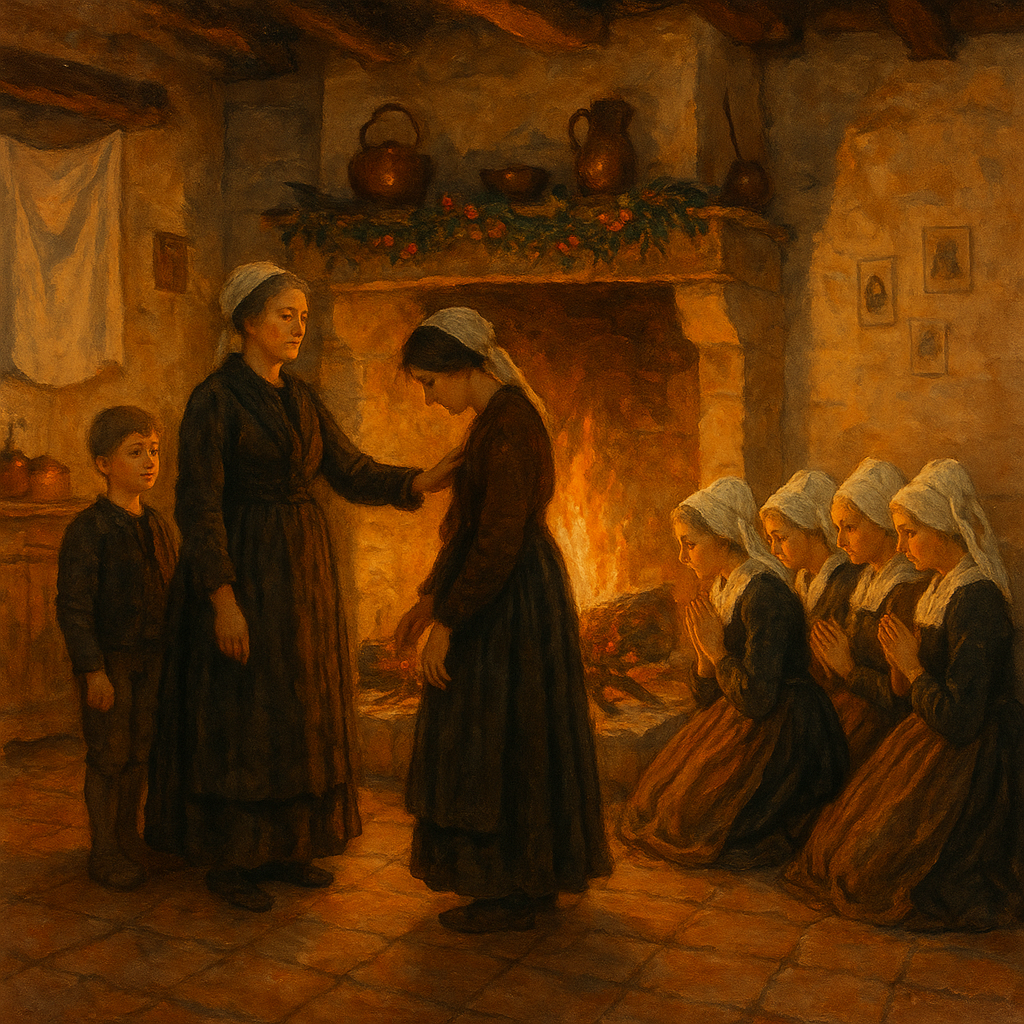
My father and mother stood on the left side of the hearth. Those women whose standing or intimacy with our family allowed them to remain in the kitchen knelt in a semicircle around the hearth. The men crowded together in the hallway, whose door was left open, and overflowed into the street as far as the graveyard wall. Every now and then a woman, detained by some household task, made her way through the crowd to join the others kneeling inside.
Aunt Gabrielle, arrayed in her ceremonial mantle — the one that always announced a solemn occasion — knelt in the center of the semicircle, directly before the Yule log, with a basin of holy water and a branch of boxwood beside her. She began the hymn, and all the assembly repeated it in chorus.
I have forgotten the words of that hymn, and I truly regret it. The melody was monotonous and plaintive, as all the tunes sung at Breton firesides tend to be. But it contained a crescendo at the moment of the blessing that reliably sent a shiver through me — what is commonly known as goose-flesh.
Aunt Gabrielle had just reached that moment of the hymn — on the 25th of December, 1822 — when I became aware of a strange disturbance among the men’s voices outside. The women either stopped singing or lost the tune; voices chased after one another, faltered, seemed stifled by a sudden emotion. My mother’s hand, which held mine, trembled for a moment, then steadied itself by a great effort of will. Her voice rose and soared above the others, who, realizing they had gone astray at an inconvenient moment, hurried back to the melody, and so the hymn ended in good order after this surprising interruption.
What had happened? Something very simple. A young woman had pushed her way through the crowd, entered the kitchen, and — apparently anxious not to be noticed — had knelt at some distance from the others and buried her face in her hands. I recognized her immediately. It was Marion, my favorite, the best seamstress in the house and the prettiest girl in the village. I would have run forward to embrace her, but the solemnity of the moment forbade me from leaving my place or making a sound. She was weeping bitterly. Why are you weeping, my sweet Marion? I was desperate for the ceremony to end so I might find out. All the other women seemed uneasy. My mother alone, when I looked full at her face, appeared calm; but her face was lying — I could tell by the trembling of her hand.
After the blessing of the Yule log it was the custom for all the women present to kiss my mother before proceeding to the church. They came forward in order, one after another, and in spite of their number — some thirty or forty — this formality took only a few minutes. I think my mother submitted to it rather against her natural reserve; but all those kind souls would have believed the order of the universe had been overturned if this part of the ceremony were ever left out.
As mistress of ceremonies — and on account of her great age — Aunt Gabrielle led the way.
Now, Aunt Gabrielle was a character. She was the living repository of folk songs, legends, and customs. People came from everywhere to consult her when they needed to know how some ceremony should properly be done. You may think that etiquette belongs only to palaces — not in Brittany. In my day a wedding had more than a thousand equally important formalities, and my good aunt was the oracle of all of them, though she had never made use of them for her own marriage, for she had none. She was an old maid, born at Belle-Île-en-Mer under Louis XV, a distant cousin of ours — the sort of relationship that exists in Brittany and can be expressed in no other language, it is so remote. My father, who never thought of himself until everyone else was provided for, had brought a whole tribe of poor relatives with him to Saint-Jean-Brévelay. Aunt Gabrielle, I think, was an exception: she gave more than she received.
She was our cook — an excellent one. She was industrious, resourceful, always cheerful and contented, full of delicate attentions for everyone, but especially for Marguerite — my mother — her best beloved. And yet my good mother was everyone’s best beloved; I have never known a woman so universally cherished.
Aunt Gabrielle had only two faults: she spoiled children abominably, and she gave the poor whatever she could lay her hands on. After a too-generous distribution of provisions among her beggars, she would sometimes set before us a dinner so ridiculously inadequate to our hunger that she would herself burst out laughing at the sight of it. We all joined in the laugh, which seemed to make us forget that we were hungry. She was the factotum of the house, as exacting and imperious as she was kind.
On this night she was greatly agitated; and when her turn came to kiss my mother, instead of folding her in her arms as usual, she whispered something with an expression of grave importance and indignation.
“Calm yourself, Gabrielle; calm yourself,” my mother said, several times, and I felt her hand tremble again.
“No, my dear, I cannot! And if you will not do it, I will do it myself.”
“You will do nothing of the sort,” said my mother. “And you will remember that I am the mistress in my own house.”
She gently moved her along so the others might come forward; but Aunt Gabrielle rejoined the women who were going out, several of whom stopped to speak with her. They were all making gestures of indignation, glancing at poor Marion, who had withdrawn into the darkest corner of the hall and stood there with her head down, her face turned away from everyone.
Then they seemed to reach a decision, and began to move toward her as if to drive her from the house — but they were stopped by a few words, spoken softly, at which all conversation ceased at once.
“Come to me, Marion.”
Marion started as if she meant to spring forward, then caught herself and crossed the room slowly, with hesitant steps. My mother kissed her on both cheeks, exactly as she had kissed the others. I realized she was doing what she considered her duty, and that she, too, greatly disapproved of my poor friend.
Aunt Gabrielle threw up her arms in horror.
“Do not dare come to work tomorrow!” she cried, loud enough for all to hear. “You will never work for us again. I discharge you — do you understand?”
Marion understood too well. It was as though she had just heard her death sentence. There was no house but ours where she could find work as a seamstress; to be discharged was to be condemned to starvation.
My mother’s voice was heard again, low, but full of quiet firmness.
“Tomorrow, Marion’s work will be taken to her at her own house.”
“I will not be the one to take it,” cried Aunt Gabrielle, and her words drew a murmur of approval from the others.
“Then I will take it myself,” said my mother, “if I can find no one to obey me.”
Marion had disappeared.
There were only a few women left now. Their cheeks were flushed with anger. The resin candles had been put out, and the room was lit only by the Yule log blazing in the hearth.
“Let us go and pray,” said my mother, and slipped her arm through Gabrielle’s. Gabrielle protested, and submitted, and kissed my mother fully ten times before we reached the church door.
The church was dazzling — for the simple reason that as it had no means of lighting itself, no lamps of any kind, each worshiper had been asked to bring a light from home. There were surely a thousand people in the building, which meant a thousand lights. I will confess they were not lamps, not tapers, not even common tallow candles. They were the cheapest wax tapers, which you might despise one by one, but which multiplied into a luminous floor beneath the dark vault: looking down, it was joyful, dazzling; looking up, into the darkness, it was something like awe. The altar blazed. All our household candles had been placed there in addition to those belonging to the church itself, and there was barely room between the flames for the chalice and the missal. The rector was vested in a fine scarlet chasuble, somewhat worn and faded, which had survived the Revolution. The mayor occupied the seat of honor in the dress of the Breton peasant — a blue waistcoat embroidered in red and yellow silk, with a great sunburst on the back. Beside him sat the deputy mayor, Monsieur Adelys, the miller of Kerdroguen; both wore white silk sashes across their chests. The blacksmith was there too, in his capacity as justice’s clerk, in a black gown and cap. Monsieur de la Goublaye, the justice and Chevalier of Saint Louis, had been kept in his château at Keriennec by the gout. But we had a corporal of gendarmery opposite the altar and two gendarmes on either side with yellow shoulder belts. Plumelec, where they were quartered, would gladly have kept them home on such a night, but Saint-Jean-Brévelay was the chief town of the canton.
At the appearance of the celebrating priest, the corporal cried out: “Gendarmes, hands to your sabres!” — whereupon the music, consisting of a fife and a drum, filled the church. That was the supreme moment of my life. I fought off sleep all year to be ready for it. I thought of it through every other month. You will not wonder, then, when I tell you that I forgot all about Marion from midnight until well past two o’clock.
Everything was over by two. The fife and drum had escorted the priest back to the rectory; the beadle had extinguished the altar lights; and as all the faithful had blown out their little tapers, the church was completely dark. In moments it was deserted, and no sound remained but the swaying of the pendulum. The graveyard, however, was crowded. If the rain or snow was too heavy, people took refuge in nearby houses — but they admitted this weakness only when they could hold out no longer. The taverns overflowed. Some people set out a little table at their door with a loaf, a sausage, and bottles of cider, cheerfully defrauding, with the connivance of the authorities, whatever tax applied to consumable goods. At three o’clock, the bells rang again for the Mass of the Aurora — the dawn Mass.
After the final service, our people came to collect us at the church door, bringing a great red cotton umbrella — which honored us as much as the same accessory honors a Roman cardinal — and an extra pair of wooden shoes half filled with warm ashes for our feet. We hurried home, exchanging warm words with everyone we met but stopping for no one; for there was a Christmas supper waiting in our kitchen — a supper to which all our friends were invited, and along with them every servant who had been present at the blessing of the Yule log.
During midnight Mass, the long kitchen table had been replaced with boards laid as evenly as possible on trestles, and covered with a cloth of dazzling whiteness — my poor mother’s pride, which she used to bleach on the meadow grass. On this night we had candles on the table: real candles, seven to the pound, sent for a week in advance from Vannes. The menu struck us as decidedly sumptuous. We had buckwheat pancakes, accompanied by many pots of cider and the most excellent butter. After that, we were served a bowl of what I can only describe as the very worst chocolate ever manufactured by a country grocer. We tried to convince ourselves it was excellent. It had to be served on that day, and drunk, and praised — but we had the satisfaction of knowing we would not be called upon to repeat the sacrifice for another year. We also had home-cured ham and rye bread. Everyone stood for the Benedicite — the grace before meals — and then those who found room sat on the benches; the others helped themselves over the heads of those lucky enough to be seated, and took their share out into the street with them.
One wave of guests succeeded another until the table was bare. Everyone was cheerful and content; there was not a man who lost his head. These peasants, who had had no formal upbringing, were by nature well-bred. They loved one another in that country of poor people — and above all, if I may say it (the thought pleases me so in my old age): they all loved us.
I never stayed until the end. I would step in for a glimpse of the celebration, to fill my eyes and imagination with it, and then go up to bed. On the night I am describing, I managed to stay down longer than usual. I looked for Marion everywhere. Others were looking for her too. My mother’s conduct had been criticized and rather disapproved of; for these were simple folk — virtuous themselves and pitiless toward others. If Marion had been brutally turned out, they would have applauded. Now they believed her to be forgiven, and they felt that forgiveness was in some measure an encouragement to sin.
Aunt Gabrielle had found a moment to speak with the rector — to excuse Marguerite, she said — but without realizing it she had merely expressed her own disapproval. I can recall not only every detail of that night, sixty-five years later, but the very room in which the scene took place, the faces and the attitudes: the saintly protectress, somewhat moved but very resolute; the rector, restless and uneasy; Gabrielle and her allies, pitiless in their censure. Although not a word had been spoken in my presence about the nature of Marion’s offense, I had understood everything — thanks, no doubt, to Célina. It is needless to say which side my heart was on.
The priest was above all anxious to preserve in our parish the strict moral customs for which it was known.
“A moral plague must be treated like a physical plague,” he said, “with drastic remedies.”
“We must be charitable,” said my mother. “Our God is a God of charity.”
The priest held that the sinner should under no circumstances be allowed to return to the house and work among the maidservants.
“Why, of course not — I never thought of such a thing,” said my mother, in that gentle voice of hers that reached one’s soul. “We must make this an example, a warning to our girls. I will see to that, never fear — I am just as concerned about it as you are. She will live alone with her child. I did not wish to crush her under the weight of a public condemnation, nor would I be so hard as to drive her to beggary or worse — that is all. I told poor Gabrielle, who is so ungovernable tonight,” she added with a smile, “that I would take Marion’s work to her myself if no one else would obey me — but that is not exactly what I meant. What I meant is this: I will go to her myself. I will go every day. I will take on, if you will permit me, something of your pastoral role. I will speak to her, encourage her; I will show her that she is among sisters who are grieved by what she has done — but sisters nonetheless.”
She said all this with simplicity, kindness, and quiet resolve.
The priest lifted his broad-brimmed hat from his head. “I uncover my white hair before you, Madame,” he said, in a loud voice, “and I pray God to bless the task you have taken up for His sake. My children, Marion will return to work among you when she has made amends for her fault. Until then, I leave her entirely in your mistress’s hands. If she cannot lead her back to the right path, we priests must simply give it up. Our Latin will not serve us here.”
This gentle joke was much admired, as everything was that fell from those venerable lips.
As for me, I was delighted — with a vague, triumphant sense that we had won some great victory. And I ran off to bed after kissing my mother with unusual tenderness.